Peptides for women covers a lot of ground: prescription weight-loss drugs, a libido medicine, skincare ingredients and research peptides sold online. They work the same way in women and men. What differs is what women use them for, and a few safety points, like birth control and pregnancy, that matter only for some women. This page goes goal by goal.
What Are the Best Peptides for Women?
It depends on the goal, and the evidence behind each one is very different:
- Weight loss: semaglutide (Wegovy, Ozempic) and tirzepatide (Zepbound, Mounjaro). FDA-approved, with large trials.
- Low sex drive: PT-141 (bremelanotide, sold as Vyleesi). FDA-approved for premenopausal women.
- Belly fat: tesamorelin (Egrifta), approved only for people with HIV.
- Skin and hair: GHK-Cu, as a serum or an injection, and collagen peptides you drink.
- Sleep, recovery and anti-aging: sermorelin, ipamorelin and CJC-1295, which raise growth hormone.
- Injuries and gut: BPC-157 and TB-500.
The first three have FDA approval for a specific use. The rest are mostly research peptides, sold “for research use only”, with lab and animal studies and very little human data. The full picture on risk is in are peptides safe.
Weight Loss Peptides for Women
The GLP-1 drugs are the only peptides with strong evidence for weight loss, and most of the people they were tested on were women. In the main semaglutide trial (STEP 1), 74% of participants were women, and the average weight loss was 14.9% over 68 weeks. In the main tirzepatide trial (SURMOUNT-1), 68% were women, and the highest dose averaged 20.9% over 72 weeks.
Retatrutide, the next drug in line, is still in trials; its side effects in women are in retatrutide side effects in women. How the three compare is in semaglutide vs tirzepatide vs retatrutide, and the other peptides sold for fat loss are covered in best peptides for fat loss.
What peptide gets rid of belly fat? Tesamorelin is the only one approved for it, and only for adults with HIV-related fat gain. In its trials it cut belly (visceral) fat by about 15% over 26 weeks. More in the tesamorelin guide.
Peptides for Menopause and Perimenopause
Peptides for perimenopause and menopause are sold for many symptoms, but no peptide is approved to treat menopause. Hormone therapy (estrogen, plus progesterone if you have a uterus) is still the most effective treatment for hot flashes and night sweats, according to The Menopause Society. Estradiol and progesterone are steroid hormones, not peptides.
Women in perimenopause and menopause use peptides for the goals that come with it:
- Weight gain, especially around the middle: the GLP-1 drugs.
- Skin and hair changes: GHK-Cu and collagen.
- Sleep: the growth hormone peptides, with little trial evidence. See best peptides for sleep.
If you’re on hormone therapy and adding a peptide, keeping both on one record makes it easier to see what changed what. The perimenopause hormone tracking guide covers estradiol, progesterone and low-dose testosterone, and testosterone for women covers the testosterone part.
Peptides for Women Over 40 and Over 50
The best peptides for women over 40 are the same ones as at 50. What changes is the reason. Estrogen falls through perimenopause and growth hormone falls with age, and peptides get sold as the fix for both: growth hormone peptides like sermorelin and ipamorelin for sleep, recovery and body composition, and GHK-Cu and collagen for skin.
For skin, collagen peptides you drink have the most human data: a 2021 review of 19 studies found better skin hydration and elasticity. For the growth hormone peptides, there are no large trials of anti-aging use in women. The CJC-1295 and ipamorelin guide explains how they work.
Peptides for Skin and Hair
- GHK-Cu is a copper peptide, three amino acids bound to copper, found in skin creams, serums and injections. The topical GHK-Cu guide covers serums, and the GHK-Cu injection guide covers the injected form. For thinning hair, see copper peptides for hair growth.
- What peptide acts like Botox? Argireline (acetyl hexapeptide-8) is the skincare peptide sold that way. It’s a cream ingredient meant to soften expression lines. It doesn’t freeze the muscle the way a Botox injection does.
- Collagen peptides are a supplement powder you drink, not an injection.
Curious what celebrities say they use? What Joe Rogan and Jennifer Aniston have said about peptides, in their own words.
Peptides for Libido
Which peptide acts like Viagra? None works on blood flow the way Viagra does. PT-141 (bremelanotide) works in the brain on desire instead. As Vyleesi, it’s FDA-approved for premenopausal women with low sexual desire that isn’t caused by another condition, a medicine or a relationship problem. It’s used as needed before sex, not daily.
Nausea is the main side effect: 40% of women in the Vyleesi trials had it, and it eased for most with the second dose. Dosing, timing and the other side effects are in the PT-141 guide.
Peptides for Injuries and Gut Health
BPC-157 and TB-500, often taken together as the Wolverine stack, are used for tendon, ligament and muscle injuries, and BPC-157 for the gut. Nothing about them is specific to women, and neither has been tested in a proper human trial. Start with the BPC-157 guide.
What Are the Side Effects of Peptides on Women?
Most side effects are the same for everyone: the GLP-1 drugs mostly cause nausea, constipation and diarrhea, and any injection can irritate the skin. A few things matter only for some women:
- Birth control pills and tirzepatide. Zepbound’s label says it can make birth control pills work less well. It says to switch to a non-pill method, or add a barrier method, for 4 weeks after starting and for 4 weeks after each dose increase.
- Pregnancy. Ozempic’s label says to stop at least 2 months before a planned pregnancy. Zepbound’s says to stop when a pregnancy is recognized. Tesamorelin’s label rules it out in pregnancy.
- Skin darkening with PT-141. The Vyleesi label warns of darker patches on the face, gums or breasts, more often with frequent use.
Who should skip peptide injections altogether is in are peptides safe. A provider who knows your full list of medicines is the right person to check a new one against it.
Track Peptides and Hormones Together With Regimen
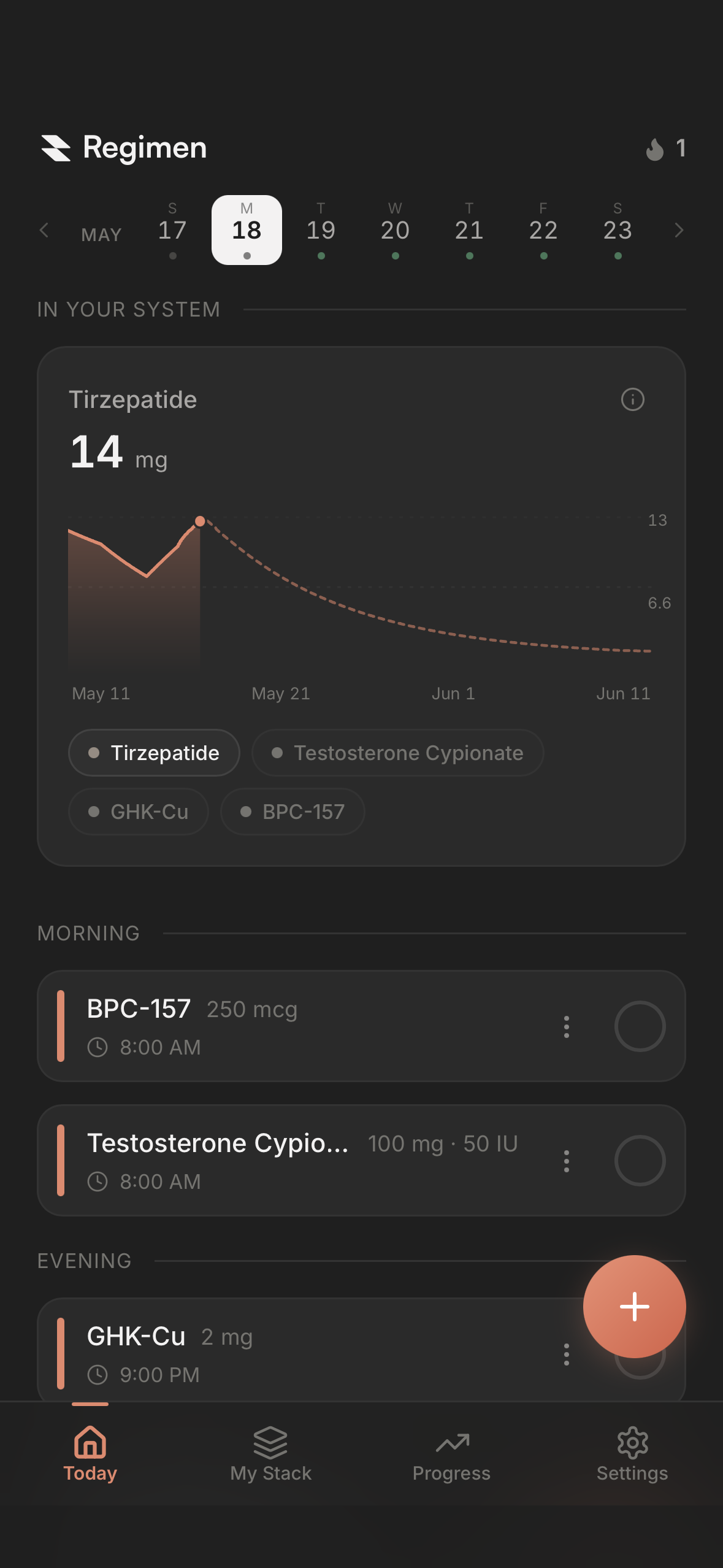
Regimen, a peptide tracker, logs peptides, HRT and GLP-1s on one timeline, each on its own schedule. Estradiol, testosterone and the rest of your bloodwork, scanned or typed in, sit next to your doses, along with hot flashes, sleep and mood.
What’s Not Known
Most peptides sold online are not approved by the FDA for human use, and few have been studied in women at all. The approvals named on this page cover one use each. This article is for education and tracking. It is not medical advice.
Sources
- Semaglutide, STEP 1: Wilding et al., NEJM 2021. Tirzepatide, SURMOUNT-1: Jastreboff et al., NEJM 2022.
- Labels (DailyMed): Zepbound, Ozempic, Egrifta WR (tesamorelin), Vyleesi (bremelanotide).
- Tesamorelin visceral fat: Falutz et al., NEJM 2007.
- Menopause hormone therapy: The Menopause Society, 2022 hormone therapy position statement.
- Collagen and skin: de Miranda et al., International Journal of Dermatology, 2021.
Frequently asked questions
Do peptides help with menopause?
No peptide is approved to treat menopause symptoms. Hormone therapy is still the most effective treatment for hot flashes and night sweats. Women in menopause use peptides for other goals: the GLP-1 drugs for weight, and GHK-Cu or collagen for skin.
Can women take sermorelin?
Yes. Sermorelin, ipamorelin, CJC-1295 and tesamorelin work the same way in women and men: they make the pituitary release more growth hormone. Only tesamorelin is FDA-approved, as Egrifta, to reduce belly fat in adults with HIV, and its label rules it out in pregnancy.
What is the best peptide for women over 40?
There isn't one for everyone. Over 40, the options women ask about are the GLP-1 drugs for weight, GHK-Cu and collagen for skin and hair, and the growth hormone peptides for sleep and recovery. Only the GLP-1 drugs have large trials for their main use.
What app tracks peptides and hormones together?
Regimen tracks peptides, GLP-1s and HRT, including estradiol, progesterone and testosterone, in one app, with side effects, daily markers and bloodwork on the same timeline as your doses. Free for one compound, no time limit; Premium if you track more than one.