CJC-1295 plus ipamorelin is the canonical community growth hormone stack. The two compounds hit different parts of your GH-release machinery: CJC-1295 nudges the GHRH side, ipamorelin nudges the ghrelin/GHSR side, and together they produce larger GH pulses than either alone. The mechanism is real, the community traction is large, and the direct body-composition trial evidence is thinner than the popularity of the stack suggests. The DAC versus no-DAC decision is where most newcomers go sideways, and the empty-stomach timing is where most lifters quietly screw up the protocol.
The Bottom Line
CJC-1295 is a GHRH analog. Ipamorelin is a selective ghrelin receptor agonist. Stacked, they produce larger GH pulses than either compound alone, with less endocrine spillover than older GHRPs like GHRP-2, GHRP-6, or hexarelin. The community-favorite version is CJC-1295 without DAC (also called Mod GRF 1-29) plus ipamorelin, nightly on an empty stomach, typically 100mcg of each, run 8-12 weeks then off for 4. Evidence tier: real endocrine and pharmacokinetic data on each compound, plus large community traction, but thin direct body-composition trials in trained lifters. Neither is FDA-approved for any indication, and both are on FDA’s Category 2 compounding-concern list.
What CJC-1295 and ipamorelin actually are
The stack pairs two compounds that work on different parts of the same GH-release system. Understanding what each does separately is what makes the “why stack them” logic land.
CJC-1295 is a synthetic GHRH (growth hormone-releasing hormone) analog. Your pituitary already responds to GHRH by releasing growth hormone in pulses. CJC-1295 binds the same receptor and produces the same downstream effect: it tells your pituitary to release more of your own GH, in the same pulsatile pattern your body uses naturally. It does not contain GH itself. It is upstream of GH, not a replacement for it.
Ipamorelin is a selective ghrelin receptor agonist (GHSR). Ghrelin is your hunger hormone, but the GHSR receptor in the pituitary also triggers a GH pulse when activated. Ipamorelin’s selectivity is its selling point: it activates the GHSR strongly enough to trigger a GH pulse, but with minimal spillover onto cortisol, prolactin, ACTH, or aldosterone. Older ghrelin mimetics (GHRP-2, GHRP-6, hexarelin) hit those secondary receptors harder, which is why the community has largely migrated to ipamorelin in the modern stack.
The stack logic is straightforward. GHRH activation (CJC-1295) and GHSR activation (ipamorelin) trigger GH release through two different intracellular pathways. Activating both at once produces a larger GH pulse than activating either alone, with the selectivity of ipamorelin keeping the side-effect profile cleaner than the older GHRP-based stacks.
The DAC question (the decision that matters most)
CJC-1295 ships in two versions and they behave so differently that they are effectively different compounds for protocol design purposes. This is the single most important distinction to get right before sourcing.
CJC-1295 with DAC is the version modified with a Drug Affinity Complex, a small molecule that binds the peptide to albumin in your bloodstream. The DAC extends the half-life from roughly 30 minutes to several days. Practical effect: weekly or twice-weekly dosing instead of nightly, with continuous GH elevation rather than discrete pulses. Convenient. The trade-off is that the GH-axis effect is more of a continuous “bleed” than a pulse. Some users find the longer-duration elevation drives more side effects: water retention, puffiness, fasting glucose creep, and occasional carpal-tunnel-like tingling.
CJC-1295 without DAC (often labeled Mod GRF 1-29) is the unmodified short-acting version. Half-life around 30 minutes. Practical effect: nightly dosing, on an empty stomach, to produce a clean GH pulse that stacks cleanly with ipamorelin’s pulse. The pulsatile pattern more closely matches what your body would do naturally during deep sleep, which is the physiological argument for the no-DAC version.
The community default for stacking with ipamorelin is no-DAC. The reasoning is mechanistic: ipamorelin produces a discrete pulse, and pairing it with a continuously-elevated GHRH signal (the DAC version) defeats the pulsatile logic. The no-DAC version produces its own pulse that aligns in time with the ipamorelin pulse, which is the cleaner physiological match.
When to pick which:
- Pick with-DAC if dosing convenience is the dominant constraint and you would skip nightly injections. A weekly injection you actually do beats a nightly injection you do half the time.
- Pick no-DAC (Mod GRF 1-29) if you care about the pulsatile pattern and can do nightly injections on an empty stomach.
Most lifters running CJC plus ipamorelin in 2026 run the no-DAC version specifically because the pulse-stacking logic is what makes the combo worth running over either compound alone.
The evidence picture
Honest assessment of what is actually proven versus what is plausible-but-unproven matters more here than in most peptide categories because the gap between mechanism evidence and body-composition outcome evidence is unusually wide for this stack.
What is well-established:
- CJC-1295 raises endogenous GH and IGF-1. Human pharmacokinetic studies of the DAC version show GH effects measurable for several days and IGF-1 elevation beyond a week from a single dose.
- Ipamorelin raises endogenous GH with less ACTH, cortisol, and prolactin spillover than GHRP-2 or GHRP-6. Endocrine studies in humans confirm the selectivity.
- The two-pathway logic of stacking GHRH analogs with ghrelin mimetics is supported by classic endocrine work. The combined pulse is larger than either alone.
What is thin or absent:
- No large randomized controlled trials of CJC-1295 plus ipamorelin specifically for body composition in trained lifters.
- No replicated human data on the magnitude of lean-mass change from the stack over realistic 8-16 week cycles.
- No long-term safety data on cycling the stack repeatedly over years.
What the community reports:
- Subjective improvements in sleep depth and recovery quality within 2-4 weeks of starting.
- Modest body composition changes (visceral fat reduction, slightly leaner look) over 8-12 weeks, with the changes harder to see than tesamorelin or HGH at comparable cycle lengths.
- Occasional water retention, puffiness, fasting glucose creep, especially on the with-DAC version.
The honest tier: real endocrine and pharmacokinetic evidence on each compound, real mechanistic logic for the stack, plus large community traction filling in the body-composition story that the formal trials have not run yet. It is not on the same evidence footing as tesamorelin (which has a real Phase 3 trial for visceral fat reduction) or HGH (decades of clinical pharmacology). It is on better footing than purely speculative compounds.
For broader context on how this stack sits within the muscle-building and recomp landscape, see the best peptides for muscle building guide and the body recomposition with peptides guide.
How the community actually doses it
Most public forum and community discussion converges on a narrow range of protocols. The specifics below describe what the community does, not what you should do.
The canonical community protocol:
- 100mcg CJC-1295 (no-DAC / Mod GRF 1-29) plus 100mcg ipamorelin
- Subcutaneous injection
- Nightly
- Empty stomach (most users wait at least 2-3 hours after the last meal)
- 8-12 weeks on, 4 weeks off
A common variant doubles the ipamorelin dose (200mcg) while keeping CJC at 100mcg, on the reasoning that the GHSR pulse benefits from a fuller activation while the GHRH side is already saturated at 100mcg. Some users dose multiple times per day (morning fasted, pre-workout fasted, bedtime) to chase more pulses, though the bedtime-only protocol is more common because it aligns with your body’s natural nocturnal GH pulse.
Why empty stomach matters. Insulin blunts GH release. A meal that spikes insulin within an hour or two of injection significantly reduces the GH pulse the stack is trying to produce. The community convention of nightly fasted dosing exists specifically to avoid that interference. Lifters who inject right after dinner and wonder why nothing is happening have usually identified their own problem.
Why cycling matters. Continuous GH-axis stimulation tends to elevate IGF-1 beyond the useful range and may blunt response over time. The community pattern of 8-12 weeks on followed by 4 weeks off (sometimes longer for the DAC version) is meant to keep IGF-1 in a productive range and let the system reset between blocks.
For lifters running this in an anti-aging clinic context rather than self-sourced, the clinic protocols often look similar but with closer bloodwork monitoring. Anti-aging clinics may prescribe sermorelin or CJC plus ipamorelin variants for general GH-axis support in patients over 40, with quarterly IGF-1 panels guiding dose adjustments.
What we see in Regimen data
About 1 in 3 Regimen users running CJC-1295 plus ipamorelin cycle their protocol on and off rather than running it continuously, consistent with the community consensus that GH-axis compounds benefit from periodic breaks. CJC-1295 plus ipamorelin remains the most-tracked GH-axis pairing on the platform, ahead of tesamorelin solo or sermorelin solo.
Side effects and what to monitor
The side-effect profile is moderate compared to other GH-axis compounds, but it is not nothing. The honest list:
Common (most users experience some of these):
- Mild injection-site redness or itch
- Lightheadedness or brief flushing after injection (more common with the ipamorelin pulse than with CJC alone)
- Vivid dreams or lighter sleep in the first 1-2 weeks (often resolves as the body adapts)
- Mild water retention, especially in the face or hands
Less common but documented:
- Fasting glucose creep (more common with the DAC version and with longer cycles)
- Numb or tingling fingers, mild carpal-tunnel-like symptoms (a known GH-axis side effect, more likely at higher doses or longer cycles)
- Joint puffiness or aching
- Mild appetite increase (ipamorelin is a ghrelin agonist; some appetite signal comes with the territory, though much less than GHRP-6)
Bloodwork to run:
- IGF-1 at baseline and at 8-12 weeks. This is the single most important marker. If IGF-1 is moving up into the upper third of the normal range, the stack is doing its biological job. If IGF-1 is unchanged, the dose is too low or the product is suspect.
- Fasting glucose and HbA1c at baseline and at 8-12 weeks. GH-axis compounds can nudge glucose; catch it on labs before it becomes a problem.
- Lipid panel at baseline. Useful for context on whether the cycle is shifting metabolic markers.
The compounds are generally well tolerated by healthy lifters at the canonical community dose. Most discontinuations happen because the user expected steroid-like changes and got subtle ones, not because the side-effect burden was intolerable.
Sourcing reality in 2026
Neither CJC-1295 nor ipamorelin is FDA-approved for any human indication. Both are on the FDA’s Category 2 list, the agency’s flag for compounds with significant safety risks or insufficient data for compounding. That status creates the sourcing landscape most lifters end up navigating.
The three channels people use:
- Anti-aging or longevity clinics. Some clinics prescribe CJC-1295 and ipamorelin (or sermorelin) through compounding pharmacies for general GH-axis support, typically for patients over 40 with clinical justification. Convenient, monitored, expensive. The most regulated path.
- Compounding pharmacies (with or without clinic prescription). Some compounding pharmacies serve the compounds under varying interpretations of Category 2 status. Quality is generally higher than research peptide vendors but availability has tightened since the FDA put both on the safety-risk list.
- Research peptide vendors. The gray market. Sold as “not for human use.” Quality control varies dramatically. Public testing of gray-market peptide product has documented wide variability in purity and concentration for CJC-1295 specifically, among other compounds.
A note on sourcing
Public testing of gray-market peptide product has found wide variability in impurity and concentration for CJC-1295 and ipamorelin across vendors. If your bloodwork at 8-12 weeks shows no IGF-1 movement at a reasonable dose, the product is one possible cause. The July 23-24, 2026 PCAC meeting is reviewing several Category 2 peptides for possible 503A bulk-list treatment; the outcome may further shift availability for both CJC-1295 and ipamorelin. This article is not a sourcing guide.
Who this stack isn’t for
The honest contraindication list. If you are in any of these groups, the answer is to address the underlying issue first or skip this category entirely.
- Anyone with active or suspected malignancy or unexplained masses. GH-axis compounds elevate IGF-1, which is implicated in tumor growth signaling. Not the right time to be running them.
- Anyone with poorly controlled glucose, prediabetes, or active type 2 diabetes. GH-axis compounds can worsen insulin sensitivity. Worth resolving glucose control first.
- Anyone with active acromegaly or pituitary tumors. GH-axis compounds compound the underlying issue.
- Anyone pregnant, breastfeeding, or still growing. Not the population to be running GH-axis experimentation.
- Competitive athletes governed by anti-doping rules. GH secretagogues are on the WADA prohibited list.
- Anyone with edema-prone states or cardiovascular fragility. The water-retention side effect is more than cosmetic in this population.
Stacks and combinations
CJC-1295 plus ipamorelin is itself a stack, so the question is usually what to layer on top of it for a given goal.
With tesamorelin (or instead of): Tesamorelin and CJC-1295 are both GHRH analogs and operate on the same pathway. Running both at the same time is generally redundant. The more common decision is: pick tesamorelin if visceral fat reduction is the specific goal and budget allows (strongest human evidence in the GH-axis lane), or pick CJC plus ipamorelin if budget matters more and you want the pulsatile GH-axis support pattern.
With a GLP-1 (semaglutide, tirzepatide (tirz), retatrutide (reta)): Common stack for body recomposition. The GLP-1 handles appetite and fat loss; CJC plus ipamorelin handles the GH-axis support for muscle preservation. The empty-stomach timing on CJC plus ipamorelin is still important even on a GLP-1, since GLP-1s delay gastric emptying and the food in your stomach matters more for blunting GH than the time since you ate.
With TRT: Common stack for serious lifters in their 30s and 40s. TRT handles the recovery and baseline; CJC plus ipamorelin layers GH-axis support on top. The combination of TRT plus a GH secretagogue is one of the most common protocols in this population. Bloodwork matters more on this stack because IGF-1, hematocrit, lipids, and glucose all need to be monitored together. See the TRT microdosing guide for the underlying TRT layer.
With BPC-157 plus TB-500 (the Wolverine pair): Pairs cleanly. CJC plus ipamorelin works the GH-axis lane (body composition, recovery support, sleep depth). BPC plus TB-500 works the recovery and tissue-repair lane (tendons, joints, soft tissue). The two stacks solve different problems and there is no mechanism conflict between them.
With MK-677: Generally redundant. MK-677 is itself a ghrelin receptor agonist (the same receptor ipamorelin hits), so stacking the two is hitting the same receptor twice. Most lifters who try this find they get the side-effect burden of MK-677 (lethargy, water retention) without much additional benefit beyond what CJC plus ipamorelin already provides.
Tracking whether it’s actually working
Two kinds of signal matter: the objective lab marker, and the subjective markers that show up earlier.
Objective (bloodwork):
- IGF-1 at 8-12 weeks. Moving up into the upper third of the normal range at a moderate dose is the cleanest confirmation the stack is doing what it should. No movement at all means the dose is too low or the product is suspect.
- Fasting glucose and HbA1c at 8-12 weeks. Catch any glucose creep on labs, not on symptoms.
Subjective (within 2-4 weeks if it’s going to work for you):
- Sleep depth. Most users report deeper sleep and feeling more rested within the first few weeks. If sleep is unchanged at 4 weeks, the dose or the product is the likely issue.
- Recovery between sessions. Slightly faster return to baseline soreness, slightly easier high-RPE work back to back.
- Vivid dreams. Common in the first 1-2 weeks, often the earliest signal the GH-axis effect is real.
Slower (8-12 weeks):
- Waist measurement. Visceral fat reduction is the body composition change most likely to show up at this dose and cycle length.
- Photos every 2-4 weeks. Slightly leaner look, modest skin quality improvements.
- Lift numbers holding or progressing during a cut. The muscle-preservation argument shows up as strength holding when calories drop.
If at least two signals are moving in the right direction within 6-8 weeks, the protocol is working. If nothing is moving, either the dose is wrong, the product is suspect, or the compound is not right for your situation.
Common mistakes
The same disappointment patterns show up over and over. Most are about protocol execution, not about the compounds themselves.
Injecting after dinner. Insulin from any recent meal blunts the GH pulse. The empty-stomach timing is the single most common protocol failure. The fix: inject at least 2-3 hours after the last meal, ideally at bedtime after no carbs since dinner.
Picking the with-DAC version because it sounded easier, then complaining about water retention. The continuous GH elevation pattern of the DAC version drives more side effects for many users. The fix: switch to the no-DAC version (Mod GRF 1-29) and accept the nightly injection commitment if you want the cleaner side-effect profile.
Expecting steroid-like changes. This stack modulates GH and IGF-1 pulses. It does not push you past your natural ceiling the way exogenous testosterone or trenbolone do. The realistic expectation is subtle body composition changes over 8-12 weeks, better sleep, and faster recovery, on top of optimized training and nutrition. If you expected dramatic visible changes, the comparison will always disappoint.
Skipping bloodwork. IGF-1 at 8-12 weeks is the cleanest objective signal that the stack is actually doing something. Running the protocol blind means you cannot distinguish bad product from wrong dose from working-but-modest-effect.
Running it continuously for a year. Continuous GH-axis stimulation tends to blunt response and push IGF-1 higher than is useful. The cycling pattern (8-12 weeks on, 4 weeks off) exists for a reason. The fix: respect the cycle.
Stacking it with MK-677. Both compounds hit the GHSR receptor. The redundancy means you pay for two compounds and get the side-effect burden of both without much additional benefit. The fix: pick one.
Frequently Asked Questions
Should I run CJC-1295 with DAC or without DAC?
For most lifters stacking with ipamorelin, without DAC (Mod GRF 1-29) is the community default. The no-DAC version has a short half-life that produces clean GH pulses that align with ipamorelin’s pulse, which is the physiological argument for the stack in the first place. With-DAC has a multi-day half-life and produces continuous GH elevation rather than pulses, which defeats some of the pulse-stacking logic and tends to drive more side effects (water retention, puffiness, fasting glucose creep). Pick with-DAC only if dosing convenience is the dominant constraint and you would otherwise skip nightly injections.
What dose of CJC-1295 and ipamorelin do people actually run?
The most common community protocol is 100mcg CJC-1295 (no-DAC) plus 100mcg ipamorelin, subcutaneously, nightly, on an empty stomach, for 8-12 weeks. A common variant bumps ipamorelin to 200mcg while keeping CJC at 100mcg. Anti-aging clinics may prescribe similar dose ranges with closer bloodwork monitoring. Higher doses do not necessarily produce proportionally larger GH pulses because the receptors saturate.
Why does CJC plus ipamorelin need to be taken on an empty stomach?
Insulin blunts GH release. A meal that spikes insulin within an hour or two of injection significantly reduces the GH pulse the stack is trying to produce. The empty-stomach convention (typically 2-3 hours after the last meal, often at bedtime) exists specifically to avoid that interference. Lifters who inject right after dinner are usually identifying their own problem when nothing happens.
How long until I see results from CJC plus ipamorelin?
Subjective signals (deeper sleep, vivid dreams, slightly faster recovery) typically show up within 2-4 weeks. IGF-1 movement on bloodwork shows up at 8-12 weeks. Visible body composition changes typically need 8-12 weeks minimum. If nothing is moving by 6-8 weeks, either the dose is wrong, the product is suspect, or the compound is not right for your situation.
Do I need to cycle CJC-1295 plus ipamorelin?
Yes. The community pattern is 8-12 weeks on, 4 weeks off, sometimes longer breaks for the with-DAC version. Continuous use tends to blunt response over time and push IGF-1 higher than is useful. The cycling is also when bloodwork is most informative for catching any glucose drift before it becomes a problem.
Can I stack CJC plus ipamorelin with tirzepatide or semaglutide?
Yes, and many lifters running a body recomposition protocol do exactly this. The GLP-1 handles appetite and fat loss; CJC plus ipamorelin handles GH-axis support for muscle preservation during the cut. The empty-stomach timing on CJC plus ipamorelin still matters on a GLP-1, since GLP-1s delay gastric emptying and the food in your stomach matters more for blunting GH than the time since you ate. See the body recomposition with peptides guide for how the stack fits into a full recomp protocol.
Can I stack CJC plus ipamorelin with TRT?
Yes. The combination of TRT plus CJC plus ipamorelin is among the most common protocols for serious lifters in their 30s and 40s. TRT handles the recovery and baseline; CJC plus ipamorelin layers GH-axis support on top. Bloodwork matters more on a stacked protocol because IGF-1, hematocrit, lipids, and glucose all need monitoring together.
Is ipamorelin cleaner than GHRP-2 or GHRP-6?
Yes, in a specific sense. All three are ghrelin receptor agonists that produce a GH pulse. Ipamorelin’s selling point is selectivity: it activates the GHSR strongly enough to produce a GH pulse without much spillover onto cortisol, prolactin, ACTH, or aldosterone. GHRP-2 and especially GHRP-6 hit those secondary receptors harder, which is why GHRP-6 in particular drives strong hunger and modest cortisol bumps. For most modern community use, ipamorelin is the better pick in the ghrelin-mimetic position of a stack.
Are CJC-1295 and ipamorelin legal?
Neither is FDA-approved for any human indication. Both are on the FDA’s Category 2 list as compounds with significant safety risks or insufficient data for compounding. They are sold either through compounding pharmacies (with varying interpretations of Category 2 status, often via anti-aging or longevity clinic prescriptions) or through research peptide vendors as “not for human use.” Possession is generally not criminalized at the federal level for these compounds, but the sourcing channels exist in a regulatory gray zone. WADA bans GH secretagogues for competitive athletes. The July 23-24, 2026 PCAC meeting is reviewing several Category 2 peptides for possible 503A bulk-list treatment, which may shift availability further.
Will this stack shut down my natural GH production?
No, not in the way exogenous HGH eventually does. CJC-1295 and ipamorelin work alongside your pituitary’s natural pulse pattern rather than replacing it. They tell your pituitary to release more of your own GH, which means the pituitary is still doing its job. Exogenous HGH suppresses natural GH production over long-term use because it removes the pituitary’s reason to release its own. That is one of the reasons community lifters often prefer the secretagogue approach over straight HGH for long-running protocols.
Related reading
- CJC-1295 Tracker
- Ipamorelin Tracker
- Body Recomposition with Peptides: The 2026 Stack Guide
- Best Peptides for Muscle Building 2026
- Tesamorelin Guide
- Tesamorelin Results Timeline: Week by Week
- TRT Microdosing Guide
- Multi-Compound Protocol Tracking Guide
This article is for educational purposes only. It is not medical advice, a prescription, or a recommendation to use any compound. CJC-1295 and ipamorelin are not FDA-approved for any human indication, and the FDA has flagged both as carrying significant safety risks or insufficient data for compounding. The July 2026 PCAC meeting may affect availability for several Category 2 peptides. Always consult a qualified healthcare provider before starting, stopping, or changing any medication or health protocol.
Ready to track your protocol?
- Smart reminders so you never miss a dose
- Track weight, photos, and progress over time
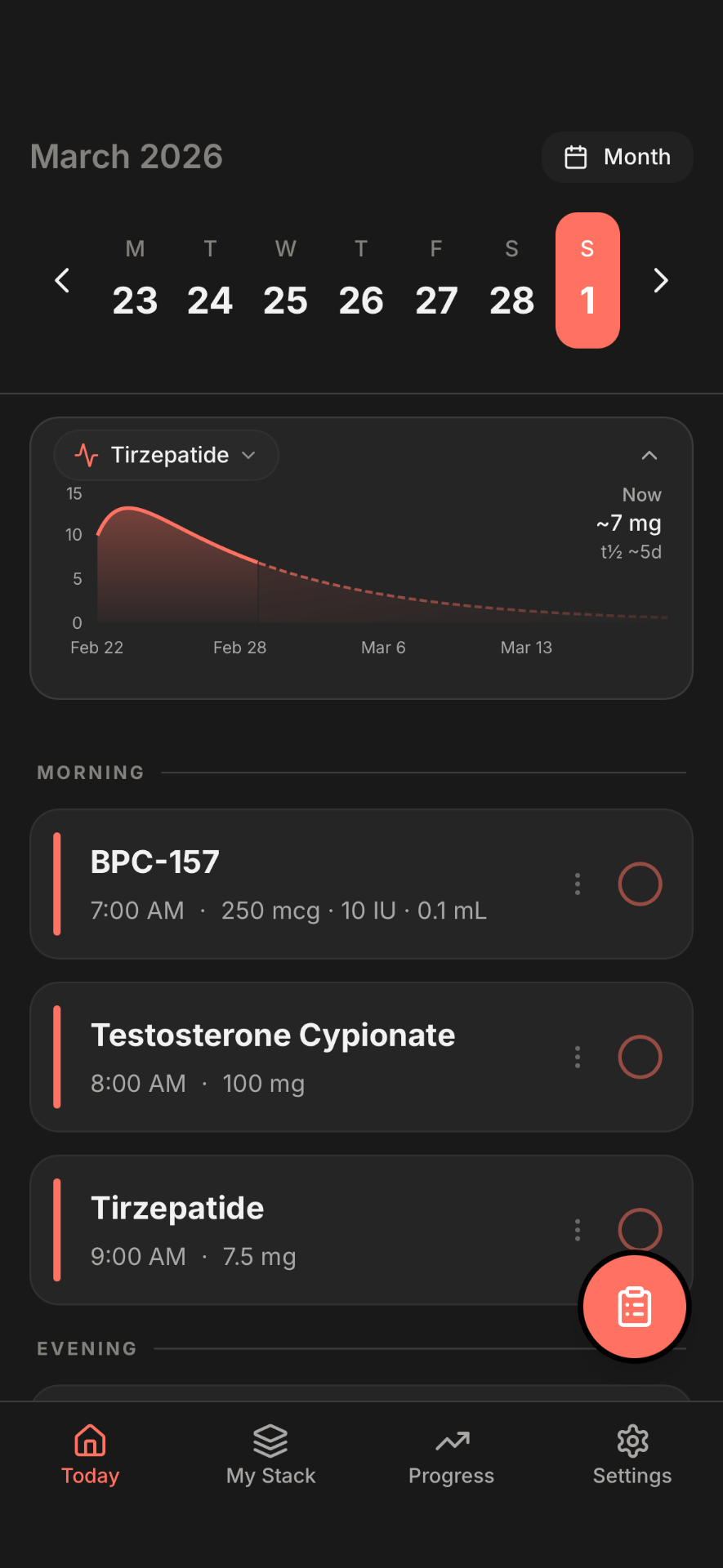
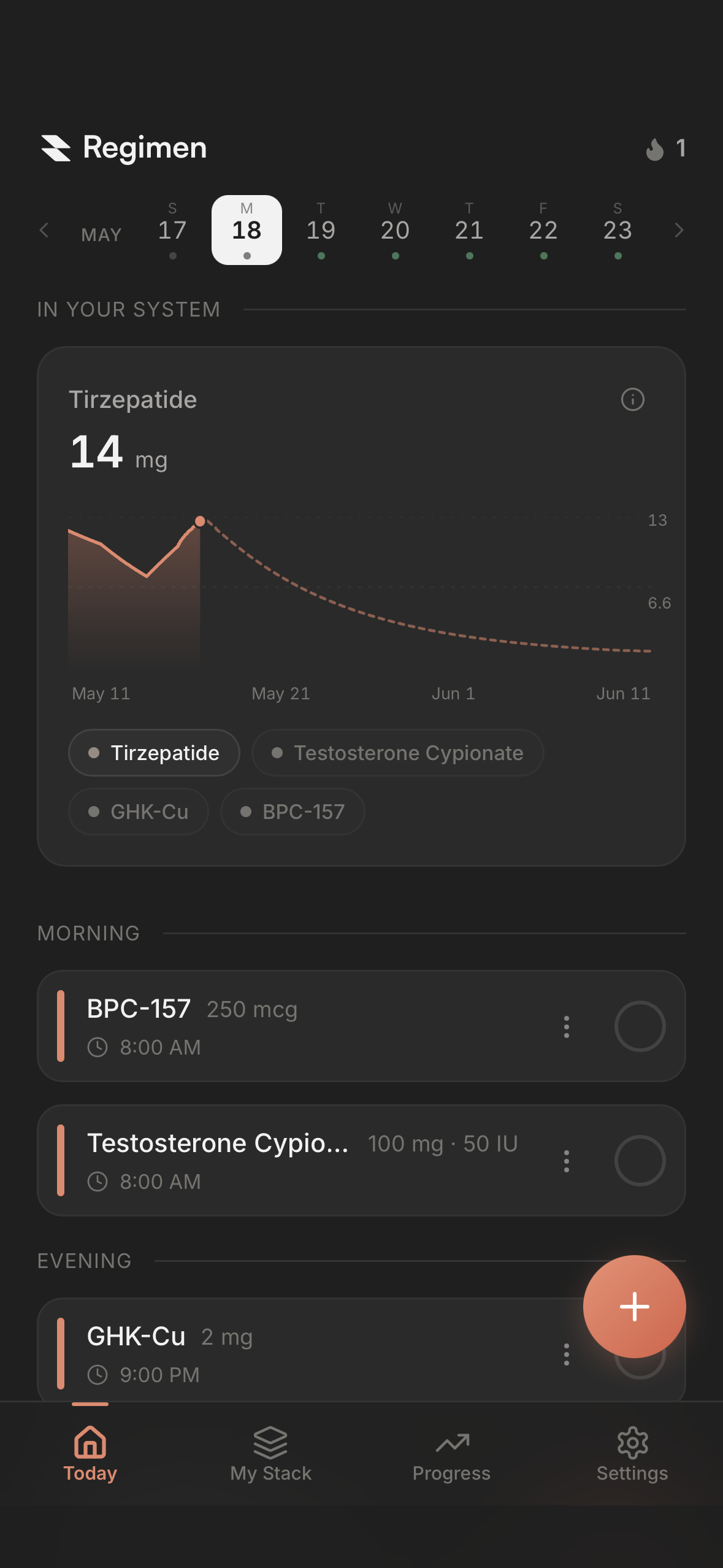
- Medication level curves for every compound