Heads up: this is community and clinical-literature reference, not medical advice. Half-life values for FDA-approved compounds come from published trial pharmacology; values for investigational or non-approved compounds are the best available estimates. Always consult a qualified prescriber.
When you inject 1mg of semaglutide every week, you do not actually have 1mg in your body. After a month or so, you are closer to 2mg circulating. The math is simple once you understand half-life, but most people skip it and end up either carrying far more drug than they realize or wondering why their dose is not doing what they expected. This guide breaks down half-lives for every major peptide (GLP-1 class, GH-axis, recovery compounds), walks through the actual math, and shows why this matters for how you run your protocol.
Quick answer
Half-life is the time it takes for half of a drug to clear out of your body. For weekly peptides like tirzepatide (~5 days), semaglutide (~7 days), retatrutide (~6 days), and cagrilintide (~7-8 days), each shot stacks on top of what is left from the last one. After about 4-5 weeks, your levels settle in (steady state) where each dose roughly replaces what got cleared. After you stop, ~97% is gone in about 5 half-lives (4-5 weeks for the GLP-1s). Short-half-life peptides like BPC-157 (under an hour) do not stack like this and need daily dosing. The big takeaway for the long-half-life GLP-1s: what is actually in your body is usually 1.5-2.5x your weekly dose.
Want to skip the math?
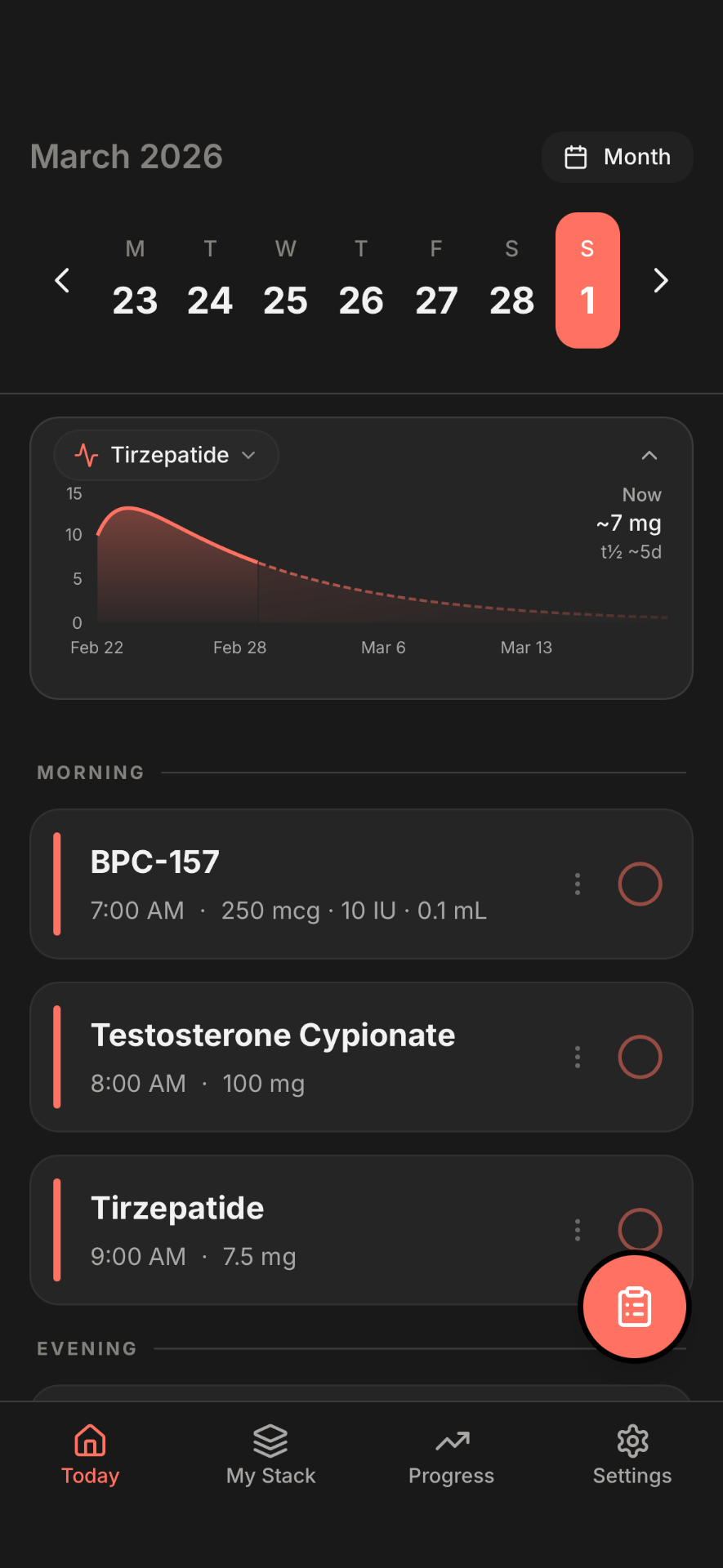
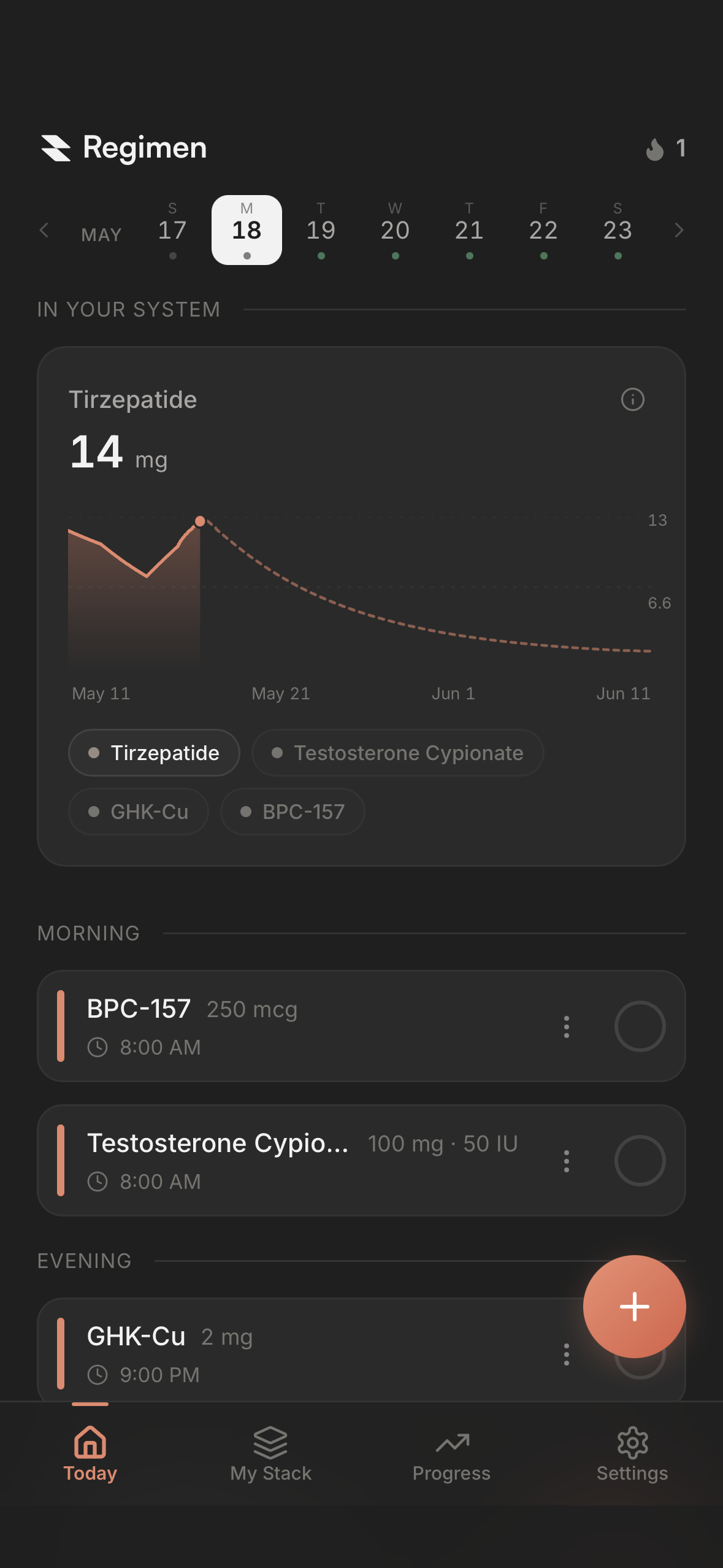
Regimen’s half-life visualizer lets you plug in any compound, your dose, and your dosing interval to see the cumulative curve and projected steady-state level. The rest of this article walks through the math by hand so you understand what the tool is calculating.
What half-life actually means
Half-life is how long it takes your body to clear half of a drug out of your bloodstream. It is a property of the molecule, not your dose. A drug with a 6-day half-life does not care if you took 0.5mg or 12mg, half of it is still going to be gone in 6 days.
A few things that fall out of that:
- Dose stacking. If you are dosing more often than the half-life, each new shot lands on top of what is left from the last one. The total in your body keeps climbing until it levels off.
- Steady state. When each new dose roughly replaces what got cleared between doses. Takes about 4-5 half-lives to get there. For a weekly GLP-1, that is 4-5 weeks.
- Clearance time. Once you stop, it takes about 5 half-lives for ~97% to be out. For tirzepatide that is about 25 days. For BPC-157, a few hours.
That is the whole concept. The math is just decay: after one half-life, half is gone. After two, three-quarters. After three, seven-eighths. And so on.
GLP-1 class half-lives (the most-searched compounds)
The GLP-1s are where the half-life math matters most. The half-lives are long, the doses stack a lot, and most people are way off when they guess what is actually in their body.
| Compound | Brand names | Half-life | Typical dosing | Why this half-life |
|---|---|---|---|---|
| Tirzepatide | Mounjaro, Zepbound | ~5 days (~120h) | Once weekly SC | Albumin-binding fatty acid chain |
| Semaglutide | Ozempic, Wegovy, Rybelsus | ~7 days (~165h) | Once weekly SC, daily oral | Albumin binding via C18 fatty acid |
| Retatrutide | (investigational) | ~6 days (~144h) | Once weekly SC | Albumin binding via C20 fatty diacid |
| Cagrilintide | (investigational, in CagriSema) | ~7-8 days (~159h) | Once weekly SC | Long-acting amylin analog |
| Liraglutide | Saxenda, Victoza | ~13 hours | Once daily SC | Shorter fatty acid chain |
| Orforglipron | Foundayo (FDA-approved 2026) | ~29-49 hours | Once daily oral | Non-peptide small molecule, oral |
Notice that the weekly injectables (tirzepatide, semaglutide, retatrutide, cagrilintide) all have half-lives of 5-8 days. That is on purpose. These molecules have long fatty acid tails that hook onto albumin in your blood, which slows clearance way down. It is what makes once-a-week dosing possible.
Worked example: Semaglutide 1mg weekly
Semaglutide has a ~7-day half-life and you are dosing weekly. Each shot drops to about half before the next one lands:
| Week | Just before dose | After dose |
|---|---|---|
| 1 | 0 | 1.0mg |
| 2 | 0.5mg | 1.5mg |
| 3 | 0.75mg | 1.75mg |
| 4 | 0.88mg | 1.88mg |
| 5 | 0.94mg | 1.94mg (steady state) |
| 6 | 0.97mg | 1.97mg |
Once you are settled in, semaglutide 1mg weekly is sitting at around 2mg in your body just after each shot, dropping to about 1mg right before the next. Your “1mg weekly” is really running like 1-2mg in your body at any given time, not just 1mg.
Worked example: Tirzepatide 5mg weekly
Tirzepatide has a ~5-day half-life. With weekly dosing (7 days between shots), more than half clears between doses, but the stacking still adds up:
- After dose 1: 5mg
- Right before dose 2 (after 7 days, ~1.4 half-lives): 5mg × (1/2)^(7/5) = 1.89mg
- After dose 2: 6.89mg
- Right before dose 3: 2.60mg
- After dose 3: 7.60mg
- Settled in (after ~5 doses): ~7.5mg just after each shot, ~2.8mg right before the next.
A 5mg weekly tirzepatide dose puts about 7.5mg in your body at peak. That matters when you titrate up. The change is not just “5mg to 7.5mg.” The steady-state level shifts by significantly more than that.
Worked example: Retatrutide 0.5mg weekly (microdosing for lean users)
Retatrutide has a ~6-day half-life. The microdosing protocol used by lean and active users (covered in the microdosing retatrutide guide) starts at 0.5mg weekly:
| Dose | Before next dose (6 days) | After dose |
|---|---|---|
| 1 | 0.25mg | 0.50mg |
| 2 | 0.38mg | 0.75mg |
| 3 | 0.44mg | 0.88mg |
| 4 | 0.47mg | 0.94mg |
Once you are settled in, a 0.5mg weekly retatrutide dose is sitting at roughly 0.9mg in your body just after each shot. That is why lean users at “0.5mg” still feel all three parts of the drug working: what is actually in their body is closer to 1mg.
Model your own protocol
Regimen’s half-life visualizer lets you plug in any of these compounds, your specific weekly dose, and your dosing interval. You will see the cumulative curve, your projected steady-state level, and how long it will take to clear if you stop. The tool also shows the curve for your full stack if you are running multiple compounds.
Why this matters for your protocol
The cumulative dose math changes how you should think about a few real-world things.
Why dose increases are spaced 4 weeks apart. The standard GLP-1 ramp (2.5mg, 5mg, 7.5mg, 10mg, 12.5mg, 15mg every 4 weeks for tirzepatide, similar for the others) is built around how long it takes to settle in. By week 4, your previous dose has hit its steady state in your body. Bumping up sooner means you are stacking changes faster than your body has caught up to the last one.
Why missing a dose matters less than you would think. If you skip one shot on a weekly GLP-1, you do not suddenly have nothing in your system. After one missed dose, you still have roughly half your normal level in your body. The effects fade slowly, they do not drop off a cliff. The catch-up window is set by the brand, not the class: Ozempic says take it within 5 days, Wegovy says take it only if your next scheduled dose is more than 2 days (48 hours) away, and Mounjaro and Zepbound say within 4 days (96 hours). Check your own label. Past that window, skip it and go back to your normal schedule.
Why gap weeks matter when switching compounds. Switching from tirzepatide to retatrutide (or any GLP-1 swap) usually involves a 1-week gap. After a week off tirzepatide (about 1.4 half-lives), you still have ~38% of your last dose in your body. By the time you are 5 half-lives off (~25 days), you are basically clear. Most community switching protocols build in a 1-week gap and accept some overlap, which is fine. More on this in the tirzepatide-to-retatrutide switching guide.
Why microdosing actually works. Low doses of long-half-life compounds still stack to meaningful levels. A 0.5mg weekly retatrutide protocol settles in around 0.9mg. A 2.5mg weekly tirzepatide settles in around 3.8mg. The drug “feels” stronger than what you injected because your body is carrying multiple doses worth of leftovers.
Why side effects from a titration show up weeks later. When you titrate up from 5mg to 7.5mg tirzepatide, you do not feel the new dose at full strength until 4-5 weeks in. The side effects land gradually as the new dose stacks to steady state. People often blame the new dose for side effects that actually started 2-3 weeks after the change, because that is when the cumulative level crossed a threshold for them.
Tracking dose and effect together
The whole point of understanding half-life is that what you injected is not what your body is actually carrying. Regimen tracks your dose, injection day, weight, side effects, hunger, and bloodwork in one place, so you can line up dose changes with body comp and side effects over the full 4-5 week settle-in window. The half-life visualizer shows what is actually in your body. The full app shows you what that is actually doing to you.
GH-axis peptide half-lives
The GH-axis peptides (growth hormone secretagogues, GHRH analogs, IGF analogs) have a much wider spread of half-lives, which is why community protocols look so different across them.
| Compound | Half-life | Typical dosing | Why this matters |
|---|---|---|---|
| Tesamorelin | ~8 minutes | Once daily SC | Very short half-life means daily dosing; the GH pulse it triggers lasts longer than the drug itself |
| Sermorelin | ~11-12 minutes | Once daily SC, usually bedtime | Same logic as tesamorelin |
| CJC-1295 without DAC | ~30 minutes | Daily or 2-3x daily, usually empty stomach | Pulse-style dosing matches the short half-life |
| CJC-1295 with DAC | ~5-8 days | Once or twice weekly | DAC modification dramatically extends half-life via albumin binding |
| Ipamorelin | ~2 hours | Daily or 2-3x daily, often paired with CJC | Short half-life, pulse logic |
| MK-677 (Ibutamoren) | ~24 hours | Once daily oral | Long enough for daily dosing to maintain steady levels |
| HGH (somatropin) | ~3-4 hours | Daily SC (often bedtime) | Exogenous GH itself; short half-life but the IGF-1 it stimulates is longer-acting |
The takeaway for the GH-axis category: most of these work on pulse logic. The half-life is short, but the GH or IGF pulse they kick off is what does the work, and the dose timing (especially around food and sleep) is what makes or breaks it.
CJC-1295 is the standout because of the with-DAC vs without-DAC split:
- CJC-1295 with DAC stays in your system for days. Weekly or twice-weekly dosing. Keeps GH elevated continuously instead of pulsing. Some people find this drives more side effects (water retention, puffiness, glucose creep).
- CJC-1295 without DAC (Mod GRF 1-29) has a 30-minute half-life. Daily or 2-3x daily dosing. Produces clean pulses that stack with ipamorelin’s pulse.
That is why the CJC + ipamorelin stack almost always uses no-DAC. Full breakdown in the CJC-1295 + ipamorelin guide.
Recovery peptide half-lives
Recovery peptides (BPC-157, TB-500, GHK-Cu, KPV) have half-lives that are less nailed down because there is a lot less human research compared to the FDA-approved GLP-1s. Here is what we do know:
| Compound | Estimated half-life | Typical dosing | Notes |
|---|---|---|---|
| BPC-157 | ~30 minutes (subcutaneous) | Daily, sometimes 2x daily | Short half-life but the tissue repair signaling persists longer than the drug |
| TB-500 (Tβ4 fragment) | Days (estimated, less well-studied) | Weekly, often front-loaded | Why community protocols use weekly dosing |
| GHK-Cu (injectable) | Estimated short (~hours) | Daily, sometimes EOD | Copper-binding peptide; tissue effects last longer than circulation |
| KPV | Estimated short | Daily or EOD | Inflammation-modulating tripeptide |
| Thymosin alpha-1 | ~2 hours | 2-3x weekly | Immune-modulating peptide |
Half-life matters less for these because they work by triggering tissue-level repair signals, not by holding a steady level in your blood. BPC-157 might only be in your bloodstream for an hour after you inject it, but the repair pathways it kicks off keep working for days. That is why daily dosing works even with such a short half-life.
For more on these compounds:
Why doing this math by hand is annoying
The math here is not hard. It is just tedious. To figure out what is actually in your body at any given time, you need:
- The compound’s half-life
- Your dose amount
- How often you dose
- Where you are in the cycle (just injected vs. right before next shot vs. somewhere in the middle)
- How many doses you have taken so far (to know if you are settled in yet)
If you are running one compound on a fixed schedule, you can do this once and remember the number. But most people running peptides are doing one or more of:
- Running multiple compounds at once (different half-lives, different schedules)
- Adjusting their doses
- Switching compounds (have to model both the gap week AND the ramp-up of the new one)
- Trying different dosing intervals (weekly vs. every 6 days vs. every 5 days)
- Tapering off
Doing this math by hand across multiple compounds and changes is enough work that most people skip it and just inject blind. That is a miss. Knowing what is actually in your body is what tells you whether bumping your dose is the right move, whether your side effects make sense, and how long to wait before you pull bloodwork.
The tool that does all this for you
Regimen’s half-life visualizer plots the cumulative curve for any compound and any protocol. Add multiple compounds and it overlays them so you can see your full stack at once. Change the dose or interval and the curve updates live. Stop a compound and you see the clearance curve in real time. This is the actual reason the tool exists. The math matters, doing it by hand is tedious, and you should know what your body is actually carrying.
Clearance time: when a compound is actually gone
Once you stop a compound, it clears on the same half-life decay. The rule of thumb is “~5 half-lives = 97% gone.” That is the practical “out of your system” mark.
| Compound | Half-life | ~97% clearance time |
|---|---|---|
| Tirzepatide | ~5 days | ~25 days |
| Semaglutide | ~7 days | ~35 days |
| Retatrutide | ~6 days | ~30 days |
| Cagrilintide | ~7-8 days | ~35-40 days |
| Liraglutide | ~13 hours | ~2.7 days |
| Orforglipron | ~29-49 hours | ~6-10 days |
| CJC-1295 with DAC | ~5-8 days | ~25-40 days |
| CJC-1295 without DAC | ~30 minutes | ~2.5 hours |
| Tesamorelin | ~8 minutes | ~40 minutes |
| Ipamorelin | ~2 hours | ~10 hours |
| MK-677 | ~24 hours | ~5 days |
| BPC-157 | ~30 minutes | ~2.5 hours |
Clearance time matters when:
- Switching compounds (how long to wash out before starting something new)
- Bloodwork timing (testing IGF-1 right after stopping a GH-axis peptide gives a misleading number)
- Side effects (the side effects of long-half-life compounds fade over weeks, not days)
- Athletic testing (USADA/WADA detection windows depend on half-life)
- Surgery or medical procedures (doctors often want a clean washout before elective surgery)
What we see in Regimen data
The most common mistake we see when users taper off GLP-1s is stopping cold turkey without thinking about the clearance curve. Effects do not drop off the day you stop. They fade slowly over 3-5 weeks (for the long-half-life GLP-1s), and your maintenance habits (protein, training) need to be locked in before the compound is fully out. Users who plan the taper around the half-life keep their results way better than users who just stop.
Frequently Asked Questions
Why does my weekly dose feel stronger after a month?
Because by 4 to 5 weeks you have settled in and the total drug in your body is roughly 1.5 to 2.5x your weekly dose, depending on the compound’s half-life and how often you dose. The drug is doing more work because there is more of it in you, not because the drug itself got stronger.
What is the half-life of BPC-157?
Approximately 30 minutes when injected subcutaneously. BPC-157’s tissue-repair effects last longer than its circulation half-life because it triggers signaling pathways that continue working after the drug is cleared. This is why daily dosing works even with a very short blood half-life.
Can I model my own protocol’s half-life curve?
Yes. Regimen’s half-life visualizer lets you plug in any of the compounds in this article, your specific dose, and your dosing interval, and it shows the cumulative curve, the steady-state level, and the clearance curve if you stop. It also handles multi-compound stacks if you are running TRT plus a GLP-1 plus a GH secretagogue and want to see all three curves at once.
How long does Ozempic stay in your system?
Semaglutide (the active ingredient in Ozempic) has a half-life of approximately 7 days. About 97% clears within 5 half-lives, which is roughly 5 weeks. After your last injection, you will have meaningful levels of semaglutide in your system for about a month.
How long does Mounjaro (or Zepbound) stay in your system?
Tirzepatide has a half-life of approximately 5 days. About 97% clears within 25 days (5 half-lives). After your last injection, expect tirzepatide to be functionally cleared by roughly 4 weeks.
How long does retatrutide stay in your system?
Retatrutide has a half-life of approximately 6 days. ~97% clearance happens around 30 days after your last dose.
How long does cagrilintide (or CagriSema) stay in your system?
Cagrilintide has a half-life of approximately 7-8 days. Functional clearance happens around 35-40 days after your last dose. When CagriSema is involved (cagrilintide + semaglutide), both molecules clear independently on their own half-lives.
What is steady state for GLP-1 medications?
Steady state is when each dose roughly replaces what got cleared between doses, and the total in your body stops climbing with each new shot. For the weekly GLP-1s (tirzepatide, semaglutide, retatrutide, cagrilintide), you hit steady state at about 4-5 weeks of consistent dosing. That is why the standard ramp waits 4 weeks between dose bumps. By then, you have settled into your current dose and your body has adjusted before you change anything.
Why does my weekly dose feel stronger after a month?
Because by 4-5 weeks you have settled in and the total drug in your body is roughly 1.5-2.5x your weekly dose, depending on the compound’s half-life and how often you dose. The drug is doing more work because there is more of it in you, not because the drug itself got stronger.
Should I dose every 6 days or every 7 days for retatrutide?
With a 6-day half-life, dosing every 6 days keeps your levels slightly more stable than weekly (every 7 days). The real-world difference is small. Some people prefer 6-day intervals because the math lines up cleaner. Others stick with weekly because it is easier to remember. Pick whatever you will actually stick with.
What happens if I miss a dose of my GLP-1?
For the weekly GLP-1s, missing one shot drops the total in your body by roughly half, but you still have real levels in your system. The catch-up window is set by the brand, not the class: Ozempic says take it within 5 days, Wegovy says take it only if your next scheduled dose is more than 2 days (48 hours) away, and Mounjaro and Zepbound say within 4 days (96 hours). Check your own label. Past that window, skip it and go back to your normal schedule. Do not double up. Just take your normal dose at your normal time.
What’s the half-life of BPC-157?
About 30 minutes when you inject it subcutaneously. BPC-157’s tissue-repair effects last way longer than its blood half-life because it triggers repair signals that keep working after the drug itself is gone. That is why daily dosing works even though the blood half-life is so short.
Why is CJC-1295 with DAC dosed weekly when CJC-1295 without DAC is dosed daily?
Because the DAC (Drug Affinity Complex) modification stretches the half-life from ~30 minutes to ~5-8 days via albumin binding. The two versions basically behave like different drugs. Most people running CJC + ipamorelin pick no-DAC specifically because it gives clean pulses that line up with ipamorelin’s pulse, instead of a constant “bleed” of GH activity.
Can I model my own protocol’s half-life curve?
Yes. Regimen’s half-life visualizer lets you plug in any of the compounds in this article, your specific dose, and your dosing interval, and it shows the cumulative curve, the steady-state level, and the clearance curve if you stop. It also handles multi-compound stacks, useful if you are running TRT + a GLP-1 + a GH secretagogue and want to see all three curves at once.
Tired of doing peptide math by hand?
Regimen’s half-life visualizer calculates the cumulative dose curve for any peptide, any dose, any schedule, including multi-compound stacks. Free, no login required.
For the full picture (dose tracking, body comp, side effects, bloodwork timeline lined up with what is actually in your body), download Regimen for iOS or Android. Free for one compound. for unlimited.
Related reading
- Microdosing Retatrutide for Lean and Active Users, applies the half-life math to lean-user dosing
- Body Recomposition with Peptides: The 2026 Stack Guide, multi-compound stacks
- Best Peptides for Fat Loss in 2026, all the GLP-1 class compounds covered above
- Best Peptides for Muscle Building in 2026, GH-axis compounds covered above
- Switching from Tirzepatide to Retatrutide, half-life-driven gap-week timing
- CJC-1295 + Ipamorelin Guide, DAC vs no-DAC half-life decision
- BPC-157 Injectable Guide, recovery peptide half-life logic
- TB-500 Guide
- Tesamorelin Guide
- Half-Life Visualizer Tool
This article is for educational purposes only. Half-life data presented here comes from published clinical pharmacology studies for the FDA-approved compounds and from the most reliable available estimates for compounds that are not FDA-approved. Half-life is one variable in protocol design; clinical effect, individual response, and medical supervision matter more. Always consult a qualified healthcare provider before starting, stopping, or adjusting any compound. This is not medical advice.
Ready to track your protocol?
- Smart reminders so you never miss a dose
- Track weight, photos, and progress over time
- Medication level curves for every compound