MOTS-c is not FDA-approved. This article summarizes published research and community protocols. It is educational, not medical advice.
Does MOTS-c actually work?
Working out units for your vial? The MOTS-c dosage calculator converts your vial size, BAC water and target dose into the exact units to draw.
MOTS-c is the peptide people run when they want their body to burn fat and use energy like it just worked out. It flips on the same “low energy, start burning” switch that exercise and fasting do. The animal research is genuinely exciting; the human research is still early. Run it as an experiment on yourself, track your metabolic markers, and don’t expect it to replace training.
What MOTS-c actually is
MOTS-c is a tiny peptide your own mitochondria make. Its main job is to be a potent AMPK activator, and AMPK is what makes this interesting.
Here’s the plain version: AMPK is the low-energy switch in your body. When it flips on, your cells basically go “hey, we’re running low on fuel, we need to get better at burning it.” So they start pulling from fat, taking up glucose, and building more mitochondria.
Your body makes more MOTS-c on its own when you fast or train hard. That’s why people call it an exercise mimetic. You’re injecting a signal your body already sends when you work out.
Does MOTS-c actually work in humans?
Honest beat: in animals, it’s impressive. Better fat burning, better glucose handling, mice literally running longer. In humans the data’s thinner. A few small studies show MOTS-c levels track with strength and climb with endurance training, and early work hints a single dose might help a workout. But no human trial has reproduced that “runs longer” result yet.
So it’s real biology with a promising story that human research hasn’t fully caught up to. Run it as an experiment on yourself, track your metabolic markers, and don’t expect it to replace training. It’s a nudge, not a shortcut.
Why people time it around fasted cardio
Since your body naturally releases MOTS-c when you fast and train, people stack the injection on top of that window: morning, empty stomach, 30 to 60 minutes before fasted cardio.
The logic is to amplify the signal your body’s already sending, when it’s most primed to burn fat. Smart theory. Just know it’s built on how the peptide works, not a proven protocol.
How people dose it
No official dose. The community usually lands around 5 to 15mg a week, split into 2 or 3 shots, starting at 5mg to gauge response. (Animal studies used much higher body-weight-scaled doses that don’t translate, so ignore those numbers.)
That is three variables at once: how much, how many times a week, and where you are in the cycle. It is the kind of thing that stays straight for about two weeks and then quietly drifts. Regimen keeps the schedule, the on and off weeks and the site rotation in one place, and puts your energy and training check-ins on the same timeline so you can see whether the protocol is doing anything.
The honest catch
MOTS-c has a short half-life and doesn’t absorb great, so a chunk of what you inject may not do much. That’s part of why human results have been underwhelming so far. Worth knowing before you spend on it.
| What it does | Evidence | Typical dose | Timing |
|---|---|---|---|
| AMPK activation, fat burning, glucose uptake | Strong in animals; early in humans | 5 to 15mg/week, split 2-3 shots | Morning, fasted, before cardio |
Mixing and storing MOTS-c
Absorbed from the standalone reconstitution guide, which now redirects here.
MOTS-c is investigational and not FDA-approved. This article summarizes community practice, not medical advice. Nothing here is a dose recommendation.
How much BAC water for MOTS-c
The MOTS-c dosage calculator does this arithmetic for your own vial, including doses per vial and a draw-to-here syringe diagram.
For a 10mg MOTS-c vial, the common mix is 1mL of bacteriostatic water. Some people use 0.5mL to keep the shot small. At 1mL in a 10mg vial, every 10 units on an insulin syringe equals 1mg, which keeps the math easy. Aim the water at the glass wall, swirl instead of shaking, and keep it in the fridge but not so cold it crystallizes.
There’s no official mixing ratio for MOTS-c, it’s investigational. These are the community-standard volumes, not medical instructions. None of this is a dose recommendation, it’s how people prepare the vial so the dosing math is clean.
How much BAC water for a MOTS-c vial?
The common move for a 10mg vial is 1mL of bacteriostatic water. It’s the conventional peptide format and it makes the math clean.
Here’s why 1mL is the easy one. Put 1mL into a 10mg vial and you’ve got 10mg spread across 100 units on a standard U-100 insulin syringe. So 10 units = 1mg. Two milligrams is 20 units. No calculator gymnastics.
Some people use 0.5mL instead. Same 10mg, half the water, so the physical shot is smaller. The tradeoff: your dosing lines get tighter (now 5 units = 1mg), and a more concentrated shot can irritate the skin a little more. If you’re getting welts, more water helps, not less.
Whatever volume you pick, run it through a reconstitution calculator once so you’re not eyeballing it. Our reconstitution calculator saves the recipe so you do the math one time per vial.
How to mix it without wrecking the peptide
Peptides are fragile. You’re rehydrating something delicate, not shaking up a protein shake.
Draw your BAC water, put the needle into the MOTS-c vial at an angle, and aim the stream at the glass wall, not straight down onto the powder. Let it run down the side.
Then swirl, don’t shake. Gentle swirl until it’s clear. Shaking foams it and can beat up the peptide. Give it a minute and it usually dissolves on its own.
Why is my MOTS-c crystallizing?
This one has a specific community answer, usually one of two things.
Fridge too cold. MOTS-c can crystallize near freezing. The good news: it often re-liquefies once it warms back up, or after a little more BAC water goes in.
Not enough water. Under-diluting is the other common cause. If you went minimal on the water and it’s crystallizing, adding a bit more usually fixes it.
So crystals in the vial aren’t a reason to toss it. Let it come to room temp, and add a touch more BAC water if it doesn’t clear.
How to store MOTS-c and how long it lasts
Reconstituted MOTS-c goes in the fridge, not the freezer, and not shoved to the back where it sits near freezing (see: crystallizing).
Honest note on shelf life: the community doesn’t agree on an exact number of days reconstituted MOTS-c stays good, and anyone giving you a confident “it lasts exactly X days” is guessing. What people do agree on is the practical stuff: keep it cold, don’t let the fridge get too cold, don’t under-dilute. The dry powder is stable cold for a long time. It’s the mixed vial where potency slowly ticks down, so mix what you’ll actually use rather than a giant batch you’ll nurse for months.
| Vial size | BAC water | Concentration | On a U-100 syringe |
|---|---|---|---|
| 10 mg | 1 mL (standard) | 10 mg/mL | 10 units = 1 mg |
| 10 mg | 0.5 mL (low-volume) | 20 mg/mL | 5 units = 1 mg |
| 5 mg | 1 mL | 5 mg/mL | 20 units = 1 mg |
Frequently Asked Questions
Does MOTS-c actually work?
In animals, yes. In humans, the intervention data is still early. MOTS-c levels correlate with fitness and endurance training, and early single-dose studies look promising, but no human trial has reproduced the mouse endurance results yet.
How do you dose MOTS-c?
There is no official dose. The most common community protocol is 5 to 15mg per week, split into 2 or 3 subQ injections, starting at the low end to gauge response. Animal doses do not translate directly to humans.
When should you take MOTS-c?
Many people dose it in the morning, fasted, 30 to 60 minutes before cardio. The idea is to stack the injection on top of the natural MOTS-c signal your body already releases during fasting and exercise. That timing is theory-based, not trial-proven.
Can MOTS-c replace exercise?
No. It may amplify the metabolic signals that exercise produces, but it is not a substitute for training, sleep, or nutrition. The animal data is exciting; the human data is not there yet.
Does MOTS-c have side effects?
Most reported side effects are mild: occasional fatigue or flu-like feeling in the first few doses, injection-site irritation, and mild GI changes. Because it can lower glucose, stacking it with insulin, sulfonylureas, GLP-1s, or aggressive carb restriction can raise hypoglycemia risk, especially in lean users. Start low and monitor glucose if stacking.
Is MOTS-c FDA-approved?
No. MOTS-c is not FDA-approved for any indication. It sits on the FDA’s Category 2 list and was on the agenda for the FDA’s Pharmacy Compounding Advisory Committee meeting in July 2026. Legal sourcing pathways may shift after that review.
Is MOTS-c banned by WADA?
MOTS-c is not a named substance on the WADA prohibited list, but the broader S2 category (Peptide Hormones, Growth Factors, Related Substances and Mimetics) is interpreted broadly. The safe assumption for any tested athlete is that any peptide outside an approved medication carries meaningful risk. Do not run MOTS-c in tested sport without explicit guidance from your anti-doping authority.
What is the best app to track MOTS-c protocol?
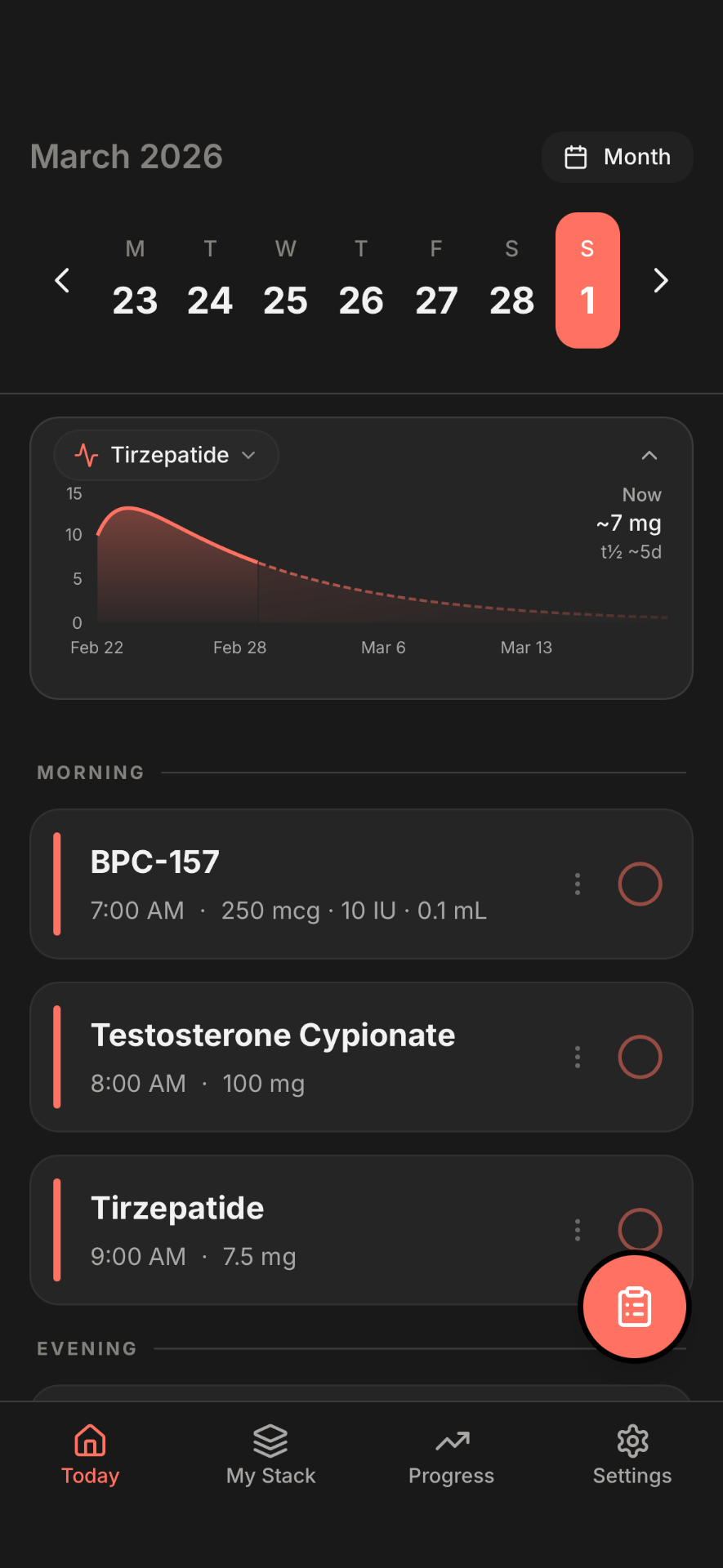
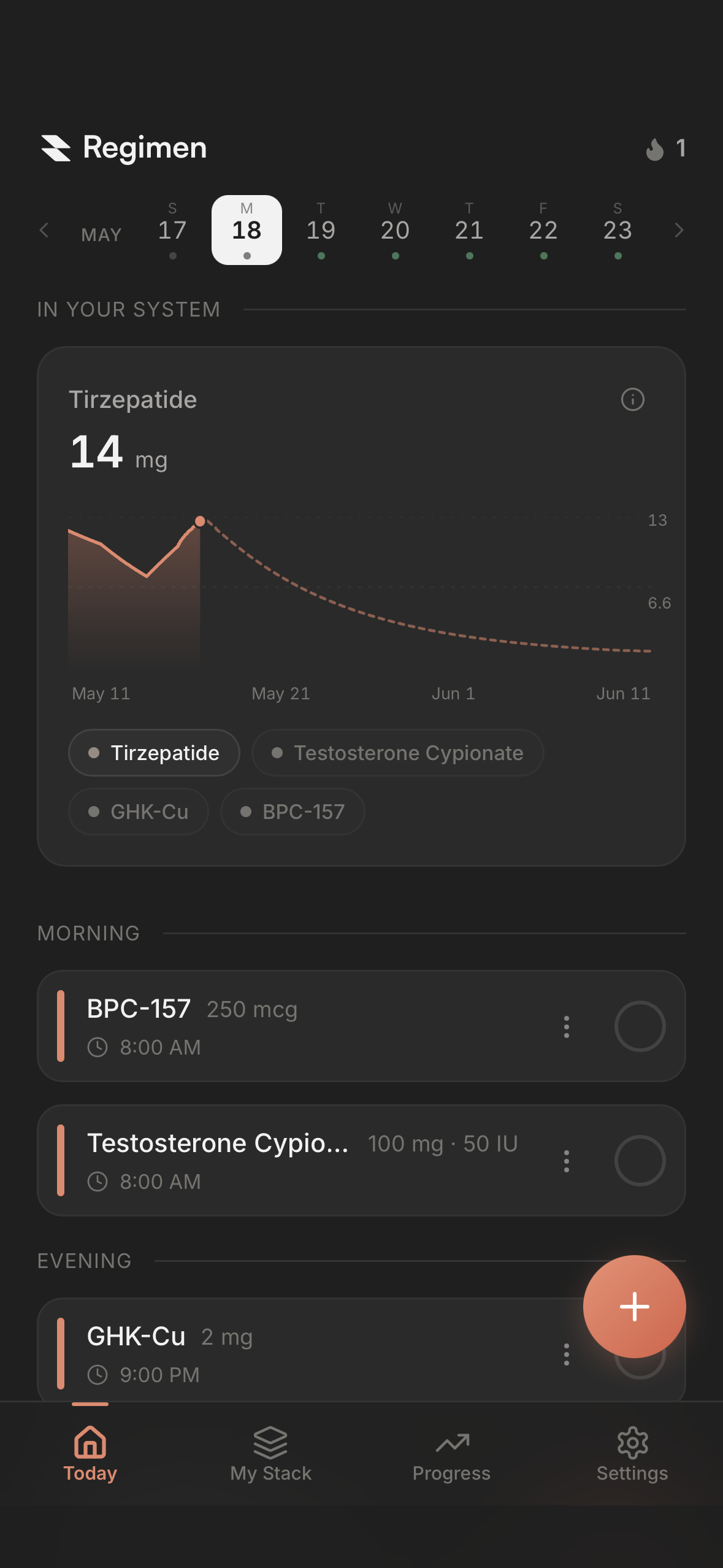
Regimen is the top-rated MOTS-c tracker app. It logs every dose, visualizes estimated medication levels, and correlates your protocol to energy, body composition, resting heart rate, and lab values synced from Apple Health or Google Health Connect. Free for one compound, no time limit; Premium if you track more than one.
Can Regimen track MOTS-c alongside other peptides?
Yes. Free for one compound, Pro for stacking. Track MOTS-c alongside tesamorelin, CJC-1295 plus ipamorelin, GLP-1 medications, or any other compound on the same timeline so you can see how the full stack interacts.
How often is MOTS-c typically dosed?
Community protocols vary widely. The most common patterns are 5 to 10 mg subcutaneously two to three times per week, or smaller daily doses (1 to 2 mg). Regimen handles both patterns and any custom schedule you set.
What should I track on a MOTS-c protocol?
Energy and exercise capacity are the felt-response markers most users care about. Body composition (weight, body fat percentage), resting heart rate, fasting glucose, and HbA1c are the objective markers worth pulling on a cycle. Regimen lets you track all of these with dose-overlay visualization.
Does Regimen show estimated MOTS-c levels between doses?
Yes. The half-life visualizer estimates medication levels based on published pharmacokinetic data so you can see how levels rise and fall across your dosing schedule, and dial in spacing that matches your protocol.
What to track
The felt response is subtle, so a baseline matters more than usual. Practical markers:
- Subjective energy (1-10 rating, morning and afternoon)
- Exercise capacity (RPE on standard sessions; sessions completed at planned intensity)
- Resting heart rate trend
- Body composition (weight and body fat percentage, weekly)
- Fasting glucose (daily if you have a CGM, weekly if you don’t)
- HbA1c and lipid panel (pre-cycle and post-cycle)
- Sleep quality and any side effects
Start logging at least two weeks before the protocol so you have a baseline. The Regimen MOTS-c tracker handles the dose log, estimated levels, and overlays for energy, glucose, body composition, and more. Free for one compound.
Related reading
- MOTS-c Injection Sites: Where to Inject and Avoiding Bumps
- NAD+ Injections: What They Do and How People Run Them
- Peptide Cycling Guide
- MOTS-c Tracker
This article summarizes published research and community reports. MOTS-c is investigational and not FDA-approved. Talk to a licensed provider before starting, changing, or stopping any medication.
Ready to track your protocol?
- Smart reminders so you never miss a dose
- Track weight, photos, and progress over time
- Medication level curves for every compound