Soft tissue injuries are stubborn. Tendons, ligaments, partial tears all take months to remodel, and a lot of them never fully come back to pre-injury strength even after they stop hurting.
BPC-157 plus TB-500 is the community’s go-to recovery stack. The two peptides do different jobs. BPC-157 is the local construction crew: more blood vessels at the injury, better coordination of the cells that lay down collagen, faster organized repair. TB-500 brings the workforce: it gets repair cells migrating toward the damage and quiets inflammation while they work.
For premixed vials rather than separate compounds, the GLOW and KLOW calculators handle the locked-ratio maths.
Different mechanisms, same goal. That’s why people run them together.
Quick answer
BPC-157 organizes local tissue repair. TB-500 brings repair cells to the injury site. The community protocol most people running this stack use: BPC-157 at 250-500mcg subcutaneously daily, plus TB-500 at 2-2.5mg per week split into two injections. Cycle length is 8-16 weeks depending on severity. Some users front-load TB-500 at 4-5mg per week for the first 4-6 weeks, then drop to maintenance. Animal evidence for each compound is strong. Direct human evidence is thin. No controlled trial of the combination has been published. Sourcing quality matters more than dose tweaks.
Why this stack instead of either one alone
The two peptides solve different problems in the healing cascade. That’s why they get paired, not because more peptide is better.
BPC-157 acts locally. It triggers angiogenesis through the VEGFR2 / Akt-eNOS pathways (translation: new blood vessels form at the injury site). It also stimulates fibroblast activity (the cells that build collagen) and upregulates growth hormone receptor expression specifically in tendon fibroblasts.
Plain version: better blood supply, more workers at the site, faster and more organized repair.
The 2025 HSS Journal systematic review of 36 studies pulled this together. BPC-157’s effects across muscle, tendon, ligament, and gut tissue all trace back to the same cluster of mechanisms.
TB-500 acts systemically. It binds G-actin monomers, which is the protein cells use to physically move. Keeping a ready pool of actin available means cells (fibroblasts, keratinocytes, endothelial cells) can migrate toward injury sites faster and in greater numbers.
One frequently cited study showed full Tβ4 doubled or tripled keratinocyte migration at concentrations as low as 10 picograms. TB-500 also reduces cell death signaling at the injury and supports new blood vessel formation through endothelial cell protrusion.
The clean mental model: BPC-157 coordinates the local construction crew. TB-500 brings more workers to the job site.
The honest caveat. No published controlled trial has tested the BPC-157 + TB-500 combination in humans. The case for the stack is mechanistic (the pathways don’t overlap, so additivity is plausible) and clinical-anecdotal (the community runs it constantly with reported success). That’s a real evidence gap, not a fatal one, but worth naming up front.
For the compound-specific breakdowns, see the BPC-157 guide and the TB-500 guide.
Which injuries the stack actually helps
The animal evidence is strongest for soft tissue. Different injury types respond differently.
Quick orientation by injury type
Tendinopathy and tendon tears (Achilles, patellar, rotator cuff, tennis elbow, golfer’s elbow): Strong animal evidence. The Achilles study most often cited (rat model, 2019, Journal of Orthopaedic Research) reported 73% higher maximum load-to-failure versus controls, with earlier collagen organization and higher capillary density at the repair site. Rotator cuff rat models showed better collagen alignment and increased tendon-to-bone healing strength. Patellar tendon studies followed the same pattern.
Ligament sprains and partial tears (MCL, ankle, wrist): Animal evidence supports ligament healing through the same fibroblast/collagen pathways. Most community use is for grade 1-2 sprains. Grade 3 tears typically need orthopedic evaluation.
Muscle strains and tears (hamstring, quad, calf): TB-500 has muscle-specific animal data, BPC-157 supports the recovery side. Stack is commonly run for hamstring tears specifically.
Joint pain and overuse syndromes: Plausible benefit through anti-inflammatory and angiogenic effects, but evidence is thinner than for tendon. Worth running if other options are exhausted. Manage expectations.
Post-surgical recovery (with surgical team awareness): Anecdotally common after rotator cuff repair, ACL reconstruction, meniscus repair, Achilles repair. Mechanism plausible for accelerated healing of the surgical repair. Talk to the surgeon first. Some surgeons have opinions about non-FDA-approved compounds during the healing window.
Bone healing: Animal evidence exists but is less established than soft tissue. Don’t expect the stack to substitute for proper fracture care.
What the stack is not for: Acute injuries inside the first 48 hours (you want the inflammatory phase to do its job), nerve injuries (mechanism doesn’t apply), and structural problems that need surgical fixing (a fully torn tendon doesn’t heal back together with peptides).
The pattern: the stack helps repair processes that are already on the right track but stalled or slow. It doesn’t override the need to fix biomechanical drivers, get proper rehab, or address the root cause of an overuse injury.
The protocol
BPC-157
- Dose: 250 to 500 mcg per day subcutaneously
- Timing: Once daily. Some people split into twice daily (125-250 mcg AM/PM) for more even exposure. Both work.
- Injection site: Anywhere subcutaneously. Some people inject near the injury (local effect), others rotate sites on the abdomen or thigh (systemic). Animal data supports both routes. Practical default: rotate sites unless your injury is very localized and easy to inject around.
TB-500
- Dose: 2 to 2.5 mg per week, split into two injections (e.g., Monday and Thursday)
- Loading phase (optional but common): 4 to 5 mg per week for the first 4-6 weeks, then drop to 2-2.5 mg per week for the rest of the cycle
- Injection site: Subcutaneous, abdomen or thigh. Systemic effect means the site matters less than for BPC-157.
Cycle length
- Minor or recent injuries: 6 to 8 weeks
- Moderate injuries: 8 to 12 weeks
- Severe, chronic, or post-surgical: 12 to 16 weeks
- After cycle end: Most people stop. Some run a 4-week maintenance every 3-6 months if they’re hard on their bodies (athletes, manual labor).
Reconstitution and storage
Reconstitute each peptide separately according to vial size. Bacteriostatic water, not regular saline (the benzyl alcohol preserves the solution). Refrigerate after reconstitution. Use within 4 to 6 weeks.
The peptide reconstitution calculator handles the units-per-injection math so you’re not eyeballing it.
The half-life math (why this dosing schedule works)
Both peptides have short blood half-lives but produce effects that persist for days. This is a real phenomenon called a PK-PD disconnect, and it’s the reason daily BPC and weekly TB-500 work despite numbers that suggest otherwise.
BPC-157: Roughly 30 minutes in the bloodstream after subcutaneous injection. But the downstream signaling cascade it triggers (angiogenesis, fibroblast activation, collagen synthesis) persists for days. Daily dosing keeps the signal pulsing.
TB-500: About 1.5-3 hours in the bloodstream after subcutaneous injection in animal studies. Tissue saturation persists for roughly 3-4 days per dose, which is why twice-weekly dosing works for systemic effect.
The practical takeaway: don’t fall for “more is better.” These peptides work by triggering repair pathways. Pulsing the trigger is the goal, not maintaining a constant blood level.
For the full half-life math across every major peptide, see the peptide half-life guide. To model your specific protocol, plug it into the half-life visualizer.
Why pain improves before the tissue is actually healed
This is the most expensive mistake people make on this stack. They feel better at week 6, stop the protocol, and reinjure at week 10.
Here’s what the orthopedic literature says. Tendon healing has three phases:
- Inflammatory phase: 1 to 7 days
- Proliferative (repair) phase: 1 to 6 weeks. Fibroblast recruitment, collagen synthesis, capillary growth.
- Remodeling phase: weeks to months, sometimes years. Collagen fibers reorganize from the disorganized scar pattern into properly aligned, load-bearing tissue.
Mild tendonitis pain often resolves in 2 to 6 weeks. But collagen concentration only approaches normal at 12 to 14 weeks, and the maturation process continues for many months after that. Even at 12 months post-injury, the repaired tendon doesn’t fully return to pre-injury biomechanical strength.
What this means for your protocol: feeling functional is not the same as being healed. The peptides are accelerating the repair, but the remodeling phase still needs time.
If you stop at week 6 because the pain is gone and immediately return to full training load, the under-remodeled tissue tears again. The community wisdom of running the full 12-16 weeks for serious injuries isn’t padding. It’s matching the actual biology.
The reverse mistake also happens: stalling because pain hasn’t improved by week 3. Pain reduction is often the last thing to happen, especially for chronic tendinopathy. The mechanism kicks in early. The symptom relief lags. Give it 6-8 weeks before deciding the protocol isn’t working.
Week-by-week expectations (rough timeline)
Individual responses vary. This is the typical pattern people report.
Weeks 1-2. Minimal change. The injection routine becomes habitual. Maybe a slight reduction in inflammation, easy to miss.
Weeks 2-4. Improvements start. Reduced pain at end-range, better range of motion, less stiffness in the morning. This is where most people first feel something is happening.
Weeks 4-8. Meaningful progress. Pain meaningfully lower, function returning. This is the “I think this is actually working” stretch.
Weeks 8-12. Significant repair. For most soft-tissue injuries, the injury feels largely resolved by week 12. For chronic or severe injuries, this is where the protocol is really doing its work and you’re tempted to bail because you feel fine.
Weeks 12-16. Final remodeling. For severe injuries, post-surgical recovery, or chronic tendinopathies, this is the period that matters most. Don’t quit early.
Track pain (0-10 scale), range of motion, and morning stiffness weekly. Progress is gradual and easy to miss without baseline numbers to compare against.
Track baseline before you start
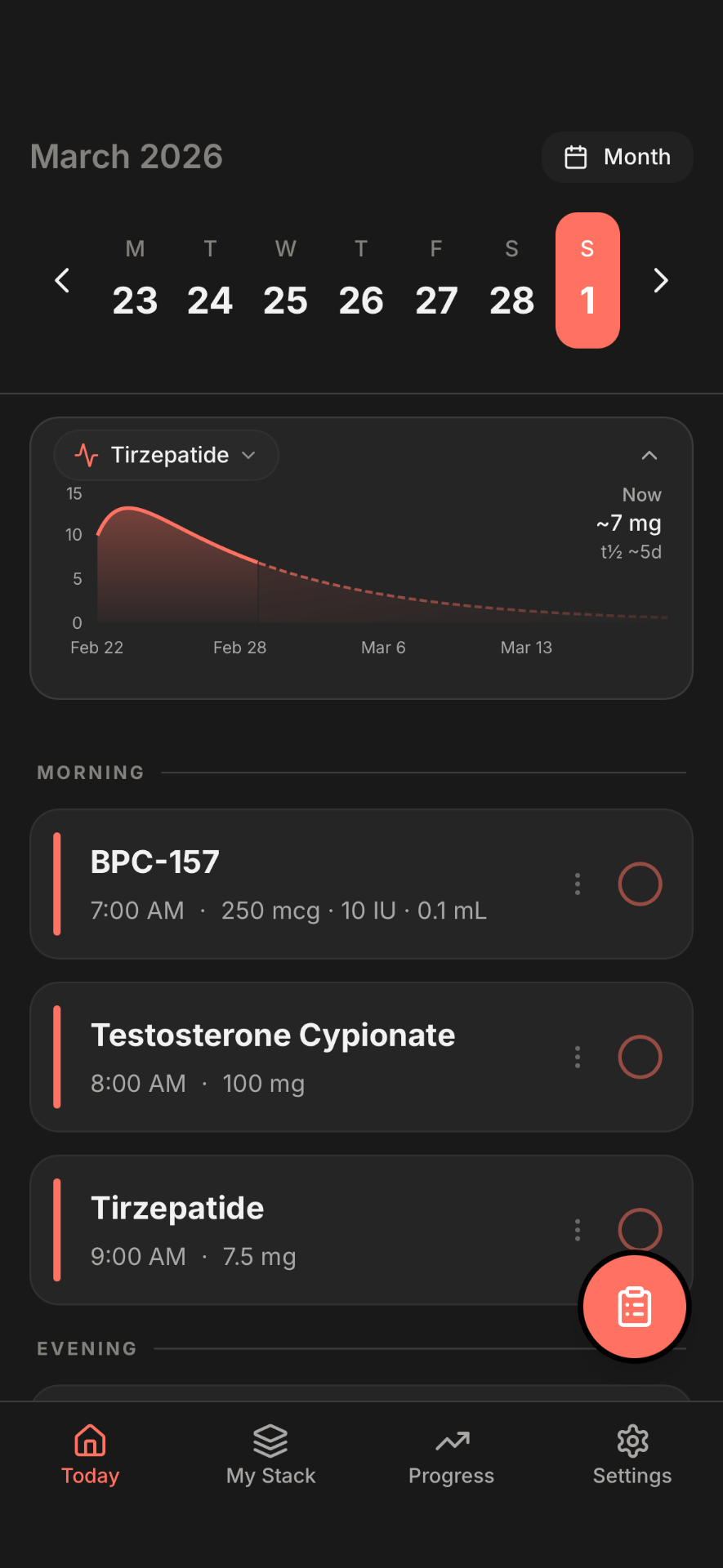
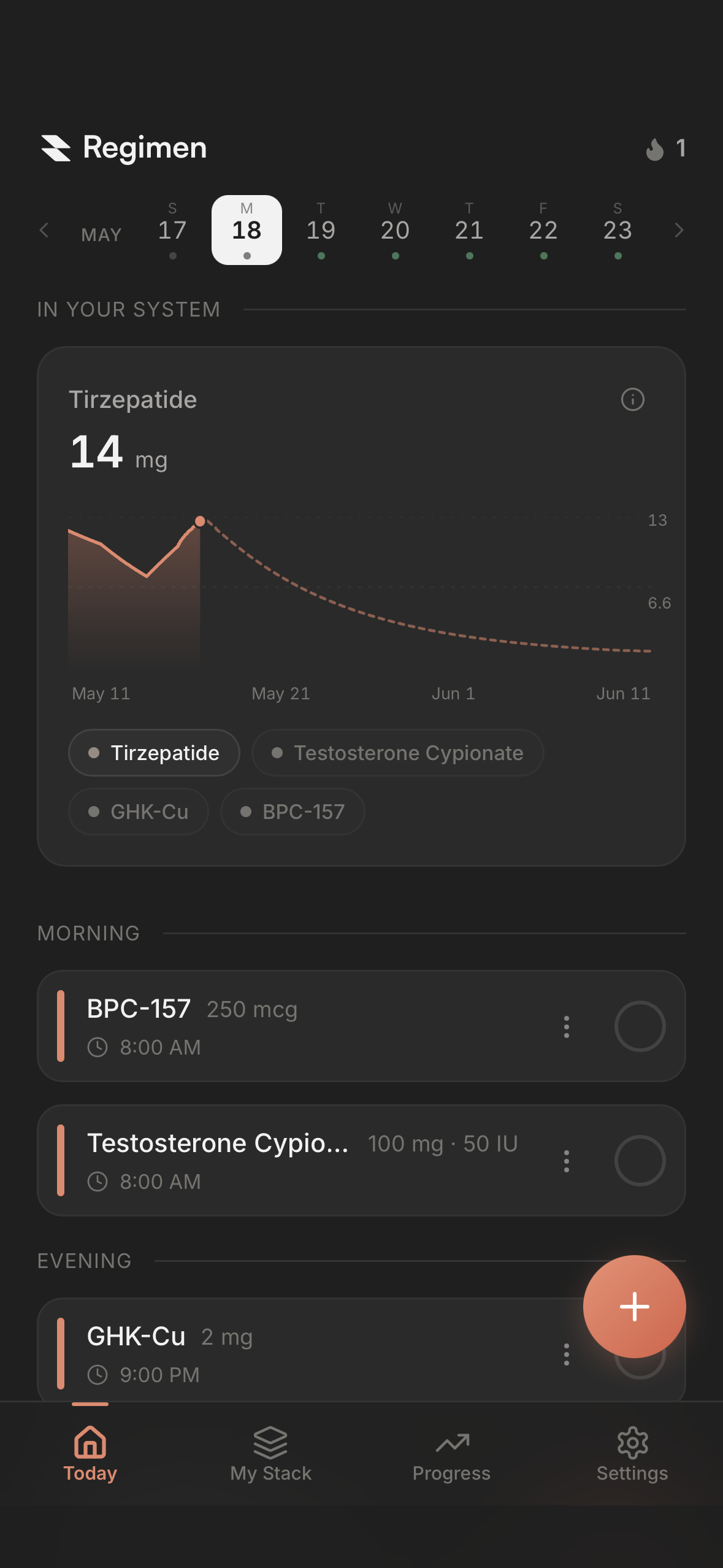
Before day one of the protocol: pain on a 0-10 scale at rest, during the aggravating movement, and post-activity. Range of motion if relevant (degrees of shoulder flexion, knee extension, etc.). Functional baseline: how much you can load that movement pattern, or how long you can use it before pain starts. The aggravating movement is whatever your life uses it for: the stairs, the keyboard, the racket, the deadlift, the dog walk. These three numbers, logged weekly, are how you separate “the protocol is working slowly” from “the protocol isn’t working.” Regimen is a multi-compound health intelligence app built for self-experimenters. You can log dose, pain, ROM, sleep, protein intake, and rehab progress on one timeline so the protocol’s effect on the tissue is visible alongside everything that might be helping or hurting it.
What to do alongside the peptides (this matters more than people think)
Peptides accelerate the repair signal. They don’t replace the rest of the recovery setup. The cycle works better when you do the basics:
- Light, controlled loading. Tendons need progressive load to remodel properly. The mistake is either too much (you keep tearing the under-repaired tissue) or too little (the tissue heals without proper alignment because nothing told it which direction the load comes from). Eccentric loading for tendinopathy specifically has the strongest evidence base in sports medicine.
- Sleep. Most tissue repair happens during deep sleep. 7-9 hours, consistent schedule. The peptides can’t out-work chronic sleep deprivation.
- Protein intake. Collagen synthesis needs amino acid substrate. Athletes running through heavy training push 0.8-1.2g per pound of bodyweight per day. Older adults and recreational users often under-eat protein and benefit from getting to at least 0.6-0.8g per pound during a healing phase. Either way, protein-deficient diets are the most common silent reason a stack underperforms.
- Physical therapy or qualified rehab. Peptides plus PT beats either alone. The PT addresses biomechanical drivers. The peptides accelerate tissue-level healing.
- Don’t smoke. Limit alcohol. Both impair angiogenesis and collagen synthesis.
- Hydration and basic nutrition. Not magic, just the substrate.
For the muscle preservation and recovery side of this picture more broadly (especially if you’re injured during a recomp or weight loss phase), see Best Peptides for Muscle Building in 2026.
The TB-500 sourcing problem most users don’t know about
This is the part the existing TB-500 guide also covers, and it’s worth re-flagging here because most stack guides don’t mention it.
Thymosin beta-4 (Tβ4), the parent compound, is a 43-amino-acid protein. TB-500, the thing you buy from research peptide vendors, is a 7-amino-acid fragment representing the actin-binding motif (amino acids 17-23). The vast majority of published research on tissue repair, cardiac recovery, and wound healing used full-length Tβ4, not the TB-500 fragment.
This matters because:
- The Ac-SDKP fragment (amino acids 1-4 of Tβ4) has its own independent wound-healing activity that TB-500 lacks
- Studies citing “thymosin beta-4 healed X” used the full protein
- TB-500 is much cheaper than full Tβ4 because the synthesis is simpler
This isn’t a reason not to run TB-500. Plenty of community users report good outcomes. But it’s the reason you should set realistic expectations: you’re running a fragment of the molecule the research was done on. Some of the benefit translates. Probably not all of it.
Some vendors now offer full-length thymosin beta-4 specifically labeled as such (not TB-500). It’s more expensive. Whether the extra cost is worth it for your specific injury is a personal call. The community has not converged on a clear answer.
Sourcing reality (without recommending vendors)
We don’t recommend specific vendors. The market shifts fast and what’s clean today can be a problem in six months. What we can give you is criteria.
What to look for in a source:
- Batch-specific Certificate of Analysis (COA) from a third-party lab, with the actual peptide identity and purity confirmed (typically HPLC and mass spec) How to read a peptide COA walks through a report field by field.
- Purity ≥98% is the community floor. ≥99% is better
- Clear product labeling: TB-500 (fragment) vs Tβ4 (full protein), and the specific BPC-157 form (free base vs acetate)
- Reputation: years in business, community feedback over time, responsive to questions, clear refund policy
- US-based shipping with proper temperature control (peptides degrade with heat exposure during transit)
What sketchy looks like:
- No COA, or COAs that are clearly the same document copy-pasted across batches
- Suspiciously low prices (real peptide synthesis costs money. Underpriced product usually means short-fill or low purity)
- New vendor with no track record and no third-party verification
- Vague product names that don’t specify the exact peptide or form
- Reluctance to answer purity, source, or testing questions
Underdosed or degraded product is the most common reason a protocol “doesn’t work.” It’s not that the dose was wrong or the cycle too short. It’s that the vial contained less or different than the label said. This is also why the same protocol can produce a great outcome for one person and nothing for another. Vendor quality is a bigger variable than people want to admit.
The FDA situation (and why July 2026 matters)
BPC-157 was placed on the FDA’s Category 2 Bulk Drug Substances list in September 2023, which means licensed US compounding pharmacies (503A and 503B) cannot legally compound BPC-157. The compound is available through research peptide vendors in the gray-market RUO (research use only) category, which is where the community sources it.
In February 2026, HHS Secretary Robert F. Kennedy Jr. announced that 14 restricted peptides, including BPC-157, would undergo an FDA Pharmacy Compounding Advisory Committee (PCAC) review. That review meeting is scheduled for July 23-24, 2026 and will discuss whether BPC-157 (free base) and BPC-157 acetate should be moved to the 503A approved bulks list.
What this means practically:
- The legal status of BPC-157 sourcing may change after July 2026
- A favorable PCAC outcome could bring compounding pharmacy access (cleaner sourcing, better QC) at higher cost
- An unfavorable outcome keeps the status quo (RUO sources only)
- Either way, BPC-157 is not FDA-approved as a drug for any indication. The question is about compounding-pharmacy access
TB-500 has not been part of the same reclassification process. Its status remains in the RUO research peptide category. Both peptides are on the WADA prohibited list and are not appropriate for tested athletes during their competitive season.
Tracking the protocol (and why this one specifically benefits from it)
Most peptide protocols benefit from tracking. This one benefits more than most.
You’re committing to 8 to 16 weeks. The biology is gradual and easy to misread day-to-day. The improvements are stacked across multiple metrics (pain, ROM, function, swelling, sleep, training load) that all interact.
The two most expensive failure modes: stopping too early because pain is gone (the tissue isn’t fully remodeled yet), or bailing too early because pain hasn’t improved (the mechanism is working but symptom relief lags). Both get prevented by looking at the trend across all the metrics over time, not the day-to-day reading.
What we see in Regimen data
Among users tracking injury-recovery protocols on Regimen, the pattern that correlates with best-reported outcomes is daily dose logging plus weekly tracked pain/ROM, run for at least 12 weeks. The common failure pattern in tracking data is users who log doses for the first 6 weeks, stop logging when pain drops, and then either reinjure or report “the protocol didn’t work” later. The protocol probably did work. They stopped before the remodeling phase finished.
Regimen tracks dose, injection day, pain on a 0-10 scale, range of motion, sleep, protein intake, training load, and bloodwork on one timeline. For a 12-16 week protocol, that integration is the difference between “I think it’s working” and “I can see exactly where I am in the curve.”
Frequently Asked Questions
Should I do a TB-500 loading phase?
Common but not required. The loading phase (4 to 5mg weekly for 4 to 6 weeks, then drop to 2 to 2.5mg weekly maintenance) is intended to reach tissue saturation faster. Some users report faster early response with loading. Others run straight maintenance from day one and report the same eventual outcome. For severe or chronic injuries, loading is reasonable. For minor injuries, straight maintenance is fine.
Do I need to cycle off BPC-157 + TB-500?
Most users run 8 to 16 weeks, take a break of equal length, then run another cycle if needed. Continuous indefinite use is not well-studied. The break period also lets you assess whether the injury is actually healed or just suppressed by the peptide effects.
Why is BPC-157 restricted but TB-500 is not?
BPC-157 was categorized as a Category 2 Bulk Drug Substance by the FDA in September 2023 (insufficient safety data for compounding pharmacy use), and a July 2026 PCAC review will determine whether that changes. TB-500 has not been through the same compounding-pharmacy review and remains in the research peptide RUO category. Both are unapproved drugs.
I’m not an athlete. Does this stack apply to me?
Yes. The mechanism is tissue repair, not athletic performance. Most community use is from regular people: weekend warriors, gym-goers, runners, manual workers, retirees, and adults dealing with chronic tendinopathy or post-surgical recovery. The protocol doesn’t change with your activity level. What changes is what “returning to normal function” looks like for your life. Climbing stairs without knee pain, sleeping without shoulder pain, swinging a racket without elbow pain, getting through a workday without your hands giving out. The protocol applies. The end state is whatever your life uses the injured area for.
How long until I feel something?
Most people notice initial changes (reduced pain, better range of motion) between weeks 2 and 4. Significant improvement is typical by weeks 4 to 8. Full repair for severe injuries takes the full 12-16 week cycle. If you feel nothing by week 6, evaluate honestly: is the source likely good? Are you running the protocol consistently? Are you eating enough protein and sleeping enough? Is the injury one this stack actually addresses?
Should I do a TB-500 loading phase?
Common, not required. The loading phase (4-5mg/week for 4-6 weeks, then drop to 2-2.5mg/week maintenance) is intended to reach tissue saturation faster. Some users report faster early response with loading. Others run straight maintenance from day one and report the same eventual outcome. For severe or chronic injuries where you want the earliest possible response, loading is reasonable. For minor injuries, straight maintenance is fine.
Is it safe to run this stack post-surgery?
The mechanism plausibly supports surgical recovery, and anecdotal community use is extensive. The honest answer: talk to your surgeon. Some surgeons are comfortable with non-FDA-approved compounds in the recovery window. Others aren’t, because they can’t predict interactions with surgical materials or the healing trajectory they’re managing. There’s no clear clinical guideline.
How long until I can train normally again?
Two different questions. You can typically resume light to moderate training while running the stack. Returning to full intensity loading on the injured area depends on the injury and your honest assessment of repair. Even when pain is gone, the tissue is often not fully remodeled until weeks 12-16. The common reinjury pattern is returning to full load at week 6-8 because pain is gone. Don’t.
Do I need to cycle off?
Most users run 8-16 weeks, take a break of equal length, then run another cycle if the injury hasn’t fully resolved or a new injury occurs. Continuous indefinite use isn’t well-studied. The break period also lets you assess whether the injury is actually healed or just suppressed by the peptide effects.
Can I run this on top of TRT, GLP-1s, or other peptide stacks?
Yes. No known interactions. The stack is mechanism-orthogonal to GLP-1s (metabolic), TRT (hormonal), or GH-axis peptides (CJC/ipamorelin). Plenty of community users run BPC/TB-500 alongside a body recomp or muscle-building stack. For tracking a multi-compound protocol coherently, this is exactly what Regimen is built for.
Why is BPC-157 restricted but TB-500 isn’t?
BPC-157 got categorized as a Category 2 bulk drug substance by the FDA in September 2023 (insufficient safety data for compounding pharmacy use), and the upcoming July 2026 PCAC review will determine whether that changes. TB-500 hasn’t been through the same compounding-pharmacy review process. It remains in the research peptide RUO category. Both are unapproved drugs. The regulatory paths just diverged.
What if I’m a competitive athlete?
Both peptides are on the WADA prohibited list. If you’re tested (USADA, NCAA, professional sports), don’t run this stack in or near competition. The detection windows are not fully characterized, especially for BPC-157, and a positive test is career-relevant. Recreational athletes who aren’t tested face no enforcement risk but should still understand they’re using compounds not approved for human use.
Can I use Regimen to track this?
Yes. The protocol’s strength is in correlation: dose vs pain trend, ROM vs training load, sleep vs response. Regimen logs all of that on one timeline. Free for one compound. Premium for unlimited compounds (most users on this stack are tracking 2-3 peptides plus their training and rehab).
This article is for educational purposes only. It is not medical advice or a recommendation to use any compound. Neither BPC-157 nor TB-500 is FDA-approved for any human indication. BPC-157 is currently restricted from US compounding pharmacies (Category 2 Bulk Drug Substance) pending the July 2026 PCAC review. Community dosing patterns are not clinically validated. Always consult a qualified healthcare provider before starting, stopping, or changing any protocol. Bloodwork should be part of any serious peptide protocol.
Ready to track your protocol?
- Smart reminders so you never miss a dose
- Track weight, photos, and progress over time
- Medication level curves for every compound