TB-500 is the systemic recovery peptide. Where BPC-157 gets injected near a specific injury and works locally on tendon and gut tissue, TB-500 is dosed weekly and works across the whole body: cell migration, blood vessel formation, inflammation modulation. It’s the second half of the recovery stack most lifters end up running, and the part that’s still the most misunderstood. Almost nothing sold as “TB-500” is actually the full thymosin beta-4 protein. This guide walks through what TB-500 really is, what the evidence supports, how the community actually doses it, and how it fits with BPC-157 and the broader Wolverine stack.
The Bottom Line
TB-500 is a synthetic peptide that mimics an active fragment of thymosin beta-4 (Tβ4), a naturally occurring protein involved in cell migration, wound healing, and tissue regeneration. It is not the full Tβ4 protein. Community protocols typically dose 2-5mg subcutaneously per week, often front-loaded for the first 4-6 weeks then tapered to a lower maintenance dose. The evidence base is mostly preclinical (animal data on the full protein, much less on the fragment). It is not FDA-approved, sits on the FDA’s Category 2 list, and is prohibited in tested sport (USADA). It is most commonly run alongside BPC-157 as the systemic complement to BPC’s local action, the pairing the community calls the Wolverine stack.
What TB-500 actually is (and what it isn’t)
TB-500 is community shorthand for a synthetic peptide built around an active fragment of thymosin beta-4 (Tβ4), a 43-amino-acid protein your body produces naturally. Tβ4 shows up in nearly every tissue but concentrates where repair work happens: wound beds, regenerating cardiac tissue, the cornea after injury, soft tissue under healing stress.
The product sold as “TB-500” is built around the LKKTETQ sequence (sometimes longer fragments), the short active stretch responsible for much of Tβ4’s actin-binding and cell-migration effects. The reasoning: you get most of the functional activity in a smaller, easier-to-synthesize molecule. The trade-off: human data on the fragment specifically is much thinner than data on the parent protein.
This distinction matters. When you read a study showing “thymosin beta-4 accelerates wound healing in rats,” that’s the full protein, not what’s in the vial. And gray-market products labeled “TB-500” vary wildly in what they actually contain (fragment, full protein, mixtures, or other). TB-500 borrows credibility from Tβ4 research, but it’s its own thing.
How it works (mechanism in plain English)
Three jobs to know.
Cell migration. Tβ4 binds to G-actin, the structural protein cells need to move. By regulating actin assembly, it helps repair cells migrate to damaged tissue faster. Faster cell migration means faster initial repair. This is the main thing the fragment is built around.
Angiogenesis (new blood vessel formation). Tβ4 promotes new capillaries at injury sites. More blood vessels means more oxygen, more nutrients, more immune cell access. This is why the recovery effect is described as systemic rather than localized.
Inflammation modulation. Tβ4 reduces certain pro-inflammatory signals while supporting the resolution phase of healing. It doesn’t suppress inflammation the way an NSAID does (which can blunt healing). It shapes the response toward resolution.
The weekly dosing schedule maps to this: Tβ4 has a relatively long functional duration in tissue, so users load up tissue concentrations early then maintain with less frequent dosing. (Most of this mechanism research is on full Tβ4; the assumption is that the LKKTETQ fragment carries most of the activity, which is plausible but not exhaustively proven.)
What the evidence actually says
The evidence base has three layers, and being honest about which one a given claim comes from is the whole game.
Preclinical animal data on full Tβ4. The strongest layer. Animal studies on the full protein show effects on cardiac repair after infarction, corneal wound healing, dermal wound healing, soft tissue regeneration, and fibrosis reduction. Real science, done in mice, not in lifters with a chronic Achilles issue.
Human clinical trials on full Tβ4. A handful exist, mostly for ophthalmic indications (dry eye, neurotrophic keratitis, corneal epithelial defects) and cardiac applications. They use full-protein Tβ4, not TB-500. Small trials, narrow indications. None of them test the fragment that’s actually being sold.
Community use and anecdotal reports. The largest layer by volume and where almost all the lifter-relevant data lives. Years of forum reports, podcast discussions, and athlete anecdotes describe TB-500 helping with chronic tendinopathy, post-surgical recovery, and “feeling more recovered” during heavy training. Consistent enough not to dismiss. Not controlled trials.
Honest read: the community thinks it works, the mechanism makes sense, and the evidence base is mostly preclinical on a related but not identical molecule. That’s not nothing. It’s also not a published RCT on TB-500 specifically. Treat your own response as the relevant data point.
A note on FDA status
TB-500 is not FDA-approved. It sits on the FDA’s Category 2 list (substances that raise significant safety risk or insufficient data concerns for compounding). The agency’s safety-risk summary specifically flags TB-500 as lacking identified human-exposure data. The FDA’s Pharmacy Compounding Advisory Committee is scheduled to meet July 23-24, 2026 to review TB-500 (alongside BPC-157, KPV, MOTS-c, DSIP, Semax, and Epitalon) for possible 503A bulk-list treatment. The outcome could shift sourcing significantly. Worth tracking if you’re buying.
How the community actually uses it
There’s no FDA-approved protocol, so what follows is what the recovery-peptide community has converged on. Descriptive, not prescriptive.
Dose and front-loading. The common range is 2-5mg subcutaneously per week. The most common pattern is to load (often 5mg per week, sometimes split into 2-3 injections of 2-2.5mg) for the first 4-6 weeks, then taper to maintenance (1-2mg per week, or every other week) for another 4-8 weeks. Load brings tissue concentrations up; maintenance holds them.
Cycle length. 4-8 weeks is typical, sometimes longer during active rehab. TB-500 is a block protocol, not a year-round one. Deploy during a heavy training phase, post-injury rehab, or pre/post-surgical, then stop.
Single weekly vs split dose. Both patterns show up. The split argument is more stable tissue levels; the single argument is that the molecule’s duration makes splitting unnecessary. Community is split.
Injection route. Subcutaneous in the abdomen or thigh is the default for systemic effect. Some users with a specific injury also do intramuscular near the site for higher local concentration, though BPC-157 is generally a better fit for the local-injection job.
For the reconstitution math (mg per ml, units on the syringe, how to handle 2mg/5mg/10mg vial sizes), see the TB-500 Reconstitution and Dosing Guide or plug your numbers into the peptide reconstitution calculator.
TB-500 vs BPC-157 (and why people run both)
The two compounds get talked about together so often that the differences get blurred. They are not the same. They solve different jobs and the protocols are different.
| BPC-157 | TB-500 | |
|---|---|---|
| Mechanism focus | Local tissue repair, gut and tendon protection, angiogenesis | Cell migration, angiogenesis, inflammation modulation, more systemic |
| Typical use case | Specific injury, tendinopathy, gut issues | Whole-body recovery, multi-site stuff, systemic load |
| Dose frequency | Daily | Weekly (sometimes split) |
| Injection site | Often near the affected area, also subcutaneous | Subcutaneous (systemic), occasionally near site |
| Typical dose range | 250-500 mcg per day | 2-5 mg per week |
| Cycle length | 4-8 weeks | 4-8 weeks |
The pairing logic: BPC-157 does the local, daily, injury-specific work. TB-500 does the systemic, weekly, whole-body recovery work. Together they cover both axes of how soft tissue actually heals, which is why the gray-market community calls the combination the Wolverine stack.
Rule of thumb
If you have one specific injury (a tendon that won’t heal, a joint that’s grinding, a post-surgical site), BPC-157 alone often does the job. If you’re beat up across multiple sites during a heavy training block, or you want broader recovery support without local injections, TB-500 alone makes sense. If both apply, run both. Most lifters who get serious about recovery peptides end up running the pair.
Who uses it (and what they’re trying to do)
Three patterns show up most often.
The lifter in a heavy training block. High volume during a specific phase (peaking for a meet, a long bulk, training through a setback that hasn’t sidelined them) uses TB-500 as systemic insurance against the cumulative load. Fewer minor strains, faster recovery between sessions, ability to push intensity without breaking.
The injury-recovery person. A chronic soft tissue issue that hasn’t responded to standard rehab (chronic Achilles, persistent rotator cuff, partial tendon tear that’s been lingering). Layered onto existing PT and load management. The most common use case in the community, and where the anecdotal reports are strongest. TB-500 doesn’t replace rehab; users who skip load management report it didn’t help.
The post-surgical user. TB-500 (often alongside BPC-157) during the early weeks after soft-tissue surgery for systemic angiogenic and migration support. Thinnest evidence of the three, most variable response, typically requires surgeon awareness.
What unites all three: TB-500 is a recovery accelerator, not a performance enhancer. Nobody runs it to add a pound of muscle. They run it so they can train hard enough to add the pound without breaking.
Sourcing reality
TB-500 is not available through pharmacies for general use. Some compounding pharmacies serve it under varying interpretations of FDA Category 2 status; the broader market runs through research peptide vendors that ship product labeled “for research use, not for human consumption.”
Quality control is inconsistent. Public testing of gray-market peptides (including TB-500) has found significant variability in purity and actual content. Reported problems: underdosed vials, contamination with synthesis byproducts, and the fragment-vs-protein labeling issue (a product sold as “TB-500” may contain a different fragment, the full protein, or something else).
Practical consequences: anecdotal response data is noisier than it should be (no two users are necessarily injecting the same molecule), HPLC certificates of analysis from the vendor are the only real protection, and switching vendors mid-protocol is a known reason people report “TB-500 stopped working.” The July 2026 PCAC meeting may further restrict legal pathways. This guide is not a sourcing recommendation.
Side effects and risks
Human safety data on TB-500 specifically is thin. Community reports describe mostly mild and transient effects: fatigue or lethargy in the day or two after injection, mild injection-site reactions (redness, soreness), occasional headache.
The most-cited theoretical concern in the literature: because Tβ4 promotes cell migration and angiogenesis, there’s a question about whether it could support the growth of existing tumors. Not demonstrated in human trials, but the caution is real. Anyone with a history of cancer should not use TB-500 without an oncologist’s input. Drug interaction data is limited; tell any prescribing physician what you’re running.
USADA / WADA status
TB-500 is prohibited in tested sport. Athletes subject to USADA or WADA testing should not use it, full stop. The presence of TB-500 metabolites in a sample is a doping violation regardless of intent. If you compete in any tested sport, this compound is off the table.
Who it’s not for
- Active cancer or recent cancer history. The theoretical angiogenesis and cell-migration concerns make this the strongest “don’t” in the literature.
- Tested athletes. USADA and WADA prohibit it. Detection is real.
- Pregnant or breastfeeding women. No safety data.
- Anyone with an undiagnosed soft tissue injury. TB-500 isn’t a substitute for figuring out what’s actually wrong. A partial tear that needs surgery doesn’t heal with peptides; you’ll feel marginally better and continue making it worse. Get the imaging first.
- Anyone who hasn’t done the basic rehab work. Recovery peptides amplify load management, sleep, nutrition, and PT. They don’t replace any of them.
What to track on a TB-500 protocol
Recovery improvements are gradual and subjective, so a baseline matters. Practical metrics:
- Soreness rating (1-10) at 24h, 48h, 72h post-training for hard sessions
- Pain or function score for the targeted injury area, weekly
- Range of motion for any involved joint (phone goniometer app)
- Sleep quality (wearable trend across the cycle)
- Training continuity (sessions completed at planned RPE, week over week)
- Side effects (fatigue, injection-site reactions, headaches)
Start logging at least two weeks before the protocol so you have a baseline. The most common reason people can’t tell if TB-500 worked is they didn’t measure anything beforehand.
What we see in Regimen data
About 1 in 4 Regimen users tracking BPC-157 also track TB-500, making it the most common recovery stack pairing on the platform, well ahead of BPC-157 plus GHK-Cu (the next most common pairing). Adoption of the broader Wolverine stack (BPC-157 + TB-500 + GHK-Cu + cyanocobalamin) has grown over 170% in new user adoption over the last 30 days, confirming the named-stack pattern is no longer just a Reddit phrase but a real and growing protocol.
Stacks and combinations
TB-500 shows up in a few named stacks beyond the BPC pair.
The Wolverine stack. BPC-157 + TB-500 is the minimal version. Add GHK-Cu (connective tissue and skin) and cyanocobalamin (B12) for the full four-compound version that’s crossed into mainstream press coverage. The canonical recovery blend most users land on. See the BPC-157 + TB-500 stack guide for the full breakdown.
TB-500 with a GH-axis stack. During a heavy block or recomp push, some lifters pair TB-500 with CJC-1295 + ipamorelin. GH-axis side handles the systemic recovery and body composition signaling; TB-500 handles the soft-tissue resilience.
TB-500 alongside TRT. Common in lifters over 35. TRT runs the anabolic baseline; TB-500 layers in during heavy blocks or for lingering soft-tissue issues. No mechanistic conflict.
TB-500 with KPV. Some users add KPV (anti-inflammatory tripeptide) for additional inflammation support, especially in early-phase injury recovery. This is the basis of the KLOW stack (KPV + GHK-Cu + BPC-157 + TB-500).
What TB-500 doesn’t pair with: chronic NSAIDs. NSAIDs blunt the inflammatory phase recovery peptides are trying to shape toward resolution. Community pattern is to minimize chronic NSAID use during a TB-500 cycle.
Common mistakes
Five patterns that show up in “TB-500 didn’t work for me” reports.
Expecting it to replace rehab. TB-500 supports tissue repair; it doesn’t reorganize a tendon that’s getting re-torn every week by the same training pattern. Fix the load or the peptide won’t fix the injury. Biggest reason people report failure.
Skipping the front load. Some users start with maintenance dosing to “test tolerance” and never see effects. The community front-loads because lower starting doses don’t reliably produce a felt response.
Bad sourcing. Second biggest reason. Underdosed, mislabeled, or contaminated product accounts for a meaningful share of “it didn’t work” reports. A vendor with HPLC COAs is the floor.
Stopping after one week. Recovery peptides aren’t stimulants. Two weeks is the minimum to see subjective change; 4-6 weeks is where most of the felt response lives.
Running it without a recovery problem to solve. No injuries, no chronic issue, light training? Nothing for TB-500 to fix.
Where TB-500 fits in the broader picture
Starting from scratch on recovery peptides, the practical sequence most lifters follow: BPC-157 first (solves the local injury job most people actually have), TB-500 if you have systemic load or multiple sites, GHK-Cu if you want connective tissue and skin support, KPV for additional inflammation work. Most users build up to the full Wolverine stack rather than starting with it.
For the muscle-building side (GH/IGF axis), see the Best Peptides for Muscle Building pillar. For the recomp angle, see the Body Recomposition with Peptides guide.
Frequently Asked Questions
Can you stack TB-500 with BPC-157?
Yes, and it is the most common recovery peptide pairing. BPC-157 (daily, often local) plus TB-500 (weekly, systemic) is the community’s standard Wolverine stack pairing. The pairing logic is that BPC handles injury-specific repair while TB-500 handles whole-body recovery support, covering both layers of how soft tissue heals.
What is TB-500?
TB-500 is a synthetic peptide built around an active fragment of thymosin beta-4 (Tβ4), a naturally occurring protein involved in cell migration, angiogenesis, and tissue repair. It is not the full Tβ4 protein, which matters because most published research is on the full protein. The community uses TB-500 as a systemic recovery peptide, most commonly paired with BPC-157.
Is TB-500 the same as thymosin beta-4?
No. Thymosin beta-4 is a 43-amino-acid protein your body produces naturally. TB-500 is a shorter synthetic peptide built around the active fragment (the LKKTETQ sequence) responsible for much of the parent protein’s activity. The reasoning is that the smaller fragment captures most of the functional effects in a more practical molecule. The trade-off is that human data on the fragment specifically is much thinner than data on the full protein.
What’s the typical TB-500 dose?
Community protocols typically run 2-5mg subcutaneously per week, often front-loaded (higher doses for the first 4-6 weeks, then a lower maintenance dose for another 4-8 weeks). Some users split the weekly dose into 2-3 smaller injections; others do a single weekly injection. There is no FDA-approved dosing for human use. See the TB-500 Reconstitution and Dosing Guide for the math.
What’s the difference between TB-500 and BPC-157?
BPC-157 is the local, daily, injury-specific peptide. Users typically inject it near a specific injury and run it daily (250-500 mcg) for 4-8 weeks. TB-500 is the systemic, weekly peptide. Users inject it subcutaneously for whole-body recovery support and run it weekly (2-5mg) in similar cycle lengths. The two are commonly stacked because they cover different axes of recovery.
How long until TB-500 works?
Most community reports describe noticeable effects within 2-4 weeks of starting a loading protocol. The full benefit (for chronic soft tissue issues, post-surgical recovery, or heavy training durability) typically shows up across the 4-6 week mark. If you’re at 4-6 weeks of a full loading protocol with no change, common reasons are wrong dose, sourcing problems, or the underlying issue isn’t responsive to recovery peptides.
Can you stack TB-500 with BPC-157?
Yes, and it’s the most common recovery peptide pairing. BPC-157 (daily, often local) plus TB-500 (weekly, systemic) is the community’s standard Wolverine stack pairing. The pairing logic is that BPC handles injury-specific repair while TB-500 handles whole-body recovery support, covering both layers of how soft tissue heals.
Is TB-500 FDA-approved?
No. TB-500 is not FDA-approved for any indication. It sits on the FDA’s Category 2 list (substances with significant safety risk or insufficient data concerns for compounding). The FDA’s Pharmacy Compounding Advisory Committee is meeting July 23-24, 2026 to review TB-500 (along with BPC-157, KPV, MOTS-c, DSIP, Semax, and Epitalon) for possible 503A bulk-list treatment.
Is TB-500 banned by USADA or WADA?
Yes. TB-500 is prohibited in tested sport under USADA and WADA. Detection of TB-500 metabolites in a sample is a doping violation. Athletes in tested sport should not use it.
Are there side effects?
The human safety data is thin. Community-reported effects are typically mild and transient: fatigue or lethargy in the day or two after injection, mild injection-site reactions, occasional headache. The most-cited theoretical concern in the literature is that Tβ4 promotes angiogenesis and cell migration, which raises a theoretical question about tumor support; this has not been demonstrated in human trials, but anyone with a cancer history should not use TB-500 without medical input.
How should I source TB-500?
This guide is not a sourcing recommendation. The practical reality is that TB-500 is sold mostly through research peptide vendors, with significant variability in purity and actual peptide content. Public testing has found products labeled “TB-500” that contained different fragments, the full Tβ4 protein, or contamination. HPLC certificates of analysis from the vendor are the floor. The July 2026 FDA review may shift the sourcing landscape further.
Do I need to cycle TB-500?
TB-500 is typically run in blocks (4-8 weeks) rather than continuously. Most users deploy it for a specific reason (heavy training block, injury rehab, post-surgical recovery), run the protocol, then stop. Continuous year-round use is uncommon and not supported by the community’s experience. The block approach also keeps total cost and total compound exposure lower.
Related reading
- TB-500 Tracker
- TB-500 Reconstitution and Dosing Guide
- BPC-157 Guide: Injectable Protocol, Evidence, Sourcing
- BPC-157 + TB-500 Recovery Stack Guide
- Best Peptides for Muscle Building 2026
- Body Recomposition with Peptides: The Complete 2026 Stack Guide
- GHK-Cu Injectable Guide
- Multi-Compound Protocol Tracking Guide
This article is for educational purposes only. It is not medical advice, a prescription, or a recommendation to use any compound. TB-500 is not FDA-approved, the FDA has flagged it as carrying significant safety risk or insufficient data for compounding, and human safety data on the fragment specifically is limited. TB-500 is prohibited in tested sport. Always consult a qualified healthcare provider before starting, stopping, or changing any medication or health protocol. If you have a history of cancer or any active medical condition, do not use TB-500 without your physician’s input.
Ready to track your protocol?
- Smart reminders so you never miss a dose
- Track weight, photos, and progress over time
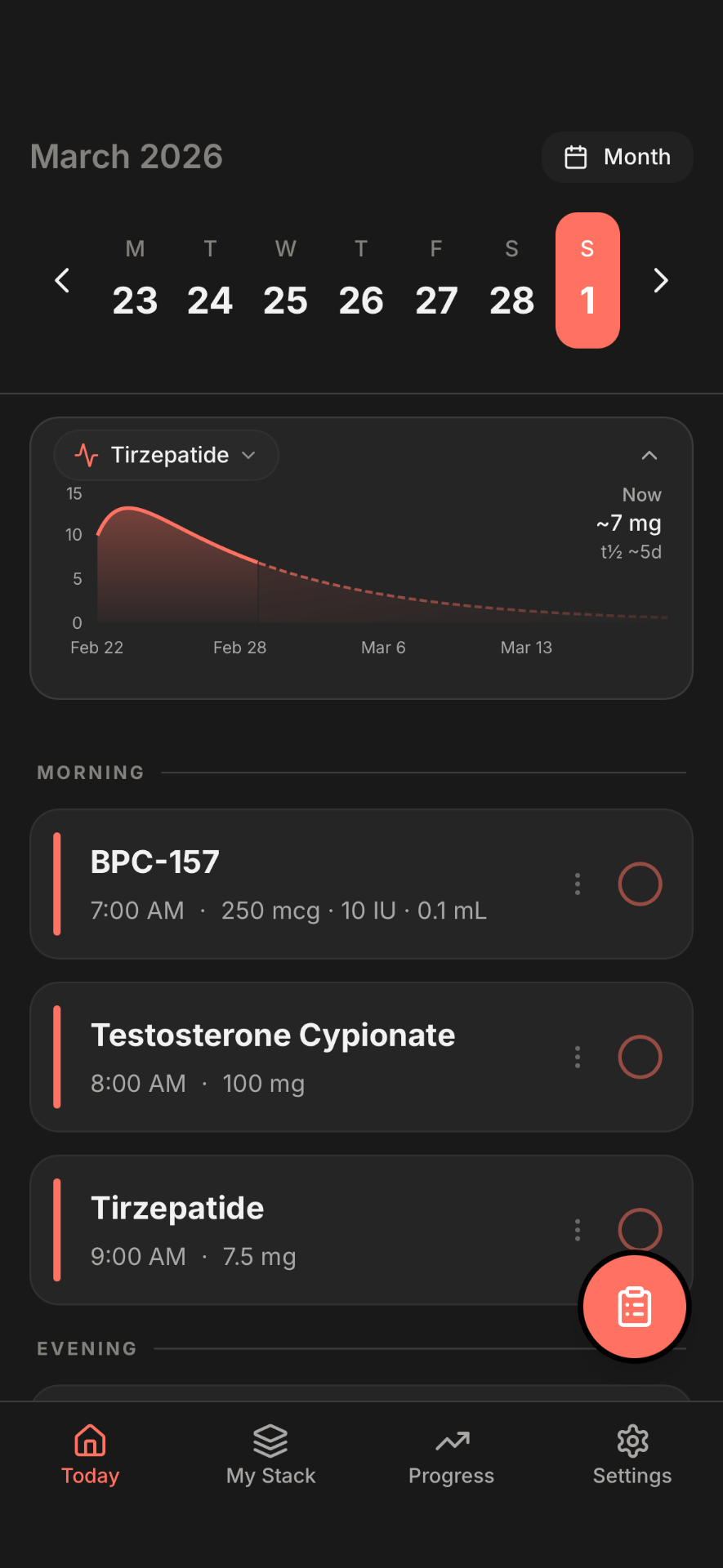
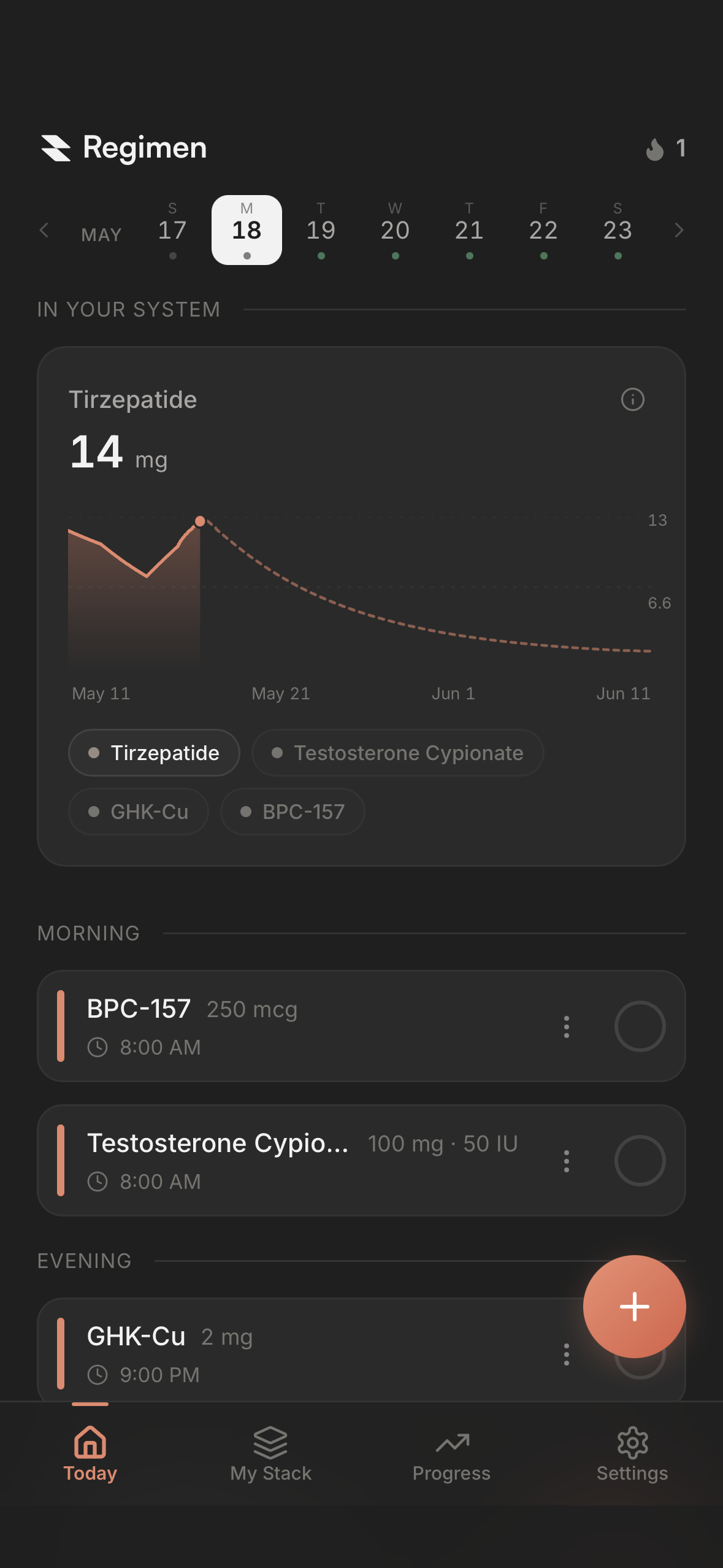
- Medication level curves for every compound