If you’ve been researching peptides for injury recovery, you’ve probably stumbled across the “healing stack” consisting of BPC-157 and TB-500, also called the Wolverine stack. These two peptides are frequently mentioned together in biohacking circles, Reddit threads, and even some forward-thinking sports medicine conversations.
But here’s the thing: most guides either go way too deep into molecular mechanisms (cool for scientists, useless for everyone else) or stay so surface-level they don’t actually help you implement anything.
If your BPC-157 and TB-500 came premixed in a named blend, the GLOW and KLOW calculators show what each draw delivers of every component.
This guide takes a different approach. We’ll cover exactly what you need to know to run this stack effectively: dosing, injection protocols, what to expect week by week, and how to track your progress. No PhD required.
What Are BPC-157 and TB-500?
BPC-157: The “Body Protection Compound”
BPC-157 is a synthetic peptide derived from a protein found in human gastric juice. It’s been studied for its effects on tissue repair, particularly for tendons, ligaments, muscle, and gut lining.
Key characteristics:
- 15 amino acids
- Works locally (near injection site) and systemically
- Often used for tendon injuries, joint issues, and gut healing
- Typically dosed in micrograms (mcg)
TB-500: The “Thymosin Beta-4” Fragment
TB-500 is a synthetic version of a naturally occurring peptide called Thymosin Beta-4. It’s involved in cell migration, blood vessel formation, and reducing inflammation.
Key characteristics:
- 43 amino acids
- Works systemically (whole-body distribution)
- Often used for muscle injuries, cardiovascular support, and general recovery
- Typically dosed in milligrams (mg)
Why Stack Them?
Using BPC-157 and TB-500 together has become popular because they appear to complement each other’s mechanisms:
| Mechanism | BPC-157 | TB-500 |
|---|---|---|
| Angiogenesis (blood vessel formation) | ✓ | ✓✓ |
| Collagen production | ✓✓ | ✓ |
| Anti-inflammatory effects | ✓ | ✓✓ |
| Tendon/ligament repair | ✓✓ | ✓ |
| Muscle tissue repair | ✓ | ✓✓ |
| Gut healing | ✓✓✓ | - |
The theory: BPC-157 excels at localized tissue repair (especially tendons and gut), while TB-500 provides broader systemic anti-inflammatory and regenerative effects. Together, you’re attacking the injury from multiple angles.
Dosing Protocols
Standard Recovery Stack Protocol
This is the most commonly used protocol for general injury recovery:
| Peptide | Dose | Frequency | Duration |
|---|---|---|---|
| BPC-157 | 250-500 mcg | 1-2x daily | 4-8 weeks |
| TB-500 | 2-2.5 mg | 2x weekly for 4-6 weeks, then 1x weekly | 8-16 weeks |
Loading Phase Option
Some users prefer a higher initial loading phase, particularly for acute injuries:
- First 4-6 weeks (Loading): BPC-157 250-500 mcg a day, as one shot or split in two + TB-500 2-2.5 mg 2x weekly (4-5 mg a week)
- After that (Maintenance): BPC-157 at the same dose + TB-500 2-2.5 mg a week
Reconstitution Math
Both peptides need to be reconstituted with bacteriostatic water before use. If math isn’t your thing, use a peptide reconstitution calculator to figure out your exact dosing.
Quick reference:
- BPC-157 (5mg vial) + 2mL BAC water = 250 mcg per 10 units (0.1mL)
- TB-500 (5mg vial) + 2mL BAC water = 2.5 mg per 100 units (1mL)
Reconstitution Reference
BPC-157 (5mg vial, add 2.5mL BAC water = 2mg/mL)
| Target Dose | Volume | Insulin Syringe Units |
|---|---|---|
| 250 mcg | 0.125 mL | 12.5 units |
| 500 mcg | 0.25 mL | 25 units |
TB-500 (5mg vial, add 2mL BAC water = 2.5mg/mL)
| Target Dose | Volume | Notes |
|---|---|---|
| 2.5 mg | 1.0 mL | Standard SubQ |
| 5.0 mg | 2.0 mL | Consider IM at this volume |
Use the peptide reconstitution calculator for your exact volumes. For individual compound details, see the BPC-157 dosage guide and TB-500 dosage guide.
How many units is 500mcg from a 25mg BPC-157 + 25mg TB-500 blend pen?
A 25mg + 25mg blend pen (50mg total peptide) reconstituted with 2mL bacteriostatic water yields 25mcg/unit on a 100-unit insulin syringe.
For 500mcg total dose: 20 units (0.20mL)
This delivers approximately 250mcg BPC-157 and 250mcg TB-500 per injection. Adjust water volume if you want different math:
- 3mL BAC water: 16.7mcg/unit, 30 units = 500mcg
- 1mL BAC water: 50mcg/unit, 10 units = 500mcg
What’s the math for a 5mg + 5mg BPC-157/TB-500 blend?
10mg total blend reconstituted with 2mL BAC water = 5mcg/unit. For a 250mcg combined dose: 50 units. Many users prefer this lower-strength reconstitution for fine-grained dose control.
How do I split a BPC-157 + TB-500 blend into separate doses?
You can’t separate them once blended. The blend pen delivers both peptides in fixed ratio per injection. If you need to dose them independently (different protocols, different durations), buy separate single-peptide vials.
Injection Protocol
Route Options
Both peptides can be administered subcutaneously (under the skin). Some people also use intramuscular injections. For a site-by-site rotation breakdown (including which spots work best for BPC-157 and TB-500), see our peptide injection sites guide.
| Route | BPC-157 | TB-500 |
|---|---|---|
| Subcutaneous (belly fat) | ✓ Common | ✓ Preferred |
| Subcutaneous (near injury) | ✓ Preferred for localized issues | ✓ Optional |
| Intramuscular | ✓ Less common | ✓ Works fine |
Practical Tips
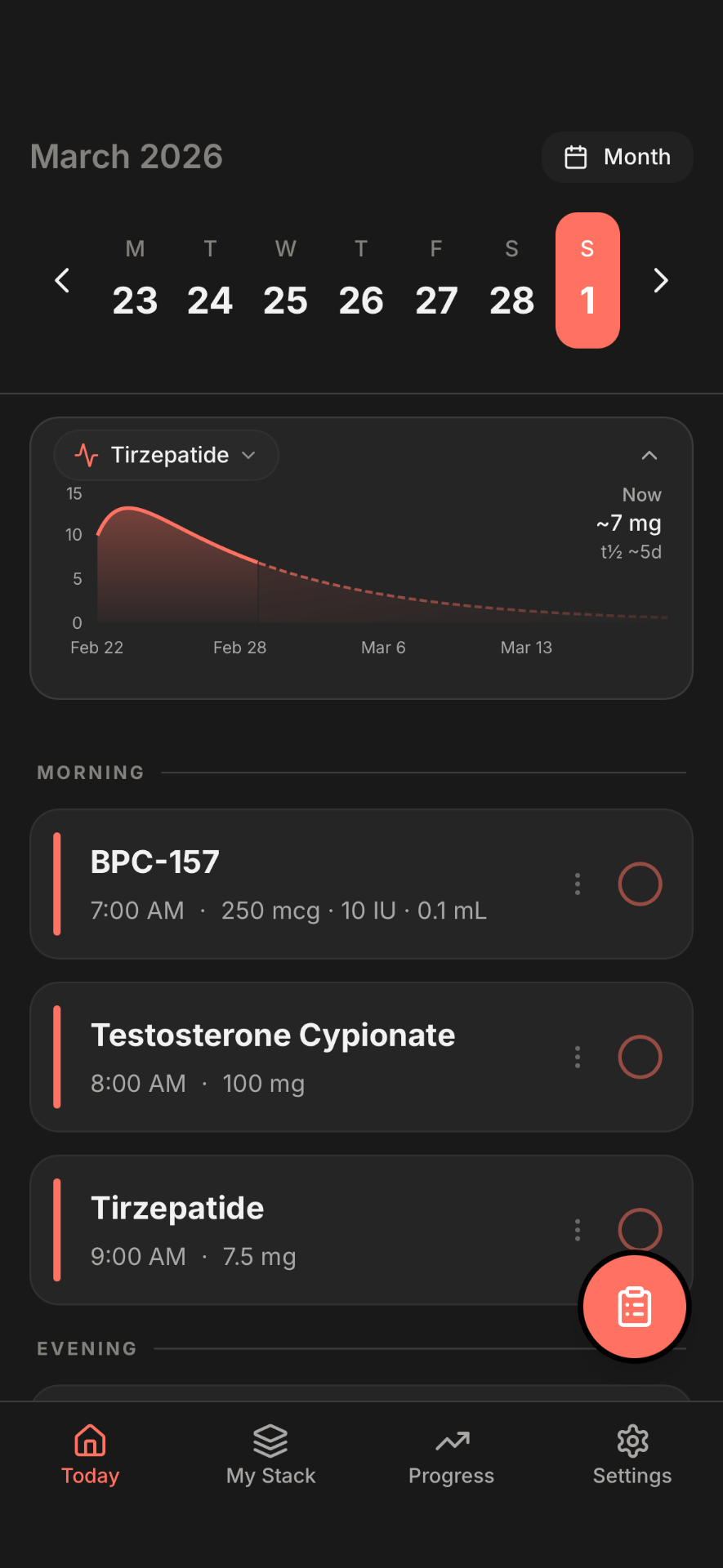
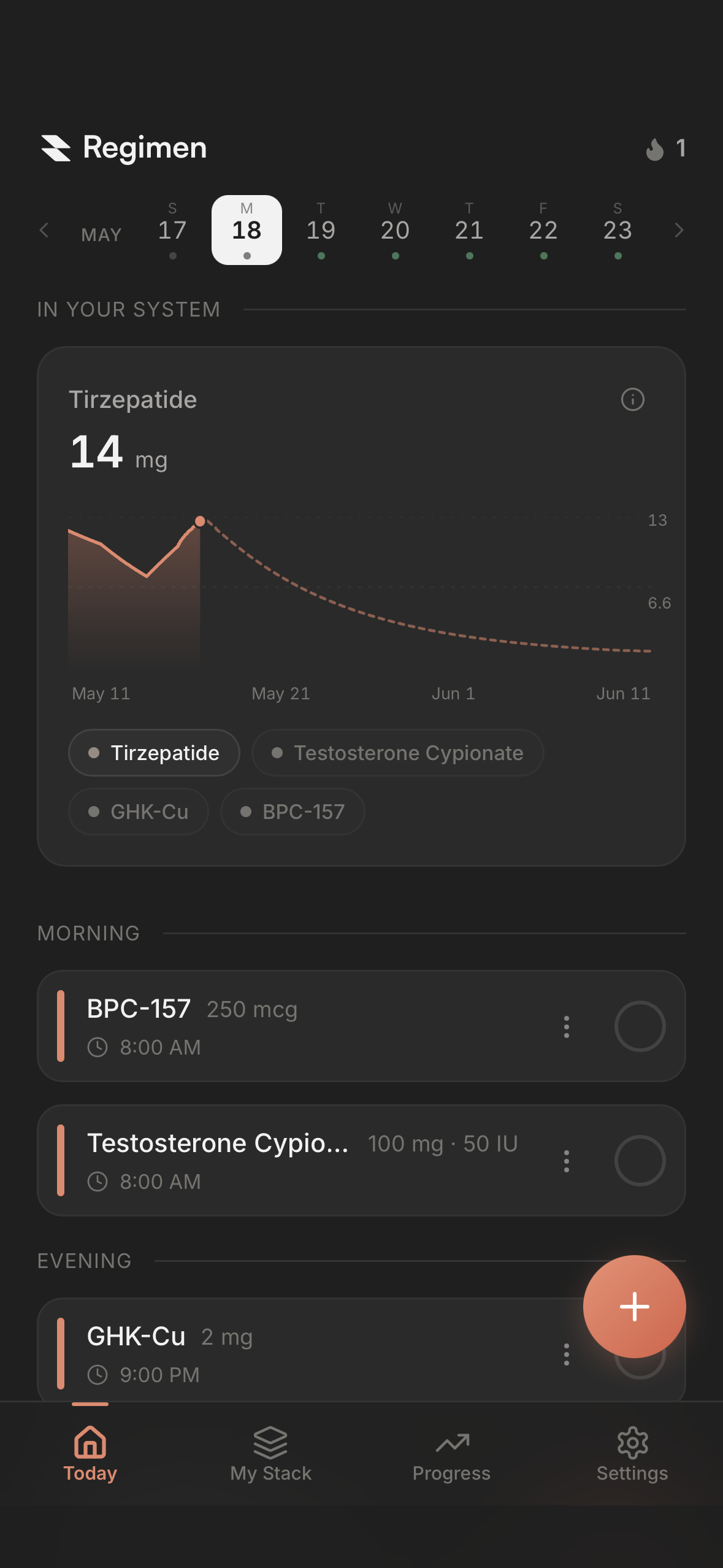
- Timing: BPC-157 is often split into morning and evening doses. TB-500 is typically injected 2x weekly (e.g., Monday/Thursday). An app like Regimen can help you stay on schedule with automatic reminders for each compound.
- Same syringe? Some users combine both peptides in the same syringe for convenience. This is generally considered fine since they’re both peptides dissolved in BAC water.
- Storage: Keep reconstituted peptides refrigerated. Use them within 21 days of reconstitution.
- Injection sites: Rotate between belly fat, love handles, or upper thigh for subcutaneous. For localized injuries, some inject BPC-157 as close to the injury site as practical.
Timeline: What to Expect
Recovery timelines vary significantly based on injury type and severity. Here’s a general framework based on commonly reported experiences:
Week 1-2
- Possible reduction in acute inflammation
- Some report improved sleep quality
- Injury may feel “different” but not necessarily better yet
- Most people don’t notice dramatic changes this early
Week 3-4
- Reduced pain during daily activities
- Increased range of motion for joint injuries
- Beginning of noticeable recovery for soft tissue injuries
- Some start light rehab exercises if cleared by provider
Week 5-8
- Continued improvement in function
- Many feel comfortable returning to modified training
- Chronic injuries may need continued treatment beyond 8 weeks
- Good time to reassess and decide whether to continue or taper
Important: These timelines are generalizations. Chronic or severe injuries typically take longer. Listen to your body and work with qualified practitioners.
Tracking Your Protocol
One of the biggest mistakes people make with peptide protocols is not tracking properly. When you’re running a 6-8 week cycle, it’s easy to forget:
- Which doses you took and when
- How symptoms changed over time
- Whether the protocol is actually working
Here’s what to track:
- Dose and timing: Log every injection with exact amounts
- Pain levels: Use a 1-10 scale daily
- Range of motion: For joint injuries, note specific movements
- Function: Can you do X activity? With how much discomfort?
- Progress photos: For visible injuries (swelling, bruising)
If you’re running this stack, tracking both compounds together matters. See our comparison of the best peptide tracker apps that support multi-compound logging.
Potential Side Effects
Both peptides are generally considered well-tolerated, but some users report:
BPC-157
- Nausea (especially at higher doses or when taken orally)
- Dizziness
- Headache
- Injection site reactions
TB-500
- Temporary lethargy
- Head rush (rare)
- Injection site reactions
Cancer concern: Because TB-500 promotes blood vessel formation, there’s theoretical concern about using it in people with active cancer. If you have a history of cancer, discuss with your oncologist before use.
Sourcing and Quality
After the April 2026 FDA ruling, BPC-157 and TB-500 are off the Category 2 list, but both are still unapproved drugs under FDA review. A few considerations:
- Purity testing: Reputable vendors provide third-party testing (HPLC, mass spec). Ask for certificates of analysis (COA). How to read a peptide COA walks through a report field by field.
- Form: Both peptides come as lyophilized (freeze-dried) powder that you reconstitute yourself.
- Storage: Keep unreconstituted vials in the freezer or refrigerator. Once reconstituted, refrigerate and use within 21 days.
Stacking BPC-157 with Testosterone Cypionate (TRT)
If you’re on testosterone replacement therapy (TRT), you’ve probably dealt with joint pain, tendon issues, or nagging injuries that won’t heal. This is one of the most common reasons TRT users add BPC-157 to their protocol - and it’s a completely different use case than the TB-500 recovery stack above.
Why TRT Users Add BPC-157
Testosterone increases strength and muscle mass, but tendons and ligaments don’t adapt as quickly. This creates a mismatch: you’re lifting heavier, but your connective tissue hasn’t caught up. BPC-157 targets exactly this gap.
- Joint and tendon support: BPC-157 promotes collagen synthesis and tendon healing, helping connective tissue keep pace with muscle growth on TRT
- Injury prevention: Many TRT users run BPC-157 proactively during heavy training blocks, not just after injuries
- Gut health: Some testosterone esters and ancillary medications (like AI) can cause GI issues. BPC-157 has well-documented gut-protective properties
BPC-157 + TRT Dosing Protocol
| Compound | Dose | Frequency | Notes |
|---|---|---|---|
| Testosterone Cypionate | 100-200mg/week | 1-3x weekly | Your prescribed TRT dose |
| BPC-157 | 250-500 mcg | 1-2x daily | SubQ, near injury or abdomen |
Timing Considerations
- Same day injections: You can inject BPC-157 on the same day as testosterone. They use different injection methods (BPC-157 is SubQ with an insulin syringe; testosterone is typically IM or SubQ with a larger gauge)
- Different sites: Don’t inject both compounds into the same spot. If you’re doing your testosterone in the glute or delt, do BPC-157 in the abdomen or near the injury
- Cycle length: Most users run BPC-157 for 4-8 weeks alongside their ongoing TRT. Some run it periodically (e.g., 6 weeks on, 4 weeks off) for joint maintenance
Side Effects When Stacking BPC-157 with Testosterone
BPC-157 doesn’t interact with testosterone at a hormonal level. It’s a peptide that works on tissue repair pathways, not the endocrine system. Reported side effects are the same as running BPC-157 alone:
- Mild nausea (uncommon)
- Injection site reactions
- Occasional headache or dizziness
BPC-157 won’t affect your testosterone levels, estrogen, or hematocrit. It won’t change your TRT bloodwork. The two compounds operate on completely separate mechanisms.
Tracking Both Compounds
Running TRT and BPC-157 simultaneously means managing two different schedules, injection sites, and dose amounts. An app like Regimen lets you track both compounds with separate schedules and reminders, so you never miss a dose or confuse your protocols. You can also use the built-in TRT dose calculator and peptide calculator to dial in your exact injection volumes.
Frequently Asked Questions
Can I take BPC-157 orally instead of injecting?
Yes, some people use oral BPC-157, particularly for gut-related issues. However, bioavailability is likely lower than injection. For systemic effects or specific injuries, injection is generally preferred. If you do use oral, doses are typically higher (500 mcg - 1 mg).
Do I need to cycle off BPC-157 and TB-500?
There’s no established protocol for cycling, but most users run 4-8 week cycles and then take a break. Some run longer for chronic injuries. Listen to your body and don’t become dependent on peptides as a crutch - address underlying issues through proper rehab.
Can I stack BPC-157 and TB-500 with other peptides?
Yes, some users add GH secretagogues (like Ipamorelin or CJC-1295) for additional recovery benefits. Others combine with GHK-Cu for skin/collagen effects. Start with the basic BPC-157 + TB-500 stack before adding complexity.
Will BPC-157 and TB-500 show up on a drug test?
Peptides are banned by WADA and most sports organizations. While detection methods are still evolving, assume they’re detectable if you’re a tested athlete. This stack is best suited for recreational athletes and biohackers, not competitive sports.
How do I know if BPC-157 and TB-500 are working?
Track objective measures: pain scale, range of motion, functional ability. Take progress photos. Compare week 4 to week 1. If you’re not seeing any improvement after 4 weeks, reassess - either the protocol isn’t right for your issue, the product quality is poor, or the injury needs different intervention.
What about using BPC-157 for gut healing specifically?
BPC-157 alone is typically used for gut issues (leaky gut, IBD symptoms, etc.). TB-500 doesn’t have specific gut-healing properties. For gut-focused protocols, BPC-157 at 250-500 mcg daily (oral or injection) is the standard approach. Some combine with L-glutamine and other gut-supportive supplements.
Can I stack BPC-157 with testosterone cypionate on TRT?
Yes. BPC-157 is commonly stacked with testosterone cypionate (TRT) for joint and tendon support. BPC-157 works on tissue repair pathways and doesn’t interfere with testosterone or estrogen levels. A typical protocol is 250-500 mcg of BPC-157 daily alongside your regular TRT injections, run for 4-8 weeks.
What is the common BPC-157 dosage for stacking with TRT?
The standard BPC-157 dosage when stacking with TRT is 250-500 mcg per day, injected subcutaneously. Most users inject once or twice daily for 4-8 weeks. You can inject on the same days as your testosterone, just use a different injection site.
Are there side effects when stacking BPC-157 with testosterone?
BPC-157 doesn’t interact with testosterone at a hormonal level. It won’t affect your testosterone levels, estrogen, hematocrit, or TRT bloodwork. Side effects are the same as BPC-157 alone: occasional mild nausea, injection site reactions, or rare headache. The two compounds operate on completely separate mechanisms.
The Bottom Line
The BPC-157 + TB-500 stack has become popular for good reason. It offers a multi-pronged approach to recovery that many people find effective for stubborn injuries. But it’s not magic.
Key takeaways:
- Follow established dosing protocols
- Give it adequate time (4-8 weeks minimum)
- Track everything so you know if it’s working
- Don’t skip rehab. Peptides support recovery, they don’t replace it
- Source from reputable vendors with third-party testing
Whether you’re dealing with a nagging tendon issue, recovering from surgery, or trying to come back from an acute injury, this stack is worth considering as part of a comprehensive recovery approach.
Related Tools & Trackers
Looking to calculate or track your protocol? These free tools can help:
- Best Peptides for Muscle Building in 2026 - Recovery stacks in the broader muscle-building context
- Body Recomposition with Peptides: 2026 Stack Guide
- Calculate your BPC-157 + TB-500 blend dosage
- Use our peptide reconstitution calculator
- Ozempic Tracker - For GLP-1 weight management protocols
- Mounjaro Tracker - Tirzepatide dosing and progress
- Testosterone Tracker - TRT dose logging and lab correlation
Disclaimer
This content is for informational purposes only and does not constitute medical advice. Peptides are research chemicals and are not approved by the FDA for human use. Always consult with qualified healthcare providers before starting any new protocol. Individual results vary significantly.
Ready to track your protocol?
- Smart reminders so you never miss a dose
- Track weight, photos, and progress over time
- Medication level curves for every compound