You Can Now Get BPC-157, Semax, and 10 More Peptides Through a Doctor
On April 15, 2026, the FDA announced the removal of 12 peptides from its 503A Category 2 list -- the classification that had effectively banned compounding pharmacies from making these substances. The removal took effect on April 22, 2026. If you have been following the peptide compounding saga since 2023, this is a significant reversal.
Here is exactly what happened, what it means for you, and what is still unresolved.
What Is the 503A Category 2 List?
Compounding pharmacies in the US operate under two regulatory frameworks:
- 503A pharmacies compound for individual patients with a prescription
- 503B outsourcing facilities compound in bulk without patient-specific prescriptions
The FDA maintains a "Category 2" list of bulk drug substances with "significant safety concerns" -- substances that 503A pharmacies cannot use without specific FDA authorization. When a peptide lands on this list, compounding pharmacies can no longer legally make it for patients, even with a valid prescription.
Between 2023 and 2025, the FDA added numerous peptides to this list, effectively ending access to many compounds that had been legally available through compounding. The April 2026 ruling reverses that for 12 of them.
Which 12 Peptides Were Removed?
The following peptides were removed from the 503A Category 2 list, effective April 22, 2026:
| Peptide | Primary Use |
|---|---|
| BPC-157 | Healing, gut health, injury recovery |
| TB-500 (Thymosin Beta-4 fragment) | Healing, inflammation, recovery |
| Semax | Cognitive enhancement, neuroprotection |
| Epitalon | Longevity, telomere support |
| MOTs-C | Metabolic health, mitochondrial function |
| KPV | Gut inflammation, wound healing |
| GHK-Cu (injectable) | Healing, skin, anti-inflammatory |
| Melanotan II | Tanning, sexual function |
| DSIP (Emideltide) | Sleep, stress regulation |
| LL-37 | Antimicrobial, immune support |
| DiHexa | Cognitive function |
| PEG-MGF | Muscle repair and growth |
What This Actually Means -- And What It Does Not
What changed:
- Licensed 503A compounding pharmacies can now legally compound these 12 peptides for patients who have a valid prescription
- Patients who lost access to BPC-157, TB-500, Semax, and the others through their compounding pharmacy may now be able to get them again
- This effectively restores the situation to what it was before 2023 for these specific compounds
What did NOT change:
- None of these peptides are FDA-approved drugs. They remain unapproved for any specific indication.
- Prescriptions are still required in most states -- these are not available over the counter
- Quality standards vary by compounding pharmacy -- not all compounders are equal
- 503B outsourcing facilities still cannot compound these without separate authorization
- Research-chemical suppliers (not compounding pharmacies) operate in a different regulatory space entirely
What Comes Next: July 2026 PCAC Meetings
The April removal is not the end of the regulatory process -- it is a pause. The FDA has scheduled Pharmacy Compounding Advisory Committee (PCAC) meetings in July 2026 to formally evaluate whether these peptides should be added to the approved bulk drug substance list:
- July 23, 2026: BPC-157, TB-500, MOTs-C, KPV
- July 24, 2026: DSIP (Emideltide), Epitalon, Semax
The PCAC meetings will determine whether these peptides receive a formal positive recommendation for compounding. A positive recommendation would provide longer-term regulatory stability. A negative recommendation could result in these peptides being re-restricted.
This means July 2026 is the next critical date for the peptide compounding space. We will cover the PCAC meeting outcomes when they happen.
Practical Impact: What to Do Now
If you were on a BPC-157, TB-500, or other restricted peptide protocol that was disrupted:
- Contact your prescribing provider -- they can now write a prescription for a 503A compounding pharmacy
- Use a licensed 503A pharmacy -- not a research chemical supplier. The FDA ruling applies specifically to licensed compounding pharmacies.
- Track your protocol carefully -- if you are restarting after a gap, your baseline has reset. Document your doses, schedule, and health metrics from day one.
Tracking Your Peptide Protocol
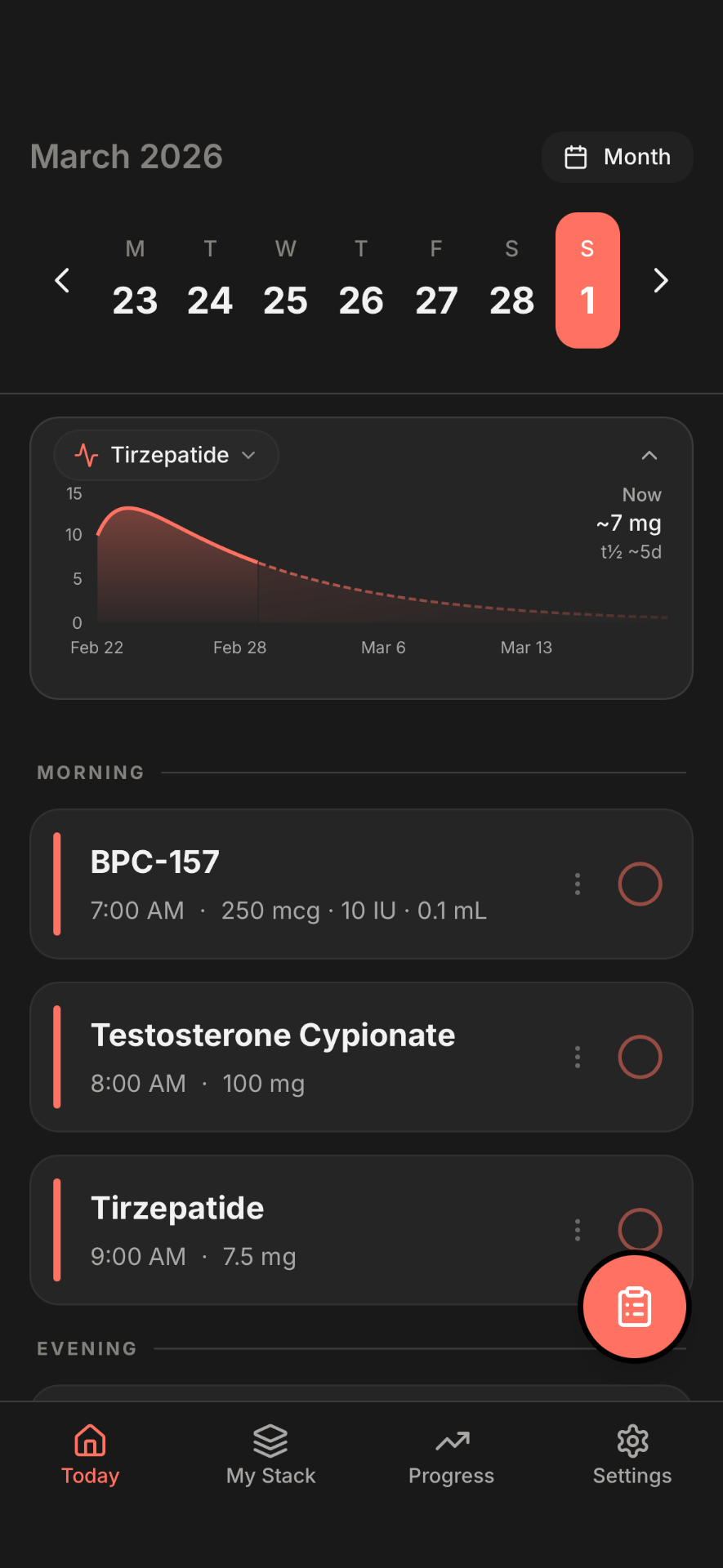
Regimen supports BPC-157, TB-500, Semax, GHK-Cu, and the other newly available peptides -- including reconstitution calculators, half-life visualizers, and health metric correlation against your Apple Health or Google Health Connect data.
If you are restarting a protocol after the compounding gap, this is the right moment to start tracking properly.
- Peptide reconstitution calculator -- calculate your BAC water volume and dose per injection
- Intranasal peptide calculator -- for Semax, Selank, and BPC-157 nasal spray protocols
- Half-life visualizer -- see how your peptide levels change between doses
Frequently Asked Questions
Regimen is a tracking tool, not a medical service. We do not provide medical advice. Always consult your healthcare professional before starting, changing, or stopping any medication protocol.
Ready to track your protocol?
- Smart reminders so you never miss a dose
- Track weight, photos, and progress over time
- Medication level curves for every compound