How Our Pharmacokinetic Models Work
The data, math, and limitations behind Regimen's half-life visualizer and PK curves - and why they help you get more from your protocol.
Why Visualizing Medication Levels Matters
When you inject a compound, your body absorbs and eliminates it over time. The question every protocol user wants answered is: “What are my levels doing between doses?”
Blood work gives you a snapshot - one point in time. Regimen’s PK curves give you the full picture between blood draws. They show you:
- Whether your dosing frequency maintains stable levels or creates peaks and valleys
- When you’re at your highest estimated level (peak) and lowest (trough)
- How changing your injection frequency would change your level stability
- Whether your current schedule reaches steady state
This isn’t a replacement for blood work - it’s a tool that helps you understand your protocol and have better conversations with your healthcare provider.
What the Half-Life Visualizer Shows
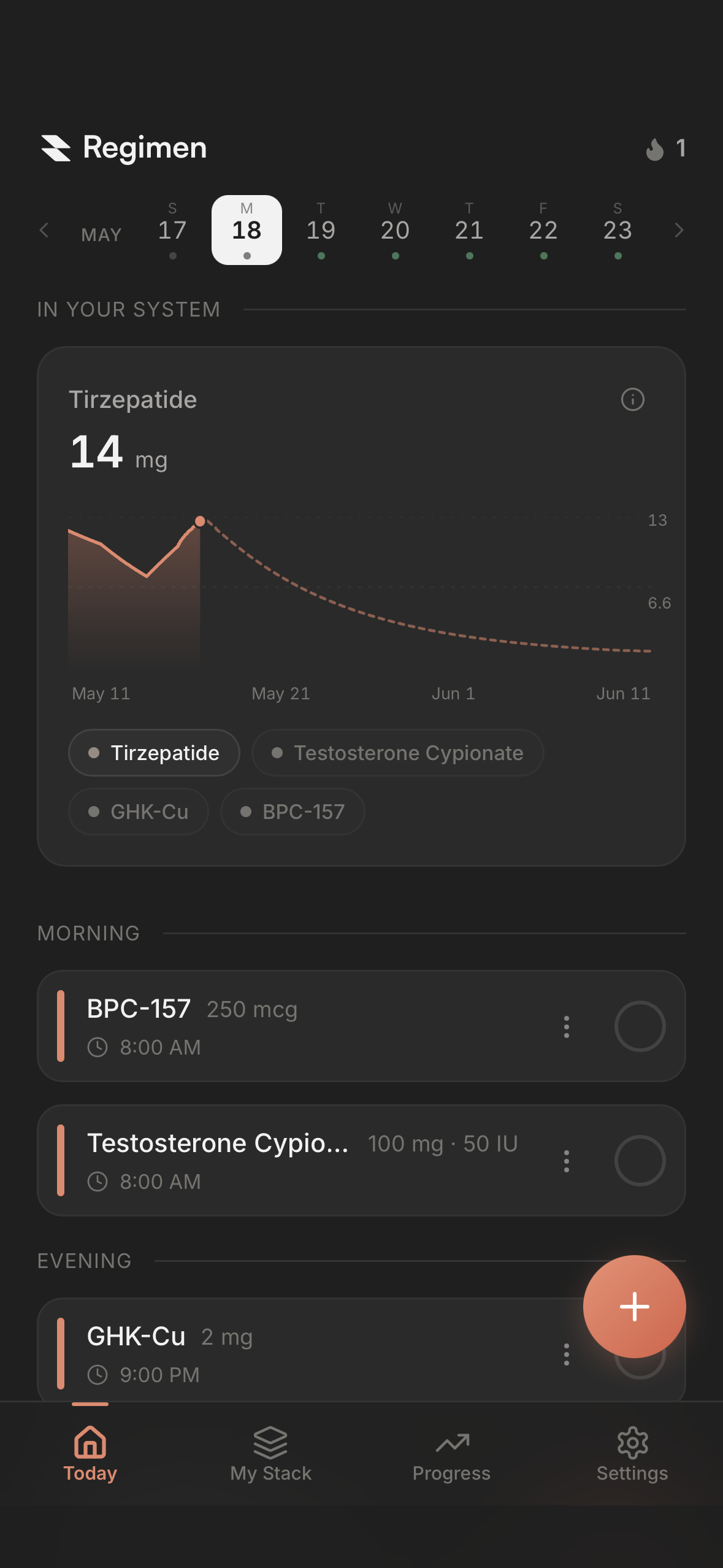
Regimen’s half-life visualizer and in-app PK curves show estimated medication levels over time for injectable compounds.
Estimated peak concentration
when levels are highest after injection
Estimated trough concentration
when levels are lowest before your next dose
Steady-state visualization
how repeated dosing at regular intervals builds to a stable concentration range
Overlapping compound curves
when tracking multiple compounds, see how their profiles interact on the same timeline
The Pharmacokinetic Model
Regimen uses a one-compartment model with first-order absorption (Bateman) - the most widely used pharmacokinetic model for depot (injected) medications, and the one that produces the characteristic rise-to-peak then decay curve you see in the app.
The core equation
C(t) = D × (ka / (ka − ke)) × (e(−ke × t) − e(−ka × t))
C(t) = estimated concentration at time t
D = dose administered
ke = elimination rate constant, derived from half-life: ke = ln(2) / t½
ka = absorption rate constant, derived from the compound’s time-to-peak (tMax)
t = time since administration
For repeated dosing, the model applies superposition - each new dose adds to the remaining concentration from previous doses, converging toward a steady-state range after approximately 4-5 half-lives.
What this means in practice: If you inject testosterone cypionate (half-life ~6.9 days) every 3.5 days, the model shows how each injection builds on residual levels from the previous dose, eventually reaching a stable peak-trough range. This helps you understand WHY splitting your dose into more frequent injections creates more stable levels.
Data Sources
Half-life values used in Regimen’s models come from:
Published clinical pharmacokinetic studies - peer-reviewed research on specific compounds and esters
FDA prescribing information - for approved medications (testosterone cypionate, semaglutide, tirzepatide (tirz), etc.)
Established pharmacology references - standard pharmacokinetic references for well-characterized compounds
For research peptides (BPC-157, TB-500, ipamorelin, etc.), published human PK data is often limited. In these cases, Regimen uses available animal model PK data, established community protocols where clinical data is absent, and conservative estimates when multiple sources disagree. All half-life values are documented in our half-life data reference.
Important Limitations
These are estimates, not blood tests. PK curves show what standard pharmacokinetic models predict for a given dose and schedule. They do not account for:
Individual variation
Metabolism, body composition, injection site, injection technique, and genetics all affect how your body absorbs and eliminates compounds. Two people on the same protocol will have different actual blood levels.
Bioavailability differences
Subcutaneous vs. intramuscular injection, carrier oil formulation, injection depth, and absorption rate all affect actual concentrations.
Multi-compound interactions
The PK model treats each compound independently. It does not model how compounds may influence each other’s effective levels.
Non-linear kinetics
Some compounds at some doses may exhibit saturable metabolism. The one-compartment Bateman model assumes linear (first-order) absorption and elimination.
Compounded medication variability
Compounded medications may vary in potency and formulation quality between sources. PK models assume the labeled dose is accurate.
The PK visualizer is a tracking tool. It helps you understand the general shape of your dosing curves, compare injection frequencies, and visualize steady-state concepts. It is not a diagnostic tool and should not be used to make medical decisions without consulting your healthcare provider.
How We Handle Updates
When we find better PK data, correct an error, or add a new compound:
-
We update the half-life value in our database
-
We document the change in our half-life data reference
-
Existing PK visualizations update automatically with the corrected data
-
We do not backdate or alter historical dose logs - your tracking data stays exactly as you logged it
Contribute or Correct
If you find a half-life value that seems wrong, or if you know of a published PK study we haven’t incorporated, please email us at support@helloregimen.com with the source. We review and update our data regularly.
Frequently Asked Questions
What half-life does Regimen use for testosterone cypionate?
Regimen uses a terminal half-life of about 6.9 days (166 hours) for testosterone cypionate. A study directly modeling testosterone cypionate found a shorter apparent half-life in men with active natural testosterone production, but the same model puts it at 6.9 days once natural production is suppressed - the situation that applies during ongoing TRT (PMC5915615), consistent with independent measured estimates. Enanthate uses the same value; the two esters behave near-identically in practice.
How accurate are Regimen's PK curves?
The curves use standard pharmacokinetic models and published half-life data. They're useful for understanding dosing patterns, comparing injection frequencies, and visualizing steady-state concepts. They are estimates - not substitutes for blood work. Individual variation means your actual levels will differ.
Where does Regimen get its half-life data?
From published clinical studies, FDA prescribing information, and peer-reviewed pharmacology references. For research peptides with limited human data, we use available preclinical studies and note this limitation. All values are documented in our half-life data reference.
Does Regimen's PK model account for individual differences?
No. The model uses population-average pharmacokinetic parameters. It does not adjust for your body weight, metabolic rate, injection technique, or genetics. The curves show what the model predicts for a typical individual at your dose and schedule.
Can I trust the PK curves for research peptides like BPC-157?
Use them directionally, not precisely. For well-studied compounds (testosterone, semaglutide), the models are based on robust clinical data. For research peptides, published human PK data is often limited, so the curves are based on the best available estimates and should be interpreted with more caution.
Why does Regimen show PK curves instead of just logging doses?
Because knowing what your levels are doing between doses is what helps you optimize. A dose log tells you what you took and when. A PK curve tells you what that means for your body - whether your levels are stable, when you're peaking, and whether a different frequency would work better. That's the difference between tracking and understanding.
Get the app
Stop guessing. Start optimizing.
Your protocol deserves better than a notes app and a calendar.


Free to download. Free for your first compound.