Peptides have changed what’s possible with body recomposition. What used to take years of perfect cutting and bulking is now achievable in months for people who combine the right compounds with solid fundamentals. This guide covers which peptides actually help with each part of recomp (appetite control, muscle preservation, metabolic support, recovery) and how to stack them with the basics that make them actually work.
Quick answer
Four categories of peptides accelerate body recomposition: GLP-1s (tirzepatide, semaglutide, retatrutide (reta), CagriSema) for appetite and fat loss, GH-axis peptides (tesamorelin, CJC-1295/ipamorelin) for muscle preservation and recovery, metabolic peptides (MOTS-c, SS-31, 5-Amino-1MQ, Lipo-C) for cellular and energy support, and recovery peptides (BPC-157 + TB-500) to keep tendons healthy under heavy training. The fundamentals (slight calorie deficit, 1g protein per pound, heavy lifting, 7-9 hours sleep) are what make all of these actually work.
Peptides amplify the fundamentals, they don’t replace them
This is the first thing to get straight before any compound goes into your body. Peptides are accelerators, not shortcuts. If you’re not eating enough protein, not lifting heavy, not sleeping enough, no peptide stack will produce the result you want. You’ll spend money, deal with side effects, and get nothing meaningful in return.
When the fundamentals are in place, peptides can do something the fundamentals alone can’t: shift the timeline from years to months. A GLP-1 makes the caloric deficit sustainable instead of grueling. A GH-axis peptide protects the muscle you’d otherwise lose. A recovery peptide keeps your training from breaking down at week six. Each one solves a specific bottleneck that derails most recomp attempts.
The rest of this article is built around that logic. The peptide categories come first because that’s why you’re here. The fundamentals section comes later because you need to know they’re load-bearing, not optional, before you start spending on compounds.
The four peptide categories for body recomposition
There are four broad categories of peptides that show up in body recomposition protocols. Each solves a different problem. The right stack for you depends on which problems you actually have.
For appetite control and fat loss (GLP-1 class)
GLP-1s are the most well-evidenced compounds in the entire body recomposition space. They work by suppressing appetite (quieting what users call “food noise”) and slowing gastric emptying, which makes the caloric deficit you need for fat loss actually achievable. Without something in this category, most lifters can’t sustain a deficit long enough to see real fat loss.
The main options:
- Tirzepatide (sold as Mounjaro for diabetes and Zepbound for weight loss). Hits two appetite receptors at the same time, which is why it tends to outperform semaglutide on the scale. Currently the strongest FDA-approved obesity drug, with around 20% body weight loss over 72 weeks in the SURMOUNT trials. Weekly injection, titrated up over months.
- Semaglutide (Ozempic, Wegovy, Rybelsus). The compound that started the wave. Slightly less potent than tirzepatide but still highly effective. Weekly injection or daily oral.
- Retatrutide. The newest of the group, and the most aggressive. Hits three different appetite and metabolic pathways at once (GLP-1, GIP, and glucagon), which is why the Phase 2 weight loss numbers are the largest in the category. Still investigational and not FDA-approved, but heavily discussed in the peptide community and the most popular gray-market GLP-1 right now.
- Cagrilintide and CagriSema. Cagrilintide works on a different appetite hormone (amylin) than the GLP-1s, and CagriSema is the combination of cagrilintide with semaglutide. The amylin pairing may help with the muscle-preservation side of fat loss, with a side-effect profile that can be gentler than max-dose tirzepatide.
For body recomp specifically, most lifters stay at moderate doses (5mg to 7.5mg tirzepatide rather than the 15mg max) because higher doses suppress appetite so much that hitting protein becomes impossible. The dose where you can still eat enough protein is the right dose.
For muscle preservation and recovery (GH-axis peptides)
These compounds work by amplifying your body’s growth hormone signaling, which helps protect lean mass during a deficit and supports recovery. They don’t build muscle on their own. They make it easier for your training and nutrition to build muscle.
The main options:
- Tesamorelin. Tells your pituitary to release more of your own growth hormone, in the natural pulsing pattern your body already uses. Strong human evidence for reducing visceral fat (the deep abdominal fat around your organs) while preserving lean mass. FDA-approved for HIV-associated lipodystrophy, but the mechanism applies broadly. The most “recomp-specific” peptide in this category because it specifically targets the visceral fat that other tools don’t touch.
- CJC-1295 + ipamorelin. The community-favorite GH-axis stack. CJC and ipamorelin work on two different parts of the GH signaling system, and together they produce larger growth hormone pulses than either alone. The mechanism is real, but the direct recomp trial evidence is thinner than for tesamorelin. Popular because it’s affordable and widely accessible.
- MK-677 (ibutamoren). The only oral option in this category. Raises GH and IGF-1 without injections. Better suited to a lean-gain phase than aggressive fat loss because it also raises appetite (which fights the GLP-1 effect if you’re stacking them).
GH-axis peptides are typically cycled (8 to 16 weeks on, 4 to 8 weeks off) because continuous use can blunt the response and elevate IGF-1 beyond useful ranges.
For metabolic and mitochondrial support
A growing class of compounds works at the cellular level rather than the appetite or hormone level. The evidence here is younger than the GLP-1 or GH-axis categories, but the community traction is real and growing fast.
The main options:
- MOTS-c. A peptide your own mitochondria produce. Acts like an exercise signal in the body, so users typically take it for better metabolic flexibility, fat oxidation, and recovery. Usually dosed two to three times per week rather than daily. Pairs well with GLP-1s because it works on a different mechanism (cellular, not appetite).
- SS-31 (elamipretide). Works directly inside the mitochondria to support energy production and protect against oxidative damage. Recently FDA-approved for Barth syndrome (a rare genetic condition), which has raised awareness of the compound. Users report improved energy and recovery during cuts.
- 5-Amino-1MQ. A small molecule (not technically a peptide) that targets an enzyme involved in fat storage. The pitch is fat loss without appetite suppression, which appeals to people who can’t tolerate GLP-1s or want something that works on a different pathway. Human evidence is still emerging but the early data is encouraging.
- Lipo-C (lipotropic injections). A blend of methionine, inositol, choline, and B12 that supports how your body processes and metabolizes fat. Used in medical weight-loss clinics for decades. Lower evidence floor than the others, but cheap, low-risk, and often included in physician-prescribed weight loss protocols.
This category is where a lot of advanced biohacker stacking happens. The compounds pair well with GLP-1s without the appetite conflicts that come from layering a GH-axis appetite-raiser like MK-677.
For training durability (recovery peptides)
When you cut hard and train heavy at the same time, tendons and joints are usually the first things that break down. These compounds keep you in the gym during the most demanding training blocks.
- BPC-157 + TB-500. The default “recovery stack” most lifters know about. BPC-157 is the more localized one, used near injury sites or for specific tissue repair. TB-500 is the more systemic one, with broader recovery effects across the body. Together they’re the standard insurance against the connective tissue issues that derail recomp protocols. The human clinical evidence is still emerging, but the community use is large and consistent. Typical use is short cycles (4 to 8 weeks) during periods of heavy training or active injury rehab, not continuous.
These aren’t fat loss or muscle building compounds. They’re insurance against the connective tissue issues that derail recomp protocols. If your training is going fine and your joints feel solid, skip them. If you’ve got a barking elbow, shoulder, or knee that’s threatening to take you out of the gym, this is where you go.
Building your stack
The right stack for you depends on which specific problem is the biggest obstacle to your recomp. The decision tree below maps the most common situations to the starting point that makes sense.
Pick your starting point based on your biggest problem
If you can’t sustain a calorie deficit because appetite is overwhelming: start with a GLP-1 (tirzepatide is the safest, best-evidenced choice). This is where most lifters with a gut should begin.
If you’re already on a GLP-1 and losing muscle alongside the fat: add tesamorelin or CJC-1295/ipamorelin to the protocol.
If your problem is specifically stubborn visceral fat (deep belly fat that won’t move with diet alone): tesamorelin solo is the cleanest option.
If you’re feeling flat, low energy, or recovery is suffering during the cut: MOTS-c or SS-31 can help on the metabolic side.
If your training keeps breaking down because of tendon or joint pain: BPC-157 + TB-500 for a 4-to-8 week block.
Smart stacking principles once you start combining compounds:
- Add one compound at a time. If you add three things at once and something feels off, you can’t tell which compound caused it. Layer in, don’t blast in.
- Give each addition at least four weeks before evaluating. Most peptides need that long to show effects above the noise.
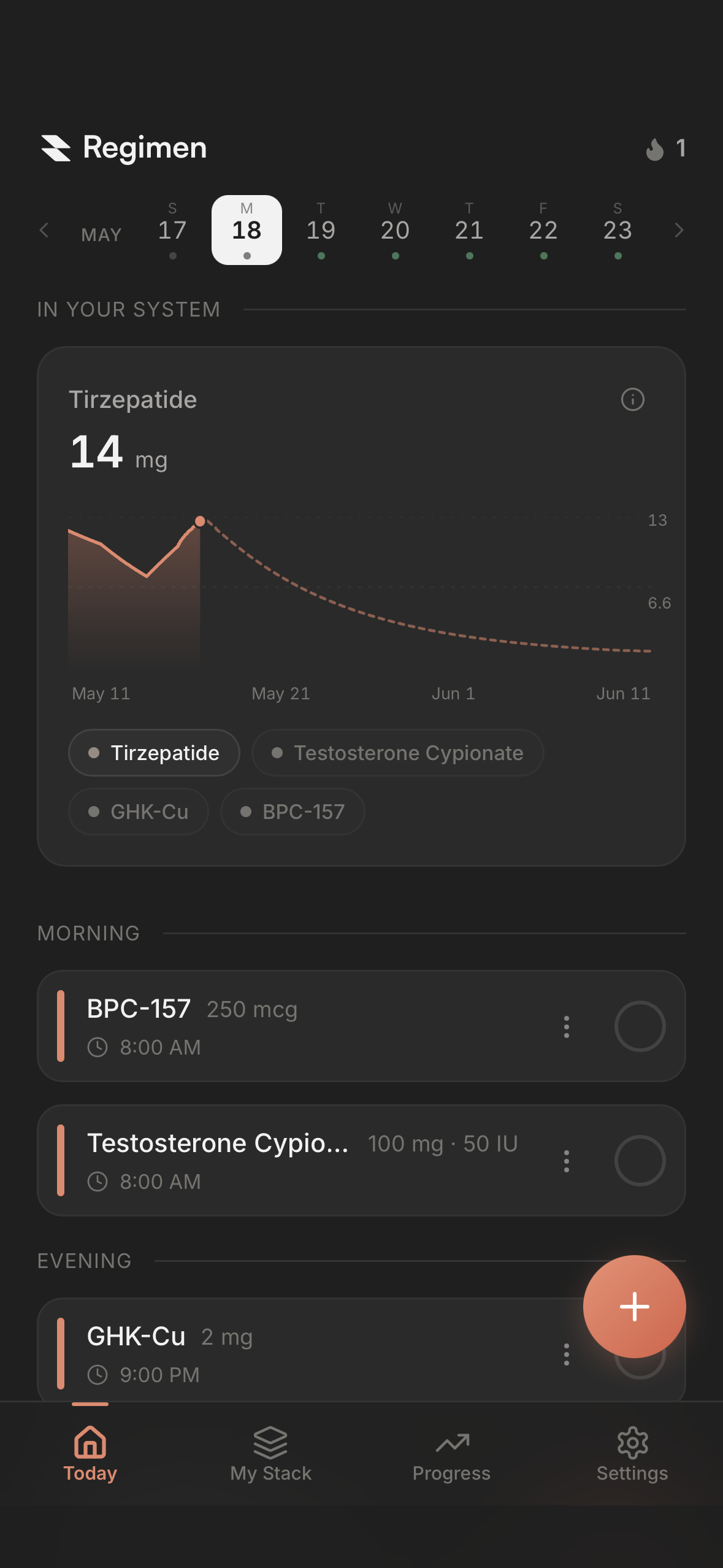
- Track everything. Dose, injection day, weight, lifts, hunger, sleep, side effects. Without the correlation data, you’re guessing.
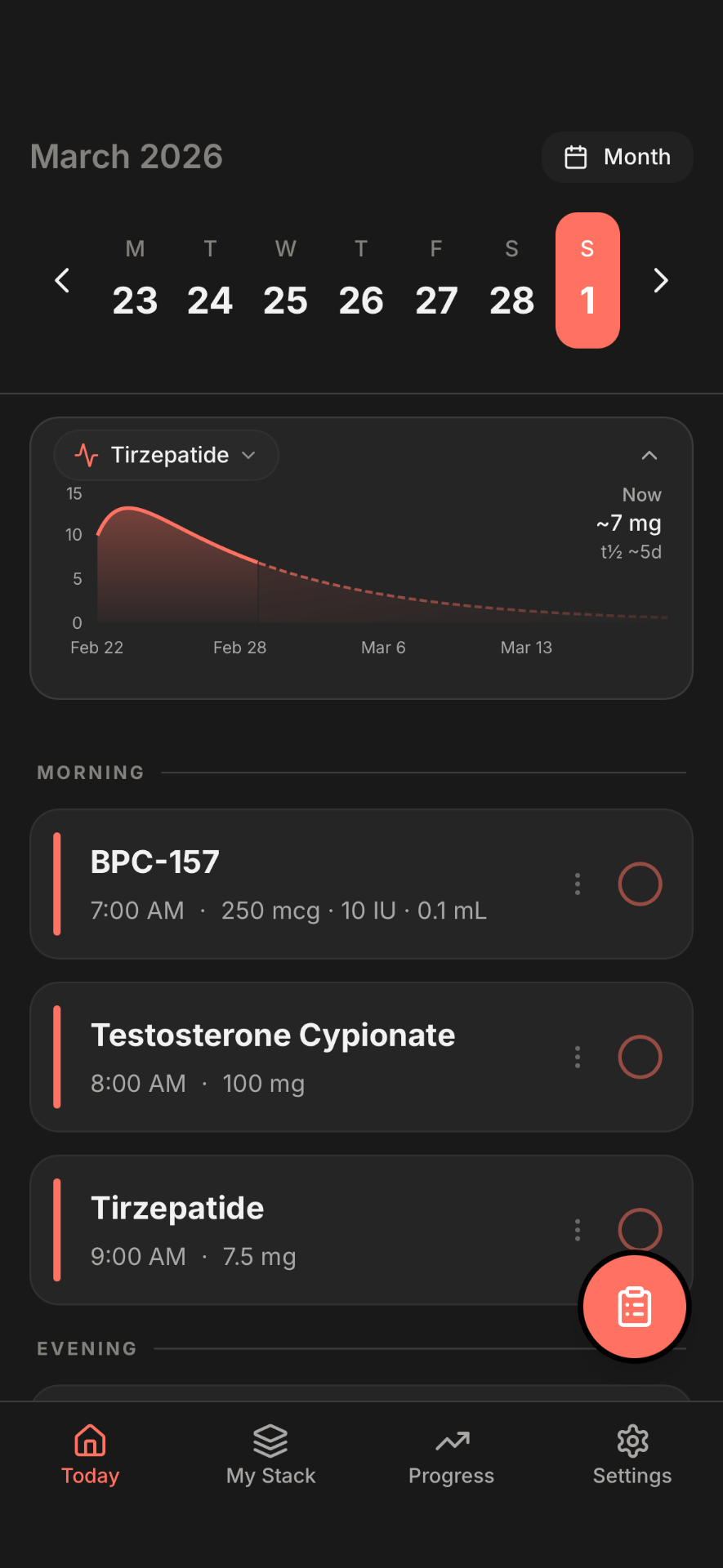
- More compounds is not better. Three or four compounds in a complex stack multiplies management complexity without proportionally multiplying results. The most successful recomp protocols on Regimen run two or three compounds, not six.
The most common multi-compound recomp protocol pairs a GLP-1 (most often retatrutide or tirzepatide) with either testosterone replacement for men with verified low T (covered separately in the TRT microdosing guide) or a GH-axis peptide for muscle preservation.
What we see in Regimen data
Among users running body recomposition protocols, GLP-1 users almost never cycle on/off (under 5% across tirzepatide, semaglutide, and retatrutide), while about 3 in 10 users running GH-axis peptides like tesamorelin or CJC-1295/ipamorelin cycle their protocols. The pattern matches the community consensus: incretin therapy works best held steady; GH-axis compounds benefit from periodic breaks.
The fundamentals that make peptides actually work
This is the part most people want to skip. Don’t.
Peptides amplify what’s already happening in your body. If what’s happening is “not enough protein, inconsistent training, six hours of sleep,” then the peptides amplify… not much. The most expensive stack in the world won’t compensate for fundamentals you’re skipping.
Here are the four that matter, with the specific numbers.
Calories: a small deficit, 100 to 300 below maintenance. Aggressive deficits (1,000+ calories) accelerate fat loss but also accelerate muscle loss and crash training quality. The narrow band of “100 to 300 below maintenance” is where recomp lives. If you don’t know your maintenance, the rough estimate is bodyweight in pounds × 14 to 16 depending on activity. Track for two weeks at that intake and adjust based on what your weight does.
Protein: around 1g per pound of target bodyweight. This is the macronutrient that decides whether the weight you lose is fat or muscle. If you’re 195 and want to be 175, hit 175g of protein every day. On a GLP-1 this becomes the make-or-break variable because appetite suppression makes protein hard to hit. Plan it. Prep it. Hit it. Practical anchors: chicken breast 30g/4oz, lean ground beef 22g/4oz, eggs 6g each, Greek yogurt 17g/cup, whey shake 25g/scoop.
Training: lift heavy, progressively, 3 to 5 times per week. Resistance training is what tells your body to hold onto (or add) muscle during a deficit. Without it, you lose muscle along with the fat. Minimum effective program: three sessions per week covering bench, row or pull-up, squat or leg press, overhead press, hinge (deadlift or RDL). Progressive overload is the principle: working weights should hold or go up over time. If they crash during the cut, your deficit is too big or your protein is too low.
Sleep: 7 to 9 hours. Sleep debt raises cortisol, worsens insulin sensitivity, impairs recovery, and increases hunger. If you’re getting six hours or less, no amount of training or protein or peptides will fully compensate. Fix sleep before you spend a dollar on compounds. It’s the cheapest and highest-impact intervention in the entire body recomposition equation.
Get these four right and your peptides will deliver what they’re capable of delivering. Skip them and you’re paying for accelerators on a car that isn’t running.
How to know if it’s actually working
The scale is the worst metric for body recomposition. It lumps fat, muscle, water, glycogen, and gut content into one number that lies on a daily basis. During a real recomp, the scale can stay flat for weeks while your body quietly changes underneath.
What to track instead:
- Weekly weight averaged. Weigh daily, but track the seven-day average. The daily number is noise.
- Waist measurement. At the navel, relaxed, same time of day. If the scale is flat and the waist is shrinking, you’re recomping.
- Lift numbers. Top working set on the major lifts. If they’re holding or going up during a deficit, your training is preserving muscle.
- Progress photos. Every two to four weeks, same lighting, relaxed. Your brain filters out gradual changes. Photos don’t.
- How clothes fit. Underrated. Belt holes, shirt across the shoulders, jeans through the thigh. Pure body composition data.
- Bloodwork. Every 8 to 12 weeks if you’re on any compound. Lipid panel, fasting glucose, HbA1c. Add IGF-1 if you’re on a GH-axis peptide.
If two or more of those are moving in the right direction, the protocol is working even when the scale is being annoying. That’s the recomp signature: scale lies, the other metrics tell the truth.
For the full tracking protocol, see How to Track Body Recomposition: 5 Metrics Better Than Scale Weight.
Common mistakes that kill body recomp protocols
The same failure modes show up over and over. Most of them are about behavior, not the compounds themselves.
Mistake 1: Pushing the GLP-1 dose too high. The temptation is to titrate to the max. The cost is that at higher doses, eating enough protein becomes genuinely hard, and lean mass loss accelerates. Hold the dose where you can still hit your protein target. For most lifters that’s 5mg to 7.5mg tirzepatide, not 15mg.
Mistake 2: Stacking everything immediately. Running a GLP-1, tesamorelin, CJC/ipamorelin, BPC-157, and TB-500 all at once on your first protocol is how you end up unable to tell what’s doing what. Layer in. Run the GLP-1 plus training and protein for two to three months before adding anything else.
Mistake 3: Skipping protein because the GLP-1 killed your appetite. The single most common cause of “I lost weight but I look worse” outcomes. The fix is not willpower. It’s structure: protein at every meal, shakes when you need them, and tracking it loosely for the first 8 to 12 weeks until it becomes a habit.
Mistake 4: Treating BPC-157 and TB-500 as fat burners. They’re not. They’re training-continuity compounds. Running them solo and expecting recomp results is the most common misuse of this category.
Mistake 5: No resistance training during the cut. If your cardio went up and your lifting went down when you started a GLP-1, you’re doing weight loss, not recomp. Protect the lifting volume. Cardio is optional. Lifting isn’t.
Mistake 6: Quitting at week four. Body recomp is slow. The scale can stay flat for weeks while waist shrinks and lifts go up. Quitting because the scale stopped moving means quitting on the protocol that was actually working.
Mistake 7: Treating peptides as the primary intervention. If your training is inconsistent and your sleep is six hours, no peptide is going to fix your body composition. The fundamentals are the intervention. The peptides are the amplifier.
Frequently Asked Questions
What is the best peptide for body recomposition?
There is no single best peptide because body recomp involves multiple goals (lose fat, preserve muscle, support recovery). For most people, the highest-impact peptide is a GLP-1 like tirzepatide because it makes the caloric deficit sustainable. For people specifically targeting visceral fat with muscle preservation, tesamorelin has the strongest evidence. For people whose limiter is recovery during heavy training, BPC-157 plus TB-500. The right peptide depends on which part of the equation you need the most help with.
Should I take peptides while I am on a GLP-1?
Depends on what is happening with your protocol. If your goal is just fat loss and it is working, the GLP-1 alone may be enough. If you want to preserve or build muscle while losing fat, a GH-axis peptide like tesamorelin or CJC-1295/ipamorelin can help on the muscle side. If you are training hard and your tendons are barking, BPC-157 plus TB-500 can keep you in the gym.
Is BPC-157 plus TB-500 worth adding during a cut?
Only if you are training hard enough that your connective tissue is actually under stress. They are not fat loss compounds. They are training-continuity compounds. If your tendons and joints are fine, skip them. If your training is being limited by elbow, shoulder, or knee pain, run them for a 4 to 8 week block.
What’s the best peptide for body recomposition?
There’s no single best peptide because body recomp involves multiple goals (lose fat, preserve muscle, support recovery). For most people, the highest-impact peptide is a GLP-1 like tirzepatide because it makes the caloric deficit sustainable. For people specifically targeting visceral fat with muscle preservation, tesamorelin has the strongest evidence. For people whose limiter is recovery during heavy training, BPC-157 + TB-500. The right peptide depends on which part of the equation you need the most help with.
Can I take a GLP-1 without losing muscle?
Yes, but it takes deliberate work. Hit protein every day (around 1g per pound of target bodyweight), keep resistance training at high intensity (don’t drop the working weights), and titrate the GLP-1 slowly so appetite suppression doesn’t make protein impossible. Without those three behaviors, GLP-1 users lose roughly a third of their total weight as muscle.
Should I take peptides while I’m on a GLP-1?
Depends on what’s happening with your protocol. If your goal is just fat loss and it’s working, the GLP-1 alone may be enough. If you want to preserve or build muscle while losing fat, a GH-axis peptide like tesamorelin or CJC-1295/ipamorelin can help on the muscle side. If you’re training hard and your tendons are barking, BPC-157 + TB-500 can keep you in the gym.
Is BPC-157 + TB-500 worth adding during a cut?
Only if you’re training hard enough that your connective tissue is actually under stress. They’re not fat loss compounds. They’re training-continuity compounds. If your tendons and joints are fine, skip them. If your training is being limited by elbow, shoulder, or knee pain, run them for a 4 to 8 week block.
How long does body recomposition take?
Months, not weeks. Expect to hold a protocol for at least three months before evaluating, and 6 to 12 months for significant transformation. The scale will move slowly. The mirror, the waist measurement, and your lifts will move first. The reason most people quit on protocols that were working is impatience with the scale.
Do I need to be on TRT to do body recomposition?
No. TRT helps men with verified low testosterone (confirmed by bloodwork plus symptoms) and does protect muscle during a deficit. But it’s not required. If you’re not actually hypogonadal, don’t start TRT for recomp. The risk-to-reward math doesn’t work for guys with healthy natural testosterone. See the TRT microdosing guide for the TRT-specific conversation.
How do I know if the peptides are actually working?
Track everything: dose, injection day, weight (weekly average), waist measurement, lift numbers, hunger and appetite suppression rating, sleep, side effects. The correlation you’re looking for is dose changes lining up with body composition changes over weeks, not days. If you’re four to six weeks into a peptide and nothing has shifted on any of those metrics, either the dose is wrong, the fundamentals aren’t in place, or the compound isn’t doing what you hoped.
Can women use the same peptides for body recomp?
Mostly yes, with adjustments. The default female recomp protocol uses the same GLP-1 backbone (semaglutide or tirzepatide) with more conservative titration, harder emphasis on protein and resistance training, and more caution on GH-axis stacking because women are more sensitive to water retention and IGF-1 elevation. Tesamorelin is occasionally used but the visceral-fat angle skews male. TRT is generally not relevant for female recomp outside specific clinical situations.
Why are GH-axis peptides cycled but GLP-1s are taken continuously?
GLP-1s and TRT are run continuously because they work by maintaining a steady level in your system. GH-axis peptides (tesamorelin, CJC-1295/ipamorelin) and recovery peptides (BPC-157, TB-500) are typically cycled (8 to 16 weeks on, 4 to 8 weeks off) because continuous use can blunt the response or elevate IGF-1 beyond useful ranges. The simple rule: hormone replacement compounds hold steady, hormone modulators cycle.
Should I take creatine alongside peptides?
Yes. Creatine monohydrate, 3 to 5g per day, indefinitely. It’s the most well-evidenced supplement in the entire fitness space for supporting strength and lean mass. Cheap, safe, works. Not a peptide and not a substitute for the fundamentals, but it belongs in every recomp protocol.
Related reading
- How to Track Body Recomposition: 5 Metrics Better Than Scale Weight
- Retatrutide and Body Recomposition: What the Clinical Trials Actually Show
- Retatrutide Side Effects Guide
- TRT Microdosing Guide
- Tesamorelin Results Timeline
- Tesamorelin Guide: The GHRH Analog for Visceral Fat
- CJC-1295 + Ipamorelin Guide
- BPC-157 Guide: Injectable Protocol, Evidence, Sourcing
- TB-500 Guide: What It Is, How It Works, How People Use It
- MOTS-c Guide: Mitochondrial Peptide, Evidence, Protocols
- NAD+ Injection Guide: At-Home Subcutaneous Protocol
- TB-500 Reconstitution and Dosing Guide
- Multi-Compound Protocol Tracking Guide
This article is for educational purposes only. It is not medical advice, a prescription, or a recommendation to use any compound. Several compounds discussed (retatrutide, BPC-157, TB-500, MOTS-c, 5-Amino-1MQ) are not FDA-approved and the FDA has issued warning letters to vendors selling some of them as unapproved drugs. Always consult a qualified healthcare provider before starting, stopping, or changing any medication or health protocol.
Ready to track your protocol?
- Smart reminders so you never miss a dose
- Track weight, photos, and progress over time
- Medication level curves for every compound