←Part of TRT, Explained: The Complete Guide
You’re injecting once a week and riding the testosterone roller coaster. Energy spike on day 2, crash by day 5, irritable by day 6. The people around you can tell what day you injected based on your mood alone. Your doctor says your levels are “fine” because they only see a single snapshot. But you live in the peaks and valleys every single day.
That’s why a growing number of men on TRT are switching to daily or every-other-day (EOD) injections. Same weekly dose, spread out across more frequent, smaller injections. The result: stable blood levels, fewer side effects, and for most men who try it, a protocol they never want to go back from.
This isn’t another clinic overview. This guide has the real community data from r/Testosterone and r/trt, the practical tips that make daily injections actually sustainable, what to expect during the transition (including the part where you actually feel worse before you feel better), and how to talk to your doctor about switching. Plus how to manage 7+ injections per week without losing your mind.
In this article:
- Can You Microdose Testosterone?
- What Is Microdosing TRT?
- Benefits of Daily TRT Microdosing
- Microdosing TRT Dosage Chart
- How to Switch from Weekly to Daily Injections
- Why People Switch (The Real Reasons)
- Common Microdosing TRT Protocols
- How to Split 200mg/Week Into Daily Doses
- What People Actually Report
- Practical Tips That Make Daily TRT Sustainable
- HCG and Ancillary Compounds
- What the Research Shows
- The Tracking Challenge
- FAQs
Can You Microdose Testosterone?
Microdosing TRT in brief
Take your weekly dose and divide by 7 for daily, or by 3.5 for EOD. A person on 100mg/week injects approximately 14mg/day or 29mg every other day. Use insulin syringes (28-31 gauge, 0.5 inch) subcutaneously. Blood levels stabilize within 2-4 weeks.
Yes. Microdosing testosterone means injecting smaller doses daily or every other day instead of one large weekly injection. Many TRT clinics now recommend this approach for more stable blood levels. The total weekly dose stays the same — you are splitting it into more frequent, smaller injections using subcutaneous technique with insulin syringes.
Daily SubQ injections are now standard at some private TRT clinics. Smaller, more frequent doses produce more stable free testosterone levels with less estrogen conversion - which is why a lot of men on daily protocols end up reducing or dropping their AI entirely.
If you are new to injections entirely, start with our SubQ injection technique guide before diving into protocols. If you are switching from weekly injections, the TRT dose calculator will convert your weekly dose to exact daily injection volumes.
What Is Microdosing TRT?
Microdosing TRT means taking your full weekly testosterone dose and spreading it across daily or every-other-day injections instead of one larger shot. Your total weekly milligrams stay the same. What changes is the curve - flatter testosterone levels, lower estrogen spikes, less hematocrit creep. Same dose, better distribution.
If your prescriber has you at 140mg of testosterone cypionate per week, a daily microdosing protocol would be 20mg per day. An EOD protocol would be 40mg every other day. The total is the same. The distribution is what changes.
Key distinction
Microdosing TRT = more frequent injections of your prescribed dose, NOT less medication. You’re not reducing your total weekly testosterone. You’re spreading it out for more stable blood levels.
Microdosing TRT Dosage Chart
This table shows the exact daily, EOD, and twice-weekly doses for common TRT prescriptions, plus the volume you would draw using 200mg/mL testosterone cypionate:
| Weekly Dose | Daily Dose | EOD Dose | Twice Weekly | Volume at 200mg/mL (daily) |
|---|---|---|---|---|
| 100 mg | 14.3 mg | 28.6 mg | 50 mg | 0.07 mL (7 units) |
| 120 mg | 17.1 mg | 34.3 mg | 60 mg | 0.09 mL (9 units) |
| 140 mg | 20 mg | 40 mg | 70 mg | 0.10 mL (10 units) |
| 150 mg | 21.4 mg | 42.9 mg | 75 mg | 0.11 mL (11 units) |
| 175 mg | 25 mg | 50 mg | 87.5 mg | 0.13 mL (13 units) |
| 200 mg | 28.6 mg | 57.1 mg | 100 mg | 0.14 mL (14 units) |
Using a different concentration? Use our TRT dose calculator to get exact syringe units for 100mg/mL, 250mg/mL, or any custom concentration.
Benefits of Daily TRT Microdosing
- 1.Stable blood levels. Less peak-to-trough variation means fewer energy crashes, mood swings, and the “day before injection” slump.
- 2.Reduced estrogen conversion. Lower peak testosterone levels mean less aromatization to estradiol. Many men reduce or eliminate their AI.
- 3.Smaller needles. Daily microdosing uses insulin syringes (29-31 gauge) for subcutaneous injections. Painless compared to 23-gauge IM needles.
- 4.Less injection site soreness. Smaller volumes (0.07-0.14 mL daily vs 0.5-1.0 mL weekly) cause less post-injection pain and oil lumps.
- 5.Better hematocrit management. More stable levels may reduce hematocrit elevation. See our hematocrit management guide for details.
Daily, EOD, and twice-weekly conversions
This table shows the exact daily, EOD, and twice-weekly doses for common TRT prescriptions, plus the volume you would draw using 200mg/mL testosterone cypionate:
| Weekly Dose | Daily Dose | EOD Dose | Twice Weekly | Volume at 200mg/mL (daily) |
|---|---|---|---|---|
| 100 mg | 14.3 mg | 28.6 mg | 50 mg | 0.07 mL (7 units) |
| 120 mg | 17.1 mg | 34.3 mg | 60 mg | 0.09 mL (9 units) |
| 140 mg | 20 mg | 40 mg | 70 mg | 0.10 mL (10 units) |
| 150 mg | 21.4 mg | 42.9 mg | 75 mg | 0.11 mL (11 units) |
| 175 mg | 25 mg | 50 mg | 87.5 mg | 0.13 mL (13 units) |
| 200 mg | 28.6 mg | 57.1 mg | 100 mg | 0.14 mL (14 units) |
Using a different concentration? Use our TRT dose calculator to get exact syringe units for 100mg/mL, 250mg/mL, or any custom concentration.
Cypionate vs Enanthate for Daily SubQ
For traditional IM injections once or twice weekly, cypionate and enanthate are interchangeable. For daily subcutaneous microdosing, enanthate has a practical edge: its oil base has lower viscosity, which means it draws more easily into insulin syringes. You will notice the difference particularly in cold weather or with smaller syringe gauges.
Both have effectively the same apparent serum half-life (about 6.9 days based on measured PK data) and identical dosing math. Older references quote cypionate around 8 days, but the two esters behave near-identically in practice (full comparison here). The choice usually comes down to what your prescribing physician or compounding pharmacy uses. If you have a choice and you are doing daily subQ, ask for enanthate. If you are stuck with cypionate and getting resistance drawing through a 29-31 gauge insulin needle, warm the vial between your palms for 30-60 seconds before drawing.
Lab Schedule for Microdosing Protocols
| Phase | Timing | What to Check |
|---|---|---|
| Starting microdosing | Baseline before first injection | Total T, free T, SHBG, E2, hematocrit, PSA |
| Adjustment phase | Every 6-8 weeks | Total T, free T, E2, hematocrit |
| Stable phase | Every 6 months | Full panel (same as baseline) |
| If symptoms change | Within 2 weeks | Total T, free T, E2 minimum |
Target total T range on a microdosing protocol: 600-900 ng/dL for most men. Free T target: 15-25 pg/mL. If you are dialing in hematocrit, aim to keep it under 52%. Daily protocols typically produce the lowest hematocrit response of any injectable schedule.
How to Switch from Weekly to Daily Injections
The switch is straightforward math: same weekly dose divided by 7.
Step by step:
- Take your total weekly dose (e.g., 150mg/week)
- Divide by 7: 150 / 7 = 21.4mg per day
- Use the TRT dose calculator to convert 21.4mg to syringe units at your concentration
- At 200mg/mL: 21.4mg = 0.107 mL = ~11 units on a 100-unit insulin syringe
- Switch to SubQ with a 29-31 gauge insulin syringe. See our SubQ injection technique guide
What to expect in the first 2-3 weeks after switching: Some men feel slightly off during the transition as their body adjusts to different peak/trough patterns. Estradiol may fluctuate. This typically resolves by week 3-4. Get bloodwork at 6-8 weeks post-switch to confirm your levels.
For a detailed comparison of all TRT injection schedule options (weekly, twice weekly, EOD, daily), see our full schedule guide. For first-time injectors, read what to expect with your first TRT injection.
Why People Switch to Daily or EOD TRT
The clinical case for more frequent injections comes down to pharmacokinetics. Testosterone cypionate has an apparent serum half-life of about 6.9 days. With a single weekly injection, you get a significant peak in the first few days and a trough by day 6-7. That’s the roller coaster.
But the real reasons men switch aren’t on the pharmacokinetic chart. They’re in the lived experience.
The day 5-6 crash
This is the #1 complaint on every TRT forum. By day 5 or 6 after your weekly injection, your testosterone levels have dropped significantly from their peak. What does this feel like? Brain fog that shows up mid-afternoon. Irritability that comes out of nowhere. Libido that was sky-high on day 2 is now nonexistent. Fatigue that lifts magically after your next injection day. You’re not imagining it. Your body is responding to a 30-40% swing in hormone levels within a single week.
The libido roller coaster
This is the one men rarely bring up with their doctor but always bring up on Reddit. Libido peaks on days 2-3 (when testosterone is highest), plateaus briefly, then falls off a cliff by day 6. Daily dosing flattens this curve. Consistent levels = consistent libido. It’s not just about the peaks - it’s about eliminating the valleys.
”People around me can tell what day I injected”
This comes up constantly in TRT communities. Partners notice the mood swings before the patient does. Day 2-3: high energy, upbeat, high sex drive. Day 6: short-tempered, withdrawn, low motivation. Daily dosing eliminates this pattern. Mood stability matters for relationships, not just lab values.
Stable blood levels. Smaller, more frequent doses create less peak-to-trough variation. Your testosterone level on Monday is nearly identical to Friday.
Reduced estrogen conversion. Lower peaks mean less aromatization. Many men reduce or eliminate their aromatase inhibitor (AI) after switching to daily. Less peak = less estrogen = potentially no AI needed.
Subcutaneous injections are painless. Daily TRT typically uses insulin needles (29-31 gauge) injected into belly or thigh fat. Most people describe it as less painful than checking blood sugar. The switch from a 23g IM needle to a 29g subQ needle is life-changing.
Reduced hematocrit elevation. Some studies suggest more frequent dosing leads to less red blood cell stimulation, reducing the elevated hematocrit that forces some men to donate blood regularly.
Testosterone Blood Levels: Weekly vs Daily Injections
Same total weekly dose (140 mg), modeled with testosterone cypionate’s 6.9-day half-life
Weekly 140 mg (single injection)Daily 20 mg (microdosing)
Testosterone blood levels over 28 days: weekly vs daily injection schedules
| Day | Weekly injection (% of peak) | Daily injection (% of peak) |
|---|---|---|
| 0 | 0 | 0 |
| 1 | 48.3 | 6.9 |
| 2 | 47 | 13.6 |
| 3 | 43.3 | 19.8 |
| 4 | 39.7 | 25.5 |
| 5 | 36.4 | 30.7 |
| 6 | 33.4 | 35.4 |
| 7 | 30.6 | 39.8 |
| 8 | 76.4 | 43.8 |
| 9 | 72.7 | 47.5 |
| 10 | 66.9 | 50.9 |
| 11 | 61.3 | 53.9 |
| 12 | 56.2 | 56.8 |
| 13 | 51.6 | 59.4 |
| 14 | 47.3 | 61.8 |
| 15 | 91.7 | 63.9 |
| 16 | 86.8 | 65.9 |
| 17 | 79.7 | 67.8 |
| 18 | 73.1 | 69.5 |
| 19 | 67 | 71 |
| 20 | 61.5 | 72.4 |
| 21 | 56.4 | 73.7 |
| 22 | 100 | 74.9 |
| 23 | 94.4 | 76 |
| 24 | 86.7 | 77 |
| 25 | 79.5 | 77.9 |
| 26 | 72.9 | 78.8 |
| 27 | 66.9 | 79.6 |
| 28 | 61.3 | 80.3 |
Shown: first 28 days starting from baseline. Steady state is typically reached around weeks 5–6.
Same total weekly dose - 140 mg. The daily protocol (slate) eliminates the peak-and-crash cycle seen with weekly injections (coral). Modeled using testosterone cypionate’s ~6.9-day half-life. Calculate your own dose with the TRT Dose Calculator.
Common Microdosing TRT Protocols
All protocols below assume testosterone cypionate or enanthate. Your prescriber sets the weekly total based on your bloodwork. You choose the frequency.
| Protocol | Weekly Total | Per Injection | Injection Type | Notes |
|---|---|---|---|---|
| Daily (7x/wk) | 100-200mg | 14-29mg | SubQ | Most stable levels |
| EOD (3.5x/wk) | 100-200mg | 29-57mg | SubQ or IM | Good compromise |
| 3x/week | 100-200mg | 33-67mg | SubQ or IM | Popular mid-ground |
| 2x/week | 100-200mg | 50-100mg | IM or SubQ | Standard split |
Want to see the difference in blood level stability between these protocols? Use the Half-Life Visualizer to compare daily vs. weekly injection curves for testosterone cypionate.
How to Split 200mg/Week Into Daily Doses (Insulin Syringe Units)
The quick version: divide your weekly mg by 7 to get the daily dose, divide that by your vial concentration to get mL, and multiply by 100 to get insulin-syringe units. On 200mg/week, that’s about 28.6mg/day, which is roughly 14 units at 200mg/mL or 11 units at 250mg/mL. Round to the nearest unit and let the weekly total average out.
For the full step-by-step syringe math, a dosing table covering 100-200mg/week at common concentrations, and the rounding rules for daily injectors, see the dedicated daily TRT insulin syringe dose guide. Or skip the math entirely with the TRT dose calculator, which outputs mL and units for any weekly dose, concentration, and frequency.
What People Actually Report
Here’s what the TRT communities on Reddit (r/Testosterone, r/trt), Discord, and various forums consistently say about switching to daily or EOD. This is anecdotal, not clinical data, but it represents thousands of real-world data points from men who’ve made the switch.
On switching from weekly to daily:
“The most common reaction on r/Testosterone is some version of ‘why didn’t I do this sooner.’ Men report the first 2-3 weeks feel weird - your body is adjusting to the new steady state. But by week 6-8, the difference is dramatic. The most frequent comment: ‘I feel the same every day now.’ That sounds boring until you’ve lived with the roller coaster.”
On dropping the AI:
“A recurring theme: men who needed anastrozole on weekly injections find they can eliminate it entirely on daily. Less peak = less aromatization. The math checks out pharmacokinetically. But don’t just stop your AI cold turkey - taper gradually and get bloodwork at 6-8 weeks to confirm your estradiol is in range. Crashing your estrogen feels worse than high estrogen.”
On subQ vs IM:
“The subQ converts are vocal. Common feedback: ‘I can’t believe I was doing IM for two years when this exists.’ The switch from a 23-gauge 1.5-inch IM needle to a 29-gauge 1/2-inch insulin needle is dramatic. But some men report subQ lumps, especially in leaner injection sites. Rotating between belly and upper thigh seems to minimize this. If you’re very lean (under 12% body fat), delts may work better.”
On the adjustment period:
“This is what nobody warns you about. Weeks 2-4 can feel worse before they feel better. Your body built a rhythm around weekly peaks and troughs. Daily dosing eliminates those swings, but your system needs time to recalibrate. Some men report temporary acne, mood changes, or fatigue during the transition. Most people who quit daily TRT do so during this window - too early to judge. Give it a full 8 weeks before deciding.”
Practical Tips That Make Daily TRT Sustainable
The difference between “I tried daily TRT and hated it” and “this changed my life” usually comes down to logistics, not pharmacology. Here’s what experienced daily injectors recommend:
Use 29g 1/2” insulin syringes.
They’re roughly $15 for 100 on Amazon. No prescription needed in most states. The 1/2-inch length is perfect for subQ into belly or thigh fat. If you’re drawing from a vial, 29g draws testosterone cypionate without issue - it just takes 15-20 seconds. Some people prefer 27g for faster draws.
Rotate between at least 4 sites.
Left belly, right belly, left thigh, right thigh. Some people add delts for a 6-site rotation. With daily injections, site rotation matters more than with weekly - you’re hitting the same areas every week. Track your sites to avoid repeating too frequently.
Draw your dose the night before.
Leave the syringe capped on your nightstand. The oil warms to room temp overnight and injects smoother and faster in the morning. Many daily injectors prep 3-4 syringes at once on Sunday to streamline the week. Just label them if you’re running multiple compounds.
Don’t change two variables at once.
If you’re switching from weekly to daily, keep your total weekly dose the same. Don’t simultaneously change your dose, drop your AI, and switch to subQ. Isolate the variable. Switch frequency first, get bloodwork at 6-8 weeks, then consider adjusting dose or AI.
Make it part of your morning routine.
The men who succeed with daily TRT long-term treat it like brushing their teeth. Same time every day, same spot in the routine. The injection itself takes 30 seconds. The hardest part is remembering - which is where a tracker comes in.
HCG and Ancillary Compounds
Here’s where microdosing TRT gets genuinely complex. Many protocols include HCG (human chorionic gonadotropin) for fertility preservation and testicular function. HCG is typically injected 2-3 times per week on its own schedule.
Some men also add DHEA, pregnenolone, or an aromatase inhibitor. The math adds up fast:
A typical multi-compound week:
- 7x testosterone (daily subQ)
- 3x HCG (Mon / Wed / Fri)
- = 10 injections per week, two different compounds, different doses, different syringe calculations
This is where a spreadsheet or memory stops being viable. Each compound has its own concentration, its own dose in mg, and its own conversion to syringe units. Miss one, double one, or confuse the two, and your protocol data is compromised.
What the Clinical Data Shows
The pharmacokinetic case for frequent dosing is straightforward. Testosterone cypionate’s ~6.9-day half-life means weekly injections create a saw-tooth pattern in blood levels. Smaller, more frequent doses flatten this curve.
A 2017 study in the Journal of Clinical Endocrinology & Metabolism (Spratt et al.) found that subcutaneous testosterone injections produced serum testosterone levels equivalent to intramuscular injections, validating the subQ approach that makes daily dosing practical. The data on injection frequency and estradiol consistently points the same direction: more frequent dosing reduces peak estrogen levels, which aligns with the widespread community report of reduced AI need.
The anecdotal evidence is remarkably consistent: across TRT forums, Reddit communities, and clinic reports, the pattern repeats. Most men who switch from weekly to daily or EOD injections report improved mood stability, more consistent energy, and reduced side effects. Very few switch back.
The Tracking Challenge
With weekly TRT, tracking is simple: one injection, one log entry, one reminder. Switch to daily, and the complexity multiplies:
- 7+ injection logs per week minimum (14+ with HCG)
- Injection site rotation matters more with daily injections. You’re cycling through belly, thighs, and delts every week. Using the same spot repeatedly causes scar tissue.
- Multiple syringe calculations. Testosterone at 200mg/mL needs different unit math than HCG at 5000 IU/mL.
- Correlating how you feel with your protocol becomes the most valuable data. With stable levels, symptoms become clearer signals.
- Bloodwork timing is actually easier since there’s no dramatic trough. You can draw labs almost any time.
7 injections a week is a lot to manage manually
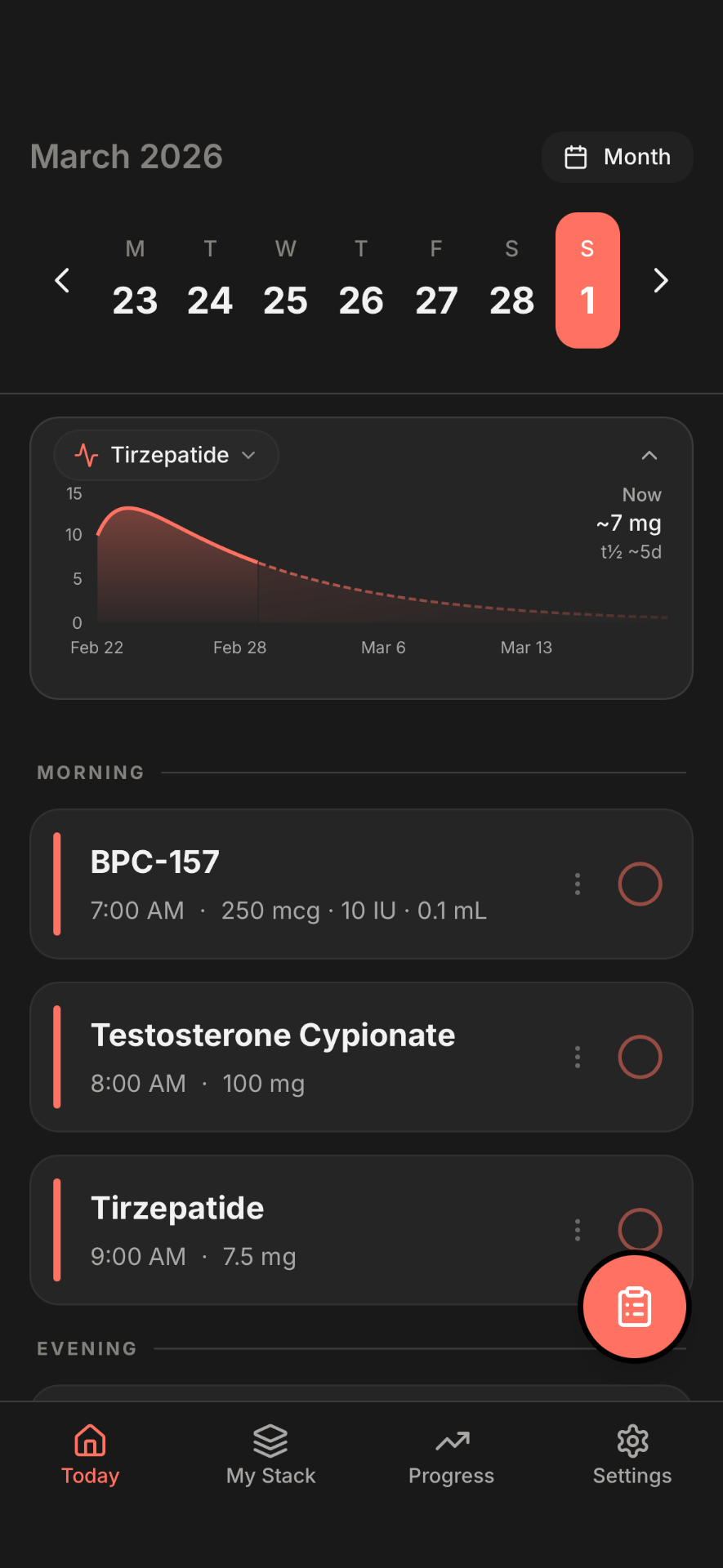
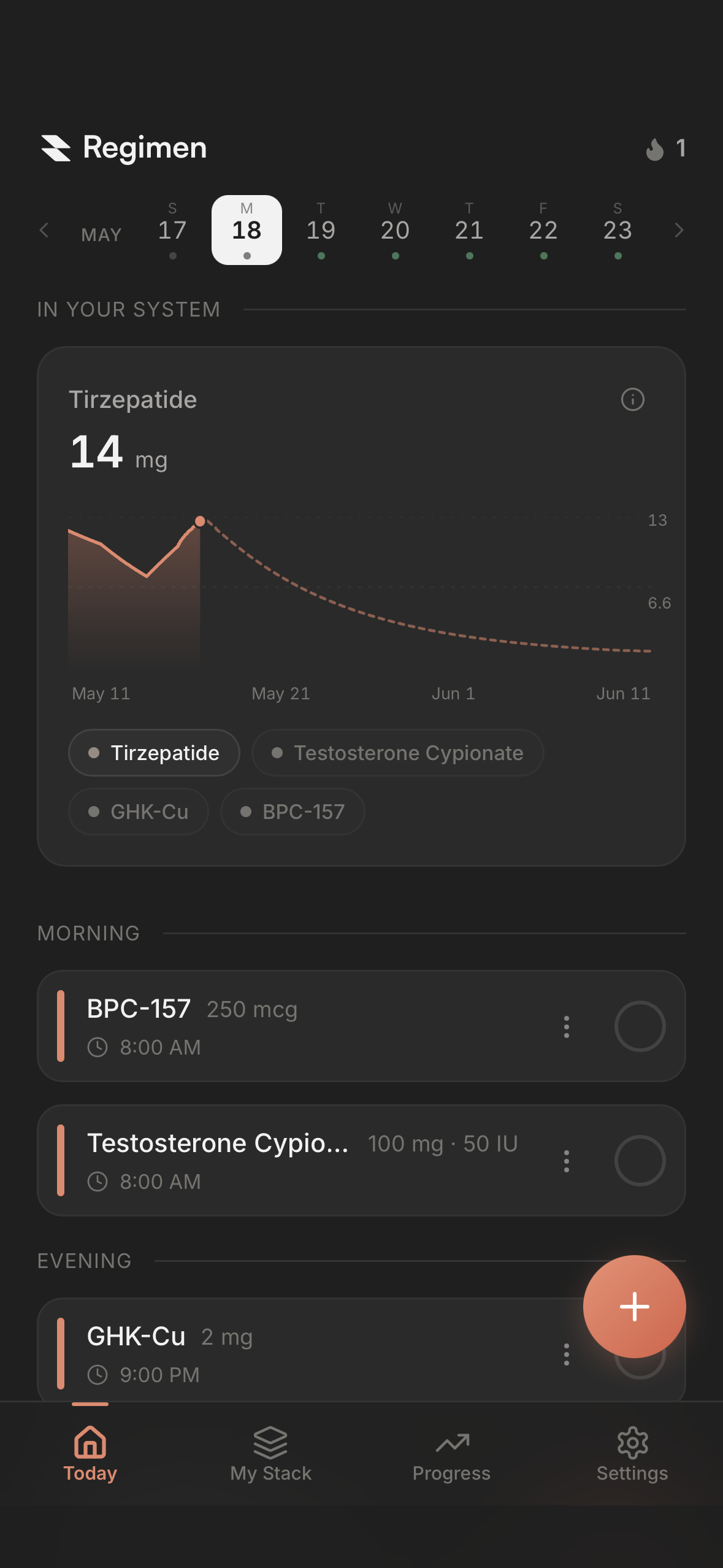
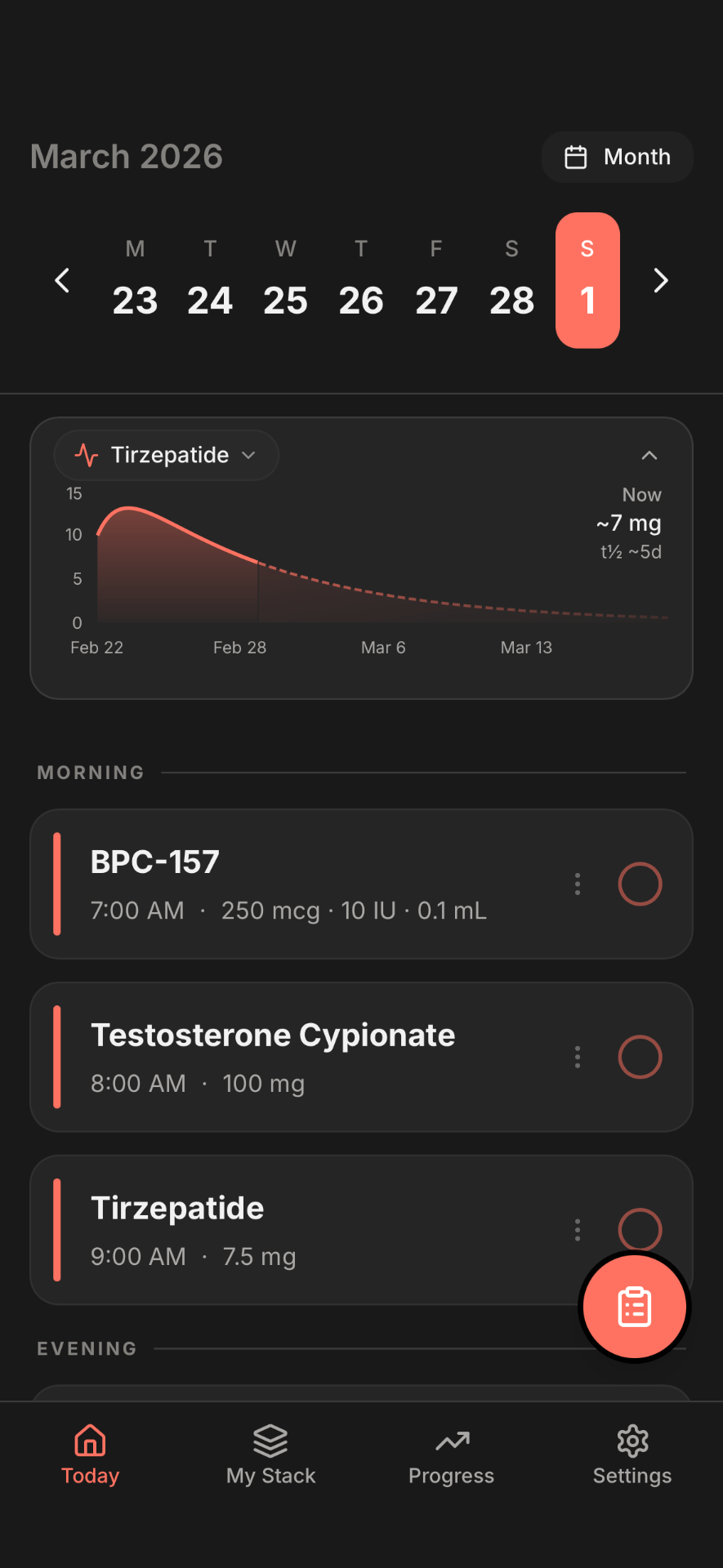
Set your daily or EOD schedule once. Regimen handles reminders, injection site rotation, syringe calculations, and tracks your multi-compound protocol automatically.
- Set your weekly target and frequency - Regimen calculates each injection automatically
- Built-in daily, EOD, or custom schedule with adjustable timing
- Automatic syringe unit calculations for any testosterone concentration
- Multi-compound tracking (testosterone + HCG + ancillaries in one place)
How to Talk to Your Doctor About This
Many TRT patients want to switch to daily or EOD but their prescriber only does weekly IM. This is a real barrier. Here’s how to approach it:
Come with data, not Reddit posts.
Reference the Spratt 2017 subcutaneous-absorption study in the Journal of Clinical Endocrinology & Metabolism, and any pharmacokinetic data on injection frequency. Doctors respond to published research, not forum anecdotes.
Ask for the same total weekly dose.
You’re not asking for more testosterone. You’re asking for more frequent administration of the same amount. Frame it as “I’d like to try splitting my 140mg weekly dose into 20mg daily injections to see if it improves my symptom stability.”
Offer to prove it with bloodwork.
Tell your doctor you’ll get labs at 6-8 weeks on the new protocol to verify levels are maintained. This shows you’re serious and data-driven, not just chasing a trend.
Mention practical benefits your doctor cares about.
Reduced hematocrit elevation, lower estradiol without AI, and better patient compliance (because you feel better) are arguments that resonate with prescribers. Lead with clinical outcomes, not how you feel on day 6.
Know your options if they say no.
Some doctors simply don’t prescribe this way. If yours won’t budge, telemedicine TRT clinics tend to be more flexible with injection frequency since they specialize in optimization, not just “normal range.” The prescription itself doesn’t change - you’re just altering how you administer it.
Risks and Considerations
Microdosing TRT isn’t for everyone. Consider these before switching:
- More injections = more injection site management. Rotate consistently to avoid scar tissue. Track your sites.
- SubQ technique matters. Injecting too shallowly can cause lumps. Proper needle depth and slow injection help. If you’re getting persistent lumps, try a slightly longer needle or a different site.
- Not all doctors support daily protocols. Some prescribers are unfamiliar with subQ TRT or daily dosing. See the section above on how to approach the conversation.
- Insurance may only cover standard dosing. More frequent injections mean more syringes and potentially more vials per month. Budget accordingly.
- The adjustment period is real. Weeks 2-4 can feel off. It takes 6-8 weeks to reach a new steady state after changing injection frequency. Don’t judge the protocol too early.
- It’s more to manage. Daily injections require more discipline than weekly. If you’re someone who already forgets your weekly shot, daily may not be the right move without a solid tracking system.
Important
Always discuss protocol changes with your prescriber. This article is educational, not medical advice. Your prescriber knows your labs, your history, and your individual response.
The Shift to Daily Dosing - What We See in Regimen Data
About 90% of Regimen users on testosterone inject more than once a week, and about 20% inject daily. Daily injection is the microdosing approach this guide covers, so it is a common choice, not an experiment on the fringe. See all Regimen data.
Related Resources
Body recomposition with peptides
The 2026 stack guide for combining TRT, GLP-1s, and GH-axis peptides
Best peptides for muscle building
GH-axis and recovery compounds that pair well with TRT
Calculate your daily microdose
Convert your mg dose to exact syringe units for any concentration
See how daily dosing smooths your blood levels
Compare blood level curves between daily and weekly injections
TRT injection schedule options
Weekly vs twice weekly vs EOD vs daily compared
Step-by-step guide to subcutaneous injections
What to expect with your first injection
Testosterone cypionate dosage guide
Standard TRT doses, beginner charts, and dose-to-mL math
TRT and mental health: depression, anxiety, brain fog
Why stable levels from daily microdosing tend to feel better than weekly peaks and troughs
Frequently Asked Questions
Can you microdose testosterone?
Yes. Microdosing TRT means injecting smaller doses daily or every other day instead of one large weekly injection. Many TRT clinics now recommend this approach for more stable blood levels.
How much testosterone should I inject daily for microdosing?
Divide your total weekly dose by 7. For example, if you’re prescribed 150mg per week, your daily microdose is approximately 21.4mg, which is about 0.11mL using 200mg/mL testosterone cypionate.
Is microdosing TRT better than weekly injections?
For many men, yes. Daily microdosing produces more stable testosterone and free testosterone levels, which can reduce side effects like estrogen spikes, mood swings, and elevated hematocrit.
Is daily testosterone better than weekly?
For many men, yes. Daily or EOD injections produce more stable blood levels, which can reduce side effects like mood swings, energy crashes, and elevated estrogen. The trade-off is more frequent injections, but subcutaneous injections with insulin needles are quick and nearly painless. Most men who switch to daily protocols report they never go back to weekly.
Can I inject testosterone subcutaneously?
Yes. Subcutaneous (subQ) testosterone injections are widely used in microdosing TRT protocols. You use a short insulin needle (29-31 gauge) and inject into belly fat or thigh fat. Studies show comparable absorption to intramuscular injections.
How do I calculate daily TRT dose from weekly?
Divide your weekly dose by the number of injections. For example, 140mg/week becomes 20mg/day (7 injections) or 40mg every other day (3.5 injections average). Then convert mg to syringe units based on your testosterone concentration (typically 200mg/mL). Regimen calculates this automatically for any concentration and schedule.
Do I still need an AI (aromatase inhibitor) with daily injections?
Many men find they can reduce or eliminate their AI on daily protocols because smaller doses create lower peak testosterone levels, which means less conversion to estrogen. However, this is individual. Get bloodwork 6-8 weeks after switching and let your estradiol levels (sensitive assay) guide the decision with your prescriber.
How do I track daily TRT injections?
With daily or EOD injections, you’re logging 7-14+ injections per week (including HCG if applicable). You need injection site rotation tracking, dose logging, and reminders for each compound on its own schedule. Regimen handles multi-compound daily scheduling, automatic syringe unit calculations, and injection site rotation automatically.
Can I microdose testosterone with an auto-injector pen?
Some compounding pharmacies offer testosterone in auto-injector pens, but most microdosing TRT is done with standard vials and insulin syringes. Vials give you the flexibility to dial in exact doses. Auto-injectors deliver pre-set amounts that may not match your specific daily dose requirement.
Is testosterone enanthate or cypionate better for daily microdosing?
Both have effectively the same half-life and dosing math. For daily subcutaneous injection, enanthate has slightly lower oil viscosity and draws more easily through insulin syringe needles. The pharmacological effect is the same. If you have a choice, enanthate is the practical preference for daily subQ protocols.
How long until blood levels stabilize on daily TRT microdosing?
Most men reach stable testosterone levels within 2-4 weeks of starting a daily protocol. Because daily injections front-load consistently, you reach steady state faster than with weekly injections. Run labs 6-8 weeks after starting to confirm your levels and adjust dose if needed.
Microdosing Sustanon (UK)
Sustanon 250 is the most commonly prescribed TRT formulation in the UK. It contains four testosterone esters with different half-lives (propionate, phenylpropionate, isocaproate, and decanoate), creating a complex release profile. Daily microdosing of Sustanon is popular in UK TRT communities because it smooths out the multiple peaks and troughs that the blend creates.
At 250mg/mL, daily microdosing of Sustanon requires very small volumes. For a 125mg/week protocol: 125 / 7 = ~17.9mg/day = 0.07mL per injection. This is well within insulin syringe accuracy range. Use the TRT dose calculator to get your exact volume.
Related Calculators
Calculate your microdose with our TRT dose calculator
Convert any weekly dose to daily injection volumes
Use our split dose calculator for daily protocols
Divide your weekly dose into any frequency
Disclaimer: This article is for educational purposes only and does not constitute medical advice. Testosterone is a controlled substance that requires a prescription. Always work with a licensed healthcare provider to determine the appropriate protocol for your individual needs. Do not change your dosing schedule without consulting your prescriber.
Ready to track your protocol?
- Smart reminders so you never miss a dose
- Track weight, photos, and progress over time
- Medication level curves for every compound