←Part of TRT, Explained: The Complete Guide
Switching to daily injections feels complicated until you do the math once. You have a vial labeled 200mg/mL, a prescription written in milligrams per week, and a 100-unit insulin syringe. This guide connects all three numbers into the amount you actually draw.
Pro Tip
Quick answer. To find your daily TRT dose in units (100-unit insulin syringe):
- Divide your weekly dose (mg) by 7
- Divide by your vial concentration (mg/mL)
- Multiply by 100
Example: 140mg/week at 200mg/mL = 140 ÷ 7 ÷ 200 × 100 = 10 units per day.
Why Daily Injections?
Weekly TRT injections create peaks and troughs. Testosterone spikes on days 2-3 after your shot, then drops toward the end of the week. That cycle drives mood swings, energy crashes, and estrogen fluctuations that most people attribute to “just how TRT feels.” It isn’t.
Daily injections deliver the same total weekly dose in small increments. Blood levels stay flat. Most people who switch report more consistent energy, less moodiness, and fewer estrogen-related issues without changing their total dose at all.
The tradeoff is injecting every day instead of once a week. With a tiny insulin syringe and subcutaneous technique, this takes about 30 seconds. For more on the protocol rationale, see our microdosing TRT guide.
Is Daily TRT Microdosing Better Than Weekly?
Is microdosing testosterone better than weekly injections?
For most people, yes, for steady serum levels and reduced estrogen conversion. Weekly testosterone injections create a peak-trough cycle: high T 1 to 2 days post-injection, low T by day 6 to 7. Daily microdosing keeps levels within a 10 to 15% band, which mirrors natural diurnal variation more closely. Users typically report fewer mood swings, more consistent libido, and lower aromatase-driven E2 spikes on daily protocols.
Does daily microdosing testosterone keep levels stable?
Yes. Daily subcutaneous injections of testosterone cypionate or enanthate produce serum T variation under 15% across the week, vs 40 to 60% variation on weekly injections. Stability depends on consistent injection timing (within a 2-hour window each day) and consistent volume.
Is subcutaneous injection preferred for daily testosterone microdosing?
For most users, yes. Subcutaneous injection (lower abdomen, outer thigh, upper arm) is more comfortable for daily use than intramuscular, requires shorter needles (5/16” or 1/2” 29 to 31g insulin syringes), and produces serum levels comparable to IM after 4 to 6 weeks of steady-state dosing. IM is still preferred by some users for absorption speed but isn’t necessary on a daily protocol.
What’s the downside of daily TRT microdosing?
Two things: (1) the time commitment of injecting daily, and (2) the precision required for sub-0.2mL volumes. The math is simple but small errors compound. A peptide and TRT tracker app helps log doses and rotate sites consistently across a 7-day pattern.
Understanding the Insulin Syringe
Insulin syringes are marked in units, not milliliters. That’s the part that throws people off.
Here’s the conversion: a 100-unit syringe holds 1 mL. So 100 units = 1 mL.
If your testosterone vial is 200mg/mL, then drawing 100 units pulls 200mg. Drawing 10 units pulls 20mg. Drawing 14 units pulls 28mg.
The unit markings on the syringe are just a way of dividing 1 mL into 100 equal parts. Once you see it that way, the math is straightforward.
The Calculation, Step by Step
You need three numbers before you start:
- Your weekly dose in milligrams (from your prescription or protocol)
- Your vial concentration in mg/mL (printed on the vial label)
- How many injections per week (7 for daily, 5 for Mon-Fri)
Step 1: Calculate your per-injection dose in mg
Weekly dose ÷ number of injections = per-injection dose (mg)
Example: 140mg/week ÷ 7 injections = 20mg per injection.
Step 2: Convert mg to mL
Per-injection dose (mg) ÷ vial concentration (mg/mL) = volume in mL
Example: 20mg ÷ 200mg/mL = 0.10 mL.
Step 3: Convert mL to syringe units
Volume in mL × 100 = units to draw
Example: 0.10 mL × 100 = 10 units.
That’s it. For 140mg/week from a 200mg/mL vial using daily injections: draw 10 units.
Dosing Table: Common TRT Protocols
Use this table to find your starting point. All values use a 100-unit (1 mL) insulin syringe.
| Weekly Dose | Vial Concentration | Daily (7x/week) | Mon–Fri (5x/week) |
|---|---|---|---|
| 70mg | 100mg/mL | 10 units | 14 units |
| 70mg | 200mg/mL | 5 units | 7 units |
| 100mg | 100mg/mL | 14 units | 20 units |
| 100mg | 200mg/mL | 7 units | 10 units |
| 100mg | 250mg/mL | 6 units | 8 units |
| 140mg | 100mg/mL | 20 units | 28 units |
| 140mg | 200mg/mL | 10 units | 14 units |
| 140mg | 250mg/mL | 8 units | 11 units |
| 150mg | 100mg/mL | 21 units | 30 units |
| 150mg | 200mg/mL | 11 units | 15 units |
| 150mg | 250mg/mL | 9 units | 12 units |
| 175mg | 100mg/mL | 25 units | 35 units |
| 175mg | 200mg/mL | 13 units | 18 units |
| 175mg | 250mg/mL | 10 units | 14 units |
| 200mg | 100mg/mL | 29 units | 40 units |
| 200mg | 200mg/mL | 14 units | 20 units |
| 200mg | 250mg/mL | 11 units | 16 units |
Values are rounded to the nearest whole unit. The difference of 0.5-1 unit is under 2mg at typical TRT doses - clinically negligible.
Which Syringe Size to Use
Insulin syringes come in three common barrel sizes: 0.3 mL (30 units), 0.5 mL (50 units), and 1 mL (100 units).
For most daily TRT protocols:
- 0.3 mL / 30-unit syringe - use this if your daily dose is 30 units or less. That covers weekly doses up to 150mg at 100mg/mL or 300mg at 200mg/mL. Smaller barrel means more precise markings, which is useful for small daily doses.
- 0.5 mL / 50-unit syringe - a good middle option if your dose is 30-50 units per day.
- 1 mL / 100-unit syringe - use this for higher doses or if you prefer having headroom. Slightly less precise for very small volumes.
For daily TRT with 200mg/mL testosterone, most protocols fall in the 7-15 unit range. A 0.3 mL syringe works perfectly.
Subcutaneous vs Intramuscular
For daily TRT injections, most people inject subcutaneously (just under the skin) rather than into muscle. The doses are small enough that deep IM injection adds discomfort without benefit.
SubQ technique: pinch a fold of skin on your abdomen, lateral thigh, or glute. Insert the insulin needle at a 45-degree angle. Inject slowly. Done.
Rotate sites on a 7-day cycle to prevent buildup: abdomen left, abdomen right, left thigh, right thigh, left glute, right glute - then repeat. Regimen’s injection site rotation tracker handles this automatically.
Some clinics still recommend IM for testosterone cypionate specifically, citing absorption consistency data. The dose math is identical either way.
For the conversion itself, in either direction, the syringe units to mL to mg guide has the full tables, and the insulin syringe reading guide shows the markings on each barrel size.
Frequently Asked Questions
How many units should I draw for 200mg/week daily TRT with a 200mg/mL vial?
For 200mg/week at 200mg/mL using daily (7x/week) injections: 200 ÷ 7 ÷ 200 × 100 = 14.3 units per day. Round to 14 units.
Can I use an insulin syringe for testosterone injections?
Yes. Insulin syringes are commonly used for subcutaneous testosterone injections, especially for daily TRT protocols. Use a 28-31 gauge, 0.5 inch needle for subcutaneous injection into the abdomen or thigh.
What is the difference between units and mL on an insulin syringe?
A 100-unit insulin syringe holds exactly 1 mL. So 10 units = 0.1 mL, 25 units = 0.25 mL, and so on. Units are just a way of dividing 1 mL into 100 equal parts.
How do I calculate my daily TRT dose from a weekly prescription?
Divide your weekly dose in mg by 7 (for daily injections). Then divide that by your vial concentration in mg/mL to get the volume in mL. Multiply by 100 to get the number of units to draw from a 100-unit insulin syringe.
Is daily TRT injection better than weekly?
Daily injections produce more stable testosterone blood levels with less fluctuation between peak and trough. Many people report more consistent energy and mood on daily protocols. The total weekly dose stays the same - only the delivery frequency changes.
What if my dose doesn’t land on a whole number?
Round to the nearest whole unit. One unit on a 100-unit syringe is 0.01 mL, which at 200mg/mL is 0.2mg of testosterone. Over-drawing or under-drawing by one unit makes no meaningful difference to your protocol.
Do I need to account for dead space in the needle?
For subcutaneous insulin needle injections at these doses, dead space is negligible - typically under 0.01 mL. No adjustment needed.
Can I miss a day and double up the next?
It’s not recommended. The whole point of daily injections is stable levels. Doubling up creates a mini-spike that partially undermines the protocol. If you miss a day, skip it and resume your normal dose the next day.
Does vial concentration affect how testosterone feels?
No. 10mg drawn from a 200mg/mL vial and 10mg drawn from a 100mg/mL vial are chemically identical. Concentration only affects how many units you draw.
How many units in an insulin syringe for 200mg/week daily TRT?
For 200mg of testosterone cypionate per week split into 7 daily injections at 200mg/mL concentration:
-
Daily dose: 28.57mg per day (200 ÷ 7)
-
Volume: 0.143mL per day
- On a 100-unit insulin syringe: 14 units per day (each unit = 0.01mL)
If your testosterone is 100mg/mL concentration, double the syringe units (28 units per day for 28.57mg). Always verify your vial concentration before dosing.
What’s the math for 200mg/week split across 3 or 5 days?
- EOD (3.5 doses/week): 57.1mg per dose, 0.286mL, 28 to 29 units on a 100-unit insulin syringe
- M/W/F (3 doses/week): 66.7mg per dose, 0.333mL, 33 units on a 100-unit syringe
- 5 days/week (Mon-Fri): 40mg per dose, 0.20mL, 20 units on a 100-unit syringe
Daily dosing produces the most stable serum levels but requires the most precise small-volume measurement. Subcutaneous injection in the lower abdomen or thigh is the standard route for daily microdosing.
What insulin syringe size is best for daily TRT microdosing?
100-unit (1mL) insulin syringes with a 29 to 31 gauge needle are standard. The smaller measurement granularity (each unit = 0.01mL) makes accurate sub-0.2mL doses possible. 50-unit syringes work too if your daily volume is under 0.5mL.
Use the Calculator
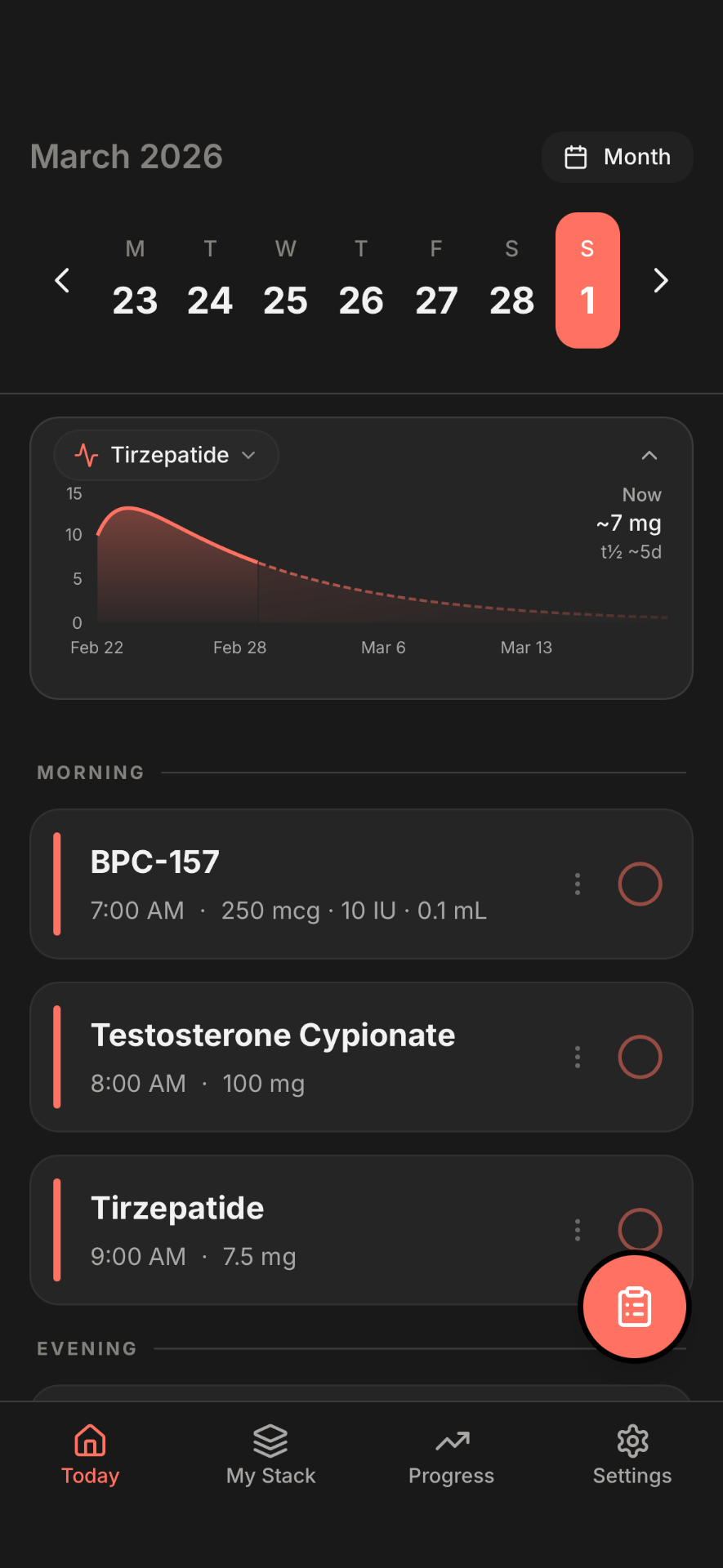
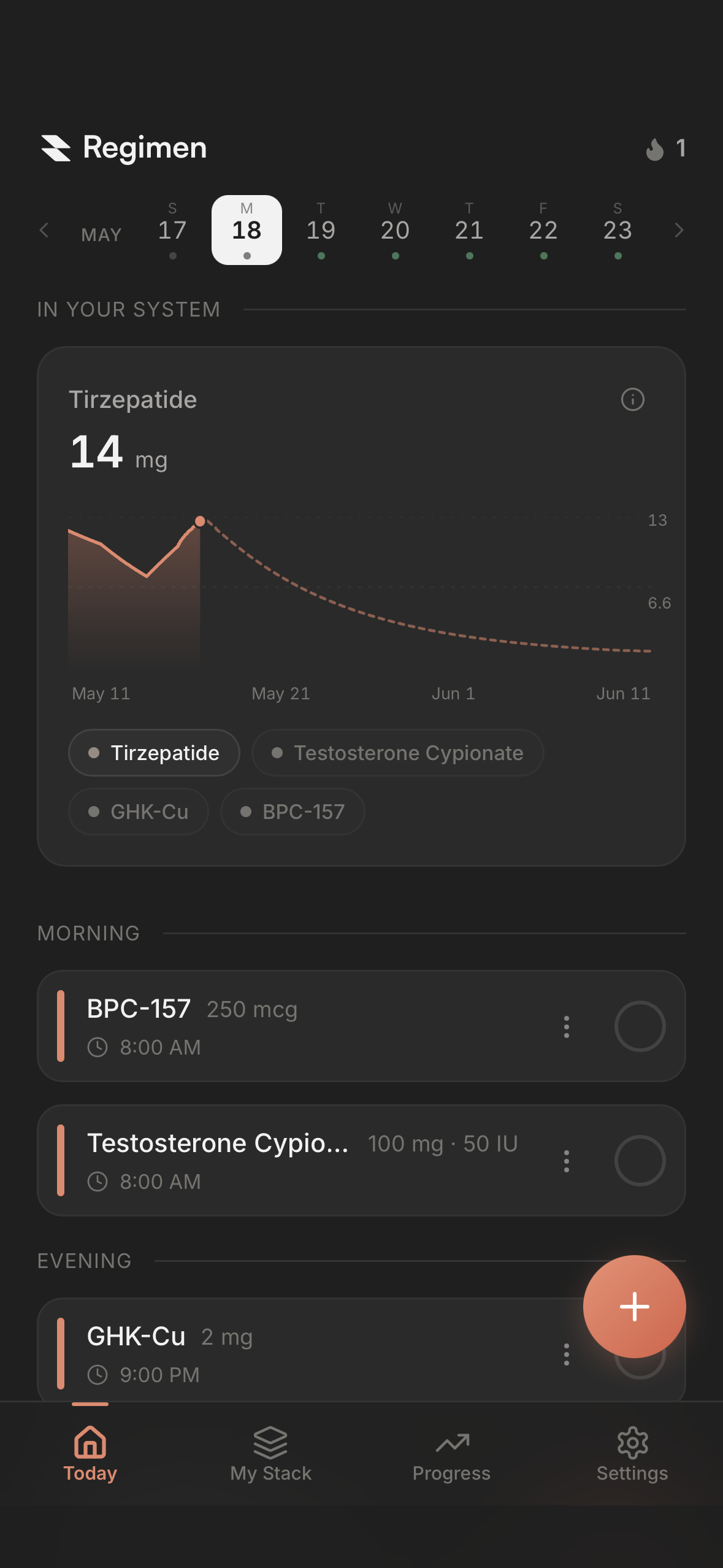
If you’d rather skip the math, the TRT dose calculator handles all of this. Enter your weekly dose, vial concentration, and injection frequency, and it calculates your per-injection volume in both mL and units. It also shows your blood level curve over time so you can see how daily injections smooth out peaks and troughs compared to your previous schedule.
This article is for educational purposes only and is not medical advice. Consult your prescribing clinician before changing your TRT protocol or injection schedule.
Ready to track your protocol?
- Smart reminders so you never miss a dose
- Track weight, photos, and progress over time
- Medication level curves for every compound