←Part of TRT, Explained: The Complete Guide
The Bottom Line
Your injection frequency matters more than your dose. The same total weekly milligrams of testosterone injected once a week versus daily produces measurably different testosterone, estrogen, and hematocrit profiles. More frequent injections create a flatter hormone curve with lower estrogen peaks and more stable energy, mood, and libido. Less frequent injections are simpler but create higher peaks and deeper troughs that some men feel as a “rollercoaster.” Use our TRT dose calculator to see your exact dose per injection at any frequency, or our split-dose calculator to convert your current weekly protocol into a different schedule.
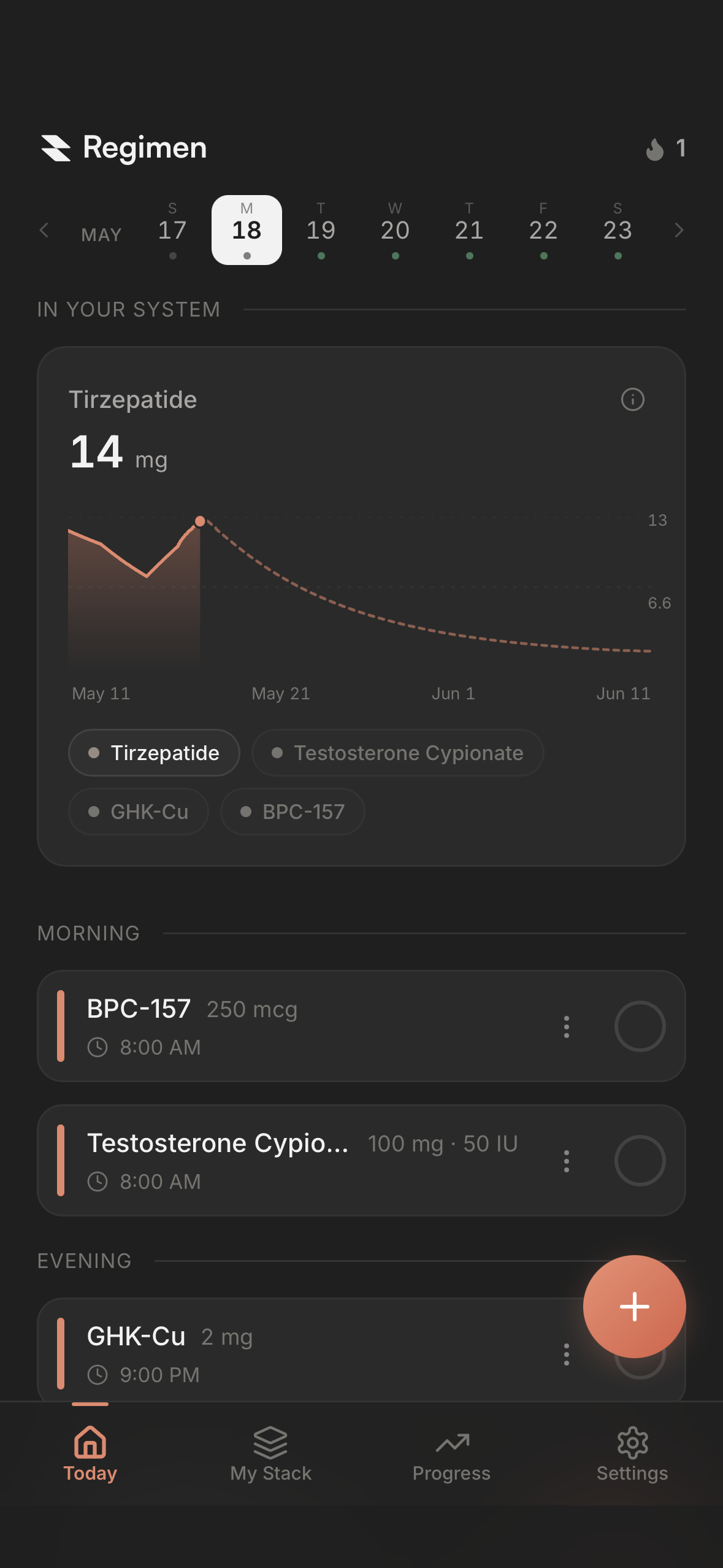
Regimen is a TRT tracker app that follows every-3.5-day and twice-weekly schedules and reminds you on the day.
A TRT injection schedule is the specific cadence at which you administer your prescribed testosterone dose - whether that is once per week, twice per week, every other day, or daily. The frequency you choose directly shapes your hormone curve: how high your testosterone peaks after each injection, how low it falls before the next one, and how much of that testosterone converts to estrogen along the way. Two men on identical weekly doses of testosterone cypionate can have dramatically different experiences based solely on how they split that dose across the week.
Why Injection Frequency Matters More Than You Think
The pharmacokinetics are straightforward. Testosterone cypionate has an apparent serum half-life of about 6.9 days based on measured PK data (older references quote 7-8 days; reconciled here). A single weekly injection produces a sharp peak within 24-48 hours, then a steady decline toward trough by day 7. Splitting that same dose into two injections narrows the gap between peak and trough. Splitting it into daily microdoses nearly flattens the curve entirely. This matters because your body responds not just to your average testosterone level, but to the swings. Large swings can amplify estrogen conversion at peak, drive up hematocrit more aggressively, and create noticeable fluctuations in energy, mood, sleep quality, and libido.
The goal of optimizing injection frequency is not to chase the highest peak number on bloodwork. It is to achieve stable, therapeutic testosterone levels at trough - the lowest point in your cycle - while minimizing side effects that come from the peaks.
Pro Tip
The best injection frequency is the one you will actually stick with. A perfect protocol you skip is worse than a good-enough protocol you never miss. If daily injections sound exhausting, start with twice weekly and adjust later. Adherence beats optimization every time.
Frequency Comparison: Weekly vs Twice Weekly vs Daily
This is the most important table in this guide. Bookmark it.
| Schedule | Inj/Week | Pros | Cons | Best For | Needle | Route |
|---|---|---|---|---|---|---|
| Once weekly | 1 | Simplest routine, fewest pokes | Highest peak-to-trough, most E2 conversion | Men who prioritize simplicity | 22-25g, 1-1.5” | IM |
| Twice weekly | 2 | Good stability, widely recommended | Still some variation | Most TRT patients - start here | 25-27g, 0.5-1” | IM or SubQ |
| Every other day | 3-4 | Near-stable levels, reduced E2 spikes | Odd schedule, more frequent | High SHBG, estrogen-sensitive | 27-29g, 0.5” | SubQ |
| Daily microdosing | 7 | Flattest curve, lowest E2 conversion | 7 pokes/week, tiny volumes | E2/hematocrit issues, prefers flat curve | 29-31g, 0.5” | SubQ |
Pro Tip
Needle choice directly affects whether you stick with your protocol. If you dread your injection because of a thick needle, you will eventually skip doses. Most men switching to more frequent protocols also switch to smaller gauge needles (27–31g) and find the experience dramatically more tolerable.
Use the TRT dose calculator to see exactly how your per-injection volume changes at each frequency. For example, 150mg/week becomes just 21.4mg per injection on a daily protocol - a tiny volume that draws easily through an insulin syringe.
What to Expect: Week-by-Week TRT Timeline
One of the most common questions when starting TRT or changing your injection schedule is how long it takes to feel the effects. Here is a realistic timeline:
| Timeframe | What Happens | What to Do |
|---|---|---|
| Week 1–2 | Levels rising but not at steady state. Subtle energy lift or nothing at all. Some water retention is normal. | Stay consistent. Do not adjust anything. Track your injections so you don’t lose count. |
| Week 3–4 | Energy improvements often begin. Mood may stabilize. Libido can start to increase. Some notice improved sleep. | Continue tracking. Note any changes - even small ones. These early signals help your provider calibrate. |
| Week 6–8 | Approaching steady state. This is the critical bloodwork window. | Get bloodwork: Total T, Free T, Estradiol (sensitive assay), CBC with hematocrit, PSA. |
| Week 8–12 | Dose adjustment period based on labs. Most adjustments are ±10–20mg per week. | Make ONE change at a time. Adjust dose or frequency, never both simultaneously. |
| Month 3–6 | Body composition changes become visible. Reduced body fat, increased muscle density, meaningful strength gains. | Stay the course. Continue tracking to document your progress. |
| Month 6–12 | Fully stabilized. Good time to experiment with frequency optimization if curious. | Consider whether your current frequency is truly optimal. Use the split-dose calculator to plan any switch. |
Community Insight
Month 2–3 is when most men get impatient and want to increase their dose. Do not do it prematurely. Wait for the bloodwork. Your body is still adjusting, and testosterone levels at week 6 are often significantly different from week 3. The men who get the best long-term results are the ones who let the process play out before making changes.
How to Switch Frequencies Without Disrupting Your Levels
Switching from one injection frequency to another is simpler than most people think. The core principle: keep your total weekly dose the same and just divide it differently.
Step 1: Calculate your new per-injection dose
If you currently inject 150mg once per week and want to switch to twice weekly, your new dose is 75mg per injection. Use the split-dose calculator to handle the math precisely.
Step 2: Start the new frequency on your next injection day
There is no need for a washout period or a loading dose. Simply inject your new, smaller dose and continue on the new schedule from there.
Step 3: Expect a 2–3 week adjustment period
Your body has been accustomed to a particular hormone curve. When you flatten it out, you may feel slightly different for a few weeks. This is normal and temporary.
Step 4: Get bloodwork at 6 weeks on the new frequency
This confirms that your trough levels are where they should be. Trough typically improves (rises) when you increase frequency.
Step 5: Do not change dose and frequency at the same time
If you change both variables simultaneously, you cannot tell which one caused any difference. Adjust frequency first, retest at 6 weeks, then adjust dose if needed.
Important
If you are switching from a very infrequent schedule (such as every-two-week injections from an older protocol) to a more frequent one, your first few weeks may feel different simply because you are eliminating the deep troughs you were accustomed to. Some men misinterpret this stabilization as “not working.” Give it the full 6 weeks before judging.
Factors That Affect Your Optimal Frequency
There is no single best injection frequency for every man on TRT. Several individual factors influence which schedule will produce the best results:
| Factor | How It Affects Frequency Choice |
|---|---|
| High SHBG (above 40 nmol/L) | More frequent injections help maintain steadier free testosterone levels. Men with high SHBG often benefit from EOD or daily protocols. |
| Low SHBG (below 20 nmol/L) | Free testosterone stays available longer after each injection. Weekly or twice-weekly may be sufficient. |
| Body fat above 25% | Higher body fat means more aromatase activity. More frequent injections reduce peaks, which reduces estrogen spikes. |
| Age above 50 | Older men may benefit from more frequent, lower-volume injections. Smaller, more frequent doses tend to produce gentler hemodynamic effects. |
| Estrogen sensitivity | Splitting your dose more frequently reduces the testosterone peak that drives aromatization. Many men who needed an AI on weekly find they no longer need one after switching to EOD or daily. |
| Hematocrit concerns | Higher peaks stimulate more red blood cell production. More frequent injections produce lower peaks, which may keep hematocrit lower. See our hematocrit management guide. |
Pro Tip
If you do not know your SHBG level, ask your provider to include it in your next blood panel. SHBG is one of the most underordered and most informative markers for optimizing a TRT protocol. It costs very little to add and can change your entire approach to injection frequency.
Blood Work: When to Test and What to Check
Bloodwork is how you turn subjective feelings into objective data. Without it, you are guessing. Draw blood on your trough day - the morning of your scheduled injection, before you inject.
| Marker | Why It Matters | Target Range |
|---|---|---|
| Total Testosterone | Overall testosterone level at trough | 600–900 ng/dL at trough |
| Free Testosterone | The biologically active fraction your tissues actually use | 15–25 pg/mL |
| Estradiol (E2) - sensitive | The LC/MS assay is critical for men - standard immunoassay is inaccurate at male ranges | 20–40 pg/mL |
| CBC with Hematocrit | TRT stimulates red blood cell production; elevated hematocrit increases blood viscosity | Hematocrit below 52% |
| PSA | Prostate-specific antigen - baseline before TRT, then annually | Baseline-dependent |
| Lipid Panel | TRT can shift lipid profiles, particularly HDL | Standard cardiovascular targets |
Warning
Do not get bloodwork at your peak (24–48 hours after injection). Peak numbers always look impressive but they hide what is happening at your lowest point. A total testosterone of 1,200 ng/dL at peak might correspond to only 400 ng/dL at trough - and trough is where you actually live most of the week. Always test at trough.
Link to our testosterone calculator to estimate your levels between lab draws, and see our hematocrit management guide for detailed strategies if your red blood cell count is trending high.
Injection Site Rotation by Frequency
Rotating injection sites prevents scar tissue buildup, reduces injection-site pain, and improves absorption consistency. Your rotation schedule should match your injection frequency.
Once weekly (IM)
Alternate between left and right glutes each week. You only need two sites.
Twice weekly (IM or SubQ)
Rotate through four sites: left glute, right deltoid, right glute, left deltoid. Each site gets two full weeks to recover.
Every other day (SubQ)
Rotate through 6–7 sites: left and right abdomen, left and right love handles, and left and right thighs. Number them 1–7 and cycle sequentially.
Daily microdosing (SubQ)
Rotate through 7+ sites so each gets a full week of rest. Use all available subcutaneous sites: abdomen quadrants, love handles, and outer thighs. Mark sites on a body map or use an injection tracker.
For a complete visual guide to all injection sites with body maps and technique tips, see our injection sites guide.
The Daily Microdosing Deep-Dive
Daily testosterone microdosing has become one of the most debated protocols in TRT communities. Here is what the evidence and community experience actually show.
What it is: Take your total weekly testosterone dose, divide it by 7, and inject that amount subcutaneously every day using an insulin syringe. A man on 150mg per week would inject approximately 21.4mg per day.
Why people do it: Daily injections produce the flattest possible hormone curve. With such small daily fluctuations, your testosterone level on any given day is nearly identical to any other day. This flatness reduces estrogen conversion, may lower hematocrit, and eliminates the “injection day high / day-before-injection low” that some men feel on weekly or twice-weekly protocols.
The real-world results: Many men who switch to daily microdosing report improved mood stability, better sleep, reduced water retention, and the ability to drop their aromatase inhibitor. The community language around this is “dialed in” - a feeling that your hormones are no longer a variable you think about because the curve is essentially flat.
The downsides: Seven injections per week is a real commitment. The volumes are tiny - at 200mg/mL, a 21mg dose is only about 0.1mL (10 units on an insulin syringe). This small volume can be difficult to measure precisely.
Who it is best for: Men who have already tried twice-weekly or every-other-day injections and still experience estrogen issues, hematocrit creep, or noticeable energy fluctuations. Daily microdosing is generally not the place to start.
For the full protocol breakdown, see our dedicated microdosing TRT guide. For help reading tiny volumes on insulin syringes, check our insulin syringe reading guide.
SubQ vs IM: Which Route for Which Frequency
Intramuscular (IM): Testosterone is injected directly into muscle tissue using a 22–25 gauge, 1–1.5 inch needle. IM injections have decades of clinical data and work well for once-weekly or twice-weekly protocols where injection volume is moderate (0.3–0.5mL).
Subcutaneous (SubQ): Testosterone is injected into the fat layer just beneath the skin using a 27–31 gauge, 0.5 inch needle. SubQ injections are nearly painless and are the dominant route for EOD and daily protocols because the volumes are small enough for comfortable subcutaneous absorption.
The practical rule: If you are injecting more than 0.5mL per shot, IM is generally more comfortable. If you are injecting 0.3mL or less, SubQ with an insulin syringe is usually the better experience.
Community Insight
The needle you use is not just a comfort preference - it is an adherence factor. Community members consistently report that switching from IM with a 22-gauge needle to SubQ with a 29-gauge insulin needle was the single change that made their protocol sustainable long-term.
Common Mistakes That Sabotage Your Protocol
| Mistake | Why It Matters |
|---|---|
| Injecting every 2 weeks | This outdated protocol creates massive peaks and deep crashes. No modern TRT-focused provider prescribes biweekly anymore. |
| Getting bloodwork at peak instead of trough | Peak numbers look great on paper but do not show what your lowest levels are. Always draw blood the morning of your injection, before you inject. |
| Changing dose AND frequency at the same time | If you change both variables and then feel different, you have no way to know which change caused it. Adjust one at a time. |
| Skipping injections because you “feel fine” | Consistent dosing is the entire point. Skipping creates the instability you are trying to avoid. |
| Not giving a new frequency 6 weeks before judging it | The first 2–3 weeks on a new schedule may feel different. Many men abandon a frequency switch after one week. Give it the full 6 weeks and a blood draw. |
Warning
If you are on TRT and your provider only checks bloodwork once a year (or never), that is a red flag. At minimum, you should have labs every 6 months once stable. During the initial optimization phase, labs every 6–8 weeks after any change are standard practice.
Frequently Asked Questions
How often should I inject testosterone?
The most common and widely recommended TRT injection frequency is twice per week. This provides a good balance between stable hormone levels and manageable routine. Once weekly is simpler but creates more peaks and troughs. Every other day and daily protocols provide the most stability but require more injections.
Is once a week enough for TRT?
For some men, yes. Weekly testosterone injections are a legitimate protocol and many men feel great on them, particularly those with lower SHBG. However, if you’re experiencing energy crashes, mood dips, or high estrogen at peak, splitting your dose into twice weekly is the first adjustment to try.
What is the best day to inject testosterone?
There is no pharmacologically superior day. Choose days that fit your routine. For twice-weekly protocols, Monday/Thursday or Tuesday/Friday are the most common because they space injections approximately 3.5 days apart.
Can I switch from weekly to daily injections?
Yes. Keep your total weekly dose the same and divide it by 7. Start the daily schedule on your next scheduled injection day. Expect 2-3 weeks to adjust. Get bloodwork at 6 weeks on the new frequency.
Does injection frequency affect estrogen levels?
Yes. Higher testosterone peaks drive more aromatase activity, which converts testosterone to estradiol. When you split the same weekly dose into more frequent injections, you lower the peaks, which reduces estrogen conversion. Many men who needed an AI on weekly injections find they can discontinue it after switching to EOD or daily protocols.
How do I know if I should change my injection frequency?
Consider changing frequency if you experience consistent energy or mood dips before your next injection, if your estrogen is elevated despite a reasonable dose, if your hematocrit is trending above 50%, or if you dread injection day because of the needle or volume.
What is the smallest needle I can use for testosterone?
For subcutaneous TRT injections with small volumes (under 0.3mL per shot), a 29-31 gauge, 0.5 inch insulin syringe works well. For IM injections with larger volumes, 25-gauge is the smallest practical choice.
Should I inject testosterone in the morning or evening?
It does not make a clinically meaningful difference for exogenous testosterone. Your natural testosterone production is suppressed on TRT, so time of day does not interact with circadian rhythms. Choose the time that fits your schedule best.
Disclaimer: This content is for informational purposes only and does not constitute medical advice. Testosterone replacement therapy should be prescribed and monitored by a licensed healthcare provider. Always consult with your doctor before starting, adjusting, or stopping any medication.