The Bottom Line
Insulin syringes come in three sizes: 30-unit, 50-unit, and 100-unit. Each small line is 1 unit on the smaller syringes and 2 units on the 100-unit syringe. Always read from the top edge of the black plunger. 1 unit = 0.01 mL. Multiply your dose in mL by 100 to get units.
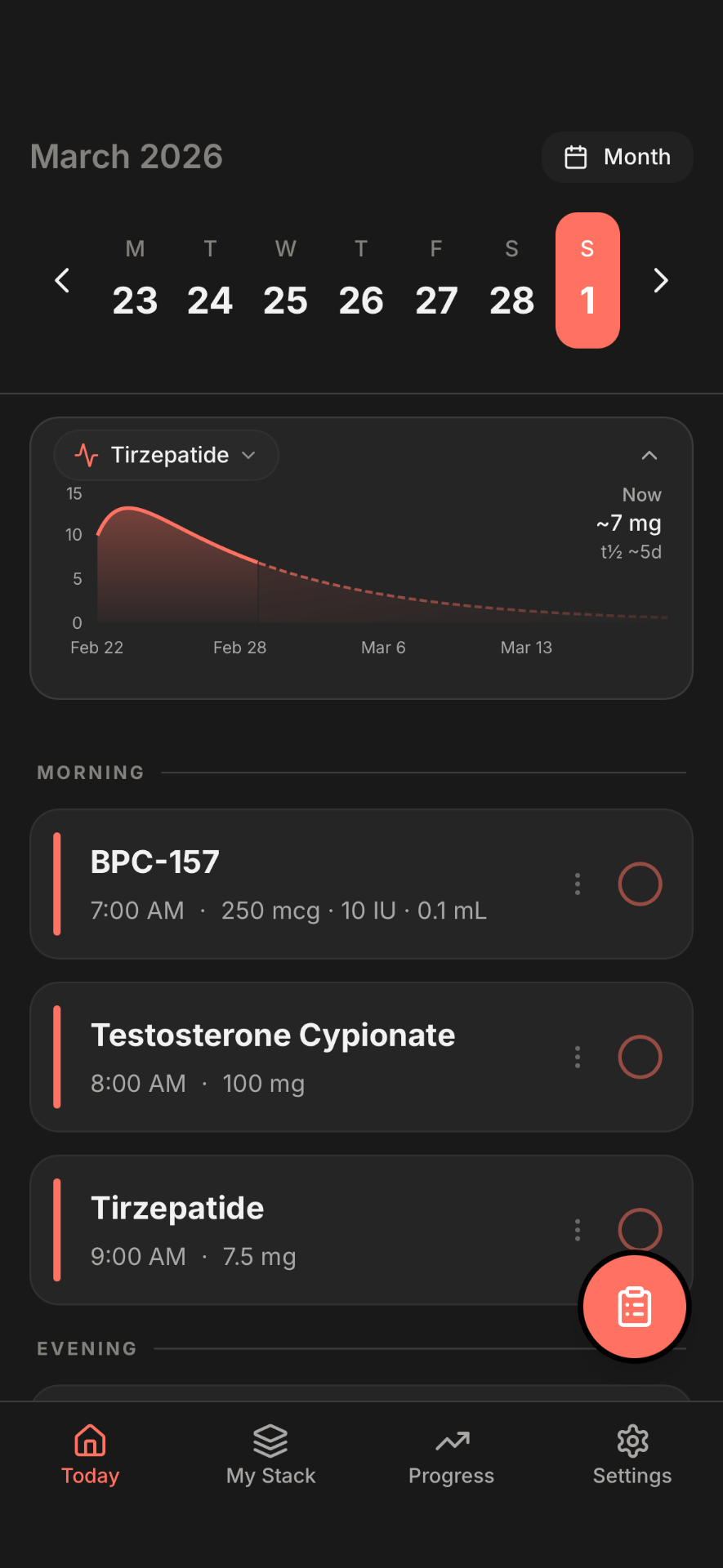
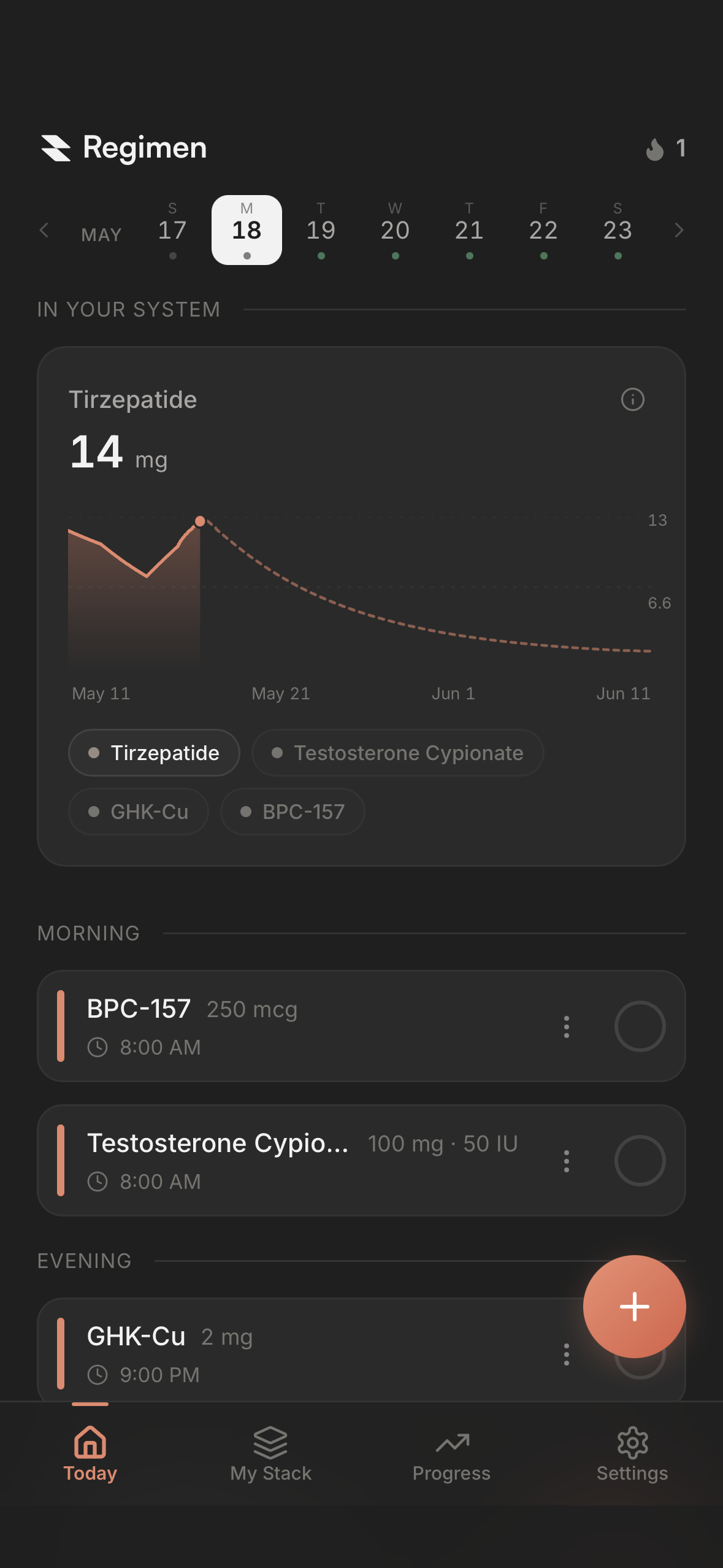
Regimen is a peptide and GLP-1 tracker app that shows the units to draw for your dose and logs each shot.
You’ve got your vial, your syringe, and a dose written in milligrams or milliliters. But you’re staring at tiny lines on a syringe barrel and second-guessing yourself. “Is each line 1 unit or 2?” “Where exactly do I read the measurement?”
You’re not alone. This is one of the most common questions from people starting peptides, TRT, HCG, or GLP-1 protocols. Getting it right matters because even a small misread can double or halve your dose.
This guide covers everything you need to read your insulin syringe confidently, with visuals, a conversion chart, and the common mistakes people make.
Insulin Syringe Sizes
There are three standard insulin syringe sizes: 0.3 mL (30 units), 0.5 mL (50 units) and 1 mL (100 units). All three use the same scale, 1 unit = 0.01 mL, so the size only changes how much the barrel holds and how finely it’s marked. The one you use determines how you read the markings.
82% of the doses Regimen users inject are 30 units or less, and 95% fit in a 0.5 mL (50-unit) syringe. See all Regimen data.
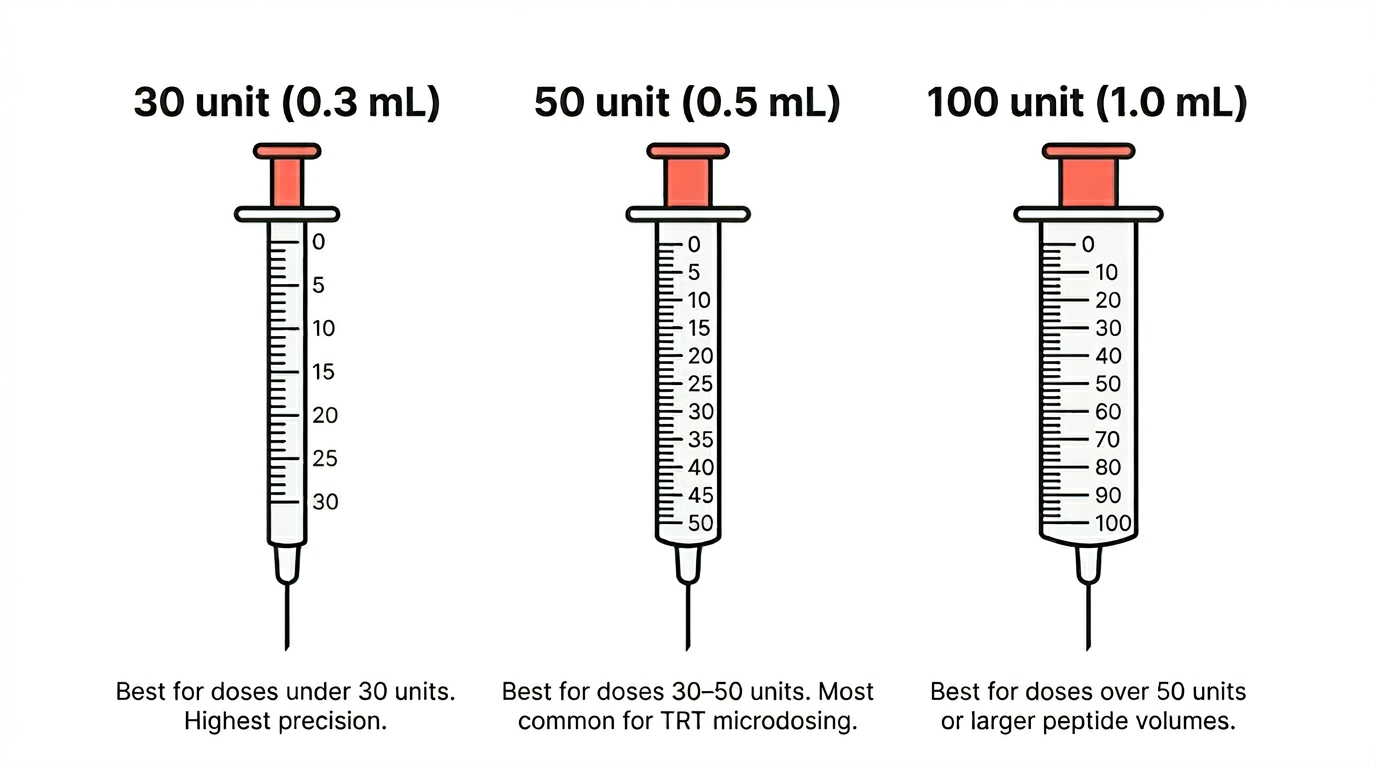
30-unit, 50-unit, and 100-unit insulin syringes compared. Use the smallest syringe that fits your dose for the highest precision.
| Syringe Size | Holds | Each Small Line | Best For |
|---|---|---|---|
| 0.3 mL | 30 units | 1 unit (0.01 mL) | Small peptide doses, precise BPC-157/TB-500 |
| 0.5 mL | 50 units | 1 unit (0.01 mL) | Most peptide and HCG doses |
| 1 mL | 100 units | 2 units (0.02 mL) | TRT, larger volume injections |
The key difference: On the 30-unit and 50-unit syringes, every tiny line is 1 unit. On the 100-unit syringe, each tiny line is 2 units. This is where most misreads happen. If you’re using a 100-unit syringe and counting each line as 1 unit, you’re measuring half your intended dose.
To translate your dose to the exact line on the barrel, use the units to ml calculator, or start from mg with the mg to units calculator, or go from a volume in mL to units with the mL to units calculator.
How to Actually Read the Markings
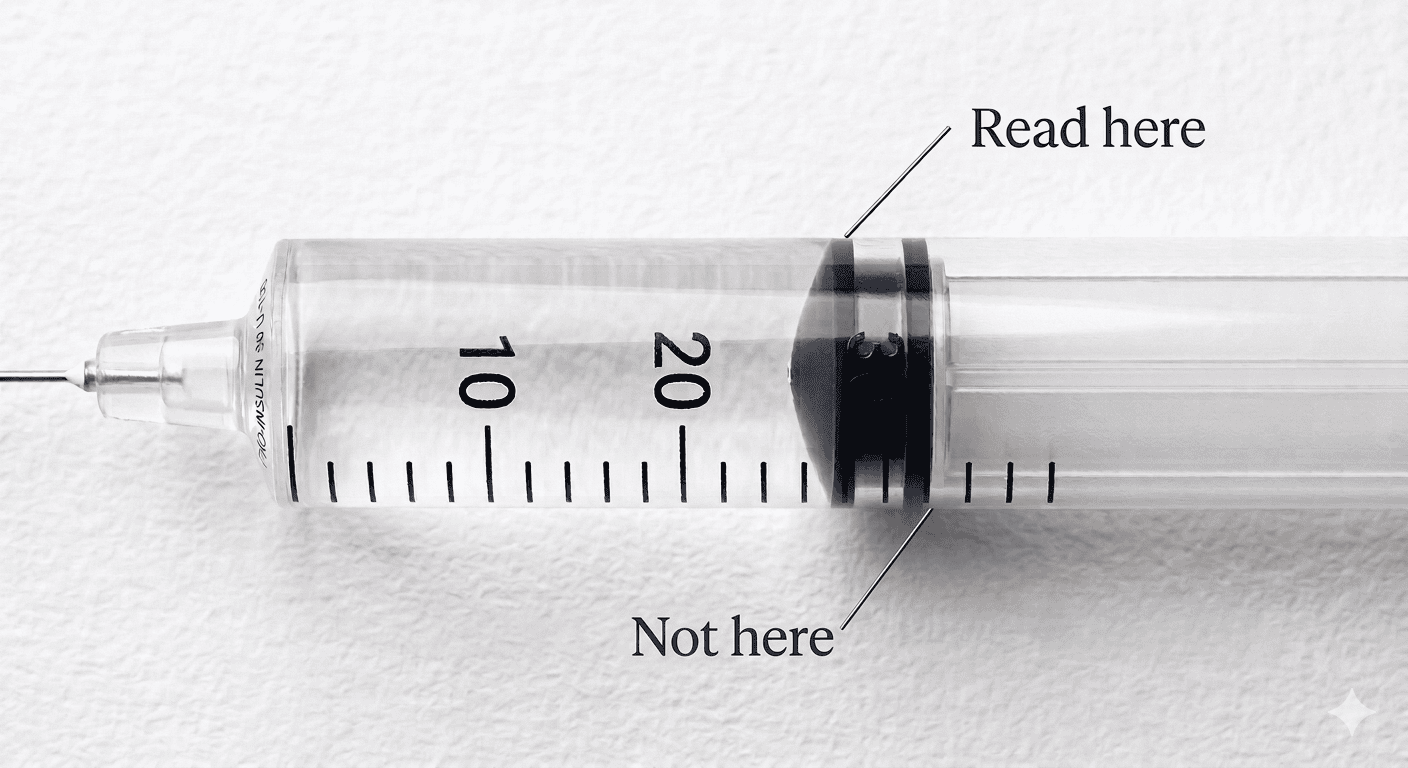
Step 1: Find the plunger
The black rubber piece inside the barrel is your plunger. Your dose is measured at the top edge of that rubber piece, the side closest to the needle.
Step 2: Hold it at eye level
Tilt the syringe so the markings face you and your eyes are level with the plunger. Looking from above or below changes the apparent position (it’s the same parallax issue as reading a thermometer).
Step 3: Count the lines
The numbered markings on most syringes go by 10s: 10, 20, 30, etc. The small unnumbered lines between them are your fine measurements. On 30-unit and 50-unit syringes, count each line as 1 unit. On a 100-unit syringe, each line is 2 units.
Quick trick
Count the small lines between two numbered marks. If there are 10 lines between “10” and “20”, each line is 1 unit. If there are only 5 lines, each line is 2 units.
Units to mL Conversion Chart
This is the chart you’ll keep coming back to. Bookmark it. Screenshot it. Tape it to your bathroom mirror.
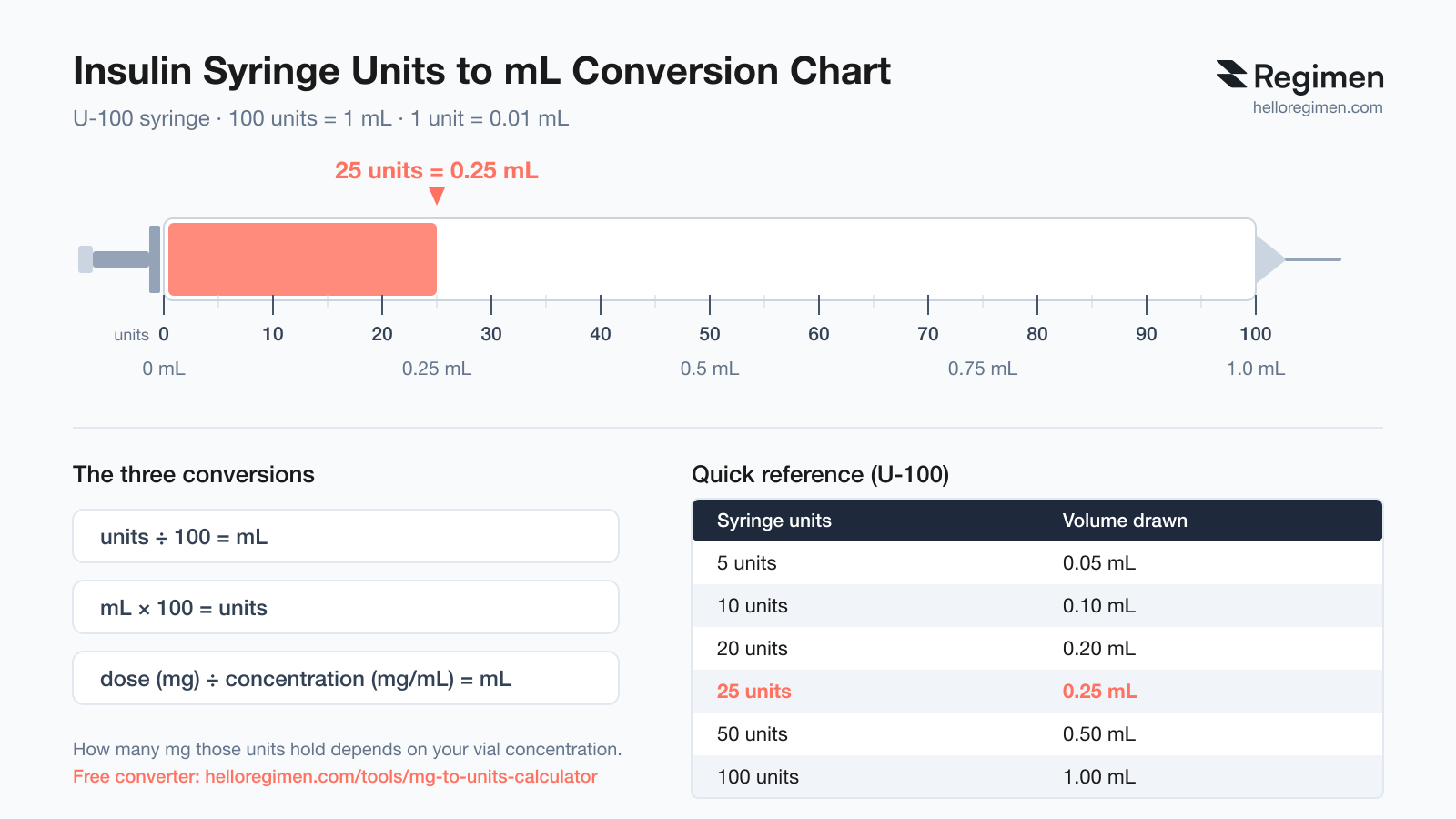
For a full reference table of every common TRT and peptide dose converted to units and mL, see the units vs mL vs mg syringe reference guide.
Units measure volume, not dose
This chart converts syringe units to milliliters. It does not tell you how many milligrams you’re injecting. Your actual mg dose depends on your medication’s concentration, which is determined by how much powder was dissolved in how much liquid. Always use a reconstitution calculator to figure out how many units you need for your specific dose.
| Units | mL | Typical Volume Range |
|---|---|---|
| 5 units | 0.05 mL | Very small doses (peptides, microdosing) |
| 10 units | 0.10 mL | Common peptide volume |
| 20 units | 0.20 mL | Mid-range peptide or HCG volume |
| 25 units | 0.25 mL | Common for TRT and GLP-1 protocols |
| 50 units | 0.50 mL | Larger injection volumes |
| 100 units | 1.00 mL | Full syringe |
The formula: Units ÷ 100 = mL. That’s it. 25 units = 0.25 mL. 8 units = 0.08 mL. Works every time. But remember: this only tells you the volume. To know your actual dose in milligrams, you need to know your concentration.
5 Mistakes That Mess Up Your Dose
1. Confusing units with milligrams
Units on the syringe measure volume, not the amount of active medication. If your peptide vial has 5 mg reconstituted in 2 mL of BAC water, then 10 units (0.1 mL) contains 0.25 mg, not 10 mg. You need to know your concentration to translate syringe units to your actual dose. A reconstitution calculator handles this instantly.
2. Using a 100-unit syringe for small doses
On a 100-unit syringe, each line is 2 units. If you need 5 units, you’re trying to land between the second and third line. That’s hard to do precisely. Switch to a 30-unit or 50-unit syringe where each line is 1 unit and small doses become much easier to measure.
3. Reading from the wrong edge of the plunger
The plunger has a dome shape. Read from the top edge (closest to the needle), not the rounded tip or the middle. Reading from the wrong spot can be off by 1-3 units.
4. Not accounting for dead space
Every syringe wastes a small amount of medication in the hub (the space between the needle base and the barrel). Standard syringes waste about 0.04-0.07 mL per injection. Over a 30-day cycle, that adds up. Low dead space syringes reduce waste to under 0.01 mL. Worth the small price premium if you’re injecting daily.
5. Forgetting to remove air bubbles
Air bubbles take up space that should be medication. After drawing your dose, hold the syringe needle-up, flick the barrel to move bubbles to the top, then push the plunger up slightly to expel them. Re-check your measurement after clearing bubbles because you probably pushed out a bit of liquid too.
Worked Examples: Real Doses on Real Syringes
Here’s how common protocols translate to syringe markings:
BPC-157: 250 mcg from a 5 mg vial reconstituted with 2 mL BAC water
Concentration: 5 mg ÷ 2 mL = 2.5 mg/mL. You need 0.25 mg (250 mcg). Volume: 0.25 ÷ 2.5 = 0.1 mL = 10 units. On a 50-unit syringe, pull to the first numbered mark.
TRT: 0.35 mL of testosterone cypionate (200 mg/mL)
0.35 mL × 100 = 35 units. On a 100-unit syringe, that’s halfway between the 30 and 40 marks (at the midpoint line plus one more small line). On a 50-unit syringe, pull to the 35 mark for easier precision.
HCG: 500 IU from a 5,000 IU vial reconstituted with 5 mL BAC water
Concentration: 5,000 IU ÷ 5 mL = 1,000 IU/mL. You need 500 IU. Volume: 500 ÷ 1,000 = 0.5 mL = 50 units. On a 100-unit syringe, pull to the halfway mark.
Semaglutide: 0.25 mg from a 5 mg vial reconstituted with 2.5 mL BAC water
Concentration: 5 mg ÷ 2.5 mL = 2 mg/mL. You need 0.25 mg. Volume: 0.25 ÷ 2 = 0.125 mL = 12.5 units. On a 50-unit syringe, that’s between the 12th and 13th line. Get as close as you can.
Which Syringe Should You Buy?
This depends on what you’re injecting and how much volume per dose.
| If You’re Taking | Typical Dose Volume | Best Syringe | Needle Gauge |
|---|---|---|---|
| Peptides (BPC-157, TB-500) | 0.05 - 0.3 mL | 30-unit or 50-unit | 29-31 gauge |
| HCG | 0.1 - 0.5 mL | 50-unit | 27-30 gauge |
| TRT (subcutaneous) | 0.2 - 0.5 mL | 50-unit or 100-unit | 27-29 gauge |
| TRT (intramuscular) | 0.5 - 1.0 mL | 100-unit (or 3 mL) | 23-25 gauge |
| GLP-1 (from vials) | 0.05 - 0.25 mL | 30-unit or 50-unit | 29-31 gauge |
Pro Tip
Buy low dead space syringes if you can find them. They waste less medication per injection. Over a multi-week protocol, that can save you an entire extra dose or two per vial.
Frequently Asked Questions
What are the different insulin syringe sizes?
Insulin syringes come in three standard sizes: 0.3 mL (30 units), 0.5 mL (50 units) and 1 mL (100 units). All three use the same scale, 1 unit = 0.01 mL. On the 0.3 mL and 0.5 mL syringes each small line is 1 unit; on the 1 mL syringe each small line is 2 units. Pick the smallest one that holds your dose.
What does each small line on an insulin syringe mean?
On a 100-unit syringe, each small line equals 2 units (0.02 mL). On a 50-unit or 30-unit syringe, each small line equals 1 unit (0.01 mL). The smaller syringes are easier to read for low doses because of this finer resolution.
How many units is 0.1 mL on an insulin syringe?
0.1 mL equals 10 units on any insulin syringe. The conversion is simple: multiply mL by 100 to get units. So 0.25 mL = 25 units, 0.5 mL = 50 units, and 1 mL = 100 units.
Which syringe size should I use for peptides?
For most peptide doses (0.1 to 0.5 mL), a 50-unit (0.5 mL) syringe works best because each line is 1 unit, making small doses easy to measure precisely. If your dose is consistently under 0.3 mL, a 30-unit syringe gives you the finest resolution.
Where do I read the measurement on the syringe?
Read at the top edge of the black rubber plunger (the edge closest to the needle). This is where the medication level actually sits. Don’t read from the bottom of the plunger or the middle.
Is 10 units the same as 10 mg?
No. Units on the syringe measure volume, not the amount of active medication. The actual mg dose depends on your medication’s concentration (how much powder was dissolved in how much liquid). Use a reconstitution calculator to convert between the two.
Can I use an insulin syringe for testosterone?
Yes. Many TRT patients use 27-31 gauge insulin syringes for subcutaneous testosterone injections. The thinner needle is more comfortable. Just make sure you’re drawing from a vial, not a pre-filled pen. A 100-unit (1 mL) syringe works for most TRT doses.
What’s the difference between units and IU?
On an insulin syringe, ‘units’ refers to volume markings on the barrel (1 unit = 0.01 mL). IU (International Units) is a measure of biological activity used for medications like HCG and insulin. They happen to align for U-100 insulin, but for other medications the conversion depends on concentration.
Once the math makes sense, the next step is tracking every dose consistently over time. Compare the best peptide tracker apps for tools that handle the logging for you.
Related Calculators
Use our dose calculator to know exactly how many units to draw
TRT dose calculator for any concentration
Calculate peptide doses in insulin syringe units
Free reconstitution calculator for any peptide
Figure out your GLP-1 dose in syringe units
Semaglutide, tirzepatide, and compounded vial math
This guide is for educational purposes only and is not medical advice. Always follow your prescriber’s instructions for dosing and injection technique. If you’re unsure about your dose or how to measure it, ask your pharmacist or provider before injecting.
Ready to track your protocol?
- Smart reminders so you never miss a dose
- Track weight, photos, and progress over time
- Medication level curves for every compound