The Bottom Line
Units, mL, and mg measure three different things: units = syringe volume markings (1 unit = 0.01 mL on a U-100 syringe), mL = liquid volume, mg = medication weight. To convert between mg and mL, divide your dose (mg) by your vial’s concentration (mg/mL). To convert mL to syringe units, multiply by 100.
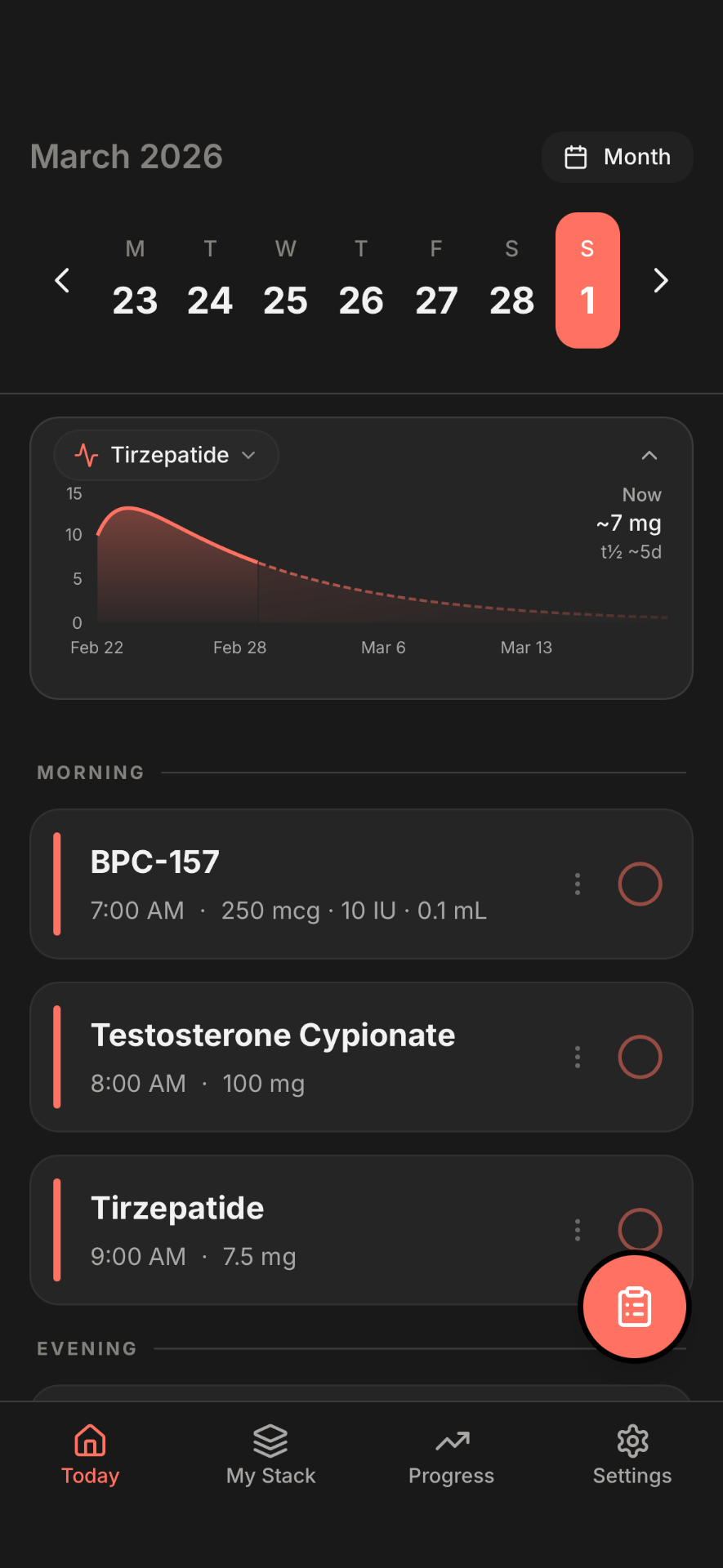
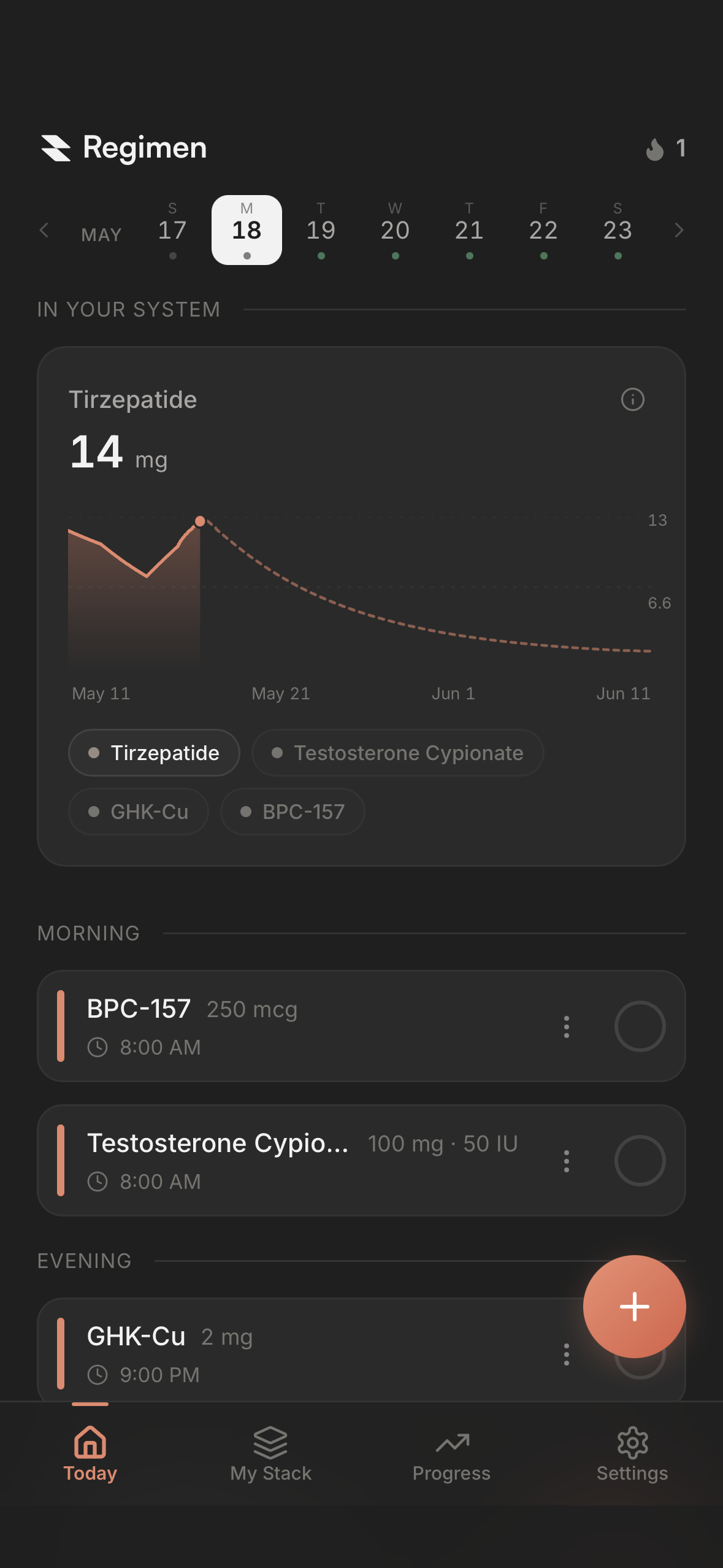
Regimen is a peptide and GLP-1 tracker app that does this unit math for you and logs the dose you drew.
Your prescription, your vial, and your syringe seem to speak three different languages. If you’ve ever stood there trying to work out how a dose in milligrams turns into lines on a syringe, this guide sorts it out for good.
The short version: mg is the weight of the drug. mL is the liquid volume. Units are the markings on the barrel. Once you see how the three connect, the conversion takes about five seconds.
Which converter do you need?
Skip the reading if you just need the number. Each direction has its own calculator, and picking the right one saves you a wrong-way conversion:
- Have a dose in mg or mcg, need the units to draw: mg to units calculator
- Have units on the syringe, need the dose in mg: units to mg calculator
- Have units, need the volume in mL: units to mL calculator
- Have a volume in mL, need the units: mL to units calculator
If you are not sure which of those you are holding, keep reading. The rest of this guide is the explanation.
The Three Measurement Systems You’ll Encounter
Milligrams (mg) / Micrograms (mcg)
What it measures: The weight of your medication, how much active ingredient you’re taking.
Where you see it: Prescriptions (“take 100mg twice weekly”), vial labels (“200mg/mL”), and dosing guides.
Milliliters (mL)
What it measures: Volume, the amount of liquid you draw into the syringe.
Where you see it: Standard syringes (1 mL, 3 mL, 5 mL), vial sizes, and bacteriostatic water.
Units (on insulin syringes)
What it measures: Also volume, but using smaller markings designed for precise low-volume dosing.
Where you see it: Insulin syringes (30-unit, 50-unit, 100-unit).
Mixing a vial, not just converting units?
Units depend on your vial’s concentration. Get the exact number for any vial and dose.
Open the peptide reconstitution calculator →
What “Units” Actually Means on an Insulin Syringe
On a standard U-100 insulin syringe (which is what most people use for peptides, TRT microdosing, and HCG), the markings work like this:
To convert: mL × 100 = units. Or: units ÷ 100 = mL.
The “units” on an insulin syringe are just a finer way of measuring volume. They were originally designed so insulin doses could be measured precisely without having to read tiny mL markings. But the principle is the same: they measure how much liquid you draw.
For a visual guide to reading these markings, see our insulin syringe reading guide which shows each syringe size with labeled markings.
What mg Means and Why You Need Concentration
Here’s where it gets important: mg tells you the dose, but it doesn’t tell you how much liquid to draw. To convert mg to mL (or units), you need one more number: the concentration of your medication.
The master formula:
Volume (mL) = Dose (mg) ÷ Concentration (mg/mL)
Then to get syringe units: multiply the mL result by 100.
Example: Testosterone
Your doctor prescribes 100mg of testosterone cypionate. Your vial says 200mg/mL.
Step 1: 100mg ÷ 200mg/mL = 0.5 mL
Step 2: 0.5 mL × 100 = 50 units
→ Draw to the 50-unit mark on your insulin syringe
Example: Reconstituted Peptide (BPC-157)
You have a 5mg vial of BPC-157 reconstituted with 2mL of BAC water. Your dose is 250mcg.
Step 1: Concentration = 5mg ÷ 2mL = 2.5mg/mL = 2,500mcg/mL
Step 2: 250mcg ÷ 2,500mcg/mL = 0.1 mL
Step 3: 0.1 mL × 100 = 10 units
→ Draw to the 10-unit mark
Don’t want to do this math every time? Our peptide reconstitution calculator and TRT dose calculator do it for you. Enter your numbers and get the exact units to draw.
Regimen does this conversion for you. Save your vial’s concentration once and every dose after shows the exact units to draw, no chart, no recalculating. It keeps a log of each dose too, so you can look back at what you actually ran.
Get RegimenU-100 vs U-40 Syringes: The Dangerous Mix-Up
Warning
Using a U-40 syringe when your medication requires a U-100 syringe (or vice versa) will cause a 2.5x dosing error. Always check that your syringe matches your medication’s unit concentration. When in doubt, use the mL markings or a standard syringe instead.
Most people in the TRT, peptide, and GLP-1 world use U-100 syringes (100 units per mL). U-40 syringes also exist; they were designed for older insulin formulations that had 40 units per mL.
| Syringe | Units per mL | 1 Unit = | Common Use |
|---|---|---|---|
| U-100 | 100 | 0.01 mL | Standard for modern insulin, peptides, TRT, HCG |
| U-40 | 40 | 0.025 mL | Veterinary insulin, some international insulin formulations |
| U-500 | 500 | 0.002 mL | Concentrated insulin only, with its own dedicated syringes |
The safest approach: Unless your provider specifically tells you to use a U-40 syringe, use a U-100. And if you’re ever unsure which syringe you have, look at the markings: a U-100 syringe will show 100 units at the 1 mL line. A U-40 will show 40. U-500 syringes exist only for concentrated insulin and should never enter the picture for peptides or TRT.
Common Scenarios: TRT, Peptides, GLP-1, HCG
TRT (Testosterone Cypionate)
Prescribed: 140mg/week, vial: 200mg/mL, injecting 2x/week
70mg per injection ÷ 200mg/mL = 0.35 mL = 35 units
Peptide (BPC-157)
5mg vial, 2mL BAC water, dose: 500mcg
Concentration: 2,500mcg/mL → 500mcg ÷ 2,500 = 0.2 mL = 20 units
GLP-1 (Semaglutide)
5mg vial, 2mL BAC water, dose: 0.5mg
Concentration: 2.5mg/mL → 0.5mg ÷ 2.5 = 0.2 mL = 20 units
HCG
10,000 IU vial, reconstituted with 5mL BAC water, dose: 500 IU
Concentration: 2,000 IU/mL → 500 IU ÷ 2,000 = 0.25 mL = 25 units
Units to mL Conversion Chart (U-100 Syringe)
On a U-100 insulin syringe, 1 unit equals 0.01 mL. Multiply syringe units by 0.01 to get mL, or multiply mL by 100 to get units. Use the table below for the most common conversions used in TRT, peptide, and GLP-1 dosing.
| Syringe units | Volume (mL) | Common use |
|---|---|---|
| 5 units | 0.05 mL | Small peptide microdose |
| 10 units | 0.10 mL | BPC-157 250mcg (at 2.5mg/mL) |
| 15 units | 0.15 mL | Reta or tirz starter doses at higher concentrations |
| 20 units | 0.20 mL | Semaglutide 0.5mg (at 2.5mg/mL) |
| 25 units | 0.25 mL | HCG 500 IU (at 2,000 IU/mL) |
| 30 units | 0.30 mL | Full 30-unit (0.3 mL) syringe |
| 35 units | 0.35 mL | TRT 70mg (at 200mg/mL) |
| 40 units | 0.40 mL | 1mg dose (at 2.5mg/mL) |
| 50 units | 0.50 mL | TRT 100mg (at 200mg/mL) |
| 75 units | 0.75 mL | Larger reconstituted doses |
| 100 units | 1.00 mL | Full 1 mL insulin syringe |
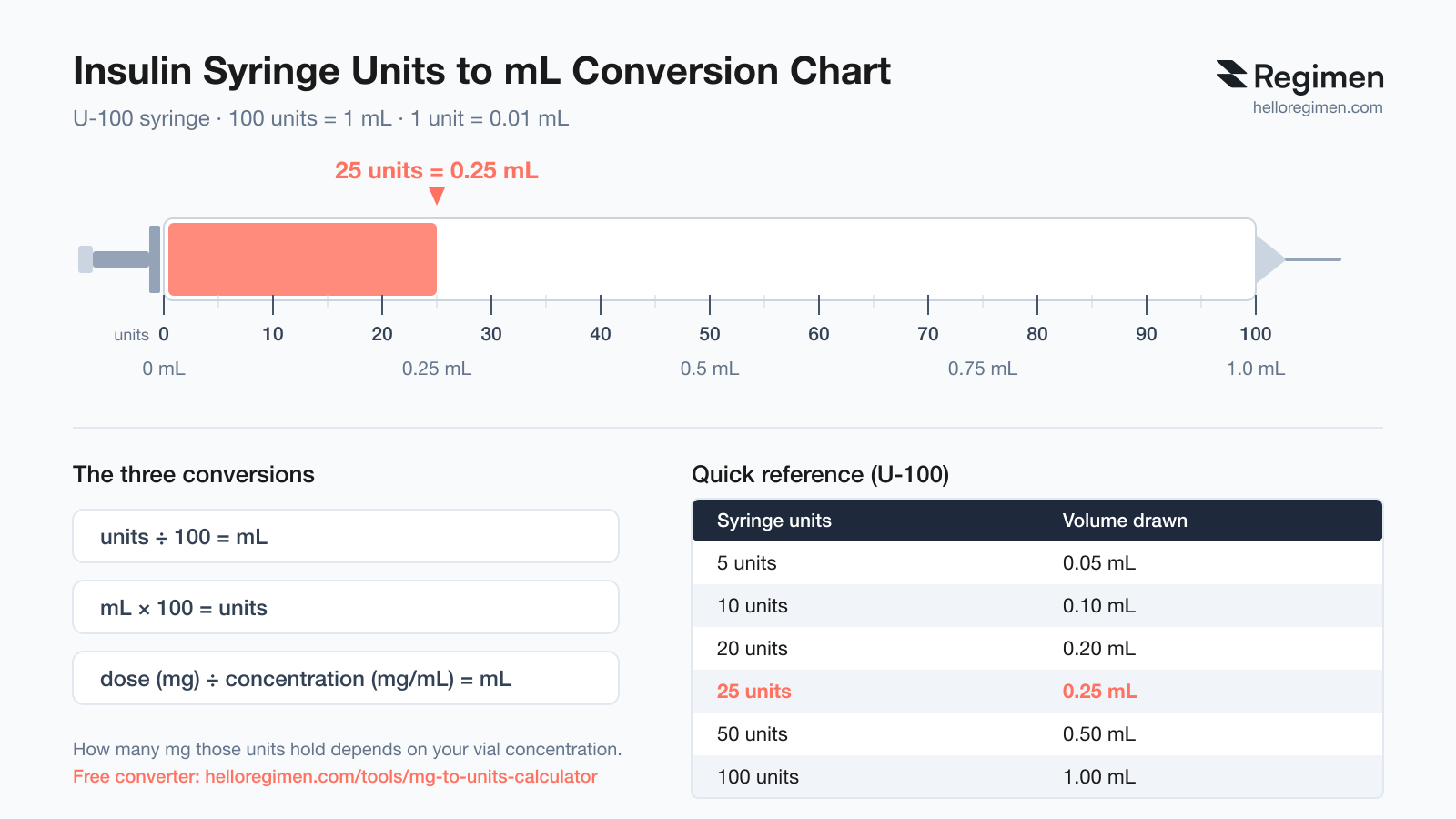
For mg or mcg conversions, you also need your vial’s concentration (mg/mL). Divide your target dose by the concentration to get mL, then multiply by 100 to get syringe units.
To run this for your own dose, use the units to ml calculator or the mg to units calculator.
mg and mcg to Units by Concentration
To turn a dose in milligrams or micrograms into syringe units, divide the dose by your vial’s concentration in mg/mL to get the volume in mL, then multiply by 100. The table below runs that math for the most common doses and concentrations (1 mg = 1,000 mcg, U-100 syringe throughout).
| Dose | 1 mg/mL | 2 mg/mL | 2.5 mg/mL | 5 mg/mL | 10 mg/mL |
|---|---|---|---|---|---|
| 0.25 mg (250 mcg) | 25 units | 12.5 units | 10 units | 5 units | 2.5 units |
| 0.5 mg (500 mcg) | 50 units | 25 units | 20 units | 10 units | 5 units |
| 1 mg (1,000 mcg) | 100 units | 50 units | 40 units | 20 units | 10 units |
| 2 mg | over 100* | 100 units | 80 units | 40 units | 20 units |
| 2.5 mg | over 100* | over 100* | 100 units | 50 units | 25 units |
| 5 mg | over 100* | over 100* | over 100* | 100 units | 50 units |
*Anything over 100 units will not fit a 1 mL insulin syringe. That is almost always a sign the concentration is too low for the dose, not a reason to split the injection. Re-check your mix before drawing anything.
From a Dry Vial to Syringe Units
If you start from a dry peptide vial, your concentration is set by how much bacteriostatic water you add: concentration (mg/mL) = vial size (mg) ÷ water added (mL). Here is how that lands in syringe units for common combinations.
| Vial + water added | Concentration | 250 mcg | 500 mcg | 1 mg | 2.5 mg |
|---|---|---|---|---|---|
| 5 mg + 1 mL | 5 mg/mL | 5 units | 10 units | 20 units | 50 units |
| 5 mg + 2 mL | 2.5 mg/mL | 10 units | 20 units | 40 units | 100 units |
| 10 mg + 1 mL | 10 mg/mL | 2.5 units | 5 units | 10 units | 25 units |
| 10 mg + 2 mL | 5 mg/mL | 5 units | 10 units | 20 units | 50 units |
| 15 mg + 3 mL | 5 mg/mL | 5 units | 10 units | 20 units | 50 units |
| 20 mg + 2 mL | 10 mg/mL | 2.5 units | 5 units | 10 units | 25 units |
Notice that 5 mg + 1 mL, 10 mg + 2 mL, and 15 mg + 3 mL all give identical unit counts. Same concentration, same marks on the syringe. The water volume matters exactly as much as the vial size, which is why writing your mix down (or saving it in Regimen) beats trusting memory.
Which Syringe Size: 30, 50, or 100 Units?
Insulin syringes come in 30-unit (0.3 mL), 50-unit (0.5 mL), and 100-unit (1 mL) barrels, and all three use the same scale: one unit mark is 0.01 mL on every one of them. A 20-unit dose is the same volume no matter which barrel you draw it in.
What changes is precision. On a 30-unit barrel the marks sit further apart, often graduated in single units or half-units, so small doses are much easier to read accurately. The same 5-unit dose on a 100-unit barrel is crammed into a tiny stretch near the needle. The rule: pick the smallest barrel that comfortably holds your dose.
And if your dose needs more than 100 units, do not reach for a bigger syringe. That is a sign to re-check your concentration, because a dose that cannot fit a 1 mL insulin syringe usually means the vial was mixed with too much water.
One naming trap worth knowing: the everyday 0.5 mL insulin syringe is often called a “50-unit syringe,” but it still uses the U-100 scale, where 1 unit is 0.01 mL. A true U-50 syringe (50 units per mL) is a different and much rarer device. Go by what is printed on the barrel: if it says U-100, treat it as U-100 in any calculator, no matter how small the barrel is.
Skip the Math: Use Our Free Calculators
If you’d rather not do unit conversions manually every time, these tools do it for you:
Peptide Reconstitution Calculator
Enter vial size, water volume, and desired dose → get exact syringe units
TRT Dose Calculator
Enter concentration and prescribed dose → get mL and units per injection
HCG Calculator
Calculate HCG doses in IU with reconstitution volume
GLP-1 Dose Calculator
Semaglutide, tirzepatide (tirz), and other GLP-1 dosing
Units to mL Calculator
Units to mg Calculator
Convert insulin syringe units to the dose in mg using your vial concentration.
mL to Units Calculator
Convert a volume in mL to insulin syringe units on a U-100, U-50, or U-40 syringe.
Convert insulin syringe units to mL for any U-100 dose
mg to Units Calculator
Enter mg dose and vial concentration → get exact syringe units
For UK-specific testosterone concentration tables (Sustanon 250, enanthate 250, cypionate 200) and NHS vs private dosing patterns, see our TRT dose conversion guide for UK patients.
Once you have the conversions down, the next step is logging every dose so the math does not have to live in your head. Our roundup of the best peptide tracker apps compares the options worth using.
Frequently Asked Questions
How many units are in 1 mL?
On a standard insulin syringe (U-100), there are 100 units in 1 mL. So 0.1 mL = 10 units, 0.5 mL = 50 units, and so on. The conversion is always: units = mL × 100.
Is 10 units the same as 10 mg?
No. Units measure volume on the syringe (0.01 mL per unit). Milligrams measure the amount of medication. To convert between them, you need to know the concentration of your medication (mg/mL).
What does IU mean and is it the same as units on a syringe?
IU stands for International Units - a measure of biological activity, not volume. Syringe units measure volume (1 unit = 0.01 mL on a U-100 syringe). For U-100 insulin, 1 IU happens to equal 1 syringe unit, but for other medications like HCG, the conversion depends on how it was reconstituted.
Can I use an insulin syringe for testosterone?
Yes. Many TRT patients use 27-31 gauge insulin syringes for subcutaneous testosterone injections. The needle is thinner and more comfortable. Just know that a 100-unit (1 mL) insulin syringe is the largest available.
How do I convert mcg to units on my syringe?
First, determine the concentration of your reconstituted peptide in mcg/mL. Then: units to draw = (desired dose in mcg ÷ concentration in mcg/mL) × 100. Our peptide reconstitution calculator does this math automatically.
How many mL is 1 unit?
One unit is 0.01 mL on a U-100 insulin syringe, so 10 units is 0.1 mL and 100 units is 1 mL. On a U-40 syringe, 1 unit is 0.025 mL, which is why matching the syringe to the medication matters.
What is 25 units in mL?
25 units is 0.25 mL on a U-100 insulin syringe, a quarter of a 1 mL barrel. How much medication that holds depends on your concentration: at 10 mg/mL it carries 2.5 mg, at 5 mg/mL it carries 1.25 mg.
What is 50 units in mL?
50 units is 0.50 mL on a U-100 insulin syringe, exactly half the barrel. At a 200 mg/mL testosterone concentration that volume holds 100 mg; at 2.5 mg/mL it holds 1.25 mg. The volume never changes, only the dose inside it.
How many units is 250 mcg?
It depends on your concentration. At 2.5 mg/mL, 250 mcg is 10 units. At 5 mg/mL it is 5 units, and at 1 mg/mL it is 25 units. The formula: (250 ÷ concentration in mcg/mL) × 100.
How many units is 500 mcg?
At 2.5 mg/mL, 500 mcg is 20 units on a U-100 syringe. At 5 mg/mL it is 10 units, and at 10 mg/mL it is 5 units. Double-check the concentration on your vial before drawing.
How many units is 0.5 mg?
0.5 mg is 500 mcg, so the same rule applies: at 1 mg/mL it is 50 units, at 2 mg/mL it is 25 units, at 2.5 mg/mL it is 20 units, and at 5 mg/mL it is 10 units. There is no fixed answer without the vial concentration.
How many units is 2.5 mg of tirzepatide?
At the common 10 mg/mL concentration, 2.5 mg of tirzepatide is 25 units on a U-100 syringe. At 5 mg/mL it is 50 units. Compounded vials vary, so confirm the mg/mL printed on your specific vial before drawing.
How many units is 5 mg?
At 5 mg/mL, 5 mg is a full 100 units (1 mL). At 10 mg/mL it is 50 units. If the math comes out above 100 units, the dose will not fit a standard insulin syringe and your concentration is probably too low.
Why does my dose come out to more than 100 units?
A dose over 100 units will not fit a 1 mL insulin syringe, and it usually means the vial was reconstituted with too much bacteriostatic water. Rather than splitting the injection, re-check the concentration; the same vial mixed with less water gives a dose that fits.
Ready to track your protocol?
- Smart reminders so you never miss a dose
- Track weight, photos, and progress over time
- Medication level curves for every compound
What’s the difference between a U-100 and U-40 syringe?
A U-100 syringe has 100 units per mL. A U-40 syringe has 40 units per mL. Using a U-40 syringe with U-100 medication (or vice versa) will give you the wrong dose. Always match your syringe to your medication’s unit concentration. When in doubt, use a standard mL-marked syringe.