The Bottom Line
The best subcutaneous (SQ) injection sites are the abdomen (left and right of navel), upper thighs (front/outer), upper glutes, and love handles (flanks). Rotate between at least 4 sites, spacing 1+ inch from the last spot. This prevents scar tissue (lipohypertrophy), keeps absorption consistent, and reduces pain. Daily injectors should use a 6–8 site rotation. Weekly injectors can use a simple 4-site pattern.
Across the shots logged on Regimen, more than half go into the abdomen (the belly and love handles), with the thighs and glutes making up most of the rest.
Are peptides injected subcutaneously or intramuscularly?
Most peptides are injected subcutaneously (subQ), into the fat just under the skin, not into muscle. SubQ gives slower, steadier absorption, hurts less, and it’s what nearly every peptide protocol calls for - BPC-157, TB-500, GH peptides, and GLP-1s included. A few cases get injected closer to a deep injury or use intramuscular delivery (glute or deltoid, common for some TRT protocols), but if a protocol doesn’t say otherwise, assume subQ.
Best peptide injection sites
| Route | Best sites |
|---|---|
| Subcutaneous (SubQ) | Abdomen, outer thigh, upper arm |
| Intramuscular (IM) | Glute, deltoid |
You nailed the reconstitution math. You bought the right syringes. You even have a protocol schedule that doesn’t make your eyes glaze over. But here’s the thing nobody warns you about until week four: where you inject starts mattering way more than you’d expect.
Most guides hand-wave injection sites with “just rotate.” Cool - but rotate where? In what order? And what actually happens if you keep hitting the same spot?
This is the guide we wish existed when we started. It covers the best subcutaneous (SQ) injection sites - including ones that don’t get enough credit - how to build a rotation system you’ll actually stick with, technique tips from the community, and the compound-specific nuances that nobody mentions until you’re three weeks in with a sore spot that won’t go away.
If you’re tracking multiple peptides, you’ll also want a way to log your sites over time. We compared the best peptide tracker apps for site rotation and multi-compound logging.
Why Injection Site Rotation Actually Matters
“Just rotate your sites” is advice you hear everywhere. But why does it matter? Three reasons - and the first one is the one most people learn about the hard way:
1. Scar Tissue Buildup (Lipohypertrophy)
When you inject in the same spot over and over, the tissue underneath starts to change. Fat cells enlarge or harden, forming lumps called lipohypertrophy. This isn’t just cosmetic - it’s functional.
Scar tissue absorbs medication differently (usually worse). Some users report breaking weight loss plateaus on GLP-1s simply by switching to a fresh injection site. That’s not magic - it’s literally better absorption because the tissue isn’t damaged.
Community Insight
Insulin-dependent diabetics have dealt with lipohypertrophy for decades. The entire body of research on injection site rotation comes from that community. If it matters for insulin (a tiny volume), it absolutely matters for peptides and GLP-1s.
2. Less Pain and Bruising
Fresh tissue hurts less. Full stop. If you’ve noticed one spot getting progressively more tender over a few weeks, you’re developing early tissue irritation. Rotating gives each site time to fully recover.
3. More Consistent Absorption
Different sites have slightly different absorption rates based on blood flow and tissue density. But damaged tissue has unpredictable absorption - which means unpredictable side effects and results. Rotation keeps your actual blood levels closer to what your protocol is designed for.
The Best Subcutaneous Injection Sites (All 7)
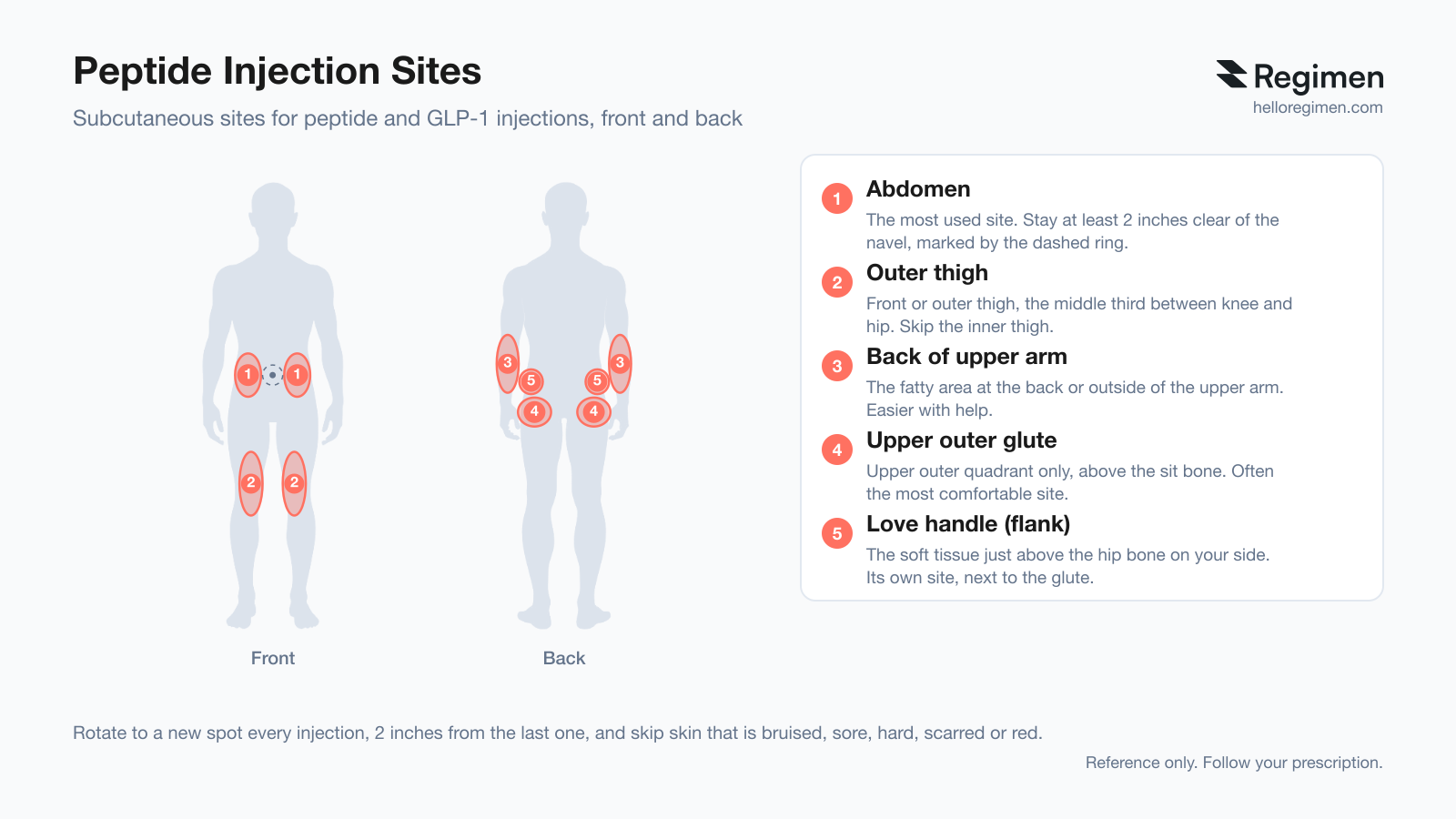
For subcutaneous (SQ) injections - which is what you’re doing with peptides, GLP-1s, and often TRT microdosing - you need areas with a decent layer of subcutaneous fat. Here are the seven main sites, with specific landmarks so you’re not guessing.
1. Abdomen - Left Side
2+ inches from the belly button, in the soft tissue between your hip bone and navel. Avoid the midline (linea alba) and any visible veins. This is the “default” for most self-injectors - easy to reach, good fat layer, relatively painless.
2. Abdomen - Right Side
Mirror of the left. Same rules: 2+ inches from the navel, avoid the midline. Together with the left side, you can create 4-6 distinct spots across the lower abdomen.
3. Upper Thigh - Left
Front or outer side of your thigh, roughly the middle third (between knee and hip). Pinch the area - if you can grab a fold of tissue, it works. Avoid the inner thigh (more nerve endings, more pain). The outer-front quadrant is the sweet spot.
4. Upper Thigh - Right
Mirror of the left. Thighs are great rotation partners for the abdomen - completely different tissue area, minimal overlap in terms of tissue stress.
5. Upper Glutes ⭐
The upper-outer quadrant of your buttocks - the meaty area above your sit bones. Most people have plenty of subcutaneous fat here, making it one of the most comfortable injection spots with fewer nerve endings than the abdomen.
Caveat: Harder to reach and see, so use a mirror or inject by feel. Most people find it easiest standing up.
6. Love Handles (Flanks) ⭐
The soft tissue just above the hip bone on your sides/back - the “love handle” area. A separate site from the upper glutes with its own fat pad. Great for people who carry weight here. Easy to reach with one hand.
7. Upper Arm - Back/Tricep Area (Optional)
Back of the upper arm, between shoulder and elbow. You need enough tissue to pinch - leaner individuals may not have enough here. This is the hardest site to self-inject (one-handed, decent flexibility). Many daily injectors skip arms entirely and stick to abdomen/thigh/glute, which is totally fine.
| Site | Ease | Pain | Best For |
|---|---|---|---|
| Abdomen (L/R) | ⭐⭐⭐⭐⭐ | Low | GLP-1, peptides, daily protocols |
| Thigh (L/R) | ⭐⭐⭐⭐ | Low–Med | TRT subQ, peptides, IM injections |
| Upper Glutes | ⭐⭐⭐ | Very Low | Larger volumes, leaner individuals |
| Love Handles | ⭐⭐⭐⭐ | Low | Easy to reach, good fat layer |
| Upper Arm | ⭐⭐ | Low | Partner assist, less frequent injections |
What are the best practices for peptide injection site rotation?
- Use a 7-day rotation pattern. Map out 7 distinct sites (left/right abdomen quadrants, left/right outer thigh, left/right upper arm, glute) and assign one to each day. Don’t reuse a site within 4 days.
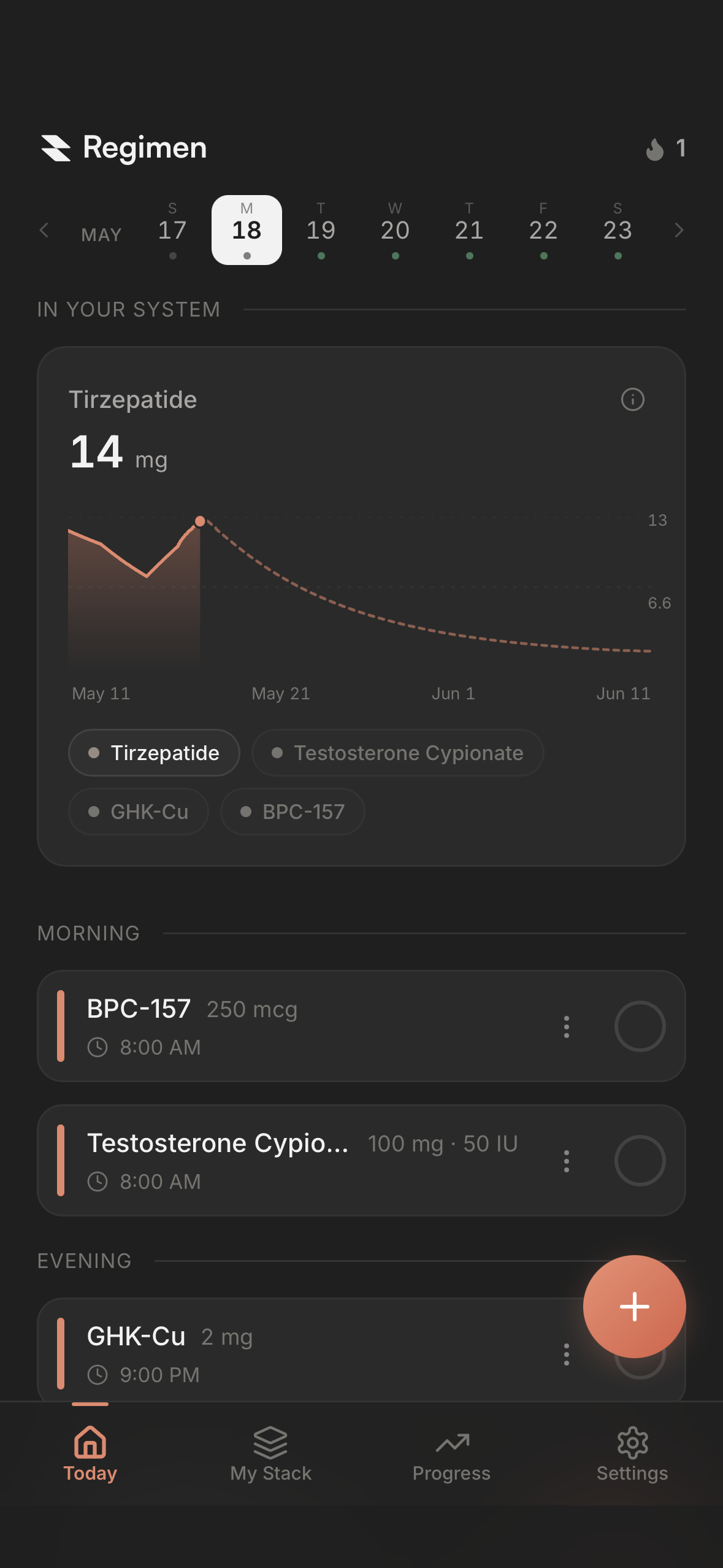
- Track sites in an app. Manual tracking fails after a week. A peptide tracker app like Regimen logs each injection automatically with site selection.
- Watch for hardness or lumps. Lipohypertrophy (hardened fat tissue) develops if you reuse a site too often. If you feel firmness, skip that site for 2 to 3 weeks.
- Match site to peptide. Subcutaneous peptides (BPC-157, TB-500, semaglutide) work in any fatty area. Intramuscular peptides (some HGH protocols) need glute or delt.
- Stay 2 inches from previous injection. Within a single quadrant, space injections at least 2 inches apart to avoid local tissue saturation.
How often should I rotate peptide injection sites?
Every injection. Daily peptides (BPC-157, TB-500) need a new site every day. Weekly peptides (semaglutide, tirzepatide) need a new site every week, but a 4-week rotation prevents tissue overuse.
Does injection site affect peptide absorption?
For subcutaneous peptides, only marginally. Abdominal injections absorb slightly faster than thigh due to higher capillary density. The difference is small enough that protocol consistency matters more than site choice. The exception is GLP-1 medications, which the FDA-approved labeling specifies for abdomen, thigh, or upper arm, all SubQ.
How to Build a Rotation Pattern
The key to rotation is making it automatic. If you have to think about it every time, you won’t do it. Here are three systems that work, depending on how often you inject:
The 4-Site Rotation (Most Common)
For people injecting 1-4 times per week:
- Left abdomen
- Right abdomen
- Left thigh
- Right thigh
- Repeat from #1
With weekly GLP-1 injections, each site gets a full month of rest. Simple, effective, and you don’t need to think about arms or glutes.
The 6-Site Rotation (Daily Injectors)
For daily protocols (BPC-157, microdosing TRT, etc.):
- Left abdomen
- Right thigh
- Right abdomen
- Left thigh
- Left glute/love handle
- Right glute/love handle
- Repeat from #1
Notice how we alternate sides - left → right → right → left. This prevents hitting the same general area on consecutive days.
The Clock System (Advanced)
Within each major site (like the abdomen), imagine a clock face:
- 12 o’clock (above navel line)
- 3 o’clock (lateral)
- 6 o’clock (below navel line)
- 9 o’clock (other lateral)
Combined with a 6-site rotation, you’re hitting 24 distinct spots before repeating. Overkill? Maybe. But your tissue will thank you.
Injection Technique Tips That Actually Help
Good technique makes the difference between “barely felt it” and “why is this bruising.” Here’s what actually matters:
Proper subcutaneous technique: pinch & lift a skin fold, insert at 45°, inject slowly over 5–10 seconds.
The Pinch
Gently pinch a fold of skin and fat - about 1-2 inches of tissue lifted. Don’t death-grip it. A gentle lift creates enough separation between subcutaneous fat and muscle.
The Angle
45 degrees if you’re leaner. 90 degrees if you have a decent fat layer. When in doubt, 45° works for almost everyone - the short needle on insulin syringes (29-31 gauge, ½ inch) makes it hard to accidentally go intramuscular.
The Speed
Insert the needle in one smooth motion - hesitating actually hurts more. Think dart throw, not slow push. Once the needle is in, inject the medication slowly (5-10 seconds). Fast injection creates pressure that causes pain.
Post-Injection
Wait 5-10 seconds before withdrawing. Don’t rub the site - light pressure with a cotton ball is fine. A small drop of blood? Totally normal. You nicked a capillary. Not a problem.
The ice trick: If you’re sensitive to needles, hold an ice cube on the injection site for 15-30 seconds before injecting. Numbs the area enough to make the needle nearly undetectable. Most people don’t need this after their first few injections, but it’s great training wheels.
Compound-Specific Site Considerations
GLP-1 Medications (Semaglutide, Tirzepatide)
Most manufacturers recommend the abdomen as the primary site, with thighs and upper arms as alternatives. Because GLP-1s are typically injected once per week, a simple 4-site rotation gives each spot a full month of rest.
When you’re paying $200+ per vial, you want every microgram absorbed properly. Fresh tissue = predictable absorption = better results.
Peptides (BPC-157, TB-500)
Peptides are the most flexible. BPC-157 has an interesting property: some users inject near the injury site for localized effects, while others inject subcutaneously in the abdomen and report systemic benefits.
TB-500 is fully systemic regardless of injection site, so location matters less. Inject wherever is convenient in your rotation.
TRT (Subcutaneous vs. Intramuscular)
Traditional TRT uses intramuscular (IM) injection in the glute or deltoid. But subcutaneous TRT has gained massive traction, especially with daily microdosing protocols.
Rule of thumb: If you’re injecting 0.1-0.2mL daily (microdosing), subcutaneous works great. For larger volumes (0.5mL+ weekly), intramuscular is usually more comfortable. Some users report small subQ nodules with higher volumes.
From the community
“I was injecting semaglutide in my left stomach every single week for 3 months. Switched to my thigh and the nausea came back like week one. Same dose. The tissue was just absorbing differently.” - r/Ozempic
What Size Needle for Subcutaneous Peptide Injections?
This is one of the most common questions beginners ask - and the answer is simpler than you’d think.
| Use | Needle Gauge | Length | Notes |
|---|---|---|---|
| SubQ injection (peptides, GLP-1, TRT micro) | 29–31 gauge | ½ inch (12.7mm) | Standard insulin syringe. Minimal pain. |
| Reconstitution (drawing BAC water) | 18–22 gauge | 1–1.5 inch | Larger gauge = faster draw. Never inject with these. |
| IM injection (TRT weekly dose) | 25–27 gauge | 1–1.5 inch | Glute or deltoid. For volumes > 0.5mL. |
The simple rule: If you’re injecting peptides, semaglutide, tirzepatide, BPC-157, or any other subcutaneous compound, grab a standard insulin syringe (29–31 gauge, ½ inch). That’s all you need. The needle is thin enough that most people barely feel it, and the half-inch length is perfect for subcutaneous depth.
For a deeper dive on syringe markings and how to read units, see our visual guide to reading insulin syringes.
When to Skip a Site
Sometimes a site needs extra rest. Skip it and move to the next in your rotation if you notice:
- A hard lump under the skin. Could be lipohypertrophy or a subcutaneous nodule. Let it resolve completely before using that spot again.
- Bruising that hasn’t faded. A small bruise from a nicked capillary clears in 2-3 days. Still there after a week? Skip that area.
- Persistent tenderness. If pressing on a site hurts even a week after the last injection, the tissue needs more time.
- Broken or irritated skin. Sunburn, rash, cuts - wait until it’s fully healed.
When to actually worry: Injection site redness that’s spreading, increasing pain after 48 hours, warmth and swelling with fever - these are signs of infection. Don’t Reddit it. See a doctor.
Tracking Your Injection Sites
Here’s the uncomfortable truth: your memory is not as good as you think.
After a few weeks of daily injections, try to remember which exact spot you used last Thursday. Can’t? Nobody can. That’s why tracking matters.
Some people use a notebook - “Mon: left abdomen, Tue: right thigh.” That works until you’re running three compounds on different schedules and each needs its own rotation.
A dedicated tracker like Regimen lets you log each injection with the site used, see your rotation history at a glance, and catch patterns you’d never notice in a notebook - like accidentally favoring your left side for two straight weeks.
Frequently Asked Questions
Is there an app that tracks injection sites so you don’t hit the same spot?
Yes. Regimen records the site with every dose and shows your rotation history as a body map, so the next spot is already picked before you draw. It keeps a separate rotation per compound, which is the part a notebook falls down on once you are running more than one thing on different schedules. Free for one compound.
Where is the best place to inject peptides subcutaneously?
The abdomen (2+ inches from the navel) is the most popular site for subcutaneous peptide injections. It’s easy to reach, has a good fat layer, and provides consistent absorption. Thighs and upper arms are also viable alternatives.
How often should I rotate injection sites?
Rotate with every injection. For daily injections, use a 4-6 site rotation (left/right abdomen, left/right thigh, and optionally left/right upper arm). Each site should get at least a week of rest between uses to prevent scar tissue buildup.
What happens if I don’t rotate injection sites?
Repeated injections in the same spot cause lipohypertrophy - hardened, lumpy tissue that absorbs medication poorly. This leads to inconsistent blood levels, reduced effectiveness, and can explain unexplained plateaus on GLP-1 medications or reduced peptide efficacy.
Should I inject BPC-157 near my injury or in my stomach?
Both approaches are used. Some users inject BPC-157 subcutaneously near the injury site for localized effects, while others inject in the abdomen and report systemic benefits. For gut healing, abdominal injection or oral administration is standard. TB-500 is fully systemic regardless of injection site.
Can I inject GLP-1 medications in my thigh instead of my stomach?
Yes. Semaglutide and tirzepatide can be injected in the abdomen, thigh, or upper arm. The abdomen tends to have the most consistent absorption, but thighs are a perfectly valid alternative. Rotate between multiple sites regardless of which you prefer.
What angle should I use for subcutaneous injections?
For subcutaneous injections with insulin needles (29-31 gauge, ½ inch), use a 45-degree angle if you’re lean or a 90-degree angle if you have adequate subcutaneous fat at the site. When in doubt, 45 degrees works for almost everyone.
Is it normal to bruise after a subcutaneous injection?
Small bruises are common and mean you nicked a tiny capillary - it’s not a sign of incorrect technique. They typically resolve in 2-3 days. To minimize bruising, don’t rub the site after injecting, and apply gentle pressure with a cotton ball for 10-15 seconds.
How do I know if I have scar tissue from injections?
Feel for hard lumps, thickened skin, or areas that are consistently more painful to inject. Lipohypertrophy can feel like a rubbery mass under the skin. If you find one, avoid that site entirely until it resolves and tighten up your rotation pattern.
Are peptides injected SubQ or IM?
Most peptides are subcutaneous (SubQ): belly, outer thigh, upper arm, or upper outer glute. A smaller set, including some TB-500 and certain HGH protocols, can be intramuscular (IM). When in doubt, SubQ is correct for the majority of common peptides including BPC-157, GHK-Cu, semaglutide, tirzepatide, and retatrutide.
Where exactly do you inject peptides subcutaneously?
The four standard SubQ sites are the abdomen (1 to 2 inches from the navel), the outer thigh, the upper arm, and the upper outer glute. Pinch a small amount of fat, insert the needle at a 45-degree angle, and inject slowly. All four sites absorb at roughly the same rate, so the choice comes down to comfort and rotation.
Can you inject peptides in the glute?
Yes. The upper outer glute is a valid and popular SubQ site. It has ample subcutaneous fat for most people and many prefer it for comfort or to rotate away from the abdomen and thighs. Use a short needle (5/16 inch) at a 45-degree angle into pinched skin to stay SubQ. The glute can also be used for IM injections when a protocol specifically calls for it; for IM, use a longer needle without the pinch technique.
How do you rotate peptide injection sites?
Rotate between at least three sites to avoid buildup of scar tissue and lipodystrophy. A simple pattern: abdomen left, thigh right, glute left, upper arm right, then repeat. Using a tracker app to log each injection site makes rotation automatic and consistent.
How deep do you inject a SubQ peptide?
Use a short needle, typically 29 to 31 gauge, 5/16 inch (8mm). Insert at a 45-degree angle into pinched skin. For most people this reaches the subcutaneous layer without going IM. If you are very lean, a shallower angle reduces the chance of hitting muscle.
Never guess your next injection site
Regimen logs your injection sites, rotation pattern, dose timing, and progress - all in one app. Free for your first compound.
Related Articles
Calculate your peptide dose before injecting
Free reconstitution calculator for any peptide.
Everything you need before your first injection.
BPC-157 + TB-500 Recovery Stack
Dosing, timing, and what to expect week by week.
Step-by-step reconstitution with dosing chart.
Disclaimer: This article is for informational purposes only and is not medical advice. Injection technique should be learned from a qualified healthcare provider. Peptides discussed may not be approved for human use. Always consult your provider before starting any injection protocol.
Ready to track your protocol?
- Smart reminders so you never miss a dose
- Track weight, photos, and progress over time
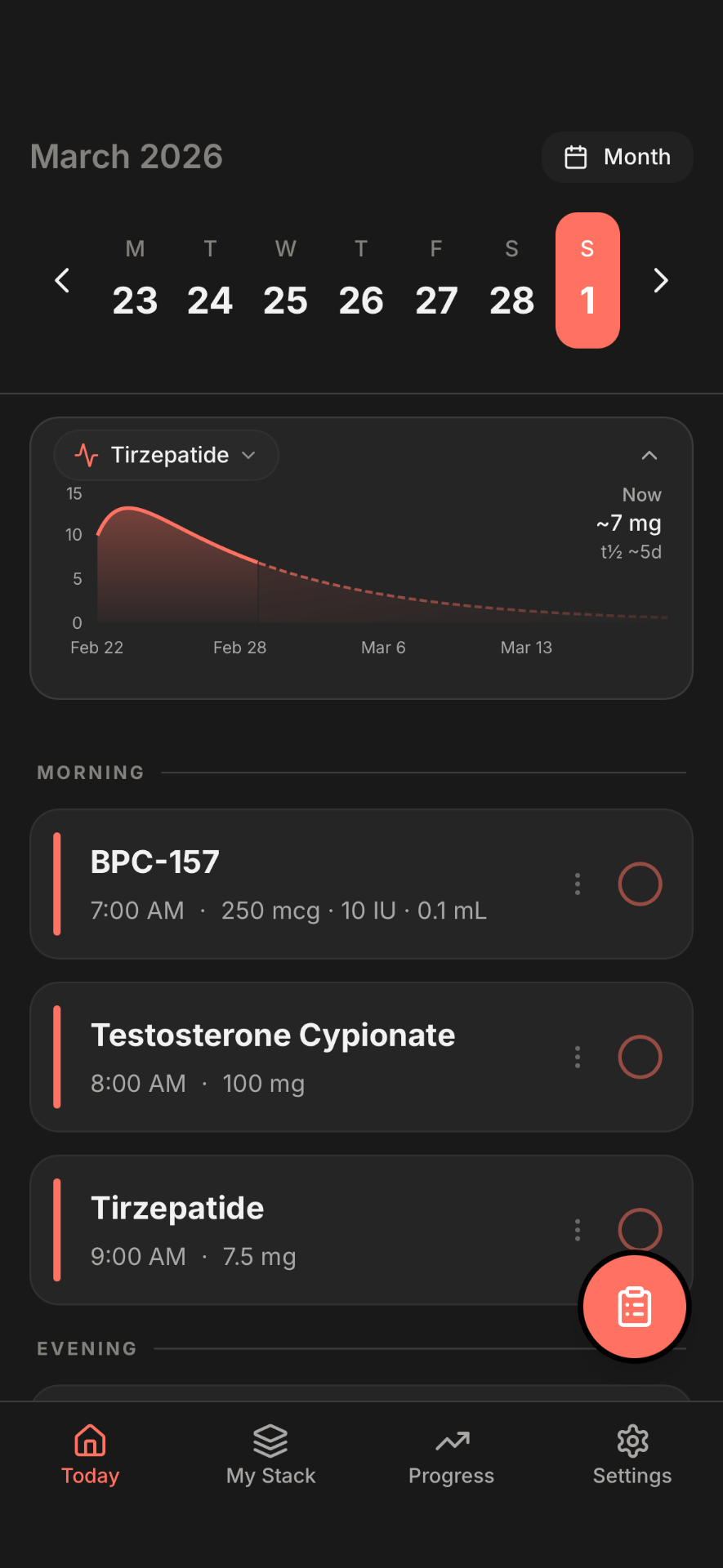
- Medication level curves for every compound