You’ve got your peptide vials. You’ve got bacteriostatic water. Now you’re staring at them wondering: how much water do I add, and how do I figure out the dose?
This is where most people get stuck. The math isn’t complicated, but one mistake means you’re either underdosing (wasting money) or overdosing (wasting peptides and risking side effects).
Here’s everything you need to know about reconstituting peptides, with a calculator that does the math for you.
Skip the math, use the calculator
Open the Peptide CalculatorEnter your vial size, BAC water and dose, and it shows the exact units to draw. For GLP-1 dose math (semaglutide, tirzepatide, retatrutide), open the GLP-1 Dose Calculator. For “how long will my vial last?” planning, use the Vial Longevity Calculator. Both run the conversions below automatically.
Quick reference: BAC water to insulin-syringe units
On a standard U100 insulin syringe, 1mL equals 100 units. So:
- 1mL BAC water = 100 units total in the vial
- 2mL BAC water = 200 units total in the vial
- 3mL BAC water = 300 units total in the vial
Then to draw a dose: units to draw = (dose ÷ vial strength) × total units. Example: a 5mg vial in 2mL water (200 units) at a 0.5mg dose = (0.5 ÷ 5) × 200 = 20 units. The “Real-World Examples” and “Understanding Syringe Measurements” sections below run through more compound-specific cases.
What Is Peptide Reconstitution?
Peptide reconstitution is the process of mixing a lyophilized (freeze-dried) peptide powder with bacteriostatic water to create an injectable solution. Most research peptides, including BPC-157, TB-500, semaglutide, and tirzepatide, are shipped as powder and must be reconstituted before use.
Peptides are stable in powder form and can be shipped without refrigeration. But you can’t inject powder. You need to add bacteriostatic water to turn it into liquid. That’s reconstitution.
The process:
- You add a specific amount of bacteriostatic water to the vial
- The powder dissolves
- Now you can draw the liquid into a syringe and inject it
Why the math matters:
The amount of water you add determines your dose size. Too much water and you’re injecting huge volumes. Too little water and you can’t measure small doses accurately.
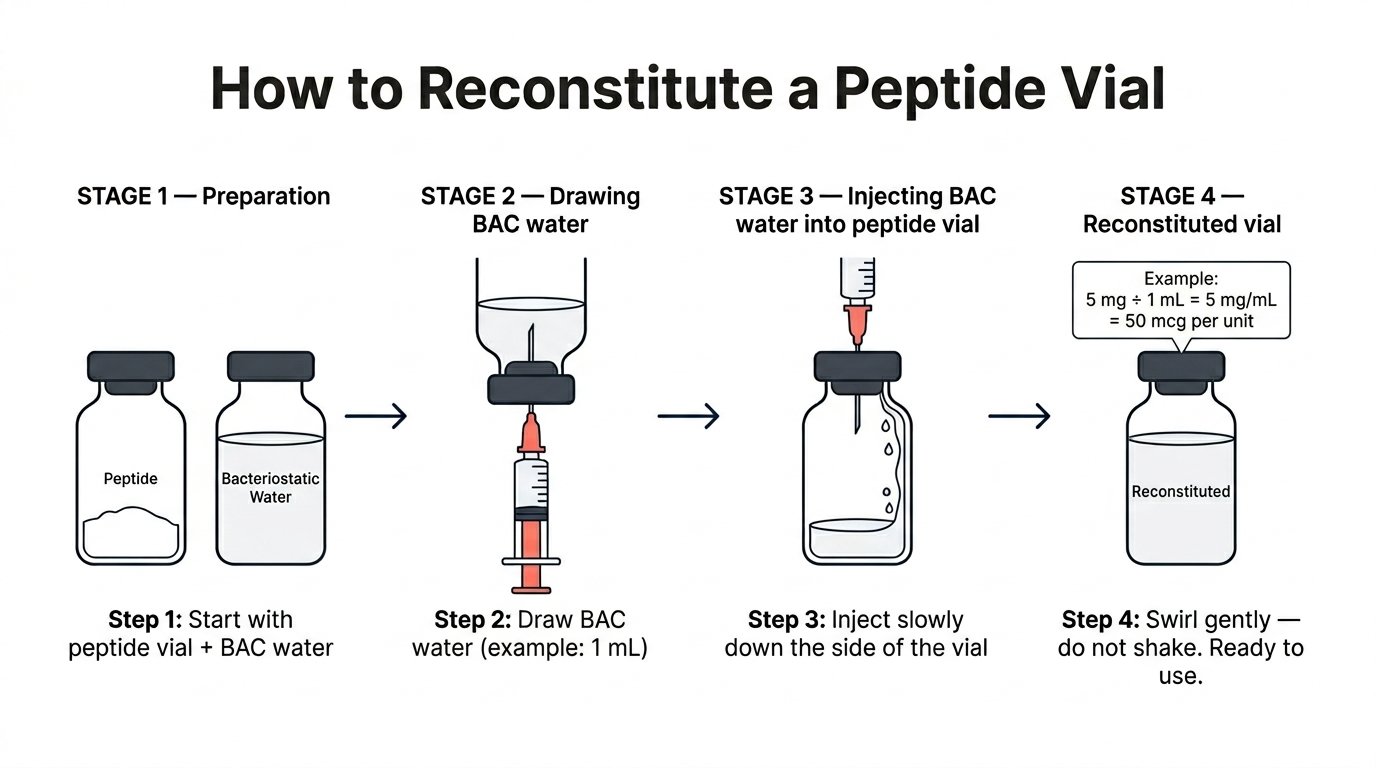
Reconstituting a peptide vial with bacteriostatic water. Get exact volumes for your vial size and target dose with the Peptide Reconstitution Calculator.
Use Our Peptide Reconstitution Calculator
Skip the Math
Enter your peptide amount, water volume, and desired dose. The calculator tells you exactly how many units to draw.
What you need:
- Amount of peptide in your vial (usually 5mg or 10mg)
- Amount of bacteriostatic water you plan to add (usually 2mL)
- Your desired dose (250mcg, 500mcg, 2.5mg, etc.)
What the calculator tells you:
- How many units to draw on your syringe
- Your concentration (mg/mL)
- Total number of doses in the vial
Example:
- Peptide: 5mg BPC-157
- Water: 2mL
- Dose: 250mcg
Result: Draw 10 units on your syringe. This vial gives you 20 doses.
Real-World Examples
Example 1: Compounded Tirzepatide
What you have:
- 10mg Tirzepatide vial (from telehealth or compounding pharmacy)
- 2mL bacteriostatic water
- Want 2.5mg dose (common starting dose)
Calculator inputs:
- Peptide: 10mg
- Water: 2mL
- Dose: 2.5mg (or 2500mcg)
Result:
- Draw 50 units on your syringe
- Total doses: 4 injections
If you inject weekly: This vial lasts 1 month.
Note: This is for compounded tirzepatide powder that you mix yourself, not the Mounjaro or Zepbound pens you get from a pharmacy. Those come pre-filled and ready to use.
Example 2: Compounded Semaglutide
What you have:
- 5mg Semaglutide vial (from compounding pharmacy)
- 2mL bacteriostatic water
- Want 0.5mg dose (common maintenance dose)
Result:
- Draw 20 units on your syringe
- Total doses: 10 injections
If you inject weekly: This vial lasts 10 weeks.
Important: This applies to compounded semaglutide powder, not Ozempic or Wegovy pens from your pharmacy. Those are pre-mixed and have their own dosing system.
Example 3: HCG for TRT
What you have:
- 5000 IU HCG vial
- 2mL bacteriostatic water
- Want 250 IU per dose (common for maintaining testicular function on TRT)
Result:
- Draw 10 units on your syringe
- Total doses: 20 injections
Note: HCG uses IU (International Units) instead of mg, but the math works exactly the same way. If you inject twice weekly, this vial lasts 10 weeks.
Example 4: BPC-157
What you have:
- 5mg BPC-157 vial
- 2mL bacteriostatic water
- Want 250mcg per dose (common starting dose)
Result:
- Draw 10 units on your syringe
- Total doses: 20 injections
If you inject twice daily: This vial lasts 10 days.
Example 5: CJC-1295
What you have:
- 2mg CJC-1295 vial
- 2mL bacteriostatic water
- Want 100mcg per dose (common dosing)
Result:
- Draw 10 units on your syringe
- Total doses: 20 injections
If you inject 3x weekly: This vial lasts about 6-7 weeks.
Peptide Dosing Chart
This peptide dosing chart puts the five examples above in one table: the vial, a common dose, and the units to draw on a U-100 insulin syringe, all with 2 mL of bacteriostatic water. The doses are common starting or maintenance amounts, not a recommendation. Your provider or protocol sets yours.
Peptide dosing chart (2 mL BAC water, U-100 syringe)
| Peptide | Vial | Common dose | Units to draw |
|---|---|---|---|
| Tirzepatide (compounded) | 10 mg | 2.5 mg (starting dose) | 50 units |
| Semaglutide (compounded) | 5 mg | 0.5 mg (maintenance dose) | 20 units |
| BPC-157 | 5 mg | 250 mcg (starting dose) | 10 units |
| CJC-1295 | 2 mg | 100 mcg | 10 units |
| HCG | 5000 IU | 250 IU | 10 units |
The most common BPC-157 setup among Regimen users is a 10 mg vial mixed with 2 mL of bacteriostatic water. If your vial or water is different from the chart, every unit number changes, so enter your own numbers in the peptide calculator. See all Regimen data.
Common Reconstitution Mistakes to Avoid
| Mistake | Why It Matters |
|---|---|
| Shaking the vial instead of swirling | Can denature the peptide, reducing potency by up to 50% |
| Using sterile water instead of BAC water | No preservative means bacterial growth risk in multi-use vials |
| Injecting water directly onto the powder cake | Can damage fragile peptide molecules on contact |
| Not labeling the vial after reconstitution | Risk of mixing up compounds or forgetting the reconstitution date |
| Storing at room temperature after reconstitution | Reconstituted peptides degrade significantly within hours at room temp |
Mistake 1: Using Sterile Water Instead of Bacteriostatic Water
The problem: Sterile water has no preservative. Bacteria can grow in it.
Why it matters: If you’re doing multiple injections from one vial, you need pharmaceutical-grade bacteriostatic water with 0.9% benzyl alcohol as preservative.
Exception: If you’re using the entire vial in one injection, sterile water is fine. But for multi-dose vials, always use bacteriostatic water.
Mistake 2: Shaking the Vial
The problem: Shaking creates foam and makes it hard to see if the powder dissolved completely.
The fix: Gently swirl the vial or roll it between your palms. The powder will dissolve on its own within a few minutes.
Mistake 3: Injecting Water Directly Onto the Powder
The problem: Creates clumping and makes dissolving take longer.
The fix: Aim the needle at the side of the vial, letting the water run down the glass. The powder will gradually dissolve without clumping.
Mistake 4: Storing Reconstituted Peptides Wrong
The problem: Heat and light degrade peptides quickly once mixed.
The fix:
- Store in refrigerator (2-8°C / 36-46°F)
- Keep in original vial (dark glass protects from light)
- Use within 4+ weeks of reconstitution (many experienced users go 6-8 weeks)
- Track start dates and cycle end dates in the Regimen app so you know exactly when each vial needs to be used by
Mistake 5: Not Knowing Your Dose Before Reconstituting
The problem: You add water, then realize you need a different concentration for your dose.
The fix: Use our calculator BEFORE you add water. Figure out your dose, see how many units you’ll need to draw, then reconstitute accordingly.
Understanding Syringe Measurements
Most people use insulin syringes for peptide injections. Here’s what the numbers mean:
Syringe sizes:
- 0.3mL syringe (30 units max)
- 0.5mL syringe (50 units max)
- 1mL syringe (100 units max)
Unit markings:
- Each line = 1 unit
- 10 units = 0.1mL
- 50 units = 0.5mL
- 100 units = 1mL
Which size to use:
0.3mL (30 unit) syringe:
- For very small doses (under 30 units)
- Easier to read precise measurements
- Best for doses under 0.3mL
1mL (100 unit) syringe:
- For larger doses (up to 100 units)
- Standard size for most peptide injections
- Good balance of precision and volume
Quick reference:
- If your dose is under 30 units, use a 0.3mL syringe
- If your dose is 30-100 units, use a 1mL syringe
- If your dose is over 100 units (1mL), you’ll need multiple injections or less water
If you are converting between mcg, mL, and syringe units for peptides, the units vs mL vs mg reference guide covers every common conversion.
Once your vial is reconstituted, you will want to log every draw so you do not lose track of doses remaining. Our roundup of the best peptide tracker apps compares the options built for exactly this.
How Much Water Should I Use?
The most common amounts are 1mL, 2mL, or 3mL of bacteriostatic water. Use our calculator to see how different water amounts affect your dosing.
Here’s how water amount affects your protocol:
Choose 2mL if:
- You’re new to peptides
- You want standard dosing
- You want less injection volume per dose
- Your protocol is straightforward
Example:
- 5mg peptide + 2mL water = 2.5mg/mL concentration
- For 250mcg dose = 10 units
- 20 doses per vial
Choose 3mL if:
- You’re dosing very small amounts
- You want maximum precision
- You’re nervous about measuring accurately
- You have plenty of fridge space
Example:
- 5mg peptide + 3mL water = 1.67mg/mL
- For 250mcg dose = 15 units
- 20 doses per vial
Notice: Total doses stays the same. Only the units per injection changes.
The right choice: Whatever makes you comfortable measuring accurately. There’s no wrong answer as long as you can measure the units precisely on your syringe.
Step-by-Step: How to Reconstitute Peptides
What you need:
- Peptide vial (freeze-dried powder)
- Bacteriostatic water
- Alcohol wipes
- 3mL syringe with needle (for mixing)
Steps:
- Calculate your dose first. Use our peptide calculator to figure out how much water to add and how many units you’ll draw per injection. Don’t skip this step.
- Clean the rubber stopper. Wipe the top of the peptide vial with an alcohol wipe. Let it dry.
- Draw bacteriostatic water. Using a 3mL syringe, draw the amount of bacteriostatic water from step 1 (usually 2mL).
- Add water to the vial. Insert the needle into the peptide vial at an angle. Aim for the side of the glass, not directly at the powder. Slowly push the plunger, letting the water run down the inside wall of the vial.
- Let it dissolve. Remove the needle. Gently swirl (don’t shake) the vial. The powder should dissolve within 1-2 minutes. If you see particles, let it sit for another minute and swirl again.
- Inspect the solution. It should be clear, not cloudy. If it’s cloudy or has particles that won’t dissolve, the peptide might be degraded. Don’t use it.
- Store and track. Store in the refrigerator immediately. Log the start date in Regimen so you get notified when your cycle is ending.
- Draw your dose. Based on the calculator results from step 1, draw the correct number of units for each injection.
Tracking Your Reconstituted Peptides
Once you’ve mixed your peptides, you need to track when you started and when they expire.
Essential tracking:
- Start date (when you reconstituted)
- Amount of water used
- How many doses you’ve taken
- Cycle end date
Better tracking:
- Mark each dose when you take it
- Daily notes (injection sites, how you felt)
- Progress over time with photos
Why this matters:
Scenario 1: Multiple vials
You’re running tirzepatide, BPC-157, and CJC-1295. You have 3 vials in your fridge. Which one did you mix first? When does each expire? Without tracking, you’re guessing. And using expired peptides means wasting money on degraded compounds.
Scenario 2: Adjusting doses
You started tirzepatide at 2.5mg, then increased to 5mg. How did you feel at each dose? When did side effects kick in? When did you notice the best results? Without tracking, you can’t optimize your protocol.
How Long Do Reconstituted Peptides Last?
In powder form (unmixed):
Most peptides are stable for 1-2 years when stored properly (frozen or refrigerated, away from light).
After reconstitution:
- Standard: 4+ weeks in the fridge
- Experienced users: Many go 6-8 weeks without issues
Factors that affect stability:
- Temperature (colder = more stable)
- Light exposure (dark glass vials protect peptides)
- Number of times you’ve poked the vial (more pokes = more contamination risk)
- Contamination (use proper sterile technique)
- Specific peptide (some are more fragile than others)
Signs your peptide has degraded:
- Solution becomes cloudy (when it was clear before)
- Particles floating in the liquid
- Color change
- Reduced effectiveness (not working like it used to)
When in doubt, throw it out. Degraded peptides won’t hurt you, but they won’t work either. You’re just wasting money injecting ineffective solution.
How to Reconstitute Tirzepatide
Compounded tirzepatide (the active ingredient in Mounjaro and Zepbound) typically comes in 5mg, 10mg, 15mg, or 30mg vials. This is the lyophilized powder form you mix yourself - not the pre-filled autoinjector pens from the pharmacy.
Common tirzepatide reconstitution:
- 5mg vial + 1mL BAC water = 5mg/mL → For a 2.5mg dose, draw 50 units
- 10mg vial + 2mL BAC water = 5mg/mL → For a 2.5mg dose, draw 50 units
- 10mg vial + 1mL BAC water = 10mg/mL → For a 5mg dose, draw 50 units
- 30mg vial + 3mL BAC water = 10mg/mL → For a 5mg dose, draw 50 units
Tirzepatide is injected once weekly, subcutaneously. Most people start at 2.5mg and titrate up every 4 weeks. Use our peptide reconstitution calculator to get exact syringe units for your specific vial size and dose, or check the GLP-1 titration planner for a week-by-week schedule.
How to Reconstitute Semaglutide
Compounded semaglutide (the active ingredient in Ozempic and Wegovy) is commonly available in 3mg, 5mg, and 10mg vials. Like tirzepatide, this is the powder form - not the brand-name pens.
Common semaglutide reconstitution:
- 5mg vial + 2mL BAC water = 2.5mg/mL → For a 0.25mg dose, draw 10 units
- 5mg vial + 1mL BAC water = 5mg/mL → For a 0.5mg dose, draw 10 units
- 3mg vial + 1.2mL BAC water = 2.5mg/mL → For a 0.25mg dose, draw 10 units
Semaglutide is injected once weekly. Starting dose is typically 0.25mg for 4 weeks, then 0.5mg. Use our reconstitution calculator to calculate exact units for your vial.
How to Reconstitute BPC-157
BPC-157 is one of the most common peptides for injury recovery. It typically comes in 5mg vials, though 10mg vials are also available.
Common BPC-157 reconstitution:
- 5mg vial + 2mL BAC water = 2.5mg/mL → For 250mcg dose, draw 10 units
- 5mg vial + 1mL BAC water = 5mg/mL → For 250mcg dose, draw 5 units
- 10mg vial + 2mL BAC water = 5mg/mL → For 500mcg dose, draw 10 units
BPC-157 is typically injected 1-2x daily, subcutaneously. Most people use 2mL of water for easier measurement. A 5mg vial at 250mcg/dose gives you 20 doses. Check our peptide calculator for your exact setup, or read our BPC-157 stacking guide for full dosing protocols.
FAQs
What does a peptide dosing chart show?
A peptide dosing chart lists, for each peptide, the vial size, the water added, a common dose and the units to draw on an insulin syringe. With 2 mL of bacteriostatic water and a U-100 syringe: tirzepatide 10 mg vial, 2.5 mg = 50 units; semaglutide 5 mg vial, 0.5 mg = 20 units; BPC-157 5 mg vial, 250 mcg = 10 units; CJC-1295 2 mg vial, 100 mcg = 10 units; HCG 5000 IU vial, 250 IU = 10 units. Your dose comes from your provider or protocol; the chart only converts it.
Can I use sterile water instead of bacteriostatic water?
Only if you’re using the entire vial in one injection. For multi-dose vials (which is most cases), you need pharmaceutical-grade bacteriostatic water. The benzyl alcohol preservative prevents bacterial growth.
What if I add the wrong amount of water?
The peptide is still good. You just need to recalculate your dose using the actual amount of water you added. Use our calculator with the correct water amount.
Can I mix peptides in the same vial?
Some peptides are sold as pre-mixed blends (like BPC-157/TB-500 or GLOW/KLOW blends), and these are generally safe when sourced from reputable suppliers who verify compatibility. However, mixing your own peptides is not recommended - different compounds have different stability profiles, pH requirements, and potential interactions. If you already have a blended vial, use our Peptide Blend Calculator to see exactly how much of each compound you’ll get per injection.
How do I know if my peptide is real?
Look for a Certificate of Analysis (COA) from the supplier. Real peptide vendors provide third-party lab testing showing purity. If they won’t provide a COA, don’t buy from them. How to read a peptide COA walks through a report field by field.
My vial is cloudy after mixing. Is it bad?
Most peptides should be crystal clear after reconstitution. A slight initial haze that clears within 30–60 seconds of gentle swirling is normal - the lyophilized powder is dissolving. But if the solution stays cloudy, has visible particles floating in it, or looks milky after 2–3 minutes, don’t use it. Common causes of persistent cloudiness:
- Contamination - bacteria or mold growth (especially if you used sterile water instead of BAC water for multi-dose vials)
- Degradation - peptide was stored improperly before reconstitution (heat exposure, left unrefrigerated too long)
- Expired BAC water - check the expiration date on your bacteriostatic water
- Too much agitation - if you shook the vial vigorously instead of gently swirling, some peptides can denature and form visible aggregates
When in doubt, discard the vial. A $30–50 peptide isn’t worth the risk of injecting degraded or contaminated product.
How long do reconstituted peptides last in the fridge?
When mixed with bacteriostatic water and stored at 2–8°C (standard refrigerator temperature), most peptides last 28 days. Some more stable peptides like BPC-157 may last up to 6 weeks, but 4 weeks is the safe standard. If mixed with sterile water (no preservative), use within 24–48 hours. Key storage rules:
- Always store reconstituted vials upright in the refrigerator
- Don’t store in the door - temperature fluctuates too much
- Label every vial with the reconstitution date
- If the solution changes color, becomes cloudy, or smells off - discard immediately
Can I freeze reconstituted peptides?
Not recommended. Freeze-thaw cycles affect peptide stability and can cause denaturation. If you have more peptide than you’ll use in 30 days, it’s better to reconstitute smaller amounts more frequently and keep unused lyophilized (powder) vials sealed in the freezer.
What size needle should I use for reconstitution vs injection?
You need two different needles for the process:
- Reconstitution (drawing + mixing): 18–22 gauge, 1–1.5 inch needle - larger bore makes it easy to draw up BAC water without excessive pressure
- Subcutaneous injection: 27–31 gauge, ½ inch needle - thin needle minimizes pain and is appropriate for shallow SubQ deposits
- Intramuscular injection: 25–27 gauge, 1–1.5 inch - longer needle reaches muscle tissue
Many people use a drawing needle to pull from the vial, then swap to a fresh injection needle. This keeps the injection needle sharp and sterile. See our Peptide Starter Kit guide for a full supply list.
Can I travel with reconstituted peptides?
Yes, but you need to maintain cold chain. Use an insulated travel case with ice packs (not frozen solid - you don’t want to freeze the peptides). TSA allows syringes and medications in carry-on bags. Tips: carry your prescription or supplier documentation, keep everything in original packaging when possible, and never check reconstituted vials in luggage (cargo holds can freeze).
What happens if I use the wrong amount of BAC water?
The peptide is still fine - you just changed the concentration. If you added more water than intended, each unit on your syringe delivers less peptide (you’ll need to draw more). If you added less water, each unit delivers more (draw less). Use our reconstitution calculator with the actual amount of water you added to get the correct dose.
Do I need to swab the vial top before drawing?
Yes, every time. Use a fresh alcohol swab on the rubber stopper before each draw. Even though BAC water contains a preservative, introducing bacteria into the vial through a dirty stopper is one of the most common causes of contamination. Let the alcohol dry for 5–10 seconds before inserting the needle.
What size needle should I use for reconstitution?
Use a larger needle (like 20-22 gauge) for drawing up bacteriostatic water and adding it to the vial. Use a smaller needle (27-30 gauge) for injecting.
How much bacteriostatic water do I add to a 5mg tirzepatide vial?
For a 5mg tirzepatide vial, adding 1mL of bacteriostatic water gives you a 5mg/mL concentration. For a 2.5mg dose, you’d draw 50 units (0.5mL). For a 10mg vial with 2mL water, the math is the same: 5mg/mL concentration. Use our peptide reconstitution calculator to get exact syringe units for any dose.
How do I reconstitute semaglutide for subcutaneous injection?
Add bacteriostatic water to your semaglutide vial (typically 2mL for a 5mg vial, giving you 2.5mg/mL). Let the powder dissolve by gently swirling — never shake. Draw your dose with an insulin syringe. For a 0.25mg starting dose from a 5mg/2mL vial, draw 10 units.
How much bacteriostatic water for a 5mg BPC-157 vial?
The most common reconstitution for BPC-157 is 2mL of bacteriostatic water in a 5mg vial, giving you 2.5mg/mL (or 250mcg per 10 units). This makes dosing simple: 10 units = 250mcg, 20 units = 500mcg. You get 20 doses of 250mcg per vial.
Related Reading
- Try our free peptide reconstitution calculator
- Use our GLP-1 dose calculator for semaglutide and tirzepatide
- BPC-157 + TB-500: The Ultimate Recovery Stack
- Peptide Blend Calculator - Dose Multi-Peptide Vials
Disclaimer: The information provided in this article is for educational and harm reduction purposes only. These peptides are research chemicals not approved by the FDA for human use. This is not medical advice. Always consult with a qualified healthcare provider before starting any peptide protocol. Improper use of peptides can cause serious side effects.
Ready to track your protocol?
- Smart reminders so you never miss a dose
- Track weight, photos, and progress over time
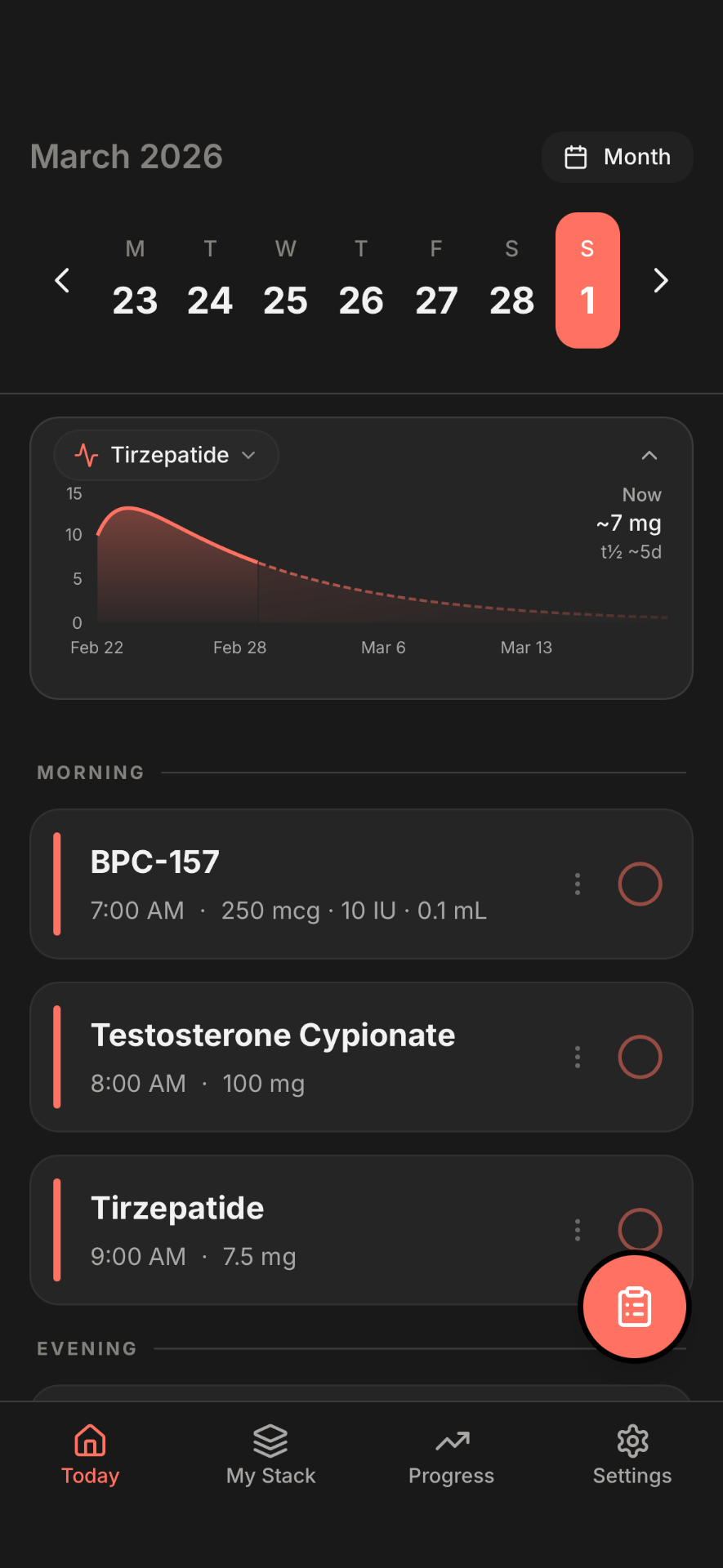
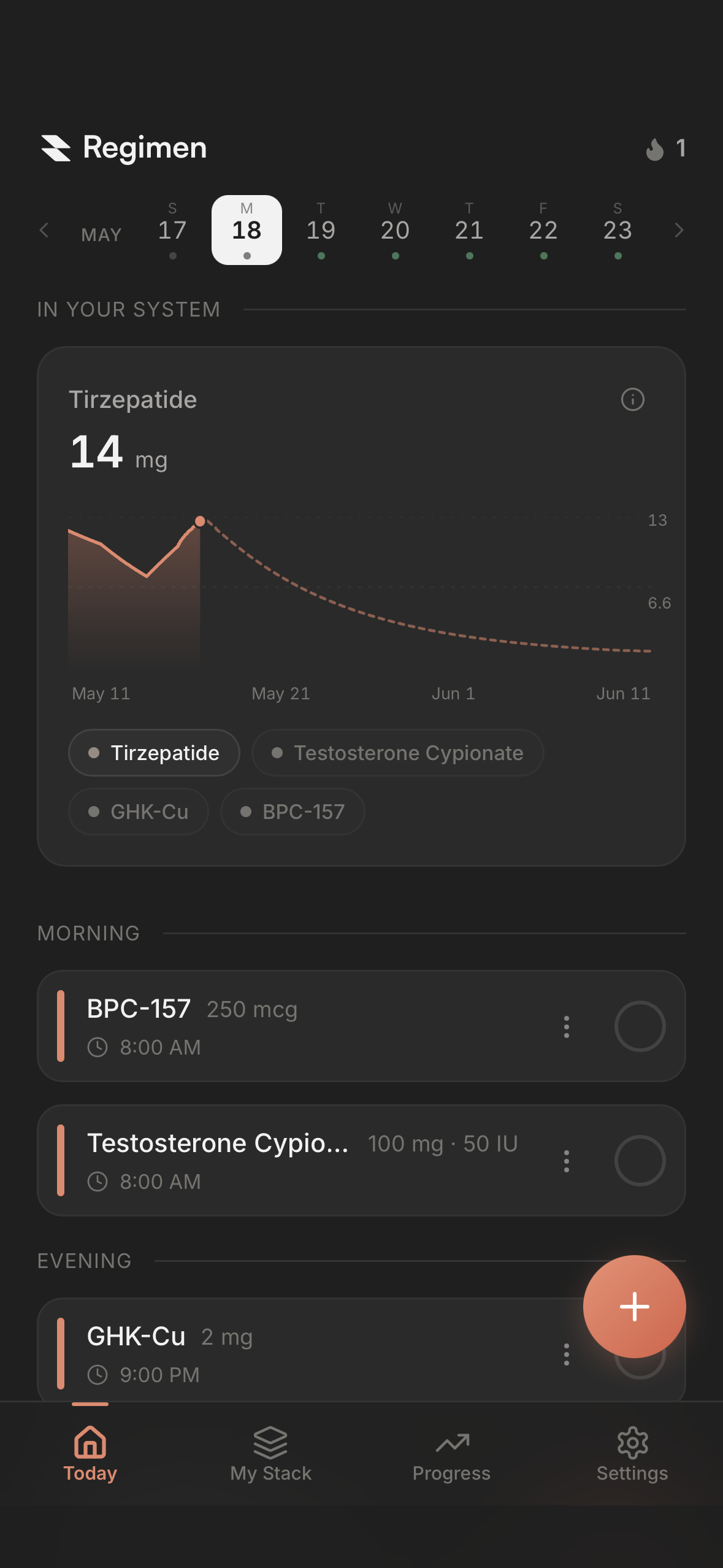
- Medication level curves for every compound