←Part of TRT, Explained: The Complete Guide
The Bottom Line
Testosterone cypionate dosing depends on three variables: your vial concentration (usually 200mg/mL), your prescribed weekly dose, and how often you inject. Most TRT patients inject between 100mg and 200mg per week, split across one, two, or seven injections depending on their protocol. Use our free TRT dose calculator to skip the math entirely - enter your concentration, dose, and frequency, and it tells you exactly how many units to draw on each injection day.
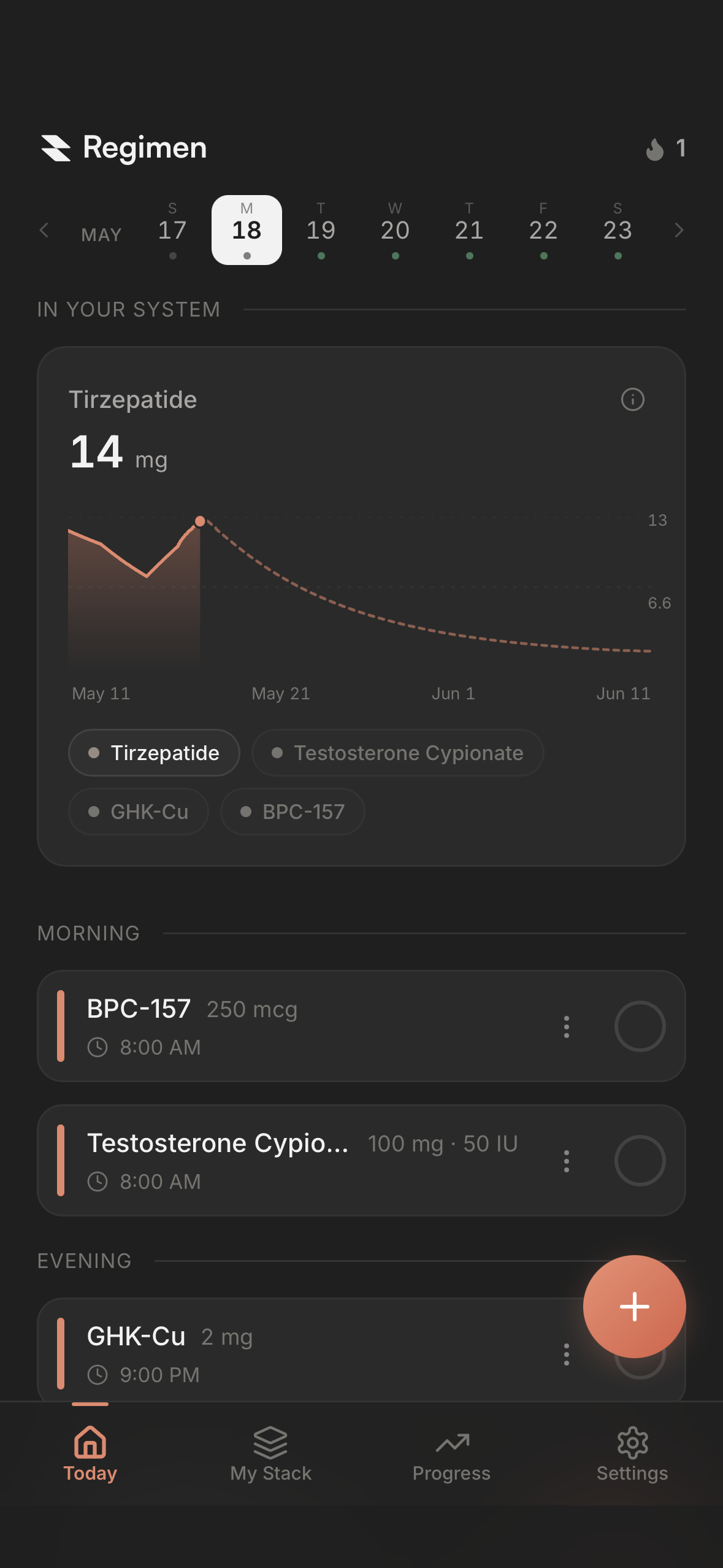
Regimen is a TRT tracker app that logs each injection and puts your bloodwork next to your doses.
Testosterone cypionate is the most commonly prescribed form of injectable testosterone in the United States for testosterone replacement therapy (TRT). It is a slow-release ester of testosterone with an apparent serum half-life of about 6.9 days (older references quote ~8 days; why the newer figure is more accurate). That release-limited profile is long enough to support once-weekly dosing but short enough that twice-weekly injections produce meaningfully more stable levels.
What Is Testosterone Cypionate?
It is available as an oil-based injectable solution in two concentrations: 200mg/mL (by far the most common) and 100mg/mL. The most recognized brand name is Depo-Testosterone, though most patients receive generic testosterone cypionate from compounding pharmacies or standard pharmacies.
Your provider prescribes a weekly milligram dose (for example, 150mg/week), and you calculate how much liquid to draw from the vial based on the concentration. That calculation is the core skill this guide teaches - and the reason we built the testosterone cypionate dosage calculator.
Pro Tip
What about testosterone enanthate? Cypionate and enanthate are nearly identical in practice. Both have an apparent serum half-life of about 6.9 days, the same injection protocols, and the same dosing math. The difference is geographic: cypionate is the US standard, while enanthate is more common internationally (especially in Europe). If your provider prescribes enanthate, everything in this guide still applies. Just confirm your vial concentration.
Standard TRT Dosing Ranges
Not every man needs the same dose. Modern TRT protocols start lower and adjust upward based on bloodwork, not arbitrary starting points. Here are the most common prescribing ranges:
| Protocol | Weekly Dose | Typical Patient |
|---|---|---|
| Starting / Conservative | 80–120mg/week | New to TRT, cautious providers, older patients, or those with elevated hematocrit at baseline |
| Standard Replacement | 120–160mg/week | The majority of TRT patients - targets mid-to-upper reference range total testosterone |
| High-Normal / Optimization | 160–200mg/week | Patients optimizing for body composition, energy, or performance under close lab monitoring |
Warning
Your optimal dose depends on YOUR bloodwork, not a generic protocol. The “200mg/week cookie-cutter” approach - where every patient gets the same dose regardless of body weight, SHBG levels, or metabolic profile - is outdated. Modern TRT clinics dial in your dose based on labs drawn at 6–8 weeks. If your provider put you on 200mg/week without any follow-up bloodwork planned, that is a red flag.
There is no universal “correct” dose. A 140-pound man with low SHBG may feel optimal at 100mg/week, while a 240-pound man with high SHBG might need 180mg/week to reach the same blood levels. The only way to know is to start, test, and adjust.
Dosage Calculator: How to Calculate Your Injection Volume
This is the single most common math problem in TRT. You know your prescribed dose in milligrams, and you need to figure out how much liquid to draw from the vial. Here is the formula:
Volume (mL) = Desired dose (mg) ÷ Concentration (mg/mL)
For insulin syringes: Units = Volume (mL) × 100
Worked Examples
Example 1: 150mg dose from a 200mg/mL vial
Volume = 150 ÷ 200 = 0.75mL → On an insulin syringe: 0.75 × 100 = 75 units
Example 2: 100mg dose from a 200mg/mL vial
Volume = 100 ÷ 200 = 0.50mL → On an insulin syringe: 0.50 × 100 = 50 units
Example 3: 20mg daily microdose from a 200mg/mL vial
Volume = 20 ÷ 200 = 0.10mL → On an insulin syringe: 0.10 × 100 = 10 units
Example 4: 60mg per injection (120mg/week split 2×) from a 200mg/mL vial
Volume = 60 ÷ 200 = 0.30mL → On an insulin syringe: 0.30 × 100 = 30 units
Don’t want to do the math every time? The TRT dose calculator handles both 200mg/mL and 100mg/mL concentrations, all injection frequencies, and gives you the exact number of units to draw. Bookmark it.
For a detailed visual breakdown of reading insulin syringe markings accurately, see our How to Read an Insulin Syringe guide.
Dosing Charts by Concentration
Save these charts for quick reference. All values are in insulin syringe units (1mL = 100 units) and rounded to the nearest half-unit for practical measuring.
200mg/mL Concentration (Most Common)
| Weekly Dose | Per Injection (1×/week) | Per Injection (2×/week) | Per Injection (Daily) |
|---|---|---|---|
| 100mg | 50 units | 25 units | 7 units |
| 120mg | 60 units | 30 units | 8.5 units |
| 140mg | 70 units | 35 units | 10 units |
| 160mg | 80 units | 40 units | 11.5 units |
| 180mg | 90 units | 45 units | 13 units |
| 200mg | 100 units | 50 units | 14.5 units |
100mg/mL Concentration
| Weekly Dose | Per Injection (1×/week) | Per Injection (2×/week) | Per Injection (Daily) |
|---|---|---|---|
| 100mg | 100 units (full syringe) | 50 units | 14.5 units |
| 120mg | - (exceeds 1mL syringe) | 60 units | 17 units |
| 140mg | - (exceeds 1mL syringe) | 70 units | 20 units |
| 160mg | - (exceeds 1mL syringe) | 80 units | 23 units |
| 180mg | - (exceeds 1mL syringe) | 90 units | 26 units |
| 200mg | - (exceeds 1mL syringe) | 100 units (full syringe) | 28.5 units |
Pro Tip
If you are doing daily microdosing, the 100mg/mL concentration is actually easier to work with than 200mg/mL. Why? Because the injection volumes are larger, which means the syringe markings are easier to read and small measuring errors have less impact on your actual dose. A 1-unit measuring error on a 7-unit draw (200mg/mL) is a 14% dose variance. The same 1-unit error on a 14.5-unit draw (100mg/mL) is only a 7% variance. Ask your provider or pharmacy about 100mg/mL if you plan to inject daily.
Injection Frequency: Weekly vs Split vs Daily
How often you inject matters as much as how much you inject. Injection frequency directly affects hormone stability, estrogen conversion, hematocrit levels, and how you feel day to day.
| Frequency | Pros | Cons | Best For |
|---|---|---|---|
| 1× per week | Simplest protocol, fewest injections | Largest peaks and troughs, higher estrogen spikes, more likely to need an AI | People who prioritize convenience above all else |
| 2× per week | Good balance of stability and simplicity, less estrogen fluctuation | Still some variation between injection days | Most TRT patients - the recommended starting frequency |
| EOD (every other day) | Near-stable blood levels, minimal estrogen spikes | 3–4 injections per week, requires more planning | High-SHBG individuals, patients who aromatize heavily |
| Daily microdosing | Most stable levels possible, lowest estrogen conversion | 7 injections per week, very small volumes | Estrogen-sensitive patients, hematocrit concerns |
Use our split dose calculator to see exactly how many units to draw per injection for any frequency.
Community Insight
“Switching from once a week to Monday/Thursday split dosing changed everything for me. The acne cleared up within a month, the mood swings on injection day disappeared, and my sleep actually improved. Same weekly dose - just split in half. I wish my first clinic had started me this way instead of the standard once-a-week 200mg protocol.”
The trend toward more frequent injections is one of the biggest shifts in modern TRT. The logic is straightforward: your body produces testosterone continuously, not in one massive weekly pulse. More frequent injections mimic natural physiology more closely.
For a deep dive into daily injection protocols, see our microdosing TRT guide. For help building your weekly injection schedule, check the TRT injection schedule guide.
SubQ vs IM: Which Is Better for Testosterone Cypionate?
This is one of the most debated topics in TRT communities. Here is what you need to know:
| Factor | Subcutaneous (SubQ) | Intramuscular (IM) |
|---|---|---|
| Needle size | 27–31 gauge, ½ inch | 22–25 gauge, 1–1.5 inch |
| Pain level | Minimal - most people barely feel it | Moderate - depends on site and technique |
| Absorption speed | Slightly slower, more gradual release | Faster initial peak, then decline |
| Blood level stability | More consistent levels between injections | Slightly more peak-and-trough |
| Best for | Daily or EOD microdosing, patients who dislike needles | Weekly injections, larger volumes |
| Volume limit per site | ~0.5mL per injection site | 1–3mL depending on muscle |
| Common sites | Abdomen, love handles, outer thigh fat pad | Ventrogluteal, vastus lateralis, deltoid |
The bottom line on this debate: bloodwork is the referee. Some men absorb testosterone identically regardless of route. Others see meaningfully different levels between SubQ and IM at the same dose. The only way to know which works better for you is to try one method, get bloodwork at 6–8 weeks, and compare.
Important
Subcutaneous injection of testosterone cypionate is not FDA-approved for this route of administration. However, it is widely used in clinical practice and prescribed by many TRT-focused providers. Multiple studies have shown equivalent absorption. Always discuss injection route with your prescribing provider before making changes.
For detailed injection site guides including landmarks, rotation patterns, and technique tips for both SubQ and IM, see our peptide injection sites guide.
Community Insight
“I was terrified of IM injections when I started TRT. My provider switched me to SubQ with insulin syringes and it completely removed the needle anxiety. I inject into my belly fat every other day and honestly forget I even did it five minutes later. The tiny 30-gauge needles are a game changer for adherence.”
How to Dial In Your TRT Dose
Starting TRT is not a one-and-done event. It is a process of iterating toward your optimal dose based on lab results and how you feel. Here is the standard timeline:
Weeks 1–4: Adjustment Phase
Your body is adapting. You may feel some benefits early (improved energy, mood) but hormones are not yet at steady state. Do not change your dose during this period. Common early experiences include improved sleep, slight water retention, and increased libido.
Weeks 6–8: First Bloodwork Check
The critical lab draw. Your provider should order at minimum: Total Testosterone, Free Testosterone, Estradiol (sensitive assay), Hematocrit/CBC, and PSA.
Adjustment Decision Based on Labs
- • Total T below 500 ng/dL at trough → likely underdosed, increase by 10–20mg/week
- • Total T 600–900 ng/dL at trough → therapeutic range for most men
- • Total T above 1000 ng/dL at trough → likely overdosed, decrease by 10–20mg/week
- • Estradiol (E2) 20–40 pg/mL → typical target range on TRT
- • Hematocrit above 52% → may need to reduce dose, increase frequency, or donate blood
Weeks 12–16: Second Bloodwork
After any dose adjustment, wait another 6–8 weeks for levels to stabilize and retest. Most men need 2–3 adjustment cycles before finding their sweet spot.
Pro Tip
Always get bloodwork drawn at trough - the morning of your injection day, BEFORE you inject. This gives you your lowest testosterone level of the cycle, which is the number you are optimizing. If you draw blood the day after your injection (at peak), your numbers will look artificially high and may lead your provider to lower a dose that was actually correct.
The Regimen app correlates your injection frequency with symptom tracking so you can see which protocol actually works best for your body - not just on paper, but in how you feel, sleep, and perform day to day.
Hematocrit and Side Effect Management
Testosterone replacement therapy is generally well tolerated, but there are side effects that require monitoring.
Hematocrit (Red Blood Cell Count)
Testosterone stimulates red blood cell production. This is beneficial to a point, but if hematocrit rises above 52%, blood viscosity increases and so does cardiovascular risk. Management strategies include: increasing injection frequency, reducing dose, therapeutic phlebotomy (blood donation), and staying well hydrated. This is the single most important safety lab in TRT.
Estrogen (Estradiol) Management
Testosterone converts to estrogen via the aromatase enzyme. Symptoms of elevated estrogen include water retention, nipple sensitivity, mood changes, and reduced libido. Many modern providers prefer to manage estrogen through injection frequency adjustments rather than adding an aromatase inhibitor. If your E2 is high, try splitting your dose more frequently before reaching for an AI.
Acne
Hormonal acne on TRT is usually related to fluctuating levels rather than absolute testosterone level. More frequent injection schedules tend to reduce or eliminate acne for most patients.
Testicular Atrophy
Exogenous testosterone suppresses natural production via the HPT axis. Some providers co-prescribe hCG to maintain testicular size and intratesticular testosterone. This is especially relevant for men who want to preserve fertility.
For a comprehensive deep dive into hematocrit management, monitoring protocols, and when to take action, read our TRT hematocrit management guide.
Common Dosing Mistakes
These are the five most common errors we see in TRT communities - and every one of them is avoidable:
| Mistake | Why It Matters |
|---|---|
| Starting at 200mg/week without baseline bloodwork | 200mg/week is supraphysiological for the majority of men. Start at 120–160mg/week and adjust based on your 6-week labs. |
| Not checking trough levels | Peak levels drawn the day after injection do not tell you how low your testosterone drops before the next injection. Trough levels are what determine if your dose and frequency are adequate. |
| Injecting once every 2 weeks | This outdated protocol creates massive peaks and valleys. You will feel great for 3–4 days, then progressively worse for 10 days. No modern TRT protocol uses biweekly injections. |
| Using an AI without bloodwork confirmation | Many symptoms attributed to “high estrogen” overlap with low estrogen. Crashing your estrogen with an AI causes joint pain, fatigue, low libido, and depression. Always confirm with the sensitive estradiol assay. |
| Not rotating injection sites | Injecting in the same spot repeatedly leads to scar tissue buildup, subcutaneous lumps, and inconsistent absorption. Rotate between at least 4–6 sites. |
Frequently Asked Questions
What is the standard TRT dose for testosterone cypionate?
The most common TRT dose range is 100–200mg per week, with the majority of patients settling between 120–160mg per week after optimization. There is no single “standard” dose because the right amount depends on your individual bloodwork response, SHBG levels, body composition, and metabolism.
How do I calculate my injection volume?
Divide your desired dose in milligrams by your vial concentration in mg/mL. For example, 150mg from a 200mg/mL vial = 150 / 200 = 0.75mL = 75 units on an insulin syringe.
Should I inject testosterone cypionate weekly or daily?
Twice weekly (such as Monday and Thursday) is the most commonly recommended frequency for TRT because it balances stable blood levels with practical convenience. Daily microdosing produces the most stable levels and lowest estrogen conversion, but requires injecting every day.
What is the difference between testosterone cypionate and enanthate?
They are functionally interchangeable for TRT purposes. Both esters have an apparent serum half-life of about 6.9 days based on measured pharmacokinetic data (older references quote cypionate around 8 days and enanthate around 7.5 days, but the two behave near-identically in practice). The dosing math, injection protocols, and expected blood levels are the same.
How long does testosterone cypionate take to work?
Most men notice initial improvements in energy, mood, and libido within 2–4 weeks. Full effects on body composition (muscle gain, fat loss) take 3–6 months. Blood levels reach steady state within 4–6 weeks of consistent injecting.
Do I need an aromatase inhibitor (AI) on TRT?
Most men on properly dosed TRT do not need an AI. The trend in modern TRT management is to control estrogen through injection frequency adjustments rather than adding anastrozole or exemestane.
Can I inject testosterone cypionate subcutaneously?
Yes, subcutaneous injection of testosterone cypionate is widely practiced in TRT, though it is technically an off-label route. Many TRT providers prescribe SubQ injection using 27–31 gauge insulin syringes. Studies have shown equivalent testosterone absorption between SubQ and IM routes.
How do I know if my testosterone cypionate dose is too high or too low?
Lab markers are the definitive answer. Signs your dose may be too high: oily skin, acne, elevated hematocrit (above 52%). Signs too low: persistent fatigue, low libido, brain fog, total testosterone below 500 ng/dL at trough. The goal is 600–900 ng/dL at trough.
Disclaimer: This content is for informational purposes only and does not constitute medical advice. Testosterone replacement therapy should be prescribed and monitored by a licensed healthcare provider. Always consult with your doctor before starting, adjusting, or stopping any medication. Individual results vary based on personal health factors.