←Part of TRT, Explained: The Complete Guide
Ask anyone in a TRT forum what their goal is and eventually they will say it: “I just want to feel dialed in.” It is the community shorthand for everything working the way it should: energy stable, mood even, libido present but not intrusive, sleep restful, body composition trending right. Not just “testosterone levels in range” but feeling good in a way that compounds over weeks.
The phrase captures something that lab values alone cannot. It is possible to have a total testosterone of 700 ng/dL and feel terrible. It is possible to have levels at 500 ng/dL and feel excellent. “Dialed in” is the subjective signal that the physiology is actually working, not just the numbers.
Why “Dialed In” Is Hard to Define (But Not Impossible)
The difficulty with “dialed in” is that it is personal. There is no universal target number for how someone should feel on TRT. The endocrine system interacts with sleep, stress, training load, nutrition, and dozens of other variables. What works for one person’s protocol may not work for another’s.
But the phrase does point to a cluster of identifiable things:
Hormonal stability: Peaks and troughs from injection cycles are minimized. Estradiol (E2) is in a range where it is neither too high nor too low for the individual. Free testosterone is bioavailable rather than heavily bound.
Absence of side effects: No notable joint pain from low E2, no water retention or mood swings from high E2, no skin issues, no sleep disruption from peaks.
Energy that is baseline-normal: Not wired or euphoric. Those are signs of a peak, and they are often followed by a trough. “Dialed in” is sustainable baseline energy, not a spike.
Recovery that matches training: Workouts feel productive. Sleep is restorative. Morning readiness is consistent rather than variable.
Mood stability: Not flatness, vibrancy. The emotional bandwidth that was absent when testosterone was low returns, without the irritability or emotional blunting that can accompany too-high peaks or estrogen imbalance.
The Role of Injection Frequency
One of the most consistent findings in TRT community data is that injection frequency matters as much as dose. Twice-weekly or more-frequent injections reduce peak-to-trough variation, which smooths the subjective experience.
Among Regimen users on testosterone, 86% inject more frequently than once weekly. This is not random. It reflects a community-driven optimization toward frequency as a lever for stability.
The pharmacology explains it. A 200mg weekly injection produces a high peak in days 1-3 and a significantly lower trough by day 7. The same 200mg split into two 100mg injections produces lower peaks and higher troughs, a much flatter curve. For many people, “dialed in” is simply the stable feeling of a flatter curve. See the microdosing TRT guide for full daily protocols.
Estradiol: The Variable Most People Overlook
Many people starting TRT focus almost entirely on total testosterone. The variable that most frequently determines whether someone feels dialed in, or doesn’t, is estradiol (E2).
Testosterone converts to estradiol via aromatase. On TRT, particularly at higher doses, E2 can rise to levels that produce unwanted effects: water retention, moodiness, reduced libido, and in some cases joint pain or emotional sensitivity. In response, some people use aromatase inhibitors (AI) to suppress E2, and then over-suppress it, producing a different set of problems: joint aches, low libido, anxiety, brain fog, and brittle mood.
The optimal E2 range is different for every individual. Some people feel best with E2 in the 20s pg/mL. Others feel best in the 40s. The number itself is less important than the symptom picture. “Dialed in” on TRT almost always means testosterone and estradiol are in a place that works for that person, not just testosterone.
Blood Work as Confirmation, Not Navigation
A common mistake when starting TRT is using blood work as the primary navigation tool. Get a result, adjust the dose, wait 6 weeks, get another result. The feedback loop is slow, and it measures proxies rather than the actual outcome.
The actual outcome is how you feel. Blood work’s best role is as confirmation after you have found a protocol that feels right, and as a safety check to catch values that are out of range for clinical reasons even when you feel fine (hematocrit, for example, can rise on TRT without producing symptoms until it is at a level that warrants attention). Tracking subjective experience daily, energy, mood, sleep quality, libido, gives a faster and more personally relevant signal than quarterly labs. See the TRT blood work guide for what labs to get and when.
Time: The Underappreciated Factor
TRT does not reach full effect quickly. Testosterone-sensitive tissues, the brain included, take weeks to months to fully respond to stable levels. Many people report that “dialed in” arrives not at 6 weeks but at 3-6 months of consistent protocol.
This is why changing variables frequently is counterproductive. When multiple things change at once, the signal is noisy. Feeling better after changing both the dose and the injection frequency leaves you unable to know which change drove the improvement, or whether either did, and you simply hit the time threshold for full tissue response. “Dialed in” is not a destination you find quickly. It is a state you stabilize toward, over time, by changing fewer things at once and waiting long enough for each change to reveal itself.
What “Not Dialed In” Usually Looks Like
- Energy varies noticeably by day-of-week relative to injection day (trough sensitivity)
- Mood swings or irritability that feel hormonal in character
- Libido present on some days, absent on others
- Sleep disruption around injection day (too-high peak)
- Persistent joint pain or water retention (E2 too high)
- Anxiety, dry joints, low libido (E2 too low from over-suppression)
- Feeling “flat”: present but not thriving
These patterns are trackable. They are also resolvable, but resolution requires identifying which variable is driving the pattern.
Key Takeaways
- “Dialed in” describes a state of hormonal and physiological stability, not a specific testosterone number
- Injection frequency is a primary lever. 86% of Regimen TRT users inject more frequently than weekly
- Estradiol is often the determining variable in whether someone feels well on TRT, not just testosterone
- Blood work confirms; daily subjective tracking navigates
- Full optimization typically takes months, not weeks. Patience and consistency are the protocol
This article is for informational purposes only and does not constitute medical advice. Discuss all treatment decisions with your healthcare provider.
Ready to track your protocol?
- Smart reminders so you never miss a dose
- Track weight, photos, and progress over time
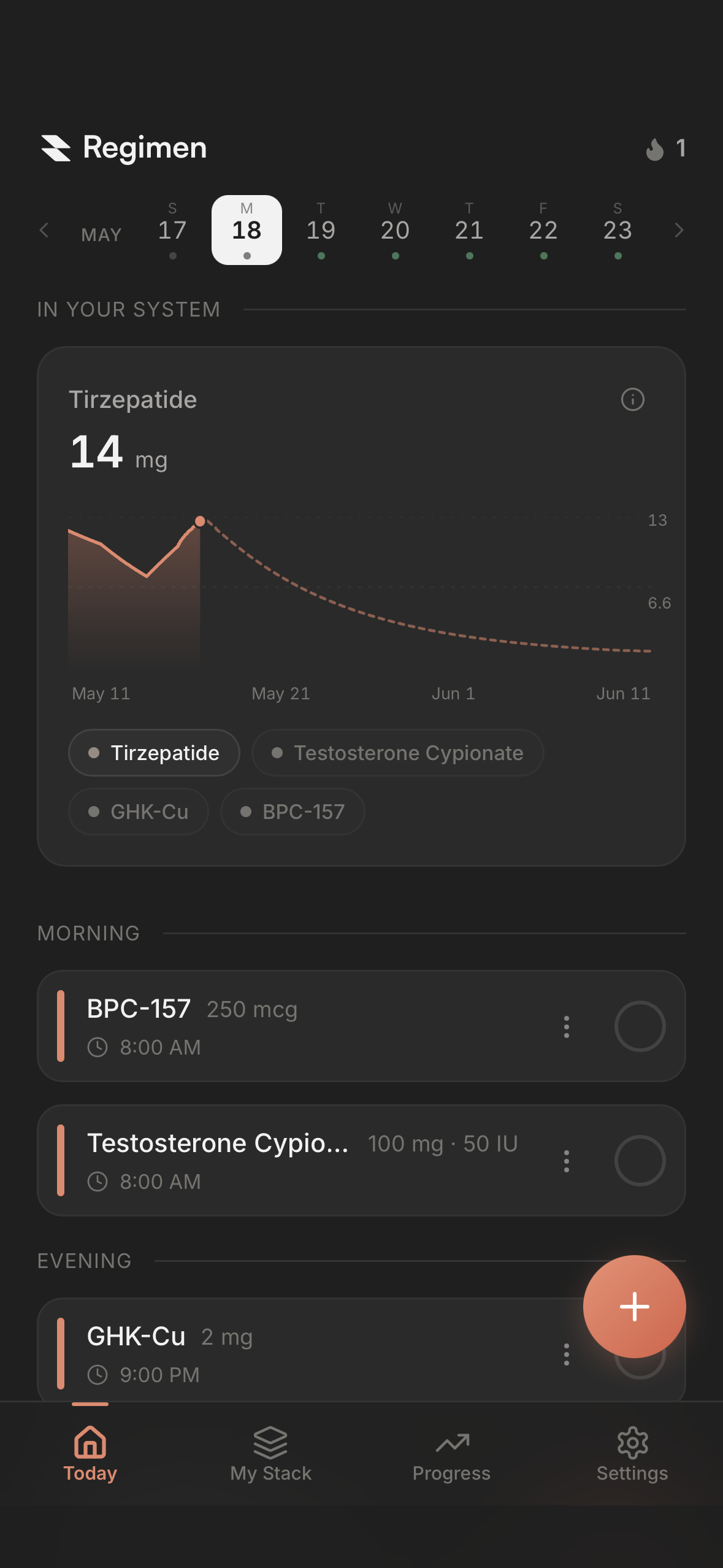
- Medication level curves for every compound