The Bottom Line
TB-500 is your body’s tissue repair system, concentrated into a vial. It’s a synthetic version of a protein you already produce naturally, and people use it to recover faster from injuries, reduce inflammation, and heal tendons, muscles, and ligaments. The catch: it comes as a powder you have to mix yourself, and it follows a unique loading-then-maintenance dosing schedule (not a flat daily dose like BPC-157). This guide covers the full mixing process, dose math, and protocol structure. Or just skip straight to our peptide reconstitution calculator, plug in your vial size and target dose, and let it handle the math.
TB-500 is basically your body’s repair crew on overdrive. It’s built from a protein you already make naturally (Thymosin Beta-4), but the synthetic version is concentrated for one job: getting repair cells to injuries faster and calming inflammation while they work.
What Is TB-500?
TB-500 is basically your body’s repair crew on overdrive. Your body already makes a protein called Thymosin Beta-4 (TB4) that helps fix damaged tissue. TB-500 is a synthetic fragment of that protein, specifically the 17-amino-acid active piece that does most of the healing work.
Here’s what it actually does in plain terms: it helps your repair cells get to the injury faster and grow new blood vessels once they arrive. The way it pulls this off is by boosting production of actin, which is the protein your cells need to move around and rebuild. More actin means cells can migrate to the damage site quicker. And the new blood vessel growth (called angiogenesis) means more blood flow to the injured area, which means more oxygen and nutrients where you need them. On top of that, it dials down inflammation through its own set of pathways.
TB-500 comes as a freeze-dried powder in vials (most commonly 2mg, 5mg, and 10mg). One thing that makes it different from BPC-157: instead of running a flat dose from day one, TB-500 uses a two-phase protocol. You start with a higher-dose loading phase for 4-6 weeks, then drop to a lower maintenance phase. That loading/maintenance structure is one of the defining features of TB-500 dosing.
Pro Tip
TB-500 and Thymosin Beta-4 aren’t the same thing. Full-length TB4 is the complete 43-amino-acid protein. TB-500 is just the active fragment responsible for most of the regenerative effects. When you buy “TB-500,” you’re getting the fragment, not the full protein. Some vendors sell full-length TB4 at a premium, but for most recovery purposes, the TB-500 fragment is the standard.
Warning
TB-500 is a research peptide. It hasn’t been FDA-approved for any human use. Everything in this guide is based on preclinical research and community-reported protocols, not medical advice. Talk to a healthcare provider before using any research peptide.
What You Need to Reconstitute
Before mixing, gather everything:
| Item | Purpose |
|---|---|
| TB-500 vial (2mg, 5mg, or 10mg) | The lyophilized peptide powder |
| Bacteriostatic water (BAC water) | Solvent for reconstitution (contains 0.9% benzyl alcohol as preservative) |
| Insulin syringes (1mL / 100 unit) | For drawing BAC water and injecting doses |
| Alcohol swabs | To sterilize vial tops before each use |
Warning
Don’t use sterile water or normal saline for multi-dose vials. Only BAC water has the benzyl alcohol preservative that prevents bacterial growth across multiple uses. Sterile water is fine for a single draw, but if you’re pulling doses from the same vial over days or weeks, BAC water is non-negotiable.
Step-by-Step Reconstitution Process
- Swab the tops of both vials (TB-500 and BAC water) with alcohol. Let them dry completely. Takes about 15-30 seconds.
- Draw your chosen amount of BAC water into the syringe. Common amounts: 1mL for the 2mg vial, 2mL for the 5mg and 10mg vials.
- Insert the needle into the TB-500 vial at an angle. Aim the stream of water at the inside glass wall, not directly onto the powder cake. Peptides are fragile molecules and direct force can damage the peptide structure.
- Push the plunger slowly. Let the water run down the side of the vial. Do NOT shake. Gently swirl the vial or roll it between your palms until the powder is fully dissolved.
- Check the solution. Once completely clear with no visible particles or cloudiness, you’re good to go. Your TB-500 is reconstituted and ready to dose.
Pro Tip
TB-500 typically dissolves in 1-3 minutes of gentle swirling. That’s a bit longer than BPC-157 but faster than most GLP-1 compounds. If it hasn’t fully dissolved after 5 minutes, set the vial upright in the fridge for 10-15 minutes, then swirl again. Don’t shake it. If the solution stays cloudy or has visible clumps after resting, don’t use it. The peptide was likely damaged by heat during shipping or storage.
Dose Calculation: The Math Explained
TB-500 is dosed in milligrams (mg), but your syringe is marked in units. Here’s how to connect them.
Worked Example
- You have a 5mg TB-500 vial
- You add 2mL of BAC water
- Concentration = 5mg ÷ 2mL = 2.5 mg/mL
- You want a 2.5mg dose (common loading dose)
- Units to draw = (2.5 ÷ 2.5) × 100 = 100 units on your insulin syringe (a full 1mL syringe)
That 5mg vial at 2.5mg per injection gives you 2 doses. That’s one week of loading if you inject 2.5mg twice per week, or two weeks if you inject 2.5mg once per week.
Or skip the math entirely. Use our Peptide Reconstitution Calculator to get the exact number of units for any vial size, BAC water volume, and target dose. For help reading your syringe markings accurately, see our insulin syringe reading guide.
TB-500 Dose Charts
5mg Vial + 2mL BAC Water (2.5 mg/mL)
| Target Dose | Units to Draw | Doses Per Vial |
|---|---|---|
| 1.0 mg | 40 units | 5 doses |
| 2.0 mg | 80 units | 2 doses |
| 2.5 mg | 100 units | 2 doses |
| 5.0 mg | N/A | Vial too small (would need 200 units) |
10mg Vial + 2mL BAC Water (5.0 mg/mL)
| Target Dose | Units to Draw | Doses Per Vial |
|---|---|---|
| 1.0 mg | 20 units | 10 doses |
| 2.0 mg | 40 units | 5 doses |
| 2.5 mg | 50 units | 4 doses |
| 5.0 mg | 100 units | 2 doses |
Pro Tip
Match your vial size to your protocol phase. During loading at 2.5mg twice per week, a 5mg vial lasts exactly one week (you’ll need 4-6 vials for a full loading phase). A 10mg vial lasts two weeks at that same dose, which saves money and means fewer reconstitutions. For maintenance at 2mg every two weeks, a single 10mg vial gives you 5 doses (roughly 10 weeks). But reconstituted peptide only stays good for 28 days. So you’d have to toss unused solution after 4 weeks regardless. Pick your vial size to minimize waste.
Loading vs Maintenance Protocol
This is the thing that makes TB-500 different from most recovery peptides. Instead of a flat daily dose like BPC-157, TB-500 uses a two-phase approach: hit it hard during loading to saturate your tissues, then drop to a lower maintenance dose to keep things going.
| Phase | Dose | Frequency | Duration | Total Weekly |
|---|---|---|---|---|
| Loading | 2-2.5 mg per injection | 2x per week | 4-6 weeks | 4-5 mg/week |
| Maintenance | 2 mg per injection | Once every 2 weeks | Ongoing or 4-8 weeks | ~1 mg/week average |
How the loading phase works: TB-500 has a short half-life in your blood (roughly 3-4 hours), but its effects on cell repair and migration last longer than the peptide itself stays in circulation. The loading phase front-loads a higher amount so enough peptide actually reaches your tissues and kicks off the repair process. Think of it like priming a pump.
How maintenance works: After 4-6 weeks of loading, you drop to a lower dose once every 1-2 weeks. You’re not starting the repair process anymore, you’re just sustaining the environment you built during loading.
When to extend loading: For more severe or chronic injuries (long-standing tendon issues, post-surgical recovery, significant tissue damage), some protocols run loading for 6-8 weeks before switching to maintenance.
Community Insight
Loading phase length is one of the most debated TB-500 topics. Standard recommendation is 4-6 weeks, but plenty of people run it for up to 8 weeks on stubborn or chronic injuries. The general consensus: check in at 4 weeks. If you’re seeing clear improvement, transition to maintenance. If progress has started but you’re not where you want to be, extend another 2-4 weeks. Nobody’s found evidence that loading past 8 weeks does anything extra.
TB-500 + BPC-157 Stack Guide
TB-500 and BPC-157 are the two most commonly stacked recovery peptides. The community calls it “the recovery stack,” and for good reason: they work through completely different mechanisms, so running them together hits recovery from multiple angles.
BPC-157 focuses on growing new blood vessels, speeding up tendon and ligament repair, and protecting the GI tract. TB-500 focuses on moving repair cells to the injury, reducing inflammation through different pathways, and supporting broader tissue remodeling. Together, BPC-157 builds the vascular infrastructure for healing while TB-500 gets repair cells to the site and manages inflammation.
| Peptide | Dose | Frequency | Mechanism Focus |
|---|---|---|---|
| BPC-157 | 250-500 mcg | 1-2x daily (flat dose, no loading) | Angiogenesis, tendon/ligament repair, GI protection |
| TB-500 | 2-2.5 mg | 2x per week during loading, then every 1-2 weeks | Cell migration, actin upregulation, inflammation reduction |
Both can be injected on the same day. BPC-157 runs daily while TB-500 runs twice per week during loading. On days you inject both, you can do them at the same time, but draw them into separate syringes from their individual vials. Don’t mix reconstituted peptides from two vials into one syringe for storage.
If you’re using a pre-blended BPC-157/TB-500 product from a compounding source, use our Peptide Blend Calculator to figure out per-peptide dosing from a single vial.
For the full breakdown of how to structure the BPC-157 + TB-500 stack, see our BPC-157 + TB-500: The Ultimate Recovery Stack Guide. For BPC-157 specifically, see our BPC-157 Reconstitution Calculator Guide.
Community Insight
BPC-157 + TB-500 is the go-to recovery stack across every peptide forum. Most common protocol: BPC-157 at 250-500mcg twice daily alongside TB-500 at 2.5mg twice weekly during loading. People consistently say the combination works better than either one solo. Timeline-wise, some people notice improvement within the first week. Others don’t feel much until 3-4 weeks in. The common advice: stay consistent through the full loading phase before you judge it.
Injection Sites for TB-500
TB-500 goes subcutaneous (SubQ). Here are the most common injection sites:
Abdomen (standard SubQ): Lower belly, at least 2 inches from the navel. This is the go-to for TB-500, same as BPC-157 and most other SubQ peptides. Easy access, consistent absorption, and the least painful spot for most people.
Near the injury site: A lot of users inject TB-500 subcutaneously as close to the injury as they can. The logic is that local injection delivers higher concentrations right where you need them. This is popular but debated: TB-500 is systemically active regardless of injection site, and there’s no controlled human data showing local injection actually works better than a standard belly shot.
Rotation: Wherever you inject, rotate your sites. Don’t keep hitting the same exact spot. For a visual map of injection sites, rotation patterns, and technique tips, see our Peptide Injection Sites Guide.
Storage After Reconstitution
| State | Temperature | Shelf Life |
|---|---|---|
| Unreconstituted (powder) | Room temperature or refrigerated | Per manufacturer expiration (typically 12-24 months) |
| Unreconstituted (powder) | Frozen (-20°C) | Extended stability (years) |
| Reconstituted (with BAC water) | Refrigerated (36-46°F / 2-8°C) | Up to 28 days |
| Reconstituted | Room temperature | Don’t do this. Significant degradation within hours. |
Never freeze reconstituted TB-500. Keep the vial upright in the fridge, away from direct light. If the solution turns cloudy, develops floating particles, or changes color, toss it and mix a fresh vial. For a full breakdown of peptide storage best practices, see our Peptide Storage Guide.
Warning
Storage is the number one way people waste peptides. The two biggest mistakes: leaving the vial out on the counter after drawing a dose (put it back in the fridge immediately), and keeping reconstituted peptide past the 28-day mark hoping it’s still fine. It’s not. Degradation happens even if the solution looks clear. When in doubt, toss it and mix fresh.
Side Effects
TB-500 has a pretty mild side-effect profile. Serious adverse effects are uncommon based on community reports. That said, formal human safety data is limited, so pay attention to how your body responds.
| Side Effect | Frequency | Notes |
|---|---|---|
| Injection site redness/irritation | Occasional | Mild, resolves within hours. Rotate sites. |
| Headache | Occasional | More common in week one of loading. Usually temporary. |
| Fatigue / lethargy | Occasional | Some users feel tired the first few days. Typically fades. |
| Temporary head rush | Rare | Brief lightheadedness after injection. Passes within minutes. |
| Nausea | Rare | More common at higher loading doses. |
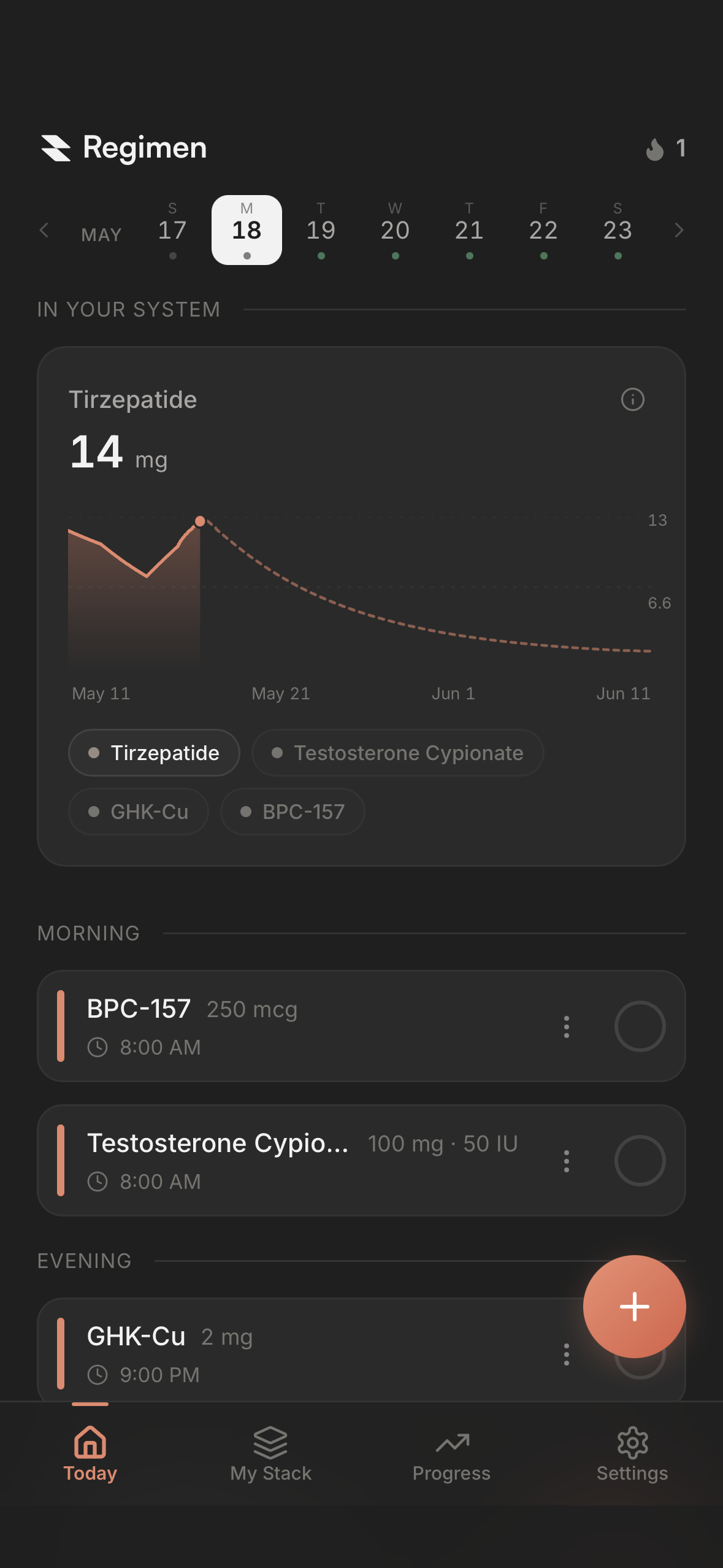
Most side effects show up during the first week of loading and fade as your body adjusts. If they stick around past week one or get worse, lower your dose and talk to a healthcare provider. Track your side effects alongside your doses in the Regimen app to spot patterns and dial in your protocol.
Common Reconstitution Mistakes
| Mistake | Why It Matters |
|---|---|
| Using sterile water instead of BAC water | No preservative means bacteria can grow in the vial within hours after the first puncture. BAC water’s benzyl alcohol prevents this for up to 28 days. |
| Injecting BAC water directly onto the powder cake | Direct pressure can damage the peptide structure. Always aim at the glass wall and let the water run down gently. |
| Shaking the vial to dissolve faster | Shaking creates air bubbles and can denature the peptide. Swirl gently or roll between your palms. TB-500 takes 1-3 minutes. Be patient. |
| Not recording your BAC water volume | Forget how much water you added? Your concentration is wrong and every dose after that is off. Write it on the vial label or log it in the Regimen app right after mixing. |
| Using the wrong vial size for your protocol phase | A 10mg vial during maintenance (2mg every 2 weeks) takes 10 weeks to finish, but it’s only stable for 28 days. Use larger vials for loading, smaller for maintenance. |
Frequently Asked Questions
How much BAC water should I add to my TB-500 vial?
For a 2mg vial, 1mL is standard (2.0 mg/mL). For 5mg vials, 2mL works well (2.5 mg/mL). For 10mg vials, 2mL (5.0 mg/mL).
Is TB-500 the same as Thymosin Beta-4?
No. TB4 is the full 43-amino-acid protein. TB-500 is the synthetic 17-amino-acid active fragment responsible for most regenerative effects.
Can I inject TB-500 near my injury?
Yes. Many users inject near the injury site, but TB-500 is systemically active regardless of injection site. Both approaches are common.
How long does TB-500 take to work?
Some notice improvements within 1-2 weeks of loading. Others need 3-4 weeks. Run the full 4-6 week loading phase before judging.
Can I stack TB-500 with BPC-157?
Yes, it’s the most popular peptide recovery stack. They work through different mechanisms and are commonly run together.
What is the loading phase and why is it necessary?
A 4-6 week period at higher frequency (2-2.5mg twice weekly) to saturate tissues. TB-500 clears fast (~3-4 hour half-life), so loading ensures enough reaches your tissues.
Is TB-500 legal?
Legal to buy as a research chemical in most places. Not FDA-approved. Banned by WADA and most professional sports organizations.
How do I store reconstituted TB-500?
Refrigerate at 36-46°F (2-8°C) and use within 28 days. Never freeze reconstituted TB-500.
Disclaimer: This article is for educational purposes only and is not medical advice. TB-500 is a research peptide that has not been FDA-approved for any human use. Always consult with a healthcare provider before starting any peptide protocol. Individual responses vary.
Ready to track your protocol?
- Smart reminders so you never miss a dose
- Track weight, photos, and progress over time
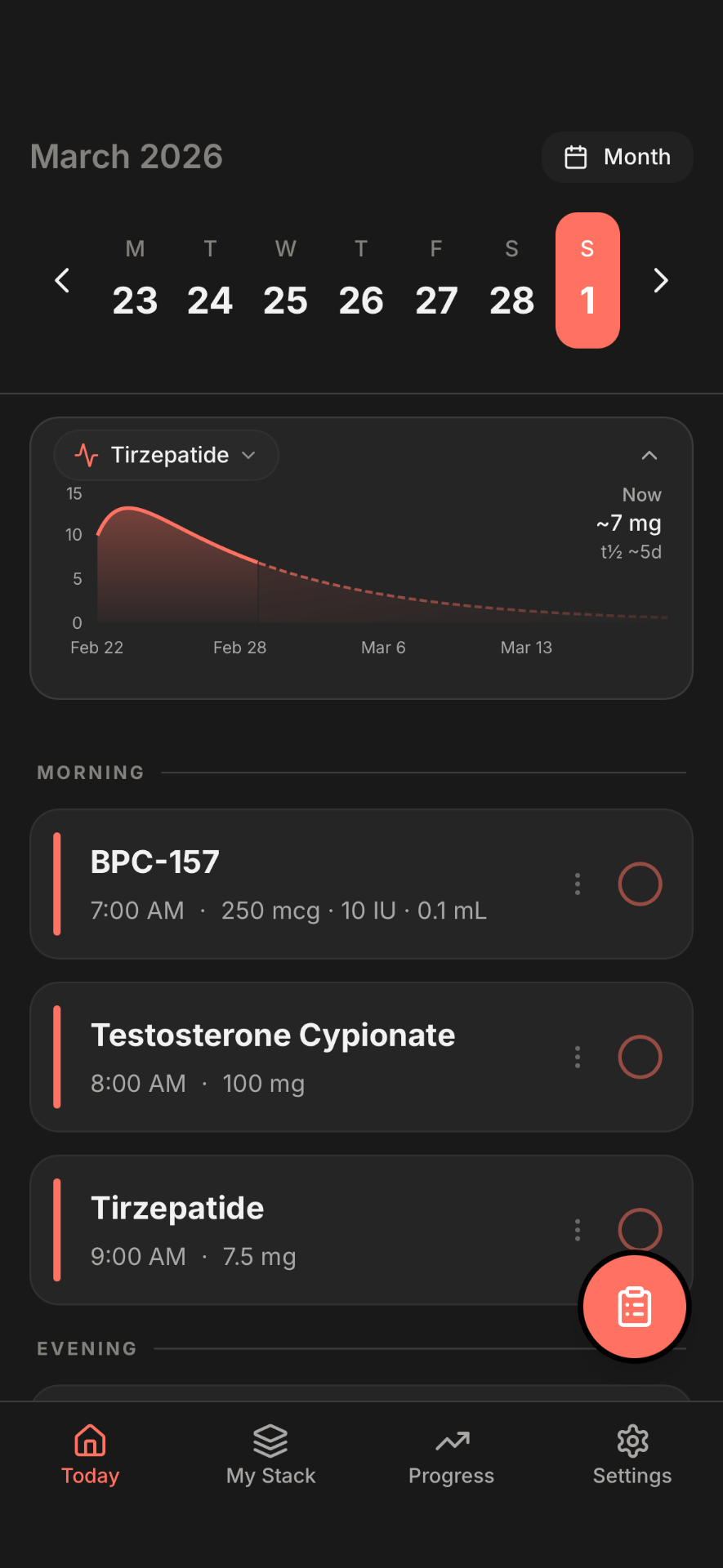
- Medication level curves for every compound