The Bottom Line
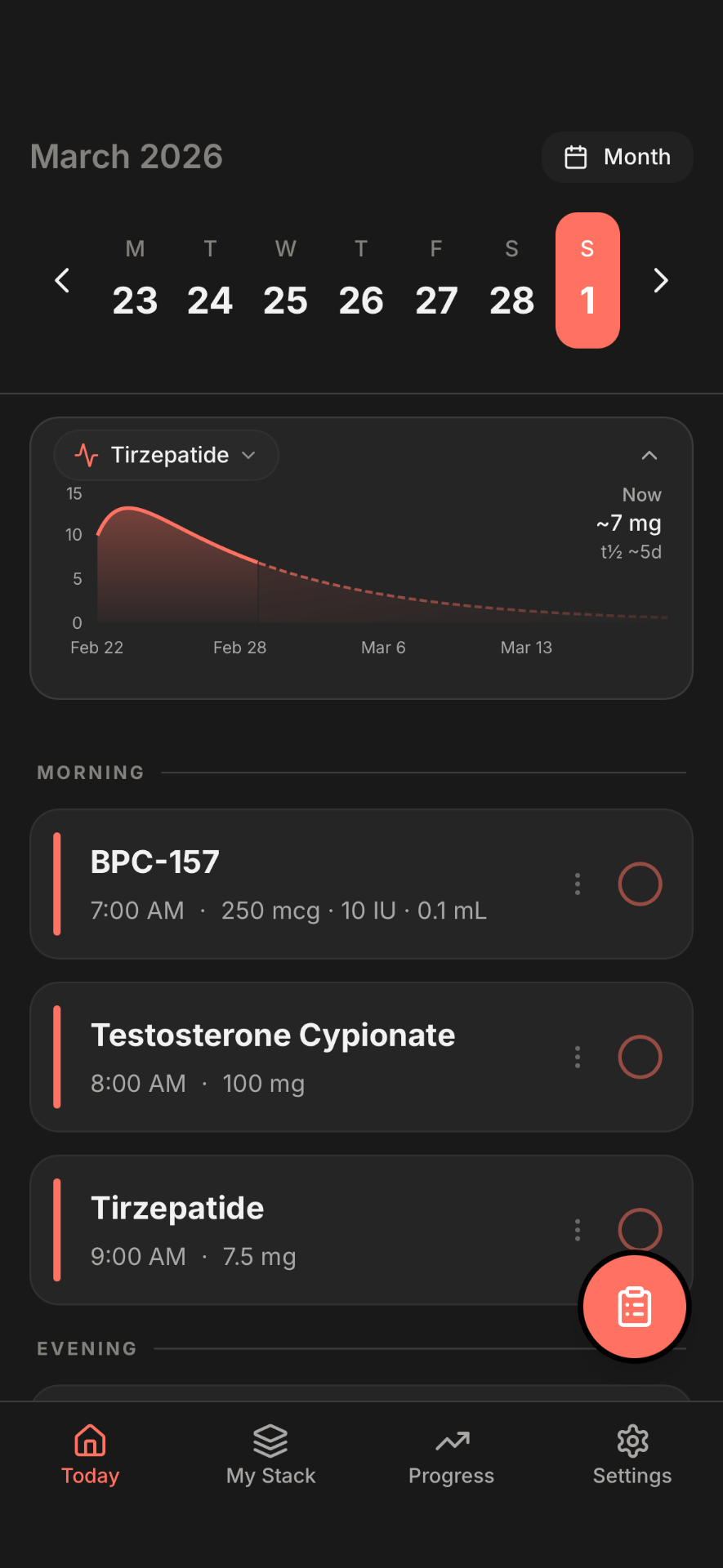
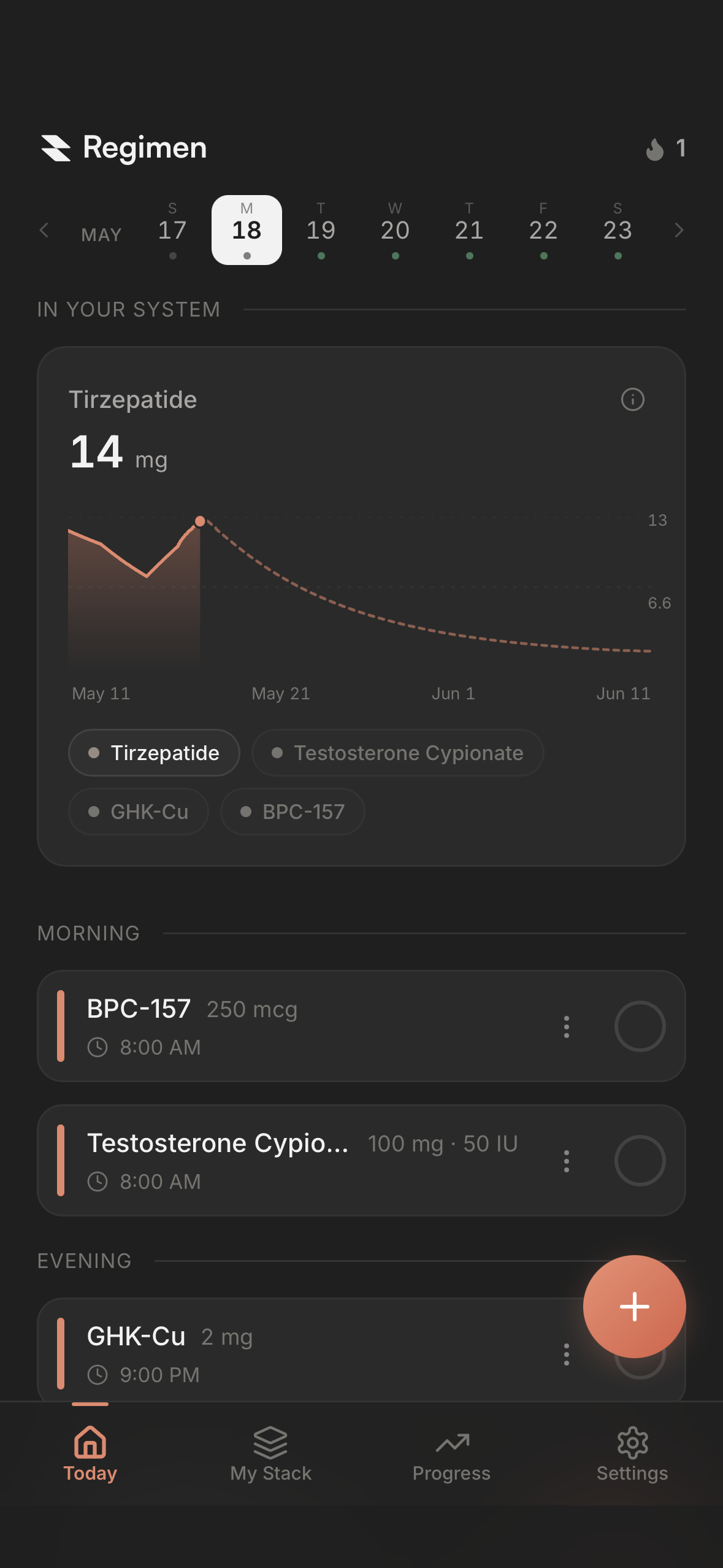
Here’s the whole thing in three states. Powder (lyophilized) is the easy one: it’s stable for months at room temp, even longer in the fridge or freezer. Mixed with BAC water, you’ve got 28 days in the fridge. Mixed with sterile water (no preservative), use it within 24-48 hours. The 28-day clock starts the second you add water to the vial. Track your reconstitution dates in the Regimen app so you’re not squinting at a vial trying to remember when you mixed it.
Every peptide you’ll handle exists in one of three states. The state it’s in tells you how to store it, how long it lasts, and when to toss it. Everything in this guide flows from this framework.
The 3 States of Peptides (and Why It Matters)
State 1: Lyophilized Powder (Unreconstituted)
Lyophilized means freeze-dried. All the water has been removed, and that’s what makes the powder so stable. That powder cake sitting in a sealed vial is tougher than you’d think. Room temperature for months? Fine. Refrigerated? Lasts a year or more. Frozen at -20°C? Good for years.
Most peptides ship this way. As long as the seal is intact and the powder hasn’t absorbed moisture, the clock is barely ticking.
State 2: Reconstituted Solution (Clock Is Ticking)
The moment you add water, everything changes. Peptide bonds start slowly breaking down. Bacteria can grow if there’s no preservative in the solvent. Light speeds up degradation. Heat speeds it up even more.
This is why every reconstituted peptide needs to go in the fridge right away and get used within 28 days (when mixed with BAC water). It’s still fully functional during that window. It’s just no longer in its bulletproof powder form.
State 3: Degraded (When to Discard)
A degraded peptide has lost enough of its structure that you can’t trust it anymore. This happens through time (past 28 days), heat (left out overnight or shipped without cold packs), contamination (bacteria from using sterile water for multi-dose vials), or physical damage (shaking the vial hard enough to break apart the peptide chain).
Degraded peptides might look cloudy, have particles, show discoloration, or look perfectly clear while silently losing potency. When in doubt, toss it.
Master Storage Table by State
| Storage Condition | Lyophilized (Powder) | Reconstituted with BAC Water | Reconstituted with Sterile Water |
|---|---|---|---|
| Room temperature (68-77°F / 20-25°C) | Acceptable for weeks to months | NOT recommended. Refrigerate immediately. | NOT recommended. Refrigerate immediately. |
| Refrigerated (36-46°F / 2-8°C) | Ideal storage. Extends shelf life significantly. | REQUIRED. Up to 28 days maximum. | REQUIRED. Use within 24-48 hours. |
| Frozen (-4°F / -20°C) | Best for long-term storage (years) | NEVER freeze reconstituted peptides | NEVER freeze reconstituted peptides |
| Light exposure | Minimal concern in sealed amber or opaque vial | Protect from direct light (accelerates degradation) | Protect from direct light |
| Shelf life | Months to years depending on storage temp | Maximum 28 days refrigerated | 24-48 hours maximum |
| Sterility concern | Low. Sealed vial with no liquid medium for bacteria. | Moderate. BAC water preservative inhibits growth for 28 days. | HIGH. No preservative, bacteria can grow immediately. |
Warning
The biggest mistake people make is grabbing sterile water instead of BAC water for a vial they plan to use over multiple days. Sterile water has zero preservative. Once you push a needle through the stopper, bacteria from the environment can get in, and there’s nothing in sterile water to stop them from multiplying. BAC water contains 0.9% benzyl alcohol (that’s the preservative that keeps bacteria from growing for up to 28 days). If you’re drawing from a vial more than once, BAC water is non-negotiable.
Compound-Specific Storage Chart
Different peptides have slightly different stability profiles. Here’s how the most common compounds stack up:
| Compound | Common Form | Reconstituted Shelf Life | Special Notes |
|---|---|---|---|
| BPC-157 | Lyophilized powder (5mg, 10mg, 15mg vials) | Up to 28 days | More temperature-sensitive than most peptides. Check the powder cake when it arrives. See our BPC-157 reconstitution guide. |
| TB-500 | Lyophilized powder (2mg, 5mg, 10mg vials) | Up to 28 days | Relatively stable in solution. Dissolves quickly. Store upright so the solution doesn’t sit against the rubber stopper. |
| Semaglutide (compounded) | Lyophilized powder (2mg, 5mg, 10mg vials) | Up to 28 days | Match vial size to dose tier. A 10mg vial at 0.25mg/week would take 40 weeks, way past the 28-day window. See our semaglutide reconstitution guide. |
| Tirzepatide (compounded) | Lyophilized powder (5mg, 10mg, 15mg, 30mg, 60mg vials) | Up to 28 days | Same vial-sizing logic as semaglutide. See our tirzepatide reconstitution guide. |
| Retatrutide (compounded) | Lyophilized powder (5mg, 12mg, 30mg vials) | Up to 28 days | Can take 3-8 minutes to dissolve, longer than most peptides. If it’s cloudy after resting, don’t use it. |
| Semax | Typically comes as a nasal spray (pre-mixed) | Follow manufacturer instructions, typically 15-30 days | Store in refrigerator. Keep the nozzle clean to prevent contamination. |
| HGH (Growth Hormone) | Lyophilized powder or pre-mixed cartridges | Up to 28 days (powder with BAC water) | Very sensitive to shaking. Never agitate. Pre-mixed cartridges follow manufacturer instructions. |
| CJC-1295 | Lyophilized powder (2mg, 5mg vials) | Up to 28 days | Store away from light. CJC-1295 with DAC has a longer half-life but the same storage rules once reconstituted. |
| Ipamorelin | Lyophilized powder (2mg, 5mg vials) | Up to 28 days | Stable and easy to reconstitute. Often stacked with CJC-1295. Keep them in separate vials. |
Pro Tip
Before you reconstitute anything, do the math. Divide total peptide content by your dose to see how many doses you get. Then figure out how many days that covers at your injection frequency. If the answer is more than 28 days, you’re going to waste peptide because the solution will go bad before you finish it. Either grab a smaller vial or add less BAC water so you draw larger volumes and finish faster. Our Peptide Reconstitution Calculator does this in seconds.
Beyond-Use Date (BUD) vs Expiration Date
These two dates confuse a lot of people in the peptide community, and mixing them up means either using degraded product or throwing away perfectly good peptide.
Expiration Date is the date set by the manufacturer for the sealed, unreconstituted product. It’s how long the powder is guaranteed to hold its labeled potency when stored correctly.
Beyond-Use Date (BUD) is the deadline for using a reconstituted peptide. The BUD clock starts the moment you add water to the vial. For most peptides mixed with BAC water and kept refrigerated, the standard BUD is 28 days.
| Expiration Date | Beyond-Use Date (BUD) | |
|---|---|---|
| Applies to | Sealed, unreconstituted product | Reconstituted (mixed) product |
| Set by | Manufacturer or compounding pharmacy | You (based on reconstitution date) |
| Typical timeframe | 12-24 months from manufacture | 28 days from reconstitution |
| Clock starts | At manufacture | When you add water to the vial |
| What happens after | Potency may have decreased below labeled amount | Sterility and potency are no longer reliable |
Here’s the scenario that trips people up: you have a vial with an expiration date of June 2027. You reconstitute it today. That expiration date no longer matters. Your BUD is 28 days from today, period. The mixed solution degrades way faster than the powder ever would.
Community Insight
“Past the BUD” anxiety is one of the biggest topics on peptide forums. People on r/compoundedtirzepatide constantly ask whether a vial that’s a day or two past 28 days is still safe. The 28-day mark is already conservative. It’s not a cliff where the peptide turns toxic at day 29. Potency drops a bit and sterility risk creeps up gradually. But the line exists for a reason, and the smart move is to follow it. If you’re regularly pushing past 28 days, your vial is too big for your dose. Switch to a smaller one so you finish within the window. Track your reconstitution dates in the Regimen app. It calculates your 28-day expiry automatically and sends a reminder before your vial expires. If you are still shopping, compare purpose-built options in our best peptide tracker app roundup.
How to Tell If Your Peptide Has Gone Bad
“Is this considered cloudy?” shows up constantly in peptide communities. The anxiety makes sense. You’re injecting this stuff, and you want to know it’s safe. Here’s how to actually check.
What a Good Reconstituted Peptide Looks Like
Completely clear (you can see through it without any haze), colorless (no yellow, brown, or pink tint), free of particles (no floaters, specks, or sediment at the bottom), and consistent (no separation or layering).
What a Bad Reconstituted Peptide Looks Like
Cloudiness that doesn’t clear after gentle swirling. Visible particles floating in the solution. Discoloration (yellow, brown, or any color change). Film or residue on the glass walls. Unusual smell when drawing from the vial. Crystallization or precipitate at the bottom.
The Decision Framework
Step 1: Hold the vial up to a light source and look through the solution.
- Solution is completely clear and colorless: Proceed to use.
- Very slight haziness within the first 24 hours after reconstitution: Gently swirl. If it clears completely, it’s likely fine.
- Noticeably cloudy, visible particles, or any color change: Discard. Don’t inject.
- Was clear but has become cloudy over time in storage: Discard. That’s degradation or contamination.
Step 2: Check the timeline.
- Within 28 days of reconstitution (BAC water) and solution is clear: Good to use.
- Past 28 days of reconstitution: Discard regardless of appearance.
- Reconstituted with sterile water more than 48 hours ago: Discard regardless of appearance.
Step 3: Consider the storage history.
- Vial has been refrigerated continuously since reconstitution: Good.
- Vial was left out at room temperature for more than a few hours: Evaluate carefully. See the temperature exposure section below.
- Vial was exposed to heat, direct sunlight, or freezing: Discard.
Community Insight
The “is this cloudy?” panic is real and extremely common on Reddit. The truth is that most of the time, the solution is fine. Actual contamination or degradation is usually obvious: significant cloudiness, visible floaters, or color change you don’t have to squint to notice. If you have to ask “is this cloudy?” it probably isn’t. If the answer is obviously yes, trust your eyes and toss it.
Temperature Exposure: What Actually Happens
This topic causes more stress than almost anything else in peptide communities. Maybe a package sat on a warm porch. Maybe you left a vial on the counter overnight. Here’s what actually happens so you can make a real decision instead of spiraling.
Peptides don’t have an on/off switch. They degrade gradually based on temperature and time. A few hours at room temperature won’t destroy a reconstituted peptide, but it does speed up the slow breakdown that’s already happening in the fridge.
| Scenario | Duration | Risk Level | Recommended Action |
|---|---|---|---|
| Reconstituted vial left on counter overnight (68-77°F) | 8-12 hours | Low to moderate | Put it back in the fridge. Likely still usable but shorten your remaining BUD by a few days. |
| Reconstituted vial left in warm room (80-90°F) | 2-4 hours | Moderate | Return to fridge. Use within the next few days and watch for visual changes. |
| Reconstituted vial left in hot car or direct sunlight (100°F+) | 1+ hours | High | Discard. High heat causes rapid peptide denaturation. |
| Lyophilized powder shipped without cold packs (summer) | 1-3 days | Low to moderate | Powder handles heat much better. Check the cake for discoloration or melting. If it looks normal, it’s very likely fine. |
| Refrigerator power outage (temp rises to 50-60°F) | 6-12 hours | Low | Most reconstituted peptides handle a brief bump. Get it back to proper temp and keep using it. |
| Reconstituted vial frozen accidentally | Any | Moderate to high | Freeze-thaw cycles can damage the peptide structure. Check for cloudiness or particles. Consider discarding. |
Warning
Shipping anxiety is real but usually overblown. Most reputable vendors ship lyophilized powder with insulated packaging and cold packs. The powder form handles temperature swings much better than reconstituted solution. If your package sat on a warm porch for a few hours, the powder inside is very likely fine. The actual risk is with pre-mixed or reconstituted products shipped without a proper cold chain. Those should always arrive cold. If you get a reconstituted product that’s warm to the touch, contact the vendor for a replacement.
Traveling with Peptides
Traveling with reconstituted peptides is one of the most searched topics in this space, and that makes sense. You need to keep them cold, get through airport security, and figure out refrigeration wherever you’re going. Our guide to traveling with peptides and GLP-1s covers the TSA side in full; below is the cold-chain part.
Keeping Peptides Cold During Travel
- Use an insulated medical travel case designed for injectable medications. These hold temperature for 8-24 hours depending on the case and outside temp.
- Wrap your vials in a small towel or cloth so they don’t touch the ice packs directly. Direct contact with a frozen gel pack can freeze the solution.
- For flights, keep your peptide case in your carry-on. Checked luggage gets extreme temperature swings in the cargo hold.
- At your destination, put vials in the hotel mini-fridge right away. Most run at 40-50°F, which works fine.
TSA and Airport Security
- Injectable medications are allowed through TSA checkpoints. There’s no regulation against carrying syringes, vials, or BAC water for medical use.
- Keep your vials, syringes, and alcohol swabs in a clear, labeled bag. Everything in one place speeds things up.
- Carry vials in their original pharmacy packaging with labels if you can. Not legally required, but it makes things faster if security asks questions.
- For international travel, check your destination country’s rules on injectable medications and syringes.
For detailed packing lists, international travel considerations, and destination-specific advice, see our complete Traveling with Peptides and GLP-1s Guide.
Pro Tip
Pack two insulated cases for trips longer than a weekend. Use one as your daily case and keep the backup in the hotel fridge with replacement gel packs. For trips longer than a week, consider bringing powder vials instead and reconstituting at your destination. Powder is way more travel-friendly than liquid.
Storage Supplies Checklist
You don’t need a fancy setup. Here’s everything that matters:
- Dedicated refrigerator space. A shelf in your regular fridge works. A small plastic container keeps vials upright and organized. A mini-fridge set to 36-46°F is a popular option if you want to keep peptides separate from food.
- Amber vials or dark storage container. If your peptides come in clear glass vials, store them inside a small opaque container or bag to block light.
- Bacteriostatic water supply. Keep at least one extra vial of BAC water on hand so you’re never tempted to grab sterile water as a substitute.
- Labels and a pen (or the Regimen app). Write the reconstitution date and BAC water volume on every vial right after mixing. This is the single most important storage habit.
- Insulated travel case with gel packs. For any time your peptides leave the fridge. A basic medical insulin travel case costs under $20 and is reusable.
- Alcohol swabs. For sterilizing the rubber stopper before every draw.
Pro Tip
The labeling system matters more than any piece of equipment. The fanciest storage setup is useless if you don’t know when you reconstituted each vial. Permanent marker on the vial itself, small adhesive labels, whatever works for you. Better yet, log it in the Regimen app. It timestamps your reconstitution automatically, calculates your 28-day BUD, and sends a reminder when the window is closing.
Common Storage Mistakes
| Mistake | Why It Matters | What to Do Instead |
|---|---|---|
| Using sterile water for multi-use vials | No preservative. Bacteria can start growing after the first needle puncture. | Always use BAC water for any vial you’ll draw from more than once. |
| Not labeling the reconstitution date | You’ll lose track of when the 28-day window started. | Write the date on the vial right after mixing. Log it in the Regimen app. |
| Storing peptides in the bathroom | Bathrooms have the highest humidity and temperature swings in most homes. | Store in the kitchen fridge or a dedicated mini-fridge. Never the bathroom. |
| Freezing reconstituted peptides | Ice crystals physically shear apart the molecular chains. | Only freeze lyophilized powder. Once you add water, refrigerate only. |
| Using peptides past 28 days “because they look fine” | Clear doesn’t mean safe. Degradation is invisible. | Follow the 28-day BUD. Switch to a smaller vial if you consistently have leftovers. |
Warning
“It looks fine so it must be fine” is the most dangerous storage logic because it feels so reasonable. Peptide degradation is invisible. The molecular bonds break down without any visible sign. And bacterial growth in BAC water can stay below the concentration that causes visible cloudiness while still posing an infection risk. The 28-day BUD exists because you can’t see what’s happening after that point. Trust the timeline, not your eyes.
Frequently Asked Questions
How long do reconstituted peptides last?
28 days in the fridge when mixed with BAC water. Mixed with sterile water (no preservative), use within 24-48 hours.
Can I freeze reconstituted peptides?
No. Ice crystals can physically damage peptide chains. Freezing is great for unreconstituted powder but never for reconstituted solution.
What happens if my peptides got warm during shipping?
If shipped as lyophilized powder, it’s probably fine. Check the cake for discoloration or melting. If shipped reconstituted and arrived warm, contact the vendor.
What is the difference between BUD and expiration date?
Expiration date is for sealed powder. BUD (beyond-use date) is the 28-day deadline after reconstitution. Once you add water, the BUD replaces the expiration date.
Can I store peptides at room temperature?
Powder, yes (weeks to months). Reconstituted, no. Always refrigerate reconstituted peptides.
How do I travel with reconstituted peptides?
Insulated medical travel case with gel ice packs. Keep in carry-on when flying. TSA allows injectable medications and syringes.
My peptide solution looks cloudy. Should I throw it away?
Slight haziness right after mixing that clears with swirling is usually fine. Obvious cloudiness, particles, or discoloration: discard.
Does BAC water expire?
Yes, typically 1-2 years from production. Once punctured, the standard BUD is 28 days.
Disclaimer: This guide is for informational purposes only and does not constitute medical advice. Always consult with a qualified healthcare professional for personalized guidance on peptide storage and usage.
Ready to track your protocol?
- Smart reminders so you never miss a dose
- Track weight, photos, and progress over time
- Medication level curves for every compound