The Bottom Line
Reconstituting compounded semaglutide is straightforward once you understand the math. Use our free GLP-1 dose calculator to skip the calculations entirely. Enter your vial size, BAC water volume, and target dose, and it tells you exactly how many units to draw. This guide walks you through the full process step by step.
Compounded semaglutide is everywhere right now. It’s the same active ingredient as Ozempic and Wegovy, but it comes in a vial instead of a pre-filled pen. That means you’re doing the reconstitution and dose math yourself. It sounds intimidating, but the process takes about five minutes once you’ve done it once.
What Is Compounded Semaglutide?
Semaglutide is a GLP-1 receptor agonist used for weight management and type 2 diabetes treatment. It is the active ingredient in Ozempic, Wegovy, and Rybelsus. Compounded semaglutide comes as a lyophilized (freeze-dried) powder that must be reconstituted with bacteriostatic water (BAC water) before subcutaneous injection.
It’s become widely used for weight management and metabolic health, especially during brand-name supply shortages. The active compound is identical. The difference is that compounded versions come in vials rather than pre-filled pens, which means you need to do the reconstitution and dose calculation yourself.
Pro Tip
If you’re switching from an Ozempic pen to compounded semaglutide, the doses are the same: 0.25mg, 0.5mg, 1.0mg, 1.7mg, 2.4mg. The only difference is how you measure them.
On Ozempic? Regimen’s Ozempic app logs the shot in one tap, reminds you before the next one, and ties your side effects and weight to each dose step.
What You Need to Reconstitute
Before mixing, gather everything:
| Item | Purpose |
|---|---|
| Semaglutide vial (2mg, 5mg, or 10mg) | The lyophilized peptide powder |
| Bacteriostatic water (BAC water) | Solvent for reconstitution. Contains 0.9% benzyl alcohol as preservative |
| Insulin syringes (1mL / 100 unit) | For drawing BAC water and injecting doses |
| Alcohol swabs | To sterilize vial tops before each use |
Important
Never use sterile water or saline for reconstitution if you plan to use the vial over multiple days. Only bacteriostatic water has the preservative needed to prevent bacterial growth. Sterile water is single-use only.
Step-by-Step Reconstitution Process
- Clean the tops of both vials (semaglutide and BAC water) with alcohol swabs. Let dry.
- Draw your chosen amount of BAC water into the syringe. Common amounts: 1mL or 2mL (we’ll explain how this affects dosing below).
- Insert the needle into the semaglutide vial at an angle, aiming the stream at the glass wall, not directly onto the powder. This prevents damaging the peptide.
- Let the water run down the side of the vial. Do NOT shake. Gently swirl or roll the vial between your palms until the powder is fully dissolved. This may take 1-3 minutes.
- Check the solution. Once clear with no visible particles, your semaglutide is reconstituted and ready to dose.
Pro Tip
If the solution looks cloudy or has floating particles after 5 minutes of gentle swirling, do not use it. This may indicate the peptide was damaged during shipping (temperature exposure) or the BAC water was contaminated.
Dose Calculation: The Math Explained
The key formula is simple:
Worked Example
- You have a 5mg semaglutide vial
- You add 2mL of BAC water
- Concentration = 5mg ÷ 2mL = 2.5mg/mL
- You want a 0.5mg dose
- Units to draw = (0.5 ÷ 2.5) × 100 = 20 units on your insulin syringe
Or skip the math entirely. Use our GLP-1 Dose Calculator to get the exact number of units for any vial size and BAC water combination.
Common Vial Sizes and Dose Charts
5mg Vial + 2mL BAC Water (2.5 mg/mL)
| Target Dose | Units to Draw | Doses Per Vial |
|---|---|---|
| 0.25 mg | 10 units | 20 doses |
| 0.5 mg | 20 units | 10 doses |
| 1.0 mg | 40 units | 5 doses |
| 1.7 mg | 68 units | ~3 doses |
| 2.4 mg | 96 units | ~2 doses |
10mg Vial + 2mL BAC Water (5.0 mg/mL)
| Target Dose | Units to Draw | Doses Per Vial |
|---|---|---|
| 0.25 mg | 5 units | 40 doses |
| 0.5 mg | 10 units | 20 doses |
| 1.0 mg | 20 units | 10 doses |
| 1.7 mg | 34 units | ~6 doses |
| 2.4 mg | 48 units | ~4 doses |
Pro Tip
Using less BAC water gives a more concentrated solution, which means smaller injection volumes. Most people prefer 1-2mL for less liquid under the skin. But smaller volumes are harder to measure accurately on an insulin syringe. If you’re dosing under 10 units, consider using more BAC water for precision. For help reading your syringe markings accurately, see our insulin syringe reading guide.
Using the Semaglutide Reconstitution Calculator
Instead of doing the math manually, use our free GLP-1 Dose Calculator:
- Select “Semaglutide” as the compound
- Enter your vial size (2mg, 5mg, or 10mg)
- Enter the amount of BAC water you added
- Enter your target dose
- The calculator shows exactly how many units to draw on your syringe
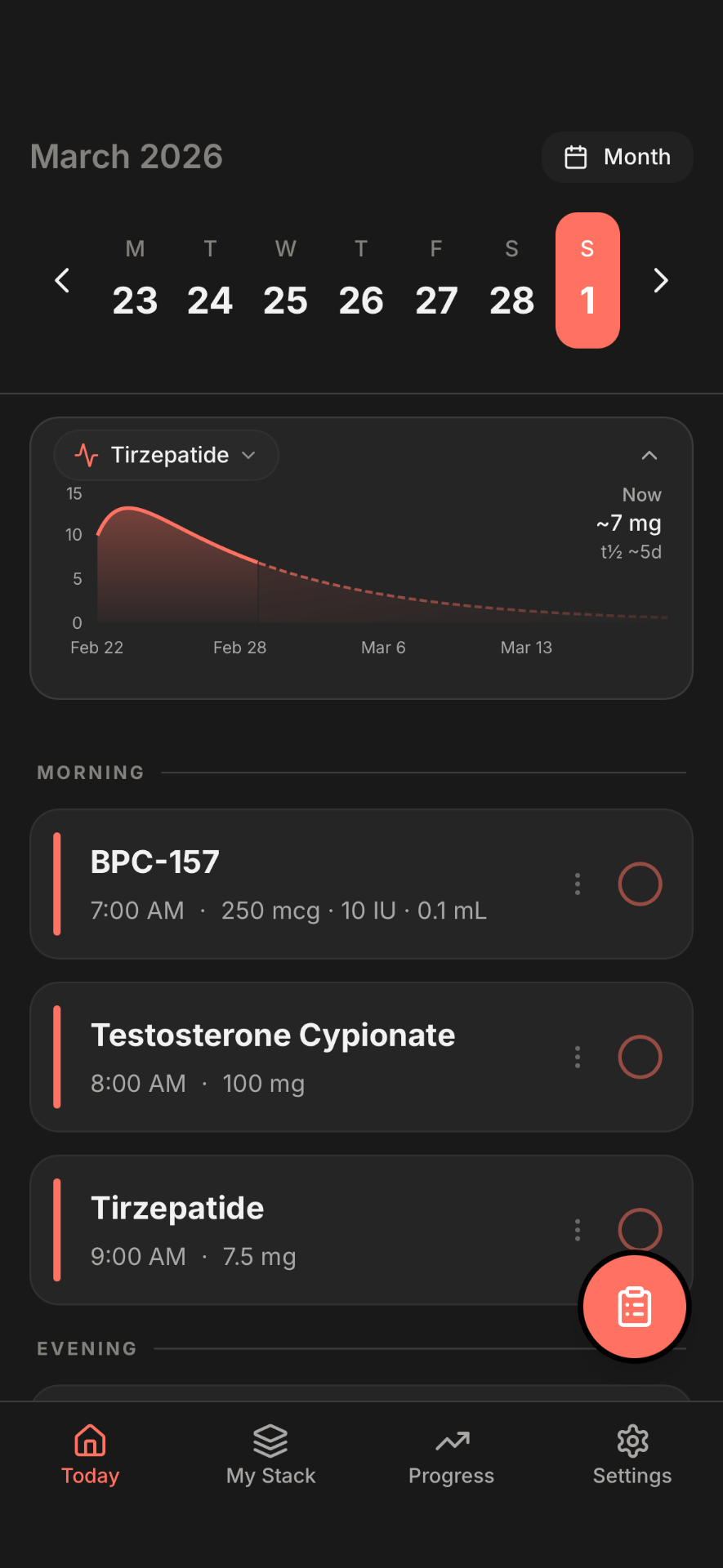
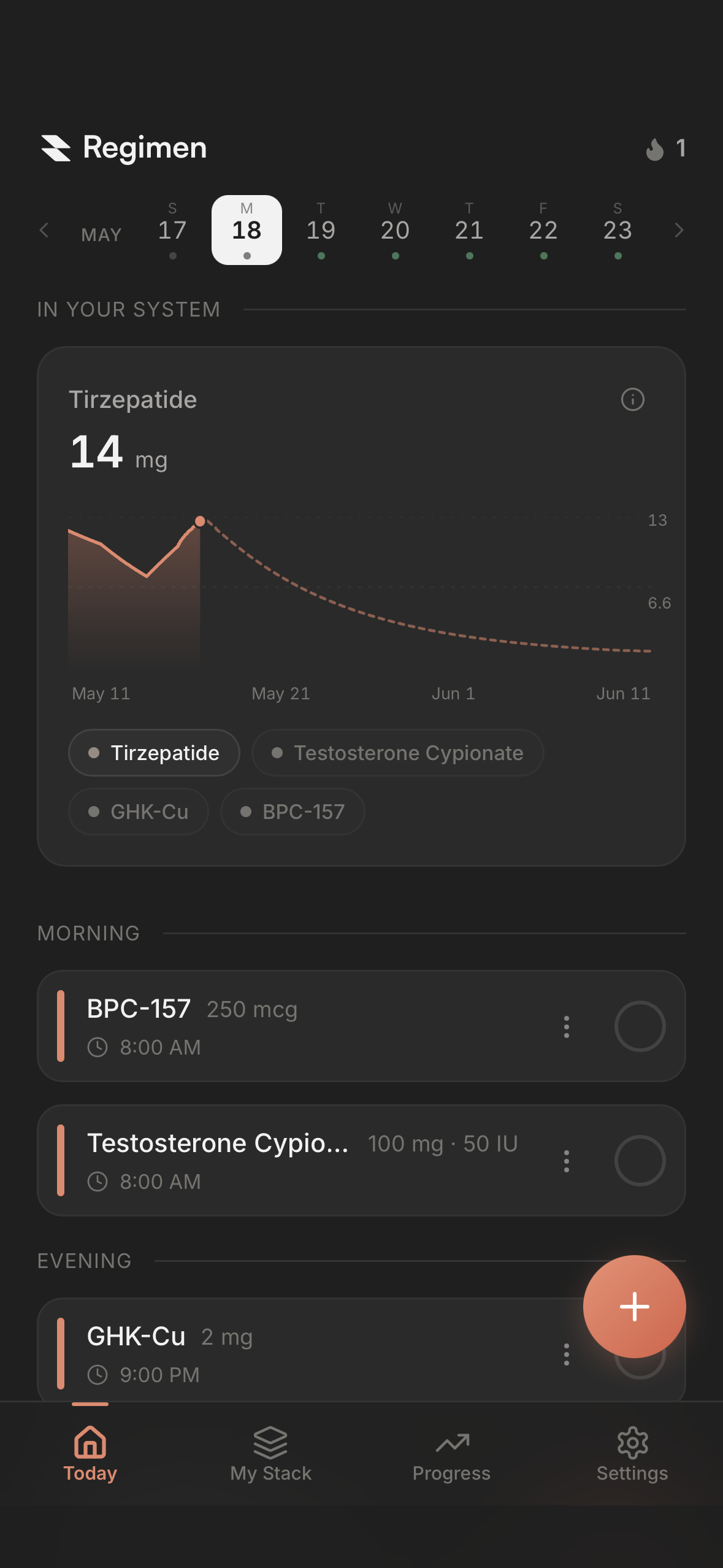
The calculator also supports tirzepatide, retatrutide, and other GLP-1 compounds. You can save your calculation and track your doses over time in the Regimen app.
Compounded vs. Brand Semaglutide (Ozempic / Wegovy)
| Feature | Compounded Semaglutide | Ozempic / Wegovy |
|---|---|---|
| Active ingredient | Semaglutide | Semaglutide |
| Form | Lyophilized powder → reconstitute yourself | Pre-filled auto-injector pen |
| Dose measurement | Insulin syringe (units) | Pen clicks (pre-measured) |
| Refrigeration | Required after reconstitution | Required |
| Cost | Generally lower | Higher (insurance may cover) |
| Availability | Compounding pharmacies | Prescription, subject to shortages |
| FDA status | Compounded (not FDA-approved as a product) | FDA-approved |
Important
This guide is for educational purposes. Semaglutide is a prescription medication. Always work with a licensed healthcare provider for dosing guidance and monitoring. Compounded medications should only be obtained from licensed compounding pharmacies.
Storage After Reconstitution
| State | Temperature | Shelf Life |
|---|---|---|
| Unreconstituted (powder) | Room temp or refrigerated | Per manufacturer expiration |
| Reconstituted (with BAC water) | Refrigerated (36-46°F / 2-8°C) | Up to 28 days |
| Reconstituted | Room temperature | Not recommended. Refrigerate. |
Never freeze reconstituted semaglutide. Keep the vial upright and away from direct light. If the solution changes color or develops particles, discard it.
Titration Schedule: How to Ramp Up Safely
The standard semaglutide titration follows the same schedule whether you’re using compounded or brand-name:
| Week | Dose | Purpose |
|---|---|---|
| Weeks 1-4 | 0.25 mg/week | Initial tolerance phase |
| Weeks 5-8 | 0.5 mg/week | Building up |
| Weeks 9-12 | 1.0 mg/week | Therapeutic range begins |
| Weeks 13-16 | 1.7 mg/week | Increasing if tolerated |
| Week 17+ | 2.4 mg/week | Full therapeutic dose |
Not everyone needs to reach 2.4mg. Many people find their effective dose at 1.0mg or 1.7mg. Increase only if weight loss has stalled AND you’re tolerating the current dose well.
Use our GLP-1 Titration Planner to build a personalized schedule with exact dates for each dose increase.
Community Insight
Many users report that the jump from 0.5mg to 1.0mg is where side effects increase most. If you experience significant nausea, stay at 0.5mg for an extra 2-4 weeks before increasing. There’s no rush.
Side Effects to Track
Common side effects, especially during dose increases:
| Side Effect | Frequency | When It Usually Improves |
|---|---|---|
| Nausea | Very common | 2-4 weeks at each dose |
| Decreased appetite | Very common (desired effect) | Ongoing |
| Constipation | Common | With fiber/hydration adjustment |
| Sulfur burps | Common | Usually subsides within days |
| Injection site reaction | Occasional | Rotate sites |
| Fatigue | Occasional | First 1-2 weeks at new dose |
For detailed management tips on sulfur burps specifically, see our GLP-1 sulfur burps guide.
Track side effects alongside your doses in the Regimen app to identify patterns and share data with your provider.
Common Semaglutide Reconstitution Mistakes to Avoid
| Mistake | Why It Matters |
|---|---|
| Shaking the vial instead of gently swirling | Semaglutide is a large molecule. Shaking can denature it and reduce efficacy |
| Using too little BAC water | Creates a high concentration that makes accurate small doses nearly impossible to draw |
| Using too much BAC water | Requires injecting larger volumes, which increases injection site discomfort |
| Injecting BAC water directly onto the powder | Forceful contact can damage the peptide. Always let water run down the vial wall |
| Skipping the vial label | Compounded semaglutide vials look identical. Always label with compound, concentration, and date |
| Storing at room temperature | Reconstituted semaglutide should be refrigerated and used within 28 days |
Tracking Semaglutide with an App
What’s the best app for tracking semaglutide?
Regimen is a purpose-built tracker for semaglutide that logs each injection with dose, site rotation, and time. The free tier covers one compound, plus a 14-day trial: PK curves (half-life visualization), injection site rotation, dose reminders, and Apple Health / Health Connect correlation so you can see how semaglutide is affecting your sleep, body composition, or weight over time.
Can I track semaglutide in Apple Health?
Apple Health doesn’t have native semaglutide tracking, but apps like Regimen sync dose logs to Apple Health and pull metrics (weight, body fat, sleep) back so you can correlate medication with outcomes.
How do I track semaglutide side effects?
A tracker app with structured check-in metrics (energy, sleep, appetite, GI symptoms) is more reliable than a notes app. Regimen tracks 20+ check-in metrics that link directly to your dose log, so patterns become visible after 3 to 4 weeks.
Frequently Asked Questions
How much BAC water should I add to my semaglutide vial?
1-2mL is standard. Less water = more concentrated solution = smaller injection volume. For 5mg vials, 2mL is the most common choice.
Is compounded semaglutide as effective as Ozempic?
The active ingredient is the same. However, compounded medications are not FDA-approved as finished products, and quality can vary by pharmacy.
How do I know if my semaglutide went bad?
Look for cloudiness, particles, or discoloration. If stored properly refrigerated with BAC water, reconstituted semaglutide lasts up to 28 days.
What if I miss a dose?
Per the Ozempic label, if you miss a weekly dose and it’s within 5 days, take it as soon as you remember. If more than 5 days have passed, skip it and take your next scheduled dose. Don’t double up.
Can I inject semaglutide in my stomach?
Yes. The abdomen is the most common subcutaneous injection site. Other options include the thigh and upper arm. Rotate injection sites to prevent lipodystrophy.
How do I switch from Ozempic pen to compounded semaglutide?
Match your current Ozempic dose. If you’re on Ozempic 0.5mg, your compounded dose is also 0.5mg per week. The only change is how you measure it.
Disclaimer: This article is for educational purposes only and is not medical advice. Semaglutide is a prescription medication. Compounded semaglutide is not FDA-approved as a finished product. Always consult with a healthcare provider before starting or changing any medication protocol. Individual responses vary.
Ready to track your GLP-1?
- Smart reminders so you never miss a dose
- Track weight, photos, and progress over time
- Medication level curves for every compound
Can I use the same syringe to draw BAC water and inject?
For drawing BAC water into the vial during reconstitution, use a fresh syringe. For daily dosing, use a new insulin syringe each time. Never reuse needles.