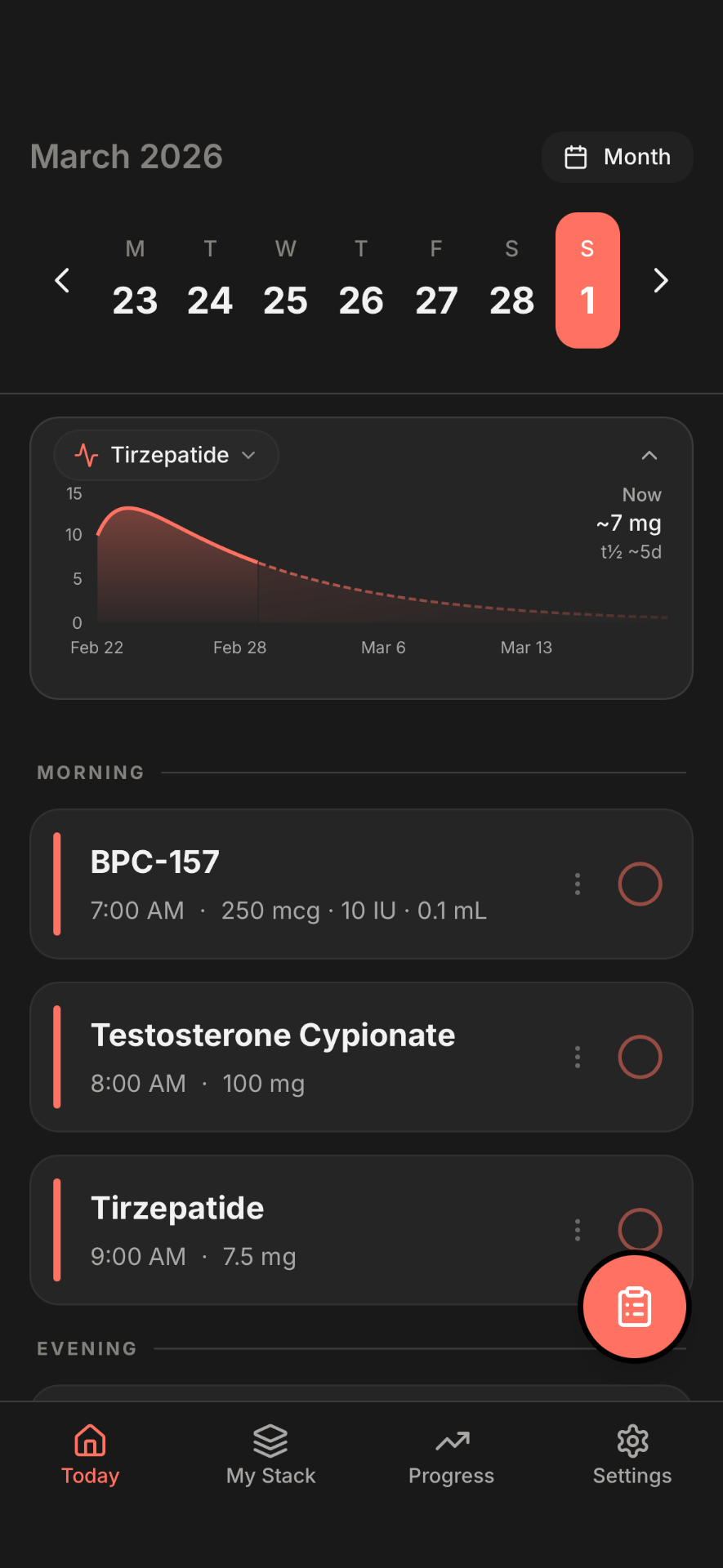
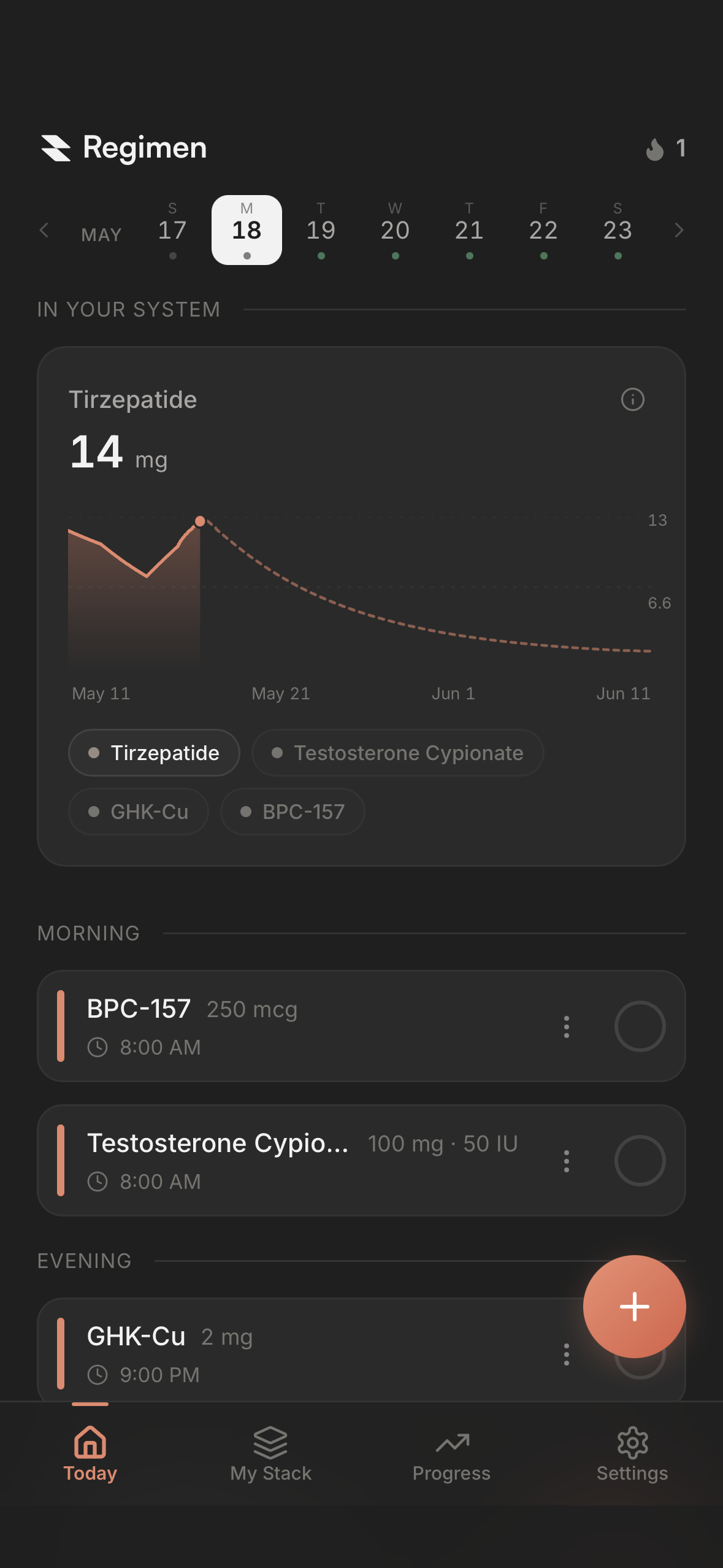
If you inject a weekly GLP-1 medication on Monday and feel great through Wednesday, clear head, low hunger, food noise quiet, but find yourself struggling with cravings again by Saturday, you are not imagining it. This pattern is real, it is pharmacological, and it has a name in clinical circles: the trough effect.
Understanding it matters because many people misinterpret it as the medication “stopping working” or as personal failure. It is neither.
The Pharmacokinetics of Weekly GLP-1s
Semaglutide (Ozempic, Wegovy) and tirzepatide (tirz) (Mounjaro, Zepbound) are both formulated for once-weekly subcutaneous injection. Their half-lives are designed to maintain therapeutic plasma concentrations across the full week, but “across the full week” is not the same as “at a constant level.”
Semaglutide has a half-life of approximately 168 hours (~7 days). This means concentrations peak roughly 24-72 hours after injection, then slowly decline. By day 6-7, concentrations are at their weekly nadir: the trough.
Tirzepatide has a similar half-life profile (~5 days). It peaks faster and declines somewhat more steeply in the back half of the week.
At trough, plasma concentrations may be 30-50% lower than at peak. For many users, this is enough of a drop to notice: hunger signals return, food noise picks back up, and the sense of “effortless” eating control that characterised days 2-4 fades.
Wondering what is normal? Ozempic side effects by dose has every rate from Novo’s label, including the three warnings most articles skip.
What the Trough Actually Feels Like
The trough experience varies considerably by individual, but commonly reported patterns include:
- Increased hunger on days 5-7, particularly in the evening
- Return of food cravings that were absent earlier in the week
- Slightly worse mood or lower energy in the 24-48 hours before next dose
- Feeling like “myself again” in a way that feels both welcome and uncomfortable. The medication’s effect is noticeable precisely by its absence
Not everyone experiences a noticeable trough. Those who do are often on lower or middle doses, or have a higher baseline appetite/food noise.
Why Some People Notice It More Than Others
Dose: Higher doses produce higher peak concentrations, and the descent to trough may still leave absolute concentrations high enough to maintain effect. At lower doses (e.g. semaglutide 0.5mg or tirzepatide 2.5mg), the trough may fall below the individually effective threshold.
Body composition: Volume of distribution affects half-life in practice. Larger body mass may mean faster absolute clearance, steepening the trough.
Individual receptor sensitivity: GLP-1 receptor expression varies between people. Those with lower receptor density may need higher concentrations to maintain the same effect, making them more sensitive to the end-of-week drop.
Dose escalation phase: The trough effect often improves with dose increases. Many people who struggle with days 6-7 at 0.5mg find the pattern resolves at 1mg.
What This Looks Like in Tracking Data
If you log hunger and cravings daily, the trough pattern is often clearly visible. A recurring weekly cycle, low hunger Monday through Wednesday, rising Thursday, noticeably higher Friday-Sunday, is a direct signal of trough sensitivity.
Spotting a pattern like this depends on logging consistently, and the best GLP-1 tracker apps rundown compares what each one lets you record.
This is one of the patterns that GLP-1 tracking tools can surface: not just “your average hunger this week” but “your hunger systematically spikes on days 5-7 relative to injection day.” The distinction matters because it points to a pharmacological explanation rather than a behavioral one.
Users who observe this pattern in their data have a concrete data point to bring to their prescriber, not just “I feel hungry at the end of the week” but a logged trend across multiple injection cycles.
How Prescribers Think About It
The trough effect is a known phenomenon that clinicians managing GLP-1 patients encounter regularly. Common approaches include:
- Dose increase: If tolerability allows and weight loss has plateaued, moving to the next dose tier often smooths the weekly curve
- Injection day optimization: Shifting injection day so the trough falls on a weekend vs. a work week (or vice versa, depending on lifestyle)
- Expectation setting: Simply knowing the trough is coming reduces its psychological impact. The hunger is not a sign of failure, it is a sign the medication is doing exactly what pharmacokinetics predict
This is a conversation to have with your prescriber. The tracking data, a logged hunger curve across injection cycles, is the most useful input you can bring to that appointment.
The Broader Point: Medication Effect is Not Constant
The trough effect is a specific instance of a broader principle that applies to many protocols: medication effect varies within the dosing interval, and that variation has a pattern.
Weekly TRT injections have a testosterone peak-and-trough cycle. Twice-daily peptides have a different profile than once-daily. Understanding where you are in your dosing cycle, and what that means for how you feel, is what separates protocol optimization from guesswork.
The goal of longitudinal self-tracking is not just to log the average. It is to surface the within-cycle variation that tells you something specific about your physiology.
This article is for informational purposes only and does not constitute medical advice. Discuss all treatment decisions with your healthcare provider.
Ready to track your GLP-1?
- Smart reminders so you never miss a dose
- Track weight, photos, and progress over time
- Medication level curves for every compound