Tirzepatide Reconstitution Calculator — How to Mix Compounded Tirzepatide
Compounded tirzepatide comes as a lyophilized powder that you mix with BAC water before injecting. The reconstitution math works the same way as semaglutide, but tirzepatide vials come in larger sizes (up to 60mg) and the dosing schedule is different. Use our free GLP-1 dose calculator to skip the math entirely. Enter your vial size, BAC water volume, and target dose, and it tells you exactly how many units to draw.
Tirzepatide is the dual-agonist GLP-1 that's been producing the biggest weight loss numbers in clinical trials. If you're using compounded tirzepatide instead of a Mounjaro or Zepbound pen, you need to reconstitute it yourself. The process is identical to semaglutide, but the vial sizes, dose ranges, and titration schedule are all different.
What Is Tirzepatide?
Tirzepatide is the first dual GIP/GLP-1 receptor agonist approved for weight management and type 2 diabetes. It's the active ingredient in both Mounjaro (diabetes) and Zepbound (weight loss). Unlike semaglutide, which targets only the GLP-1 receptor, tirzepatide activates two incretin receptors simultaneously: GIP (glucose-dependent insulinotropic polypeptide) and GLP-1 (glucagon-like peptide-1).
This dual mechanism is what sets tirzepatide apart. GIP receptor activation enhances fat metabolism and works synergistically with GLP-1 signaling to suppress appetite, slow gastric emptying, and improve insulin sensitivity. In head-to-head clinical trials, tirzepatide produced greater average weight loss than semaglutide at comparable dose tiers.
Compounded tirzepatide comes as a lyophilized powder in vials, typically 5mg, 10mg, 15mg, 20mg, 30mg, or 60mg. You reconstitute it with bacteriostatic water (BAC water) and inject subcutaneously once per week, the same process as compounded semaglutide.
If you're switching from a Mounjaro or Zepbound auto-injector pen to compounded tirzepatide, the doses are the same: 2.5mg, 5mg, 7.5mg, 10mg, 12.5mg, 15mg. The only difference is you're measuring units on an insulin syringe instead of using pre-filled pen clicks.
What You Need to Reconstitute
Before mixing, gather everything:
| Item | Purpose |
|---|---|
| Tirzepatide vial (5mg to 60mg) | The lyophilized peptide powder |
| Bacteriostatic water (BAC water) | Solvent for reconstitution. Contains 0.9% benzyl alcohol as preservative |
| Insulin syringes (1mL / 100 unit) | For drawing BAC water and injecting doses |
| Alcohol swabs | To sterilize vial tops before each use |
Never use sterile water or normal saline for reconstitution if you plan to use the vial over multiple days. Only bacteriostatic water contains the preservative (benzyl alcohol) needed to prevent bacterial growth in multi-use vials. Sterile water is single-use only. Once opened, it has no antimicrobial protection.
Step-by-Step Reconstitution Process
- Clean the tops of both vials (tirzepatide and BAC water) with alcohol swabs. Let the alcohol dry completely, about 15-30 seconds.
- Draw your chosen amount of BAC water into the syringe. Common amounts: 1mL or 2mL. For larger vials (30mg, 60mg), 2mL is standard to keep injection volumes manageable across multiple weeks.
- Insert the needle into the tirzepatide vial at an angle, aiming the stream of water at the inside glass wall, not directly onto the powder cake. Direct force can damage the peptide structure.
- Let the water run slowly down the side of the vial. Do NOT shake. Gently swirl or roll the vial between your palms until the powder is fully dissolved. This typically takes 2-5 minutes for tirzepatide.
- Check the solution. Once completely clear with no visible particles or cloudiness, your tirzepatide is reconstituted and ready to dose.
Tirzepatide can sometimes take slightly longer to dissolve than semaglutide, especially in larger vials. If you still see particles after 5 minutes, let the vial sit upright in the refrigerator for 10-15 minutes and then swirl again. If it remains cloudy or has visible clumps, do not use it. The peptide may have been compromised during shipping.
Dose Calculation: The Math Explained
The formula is the same for all reconstituted peptides:
Concentration = Total peptide (mg) ÷ BAC water added (mL)
Dose in units = (Target dose in mg ÷ Concentration in mg/mL) × 100
Worked Example
- You have a 30mg tirzepatide vial
- You add 2mL of BAC water
- Concentration = 30mg ÷ 2mL = 15 mg/mL
- You want a 5mg weekly dose
- Units to draw = (5 ÷ 15) × 100 = 33.3 units on your insulin syringe (round to 33 units)
That 30mg vial at 5mg/week gives you 6 weekly doses, about 6 weeks of use from a single vial.
Or skip the math entirely. Use our GLP-1 Dose Calculator to get the exact number of units for any vial size and BAC water combination. It handles the rounding and shows you how many doses remain in your vial.
Common Vial Sizes and Dose Charts
10mg Vial + 2mL BAC Water (5.0 mg/mL)
| Target Dose | Units to Draw | Doses Per Vial |
|---|---|---|
| 2.5 mg | 50 units | 4 doses (4 weeks) |
| 5.0 mg | 100 units | 2 doses (2 weeks) |
30mg Vial + 2mL BAC Water (15.0 mg/mL)
| Target Dose | Units to Draw | Doses Per Vial |
|---|---|---|
| 2.5 mg | 17 units | 12 doses (12 weeks) |
| 5.0 mg | 33 units | 6 doses (6 weeks) |
| 7.5 mg | 50 units | 4 doses (4 weeks) |
| 10.0 mg | 67 units | 3 doses (3 weeks) |
| 12.5 mg | 83 units | ~2 doses (2 weeks) |
| 15.0 mg | 100 units | 2 doses (2 weeks) |
60mg Vial + 2mL BAC Water (30.0 mg/mL)
| Target Dose | Units to Draw | Doses Per Vial |
|---|---|---|
| 2.5 mg | 8 units | 24 doses (24 weeks) |
| 5.0 mg | 17 units | 12 doses (12 weeks) |
| 7.5 mg | 25 units | 8 doses (8 weeks) |
| 10.0 mg | 33 units | 6 doses (6 weeks) |
| 12.5 mg | 42 units | ~4 doses (4 weeks) |
| 15.0 mg | 50 units | 4 doses (4 weeks) |
Larger vials like the 60mg are the most cost-effective, but keep in mind that reconstituted tirzepatide with BAC water should be used within 28 days. At lower starting doses (2.5mg/week), a 60mg vial will last far longer than 28 days. Consider using a smaller vial or splitting your reconstitution schedule. Many compounding pharmacies offer 10mg or 15mg vials specifically for patients in the early titration phase. For help reading your syringe markings accurately at small volumes like 8 or 17 units, see our insulin syringe reading guide.
Using the Tirzepatide Reconstitution Calculator
Instead of doing the math manually, use our free GLP-1 Dose Calculator:
- Select "Tirzepatide" as the compound
- Enter your vial size (5mg, 10mg, 15mg, 20mg, 30mg, or 60mg)
- Enter the amount of BAC water you added
- Enter your target weekly dose
- The calculator shows exactly how many units to draw on your insulin syringe, plus how many doses are left in the vial
The calculator also supports semaglutide, retatrutide, and other reconstituted compounds. You can save your calculation and track your doses over time in the Regimen app.
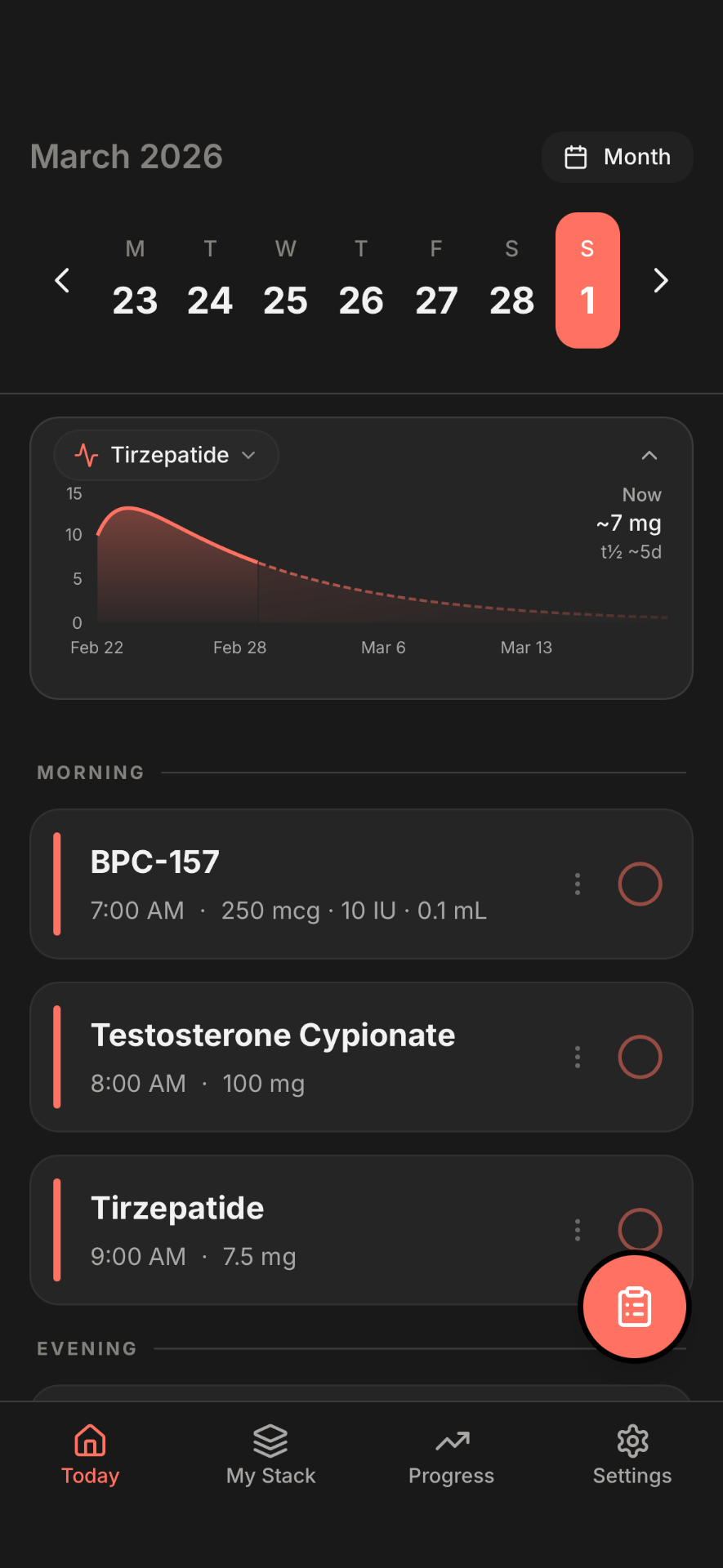
Track your tirzepatide doses, weight, and side effects in one place
- Smart reminders for your weekly injection
- Estimated medication level curves for tirzepatide
- Track weight, photos, and progress correlation over time
Compounded vs. Brand Tirzepatide (Mounjaro / Zepbound)
| Feature | Compounded Tirzepatide | Mounjaro / Zepbound |
|---|---|---|
| Active ingredient | Tirzepatide | Tirzepatide |
| Mechanism | Dual GIP/GLP-1 receptor agonist | Dual GIP/GLP-1 receptor agonist |
| Form | Lyophilized powder → reconstitute yourself | Pre-filled auto-injector pen |
| Dose measurement | Insulin syringe (units) | Pen clicks (pre-measured) |
| Available doses | Flexible, any dose based on reconstitution math | Fixed: 2.5, 5, 7.5, 10, 12.5, 15 mg |
| Cost | Generally lower ($150-400/month typical) | Higher ($1,000+/month without insurance) |
| FDA status | Compounded (not FDA-approved as a product) | FDA-approved |
This guide is for educational purposes. Tirzepatide is a prescription medication. Always work with a licensed healthcare provider for dosing guidance and monitoring. Compounded medications should only be obtained from licensed 503A or 503B compounding pharmacies. Verify your pharmacy's credentials before purchasing.
Tirzepatide vs. Semaglutide: Key Differences
If you're deciding between tirzepatide and semaglutide, or switching from one to the other, here's what matters:
| Factor | Tirzepatide (Mounjaro/Zepbound) | Semaglutide (Ozempic/Wegovy) |
|---|---|---|
| Receptor targets | Dual: GIP + GLP-1 | Single: GLP-1 only |
| Max weekly dose | 15 mg | 2.4 mg |
| Titration steps | 6 tiers (2.5→15 mg) | 5 tiers (0.25→2.4 mg) |
| Average weight loss (trials) | Up to ~22.5% body weight | Up to ~15% body weight |
| Common vial sizes (compounded) | 5-60 mg | 2-10 mg |
| Injection frequency | Once weekly | Once weekly |
The reconstitution process is identical. The only differences are vial sizes and dose ranges. If you're also interested in semaglutide reconstitution, see our complete semaglutide reconstitution calculator guide.
Many users who plateau on semaglutide switch to tirzepatide and see renewed progress. The dual-receptor mechanism may provide additional benefit for people who have adapted to GLP-1-only agonism. Talk to your provider if you've stalled. See our GLP-1 plateau guide for more strategies.
Titration Schedule: How to Ramp Up Safely
The standard tirzepatide titration follows the same schedule whether you're using compounded or brand-name. Each tier lasts a minimum of 4 weeks before increasing:
| Weeks | Dose | Purpose |
|---|---|---|
| Weeks 1-4 | 2.5 mg/week | Initial tolerance phase. Assessing GI tolerance |
| Weeks 5-8 | 5.0 mg/week | First therapeutic dose |
| Weeks 9-12 | 7.5 mg/week | Increasing if tolerated and weight loss has slowed |
| Weeks 13-16 | 10.0 mg/week | Mid-range therapeutic dose |
| Weeks 17-20 | 12.5 mg/week | Higher range, only if needed |
| Week 21+ | 15.0 mg/week | Maximum dose |
Not everyone needs to reach 15mg. Many people find their effective maintenance dose at 5mg, 7.5mg, or 10mg. The principle: increase only if weight loss has meaningfully stalled AND you're tolerating the current dose without significant side effects.
Use our GLP-1 Titration Planner to build a personalized schedule with exact dates for each dose increase and reminders for when to reassess.
The 2.5mg starting dose is intentionally sub-therapeutic for most people. It's designed to let your GI system adapt to the dual GIP/GLP-1 activation. Don't be discouraged if you see minimal appetite suppression or weight loss in the first 4 weeks. The real effects typically begin at 5mg. Resist the urge to skip the 2.5mg phase. The side effect reduction is worth it.
Storage After Reconstitution
| State | Temperature | Shelf Life |
|---|---|---|
| Unreconstituted (powder) | Room temp or refrigerated | Per manufacturer/pharmacy expiration date |
| Reconstituted (with BAC water) | Refrigerated (36-46°F / 2-8°C) | Up to 28 days |
| Reconstituted | Room temperature | Not recommended. Refrigerate immediately |
Never freeze reconstituted tirzepatide. Keep the vial upright and away from direct light. If the solution develops cloudiness, visible particles, or any discoloration, discard it and use a new vial.
If you're using a large vial (30mg or 60mg) at a low dose, check whether your supply will last beyond the 28-day window. A 60mg vial at 2.5mg/week would theoretically last 24 weeks, but the reconstituted solution is only stable for 28 days. Plan your vial sizes to match your current dose tier, or discuss multi-vial strategies with your provider.
Side Effects to Track
Common side effects, especially during dose increases and titration:
| Side Effect | Frequency | When It Usually Improves |
|---|---|---|
| Nausea | Very common | 1-3 weeks at each new dose |
| Decreased appetite | Very common (desired effect) | Ongoing |
| Diarrhea | Common (more frequent than with semaglutide) | 1-2 weeks at each dose |
| Constipation | Common | With fiber/hydration adjustment |
| Sulfur burps | Common | Usually subsides within days |
| Injection site reaction | Occasional | Rotate sites |
| Fatigue | Occasional | First 1-2 weeks at new dose |
| Acid reflux / GERD | Occasional | May need dose adjustment |
Tirzepatide's dual mechanism means the GI side effect profile can differ from semaglutide. Some users report more diarrhea than constipation compared to semaglutide, especially during early titration. For detailed tips on managing sulfur burps, see our GLP-1 sulfur burps guide.
Track side effects alongside your doses in the Regimen app to identify patterns, share data with your provider, and know when you're ready to titrate up.
Common Tirzepatide Reconstitution Mistakes to Avoid
| Mistake | Why It Matters |
|---|---|
| Shaking the vial instead of swirling | Tirzepatide is a dual-agonist peptide. Shaking can damage its structure |
| Using the wrong BAC water volume for your dose | Tirzepatide doses escalate from 2.5mg to 15mg. Your BAC water volume determines dose accuracy at every level |
| Injecting water forcefully onto the lyophilized cake | Always let BAC water flow gently down the inside wall of the vial |
| Using a vial past 28 days after reconstitution | Potency drops significantly after 4 weeks. Note the date on every vial |
| Not refrigerating immediately after reconstitution | Tirzepatide begins degrading at room temperature within hours |
Tracking Tirzepatide with an App
What's the best app for tracking tirzepatide?
Regimen is a purpose-built tracker for tirzepatide that logs each injection with dose, site rotation, and time. The free tier covers one compound with all features unlocked: PK curves (half-life visualization), injection site rotation, dose reminders, and Apple Health / Health Connect correlation so you can see how tirzepatide is affecting your sleep, body composition, or weight over time.
Can I track tirzepatide in Apple Health?
Apple Health doesn't have native tirzepatide tracking, but apps like Regimen sync dose logs to Apple Health and pull metrics (weight, body fat, sleep) back so you can correlate medication with outcomes.
How do I track tirzepatide side effects?
A tracker app with structured check-in metrics (energy, sleep, appetite, GI symptoms) is more reliable than a notes app. Regimen tracks 20+ check-in metrics that link directly to your dose log, so patterns become visible after 3 to 4 weeks.
Frequently Asked Questions
Disclaimer: This article is for educational purposes only and is not medical advice. Tirzepatide is a prescription medication. Compounded tirzepatide is not FDA-approved as a finished product. Always consult with a healthcare provider before starting or changing any medication protocol. Individual responses vary.
Ready to track your protocol?
- Smart reminders so you never miss a dose
- Track weight, photos, and progress over time
- Medication level curves for every compound