The Bottom Line
Making a peptide nasal spray is just reconstituting a peptide, doing some basic math, and transferring it to a spray bottle. The process takes about 10 minutes once you have done it a couple times. The hardest part is getting the concentration right so each spray delivers the dose you want. This guide walks you through everything step by step, or you can skip the math entirely and use our free intranasal dose calculator to figure out your exact numbers.
Peptide nasal sprays are becoming one of the most popular ways to take certain peptides without needles. The process is simple: reconstitute the peptide, calculate your concentration, transfer to a spray bottle, and you are ready. This guide covers every step in detail, from supplies to storage.
How to make a peptide nasal spray
To make a peptide nasal spray, reconstitute a lyophilized peptide vial with bacteriostatic water, calculate the dose per 0.1mL spray, transfer the solution to a metered-dose nasal spray bottle, prime the pump, and refrigerate. The full process takes about 10 minutes.
- Wipe both the peptide vial and the bacteriostatic water vial with alcohol swabs.
- Draw bacteriostatic water into an insulin syringe and inject it slowly down the wall of the peptide vial.
- Swirl gently until the powder dissolves into a clear solution. Do not shake.
- Calculate the dose per spray: peptide mcg divided by water mL, multiplied by 0.1. Use the intranasal calculator to skip the math.
- Transfer the reconstituted solution to a metered-dose nasal spray bottle (0.1mL per pump).
- Prime the pump with 3 to 5 sprays into the air, then refrigerate. Use within 28 days.
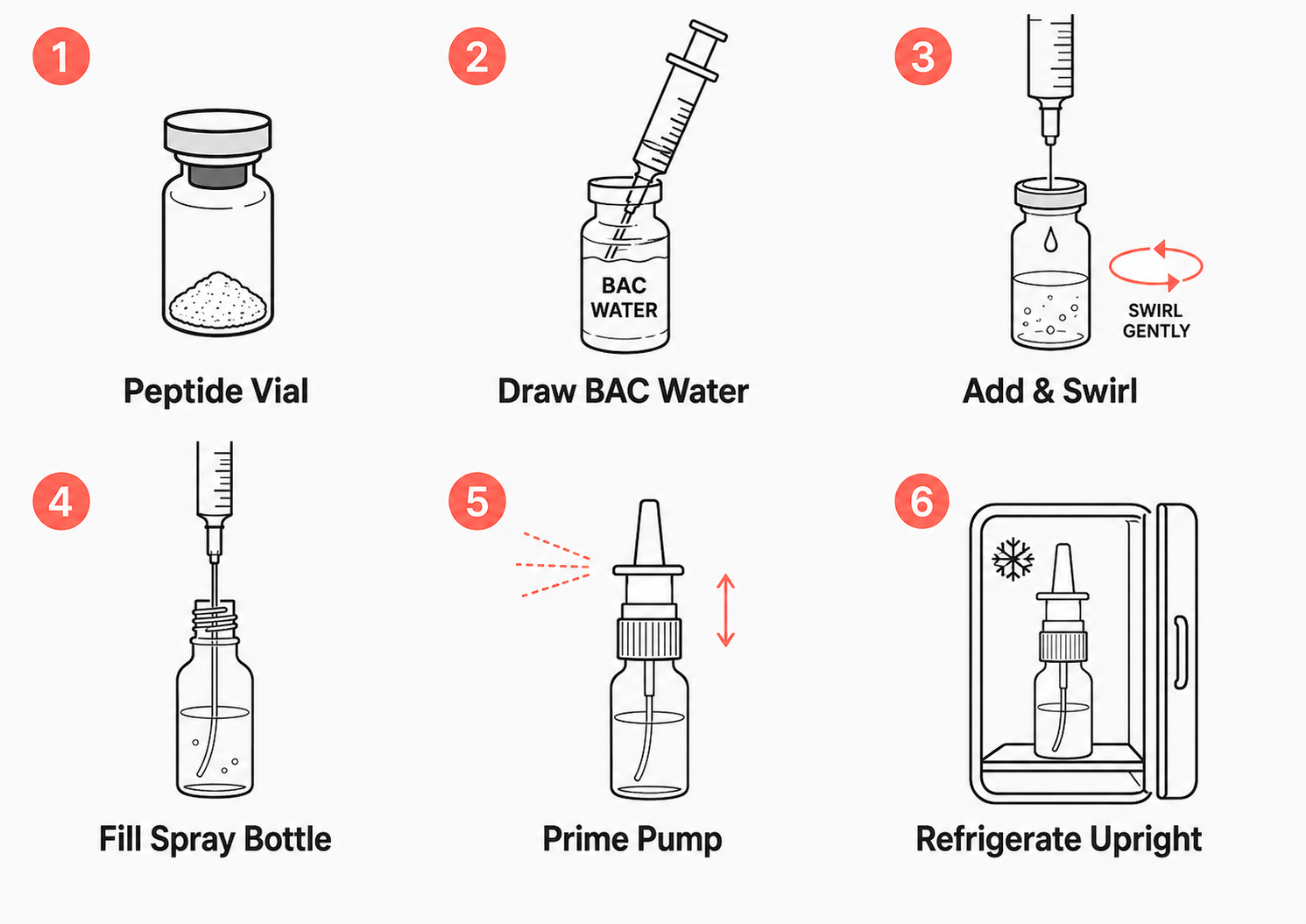
How to reconstitute and fill a peptide nasal spray, step by step.
What You Need (Full Supplies List)
Before you start, gather everything. You do not want to be halfway through reconstitution and realize you are missing a syringe.
The essentials:
- Peptide vial (lyophilized powder, typically 5mg or 10mg)
- Bacteriostatic water (BAC water) for reconstitution. Not sterile water, not saline. BAC water contains 0.9% benzyl alcohol as a preservative, which is what keeps bacteria from growing over the 3-4 weeks you will be using the vial.
- Nasal spray bottle (metered-dose, 0.1mL per spray). These are the standard amber or clear glass bottles with a pump mechanism. Make sure it is a metered-dose bottle, not a continuous spray or squeeze bottle.
- Insulin syringes (1mL, 29-31 gauge). You need these to draw up BAC water and transfer the reconstituted solution.
- Alcohol swabs for sterilizing vial tops before every needle insertion.
- A clean workspace. A wiped-down counter is fine. You are not performing surgery, but do not do this next to an open window or in a dusty garage.
Nice to have but not required:
- Larger syringe (3mL or 5mL) if you are adding a bigger volume of BAC water. Drawing 3mL with a 1mL insulin syringe means refilling three times, which is just annoying.
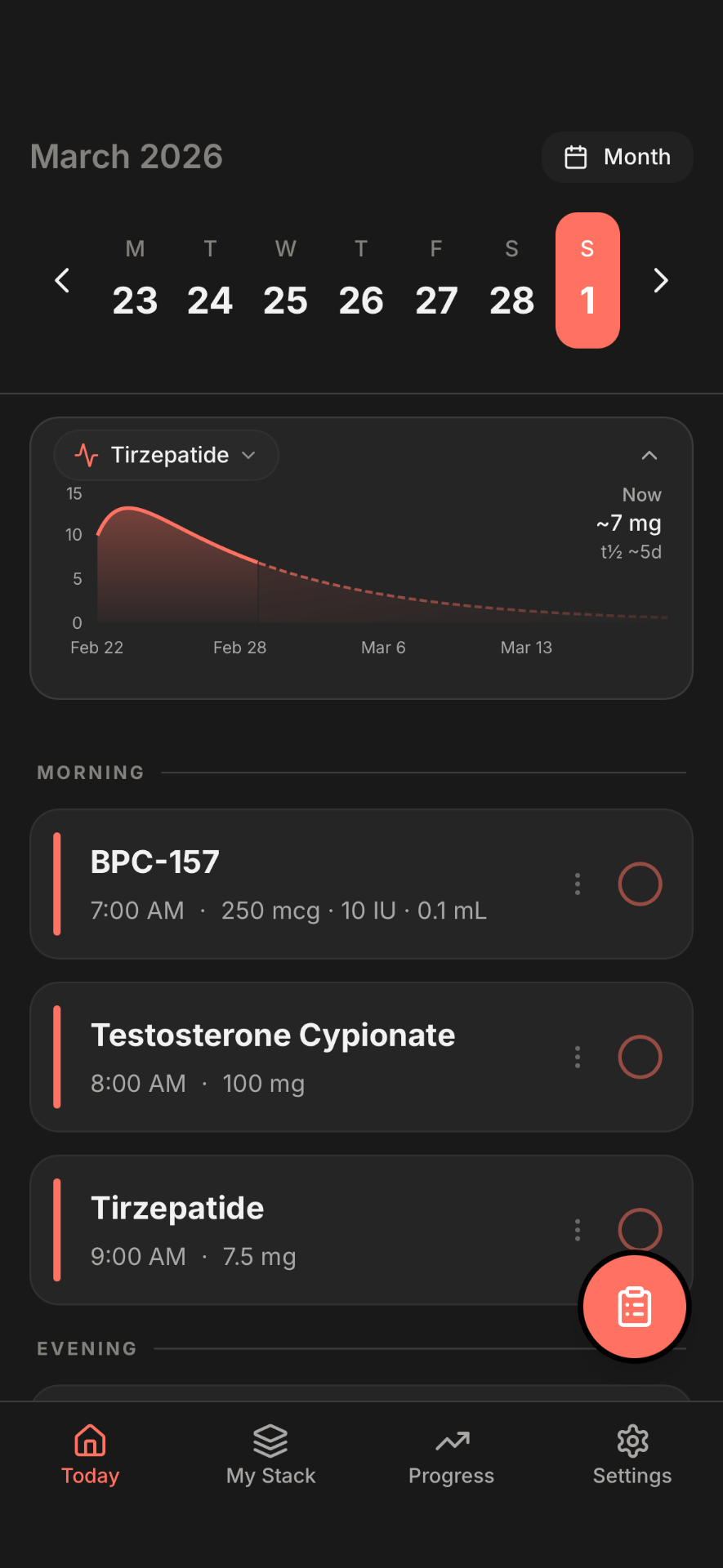
- A peptide reconstitution calculator like the one in the Regimen app, which shows you the math before you start mixing so you do not have to figure it out mid-process.
How Peptide Nasal Sprays Work
The inside of your nose is lined with a thin mucous membrane that is loaded with blood vessels. When you spray a peptide solution onto that membrane, the peptide molecules absorb through it and enter your bloodstream directly.
This is the same principle behind pharmaceutical nasal sprays like oxytocin and desmopressin. It is not new or experimental as a delivery route. The question is which peptides absorb well this way (smaller molecules generally do better) and how the bioavailability compares to subcutaneous injection. For a detailed breakdown, see our guide on which peptides actually work as nasal sprays.
The standard metered-dose nasal spray bottle delivers 0.1mL per pump. That is the number you will use for all your concentration math. Every spray = 0.1mL of solution = a predictable amount of peptide.
Step 1: Reconstitute the Peptide
Reconstitution just means adding water to the freeze-dried powder so it becomes a liquid you can use.
- Wipe the top of the peptide vial with an alcohol swab. Let it air dry for about 15 seconds.
- Wipe the top of the BAC water vial with a fresh alcohol swab.
- Draw up your BAC water. The amount depends on your target concentration (covered in Step 2, but for now, a common starting point is 2mL for a 5mg vial or 2-5mL for a 10mg vial).
- Insert the needle into the peptide vial at an angle. Aim the stream at the glass wall, not directly at the powder cake. Push the plunger slowly. You want the water running gently down the side of the vial.
- Swirl gently. Do not shake it. Just rotate the vial between your fingers until the powder dissolves completely. This usually takes 30-60 seconds.
The solution should be clear when it is fully dissolved. If it is cloudy or has visible chunks that will not dissolve, something is wrong with the peptide and you should not use it.
Pro Tip
The amount of BAC water you add determines your concentration per spray. More water = weaker solution per spray = more sprays needed per dose. Less water = stronger solution per spray = fewer sprays needed. There is a sweet spot, and we will cover it next.
Step 2: Calculate Your Concentration
This is where most people get confused, but the math is actually simple once you see the pattern.
You need to figure out: how many micrograms (mcg) of peptide are in each 0.1mL spray?
Peptide amount (mcg) / BAC water volume (mL) = concentration per mL
Concentration per mL x 0.1 = mcg per spray
Example: You have a 10mg (10,000mcg) vial of BPC-157. You add 5mL of BAC water.
- 10,000mcg / 5mL = 2,000mcg per mL
- 2,000mcg x 0.1 = 200mcg per spray
Another example: You have a 5mg (5,000mcg) vial of Semax. You add 2.5mL of BAC water.
- 5,000mcg / 2.5mL = 2,000mcg per mL
- 2,000mcg x 0.1 = 200mcg per spray
Do not want to do the math? The intranasal calculator does all of this for you. Plug in your vial size, BAC water volume, and desired dose, and it tells you exactly how many sprays you need.
Working backwards: If you know the dose you want per spray, you can figure out how much BAC water to add:
BAC water volume (mL) = Peptide amount (mcg) / (desired mcg per spray x 10)
So if you have 10,000mcg of peptide and want 250mcg per spray: 10,000 / (250 x 10) = 4mL of BAC water.
Step 3: Transfer to the Nasal Spray Bottle
Now you need to get the reconstituted solution from the vial into your nasal spray bottle.
- Open the nasal spray bottle. Most unscrew at the top where the pump mechanism meets the bottle. Some have a cap that pops off.
- Draw the full solution from the peptide vial using a syringe. If the total volume is more than 1mL, you will need multiple draws.
- Inject the solution into the spray bottle through the opening. Go slowly.
- Reassemble the spray bottle. Screw the pump mechanism back on tightly.
Warning
Make sure the nasal spray bottle is clean and sterile before use. New bottles out of the package are generally fine. If you are reusing a bottle, wash it thoroughly with distilled water and let it dry completely. Some people run a small amount of isopropyl alcohol through the pump mechanism and rinse with sterile water.
Step 4: Prime the Bottle
Before your first use, you need to prime the pump. This fills the internal tube with solution so the first actual spray delivers a full dose.
Hold the bottle upright and pump it 3-5 times until you see a fine mist coming out. These priming sprays do not go in your nose. Point the bottle away from you and just pump until the spray pattern is consistent.
You will also need to re-prime (1-2 pumps) if the bottle has sat unused for more than a day or two. The solution in the tube can drain back down.
Those priming sprays use up some of your solution, so factor that into how long the bottle will last. It is usually only about 0.3-0.5mL total for initial priming, but it is not zero.
Step 5: Store It Properly
Reconstituted peptide nasal sprays go in the refrigerator. Not the freezer. Not the counter. The fridge.
Key storage rules:
- Temperature: 36-46F (2-8C). Standard fridge temperature.
- Light: Keep it in the box or wrap the bottle in foil. Many peptides degrade faster with light exposure.
- Shelf life: Most reconstituted peptides last about 28 days refrigerated. BAC water’s preservative (benzyl alcohol) keeps bacteria at bay, but it is not indefinite. After a month, mix a fresh batch.
- Do not contaminate it. When you spray, try not to touch the nozzle tip to your nose or anything else. If you do, wipe it with an alcohol swab.
Community Insight
Some people store their spray bottles in small ziplock bags in the fridge to prevent the nozzle from picking up fridge odors or contaminants. It is a small thing, but it is a good habit.
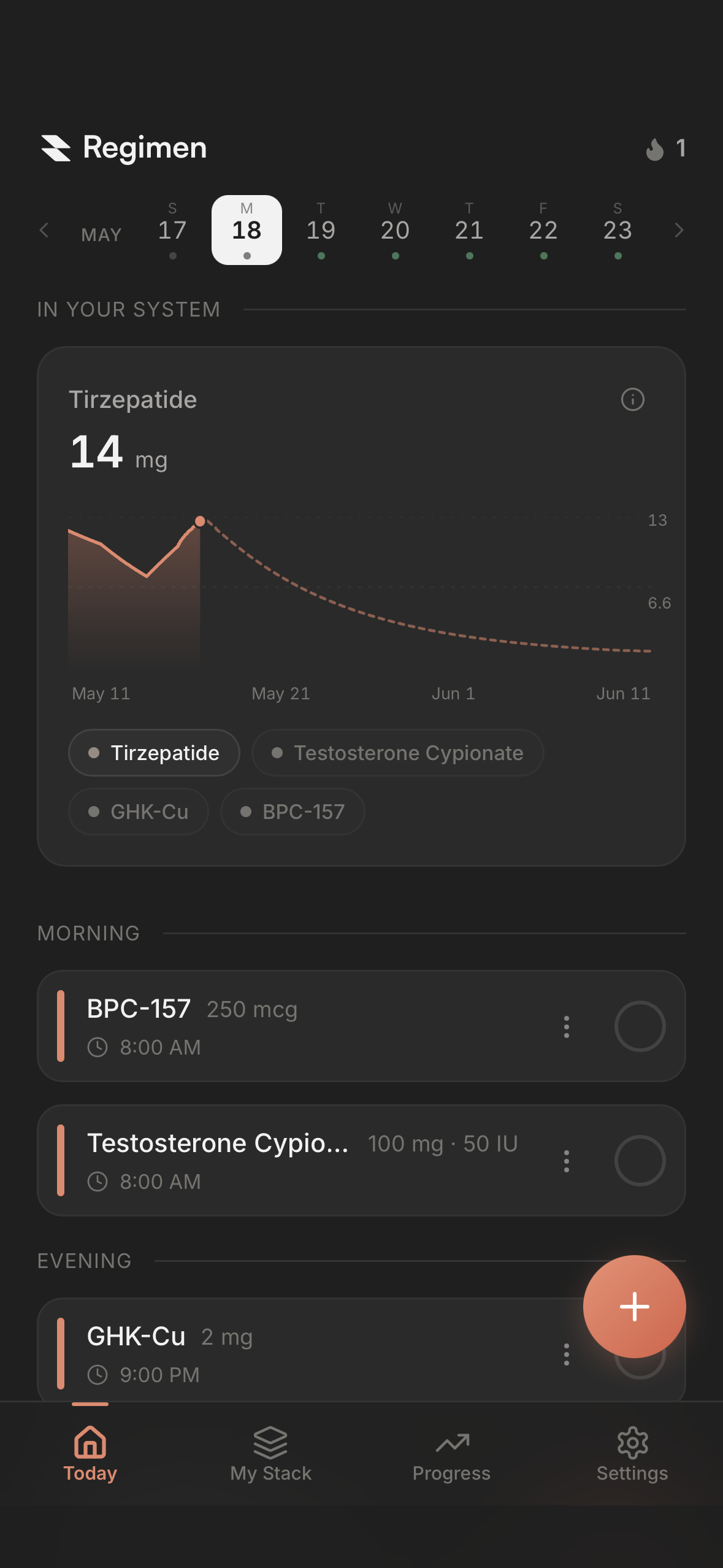
If you are tracking multiple peptides with different reconstitution dates and expiration windows, the Regimen app lets you log when you mixed each one and will remind you when it is time to toss it.
The Math Explained Simply
Here is a quick reference table showing common vial sizes and how different BAC water volumes change your per-spray concentration:
| Vial Size | BAC Water | Concentration/mL | Per Spray (0.1mL) |
|---|---|---|---|
| 5mg (5,000mcg) | 2mL | 2,500mcg/mL | 250mcg |
| 5mg (5,000mcg) | 2.5mL | 2,000mcg/mL | 200mcg |
| 5mg (5,000mcg) | 5mL | 1,000mcg/mL | 100mcg |
| 10mg (10,000mcg) | 2mL | 5,000mcg/mL | 500mcg |
| 10mg (10,000mcg) | 5mL | 2,000mcg/mL | 200mcg |
| 10mg (10,000mcg) | 10mL | 1,000mcg/mL | 100mcg |
The pattern: doubling your BAC water volume cuts your per-spray dose in half. The less water you add, the more concentrated each spray is.
How to pick the right volume: Think about your target dose and how many sprays you want to do per session. Most people prefer 1-2 sprays per nostril per session. Nobody wants to sit there doing 10 sprays per nostril. So work backwards from your target dose to find a BAC water volume that gives you a reasonable spray count.
The intranasal calculator handles this automatically and shows you the spray count for any combination.
Common Mistakes to Avoid
1. Using sterile water instead of bacteriostatic water
Sterile water has no preservative. Once you open it and start drawing from it with a needle, bacteria can grow. BAC water’s benzyl alcohol prevents this. If you use sterile water, you need to use the entire vial in one session, which defeats the purpose of a multi-dose nasal spray.
2. Shaking the vial instead of swirling
Peptides are proteins. Aggressive shaking can damage them. Gentle swirling is all you need.
3. Spraying directly at the septum
Tilt the bottle slightly outward toward the side wall of your nostril, not straight up the middle. The septum (the wall between your nostrils) has less blood flow than the outer walls. Spraying at the outer wall means better absorption. It also means less irritation and fewer nosebleeds.
4. Not priming the bottle
If you skip priming, your first few doses will be short. The pump mechanism needs to be filled with liquid before it delivers a full 0.1mL per spray.
5. Getting the math wrong
One decimal point error and you are either taking 10x your intended dose or 1/10th of it. This is exactly why the intranasal calculator exists. Double-check your numbers or just let the tool do it.
6. Storing at room temperature
Reconstituted peptides degrade fast at room temperature. Always refrigerate. If your spray was left out overnight, it is probably fine, but do not make a habit of it.
7. Using the spray past 30 days
Even with BAC water, the preservative effectiveness degrades over time. A month is the safe window. Label your bottle with the reconstitution date so you do not lose track. For more detail, see our peptide storage guide.
When to Choose Nasal vs Injection
Nasal sprays are not always the best delivery method. They are ideal for peptides that are small enough to absorb well through nasal mucosa (generally under 1,000 daltons molecular weight). For larger peptides like semaglutide or growth hormone peptides, subcutaneous injection is the only effective route.
Nasal sprays work best for: Semax, Selank, DSIP, Oxytocin, and (with lower bioavailability) BPC-157.
Nasal sprays work poorly for: Most GLP-1 peptides, growth hormone secretagogues, and any peptide over about 3,000 daltons.
If you are unsure whether your specific peptide is a good candidate for nasal delivery, check the full guide on which peptides actually work as nasal sprays.
Quick Answers
Do peptide nasal sprays need to be refrigerated?
Yes. Reconstituted peptide nasal sprays should be stored in the refrigerator at 36 to 46F (2 to 8C). At room temperature, peptides degrade quickly and bacteriostatic water’s preservative effect weakens. A short trip out of the fridge for dosing is fine, but the bottle should live in the fridge between uses.
How long does a peptide nasal spray last in the fridge?
A reconstituted peptide nasal spray gets 28 days refrigerated. Bacteriostatic water’s benzyl alcohol preservative keeps bacteria at bay for roughly four weeks. After that window, mix a fresh batch and label the bottle with the reconstitution date so you do not lose track.
Can you use bacteriostatic water for a peptide nasal spray?
Bacteriostatic water is the standard solvent for peptide nasal sprays. It contains 0.9% benzyl alcohol, which prevents bacterial growth across the 3 to 4 week life of a reconstituted vial. Plain sterile water and contact-lens saline are not suitable because they lack a preservative once opened.
How do you store a peptide nasal spray?
Store peptide nasal sprays upright in the refrigerator, away from light. Keep the bottle in its original box or wrap it in foil, since many peptides degrade with light exposure. Avoid the freezer, which can damage the peptide structure, and avoid the door of the fridge where temperature swings the most.
How is nasal peptide dosage measured?
Nasal peptide doses are measured in micrograms (mcg) per spray, calculated from the vial strength and the volume of bacteriostatic water used to reconstitute it. A standard metered-dose bottle delivers 0.1mL per pump, so dividing the peptide amount by the water volume and multiplying by 0.1 gives the mcg per spray. The intranasal calculator handles this automatically.
Which peptides are commonly administered intranasally?
Peptides commonly administered intranasally include Semax, Selank, DSIP, Adamax, and oxytocin. The nasal route is used for smaller, centrally-acting peptides because the nasal mucosa allows them to reach the brain more efficiently than subcutaneous injection. Larger peptides like semaglutide and growth hormone secretagogues do not absorb well through the nasal mucosa and require injection.
Frequently Asked Questions
How much bacteriostatic water should I add to my peptide vial for nasal spray?
It depends on your vial size and the dose you want per spray. A good starting point: if you want 200mcg per spray from a 10mg vial, add 5mL of BAC water. If you want 100mcg per spray, add 10mL.
How many sprays are in a nasal spray bottle?
A standard 10mL nasal spray bottle holds about 100 sprays (10mL / 0.1mL per spray). A 5mL bottle holds about 50 sprays. Subtract 3-5 sprays for initial priming.
Can I use regular saline instead of bacteriostatic water?
Pre-made saline is not recommended because it is not sterile once opened and does not contain a preservative. BAC water is the standard for peptide reconstitution.
How long does a reconstituted peptide nasal spray last?
About 28 days in the fridge. The BAC water preservative keeps it safe during that window. After a month, mix a fresh batch.
Is it safe to make my own peptide nasal spray?
The process is straightforward and the same basic technique that clinics and compounding pharmacies use. The main risks are contamination (solved by using BAC water and clean technique) and dosing errors (solved by doing the math carefully or using a calculator).
Tracking your nasal spray schedule (which peptide, how many sprays, which nostril, and what you noticed) makes it far easier to adjust your protocol. The best peptide tracker apps support nasal spray dosing alongside injections.
Ready to track your protocol?
- Smart reminders so you never miss a dose
- Track weight, photos, and progress over time
- Medication level curves for every compound
How do I know if my nasal spray bottle delivers exactly 0.1mL per pump?
Metered-dose bottles are designed to deliver a consistent volume per pump. If you bought one marketed for nasal spray use, it is almost certainly 0.1mL per actuation. You can verify by weighing the bottle before and after 10 pumps. Ten pumps should reduce the weight by about 1 gram (since 1mL of water weighs approximately 1 gram).
Do I need to refrigerate my peptide nasal spray?
Yes, always. Reconstituted peptides degrade significantly faster at room temperature. Keep the bottle in the fridge when you are not using it. A quick trip to the bathroom for your morning spray is fine, but do not leave it on your nightstand all day.
Can I fly with a peptide nasal spray?
TSA does not specifically test for peptides, and nasal spray bottles are under the 3.4oz liquid limit. That said, keeping it unrefrigerated for long flights will reduce its shelf life. If you are traveling for more than a day or two, bring a small insulated bag with a cold pack.