The Bottom Line
Running TRT + GLP-1 + peptides and you cannot tell what is doing what? You are not alone. The attribution problem is the #1 complaint in every peptide community. The fix is systematic tracking: log every compound with start dates and dose changes, track category-specific metrics, and when you need to cut something, remove one compound at a time and monitor for 4 weeks before drawing conclusions.
The Attribution Problem
You start TRT and feel better. You add a GLP-1 and start losing weight. You add tesamorelin for visceral fat. You add BPC-157 for a nagging shoulder injury. Six months later you feel great, your body composition has changed, and your shoulder is better.
Then your provider raises a concern about your hematocrit. Or your budget tightens. Or a compound becomes unavailable. Now you need to cut something, and you have no idea which compounds are essential and which are doing nothing. Are you losing weight because of the GLP-1, or because TRT improved your energy enough to train harder? Is the tesamorelin reducing your waist measurement, or is that the GLP-1? Is BPC-157 healing your shoulder, or would it have healed on its own?
This is the attribution problem, and it is the #1 reason multi-compound users need a tracking system, not a spreadsheet, not a notes app, not memory.
The One-at-a-Time Rule (and Why Nobody Follows It)
The medically recommended approach is straightforward: start one compound, give it 4-8 weeks to reach steady state, assess its effects, then add the next one. This way, you know exactly what each compound does because you can isolate its effects.
In practice, almost nobody does this. People add 2-3 compounds at once because they are excited, their provider prescribed a combination, or they found a deal on a bundle. The content that follows is honest about this reality while explaining why sequential introduction, when possible, makes tracking and attribution dramatically easier.
If you have already started multiple compounds simultaneously, all is not lost. You just need to be more systematic about tracking so you can work backward to attribute effects.
What to Track for Each Compound Category
| Compound Type | Key Metrics | Tracking Frequency |
|---|---|---|
| TRT | Total/free T, E2, hematocrit, mood, energy, libido | Labs quarterly, symptoms daily |
| GLP-1 (sema/tirz/reta) | Weight, appetite, GI symptoms, glucose, thyroid | Weekly weight, symptoms daily |
| GH Peptides (tesamorelin, CJC/Ipa) | Waist circumference, sleep quality, recovery, IGF-1 | Weekly measurements, labs quarterly |
| Healing peptides (BPC-157, TB-500) | Pain levels (0-10), range of motion, recovery time | Daily symptom log |
Each compound category has different success metrics. Tracking weight to evaluate BPC-157 is useless. Tracking pain levels to evaluate TRT is misleading. Match the metric to the compound.
How to Attribute Results in a Stack
When you are running multiple compounds, attribution requires discipline:
- Log the date you start, stop, or change dose on every compound. This is the foundation. Without a timeline, attribution is impossible.
- When something changes (good or bad), check: what did I change in the last 2-4 weeks? Most compounds reach steady state within this window.
- Keep a protocol timeline: compound name, dose, start date, every dose change with date. This is not optional for multi-compound users.
- If you need to remove a compound: drop one at a time and monitor for 4 weeks before removing the next. This is the only reliable way to determine which compounds are doing what.
The Bloodwork Schedule for Multi-Compound Users
Running multiple compounds means your bloodwork panel needs to cover multiple systems. Here is a consolidated schedule:
Quarterly
| Test | Relevant Compound(s) |
|---|---|
| Total/free testosterone | TRT |
| Estradiol (E2) | TRT |
| CBC with hematocrit | TRT |
| Comprehensive metabolic panel | All |
| Lipid panel | TRT, GLP-1 |
| HbA1c / fasting glucose | GLP-1 |
| IGF-1 | GH peptides |
| Thyroid (TSH, free T4) | GLP-1 |
Semi-Annually
- PSA (men on TRT)
- Liver panel (extended)
- Kidney function
Annually
- DEXA scan (body composition)
- Comprehensive metabolic panel (full)
This is not cheap. Multi-compound protocols require more monitoring than single-compound use. Factor lab costs into your protocol budget. For detailed guidance on interpreting results, read our TRT blood work guide.
When to Simplify Your Protocol
More compounds does not always mean better outcomes. Here are the signs that it is time to reduce:
- You cannot afford the full stack consistently. Gaps in dosing are worse than not starting. If cost is forcing you to skip doses, cut a compound and run the rest consistently.
- Side effects you cannot attribute. If you are experiencing new symptoms and cannot identify which compound is responsible, you are in dangerous territory.
- 4+ compounds for 6 months with no measurable improvement. If your tracking data shows no meaningful change in any metric after 6 months, something is not working.
- Bloodwork shows concerning trends. Rising hematocrit, elevated liver enzymes, thyroid changes, or glucose issues all warrant immediate discussion with your provider and potential protocol simplification.
The Protocol Review: A Monthly Practice
Set aside 15 minutes once a month to review your tracking data. Ask yourself:
- What has changed in the last 30 days? (Weight, measurements, energy, mood, sleep)
- What compound changes did I make in the last 30-60 days?
- Is there a correlation between compound changes and metric changes?
- Are there any side effects I should discuss with my provider?
- Am I due for bloodwork?
This monthly review is the difference between running a protocol and being run by one. It takes less time than scrolling Reddit for dosing advice, and it is actually useful.
What Your Provider Needs From You
When you walk into a provider appointment managing multiple compounds, the most valuable thing you can bring is organized data. Your provider needs to see:
- A complete list of every compound, dose, and frequency
- Start dates and any dose changes with dates
- Your most recent bloodwork with trends from previous draws
- Any side effects with dates of onset
- Body composition trends (weight, waist, strength)
“I am on a few things” is not helpful. A clear protocol timeline with tracked metrics is.
What We See in Regimen Data
Multi-compound protocols are not the exception on Regimen - they are the norm. Approximately 33% of active Regimen users track two or more compounds simultaneously, and the average subscriber manages four active compounds at once. Among users tracking any GLP-1 compound, 157 are also tracking testosterone concurrently. These are not outliers - combined hormonal and metabolic protocols have become a common real-world pattern, and they represent exactly the use case where single-compound attribution breaks down most severely. The most common combinations follow predictable clinical patterns: TRT paired with hCG for fertility preservation, TRT combined with a GLP-1 for body composition, and peptide stacks like BPC-157 + TB-500 for recovery. These are not random stacks. They reflect real protocols prescribed by real providers.
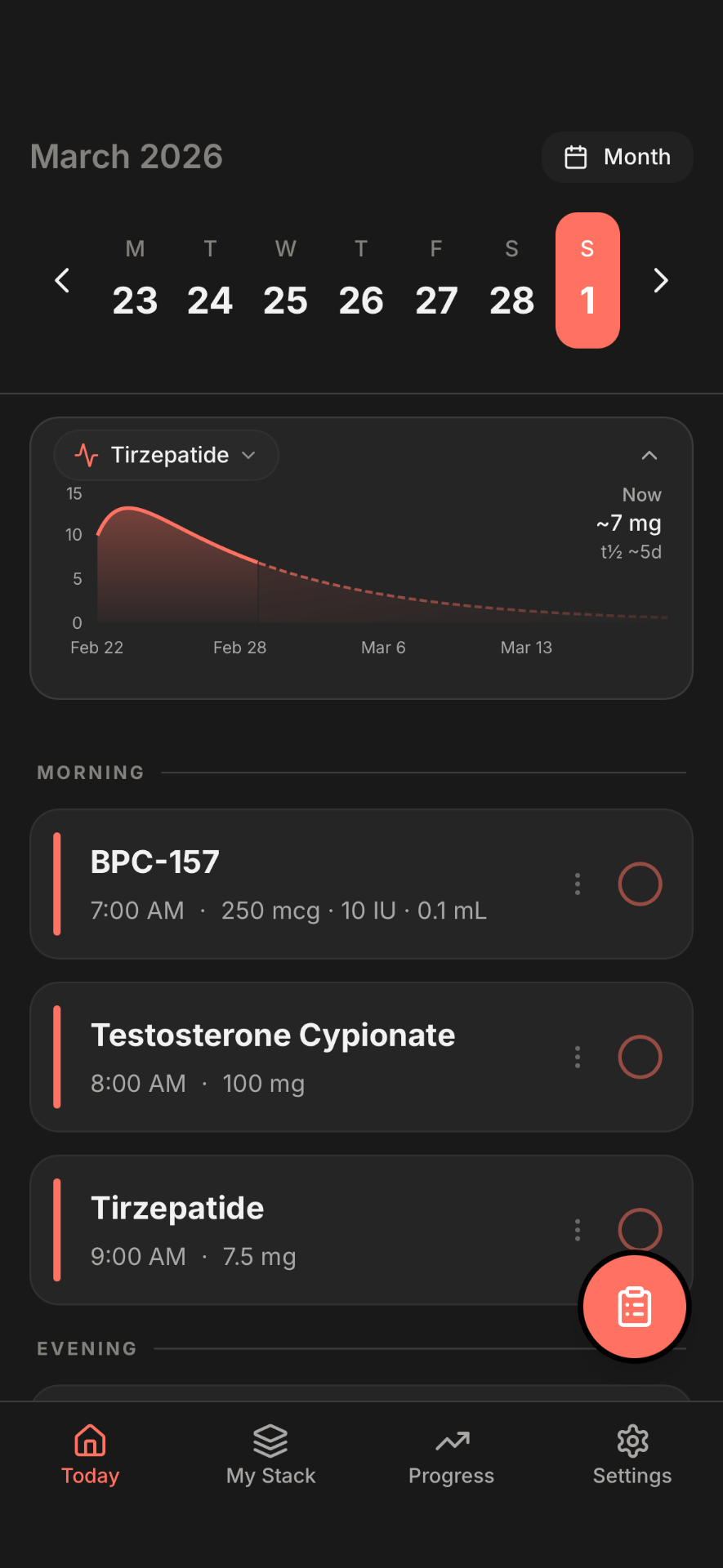
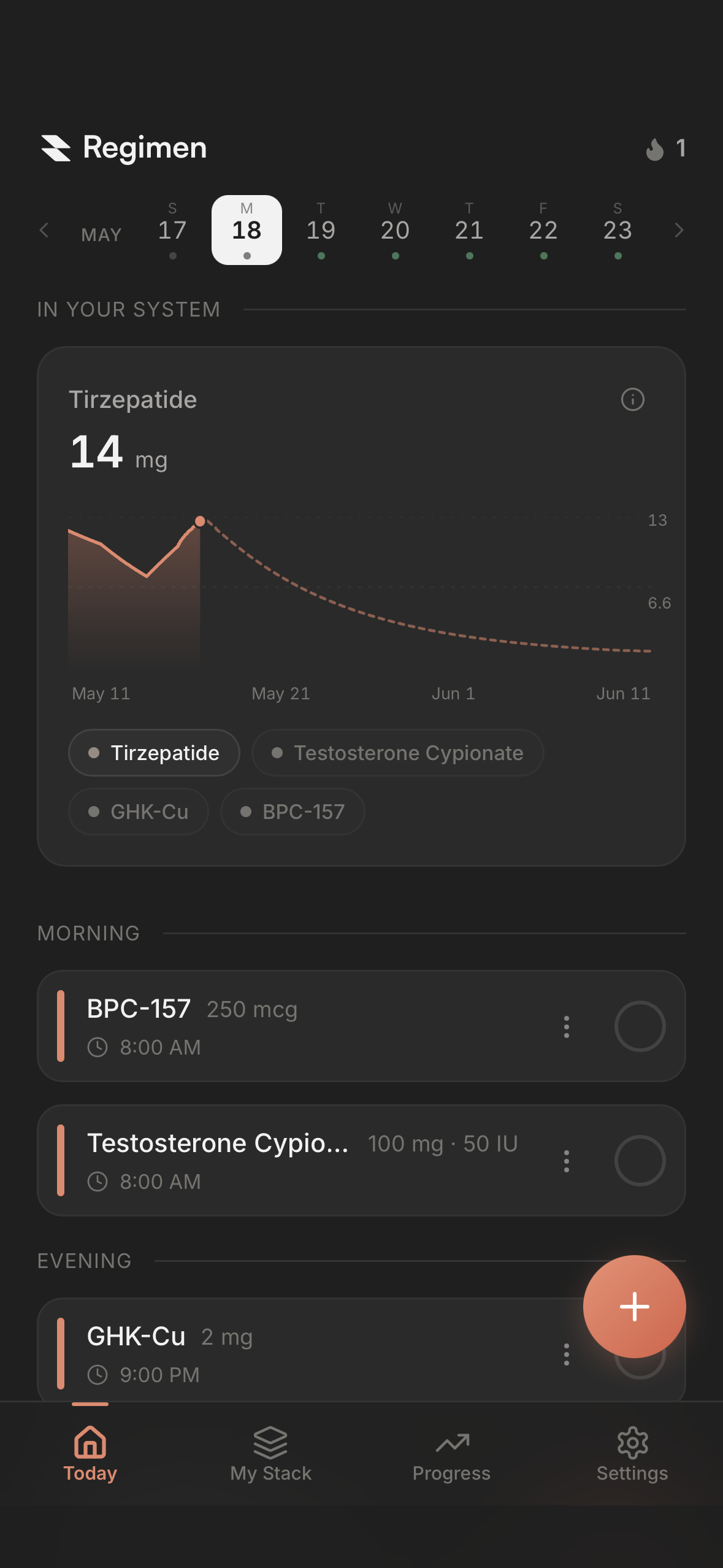
The attribution problem this article describes is the #1 reason users cite for switching to Regimen from generic reminder apps or spreadsheets. When you are running multiple compounds on different schedules with different metrics, a notes app falls apart fast. Regimen’s protocol timeline - which logs every start date, dose change, and compound addition with timestamps - is the feature multi-compound users rely on most. When something changes (good or bad), they can look back and see exactly what shifted in the previous 2-4 weeks. That is the difference between informed optimization and guesswork.
Related Resources
- How to Track Body Recomposition: 5 Metrics Better Than Scale Weight
- GLP-1 Muscle Loss: Does TRT Actually Prevent It?
- Tesamorelin Results Timeline: Week-by-Week Guide
- TRT Blood Work Guide
- TRT Dose Calculator
- Peptide Reconstitution Calculator
- Peptide Injection Schedule for Beginners
This article is for educational purposes only and is not medical advice. Managing multiple compounds requires medical supervision. Do not start, stop, or modify any medication or supplement without consulting your healthcare provider. The tracking recommendations in this article are intended to supplement, not replace, professional medical guidance.
Ready to track your protocol?
- Smart reminders so you never miss a dose
- Track weight, photos, and progress over time
- Medication level curves for every compound