The Bottom Line
Every peptide has its own schedule based on its half-life. Daily peptides (BPC-157, ipamorelin) should be taken at the same time each day. Weekly peptides (semaglutide, tirzepatide (tirz)) go on the same day each week. The most important thing is consistency - pick a time and stick with it.
You’ve got your peptides, you’ve reconstituted them, and now you’re staring at a schedule that says “250mcg BID SubQ” and wondering what planet the instructions came from. Setting up your first peptide protocol doesn’t have to be complicated - but it does require understanding why different peptides need different timing.
This guide covers how to set up an injection schedule for the most common peptides, from daily compounds like BPC-157 to weekly GLP-1 medications, including how to manage multiple peptides on different timelines.
Why Peptides Need a Schedule
Unlike testosterone (which has a half-life measured in days), many peptides have half-lives measured in minutes to hours. This means:
- Short-acting peptides need to be taken frequently (often daily or twice daily) to maintain therapeutic levels
- Long-acting peptides (like semaglutide with a ~7-day half-life) only need weekly dosing
- Timing relative to food matters for some peptides - growth hormone secretagogues need an empty stomach to work properly
- Consistency matters more than perfection - injecting at roughly the same time each day is more important than hitting the exact minute
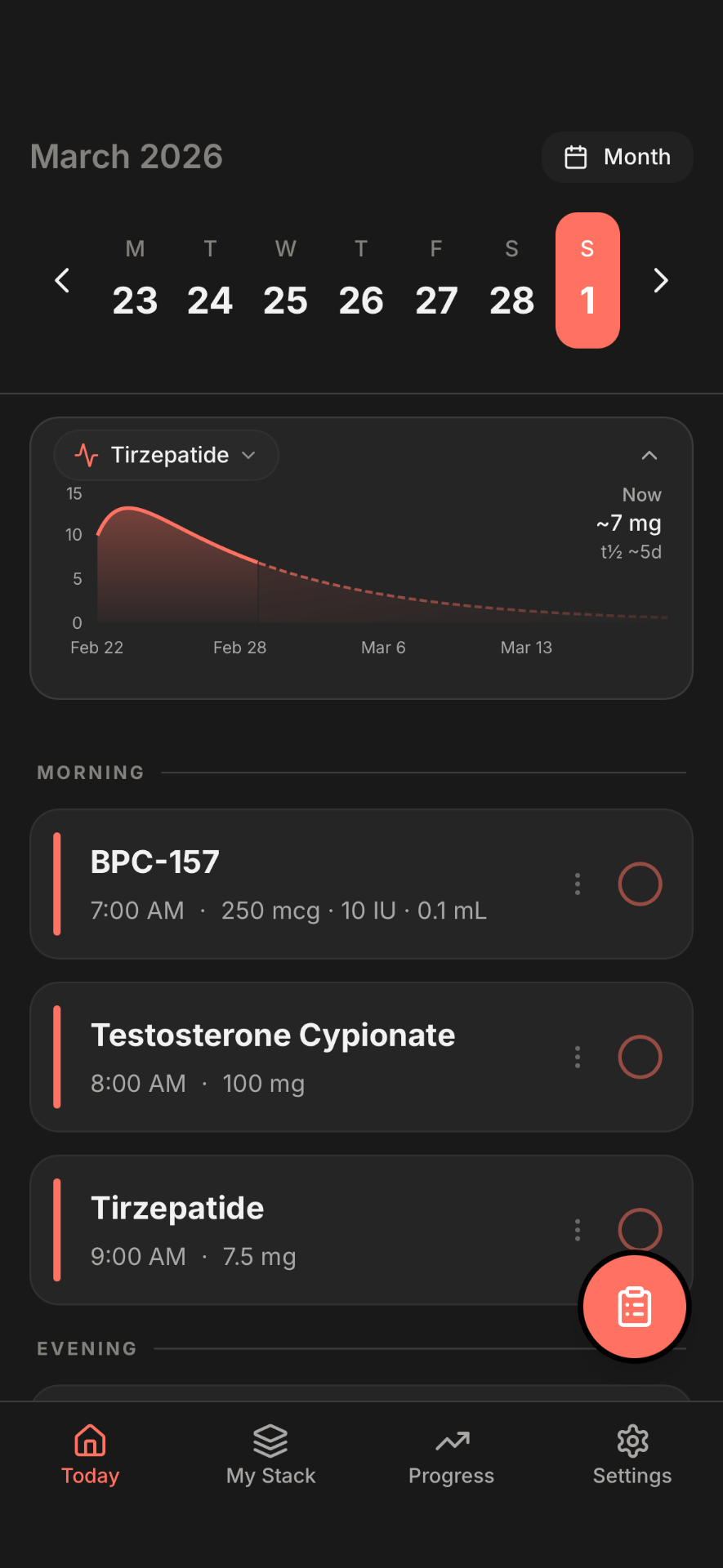
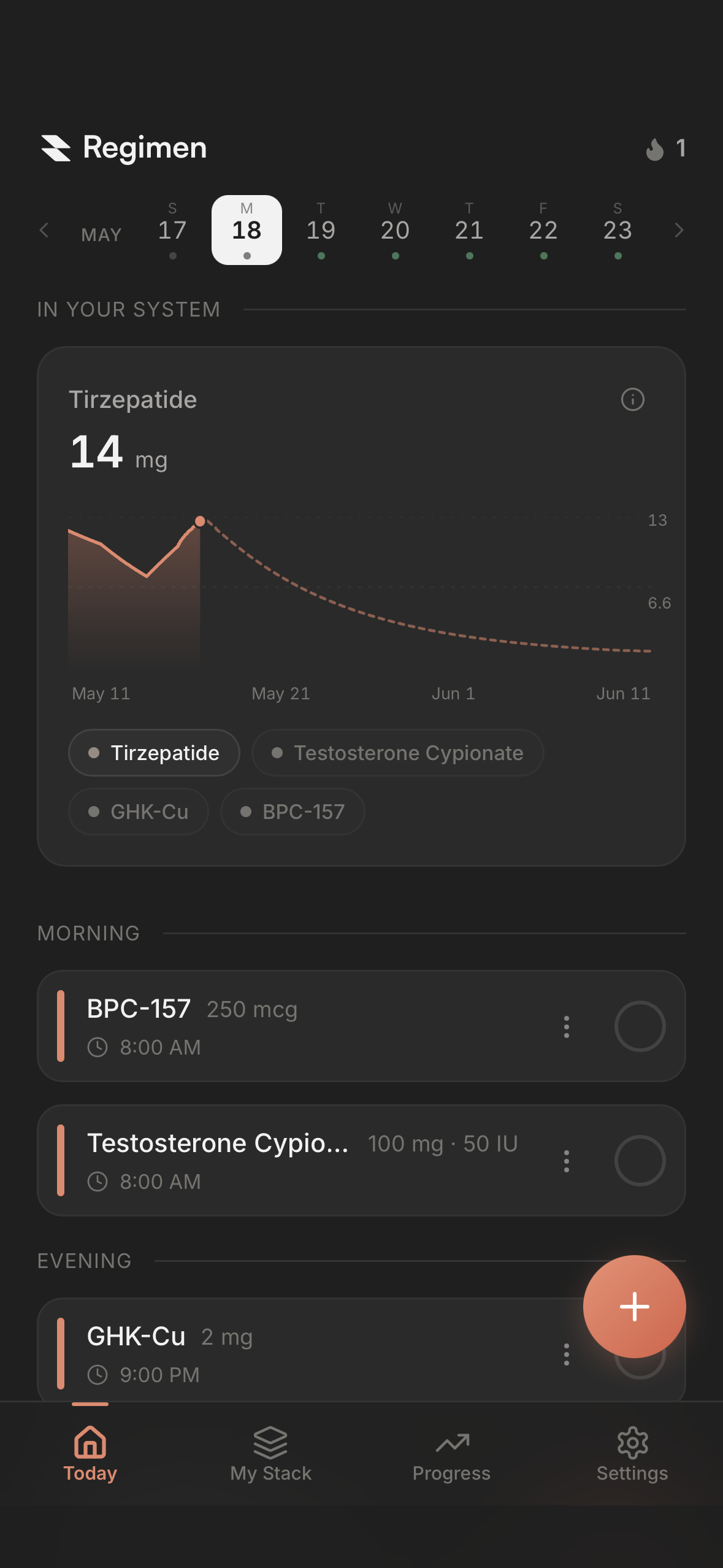
Use our half-life visualizer to see exactly how long each peptide stays active in your system and why frequency matters.
Common Peptide Schedules by Compound
| Peptide | Typical Dose | Frequency | Best Timing |
|---|---|---|---|
| BPC-157 | 250-500 mcg | 1-2x daily | Any time; near injury site if possible |
| TB-500 | 2-5 mg | 2x/week (loading), 1x/week (maintenance) | Any time; systemic - site doesn’t matter |
| Ipamorelin | 200-300 mcg | 1-3x daily | Empty stomach; 30 min before meals or at bedtime |
| CJC-1295 (no DAC) | 100-200 mcg | 1-3x daily | Often stacked with ipamorelin at bedtime |
| Semaglutide | 0.25-2.4 mg | 1x/week | Same day each week; any time of day |
| Tirzepatide | 2.5-15 mg | 1x/week | Same day each week; any time of day |
| Tesamorelin | 1-2 mg | 1x daily | Before bed, empty stomach |
Doses shown are common ranges - always follow your provider’s specific instructions. Use our peptide reconstitution calculator to convert your dose into syringe units.
How to Set Up Your First Week
Here’s a practical approach for your first week on a new peptide:
Day 1: Set your anchor time
Pick a time you can consistently stick to. For bedtime peptides, “right before brushing my teeth” works. For morning peptides, “right after waking up, before coffee” creates a natural habit trigger. Set a phone alarm for the first week until it becomes automatic.
Day 1-3: Start with the lowest dose
If your protocol calls for 500mcg, start at 250mcg for the first 2-3 days. This lets your body adjust and helps you identify any side effects at a lower dose before ramping up. Your provider may have specific titration instructions - follow those.
Day 1-7: Log everything
Track your dose, injection time, injection site, and any effects (positive or negative). This data becomes invaluable if you need to adjust your protocol later. Even “felt nothing” is useful information.
End of Week 1: Assess and continue
Review your week. Were you consistent with timing? Any unexpected reactions? Any doses missed? Adjust your routine (not your dose - that’s your provider’s call) based on what you learned.
Stacking: Managing Multiple Peptides
Running multiple peptides on different schedules is where things get complex. Common stacks and how to manage them:
Example: BPC-157 + TB-500 Recovery Stack
- BPC-157: 250mcg twice daily (morning + evening)
- TB-500: 2.5mg twice per week (Monday + Thursday)
- Key: Different syringes, different injection sites. TB-500 is systemic so inject anywhere convenient. BPC-157 can be injected near the injury site.
Example: GH Stack (Ipamorelin + CJC-1295)
- Ipamorelin + CJC-1295 (no DAC): 200mcg + 100mcg before bed, empty stomach
- Key: These are often taken together but in separate syringes. No food for 30-60 minutes before or after. The bedtime dose aligns with your body’s natural GH pulse during sleep.
Storage and Reconstitution Reminders
Peptide storage is unforgiving. Once reconstituted, most peptides degrade quickly if not handled properly:
- Use bacteriostatic water (BAC water), not sterile water. The benzyl alcohol preservative in BAC water extends shelf life from 24 hours to 14-28 days.
- Refrigerate immediately after reconstitution. Store at 36-46°F (2-8°C). Never freeze reconstituted peptides.
- Write the date on the vial. A Sharpie on the vial cap is the simplest system. Don’t trust your memory.
- Don’t shake - swirl gently. Vigorous shaking can damage peptide bonds and reduce potency.
- Track your vial usage. Knowing how many doses are left in each vial prevents running out mid-protocol.
For detailed reconstitution instructions, see our peptide reconstitution guide or use the peptide calculator to calculate your exact water volume and dose.
What to Track on a Peptide Protocol
- Every injection - compound, dose, time, injection site
- Injection site rotation - especially important if you’re injecting daily
- Side effects - nausea, flushing, injection site reactions, headaches
- Progress toward goals - pain levels (for BPC-157/TB-500), weight (for GLP-1), sleep quality (for GH peptides)
- Vial tracking - reconstitution date, doses remaining, expiry
Common Beginner Mistakes
Starting too many compounds at once
If you start three peptides simultaneously and feel amazing (or terrible), you won’t know which one caused it. Start one compound at a time when possible, with at least a week between adding new ones.
Inconsistent timing
Taking a daily peptide at 7am one day and 11pm the next undermines the stable blood levels you’re trying to achieve. A 1-2 hour window is fine, but try to stay consistent.
Not tracking reconstitution dates
Injecting a peptide that’s been sitting reconstituted for 6 weeks in the fridge means you’re injecting degraded product. Most reconstituted peptides are only good for 14-28 days. Mark every vial with the date you mixed it.
Eating before GH peptides
Growth hormone secretagogues (ipamorelin, CJC-1295, tesamorelin) need to be taken on an empty stomach. Insulin and blood sugar blunt the GH response. Wait at least 30-60 minutes after your last meal before injecting, and don’t eat for at least 30 minutes after.
Skipping doses and doubling up
If you miss a dose, just take the next scheduled one. Don’t double your next dose to “make up for it.” This is especially important with GLP-1 medications where dose-dependent side effects are significant, and each GLP-1 brand sets its own catch-up window, so check your own label before you decide whether to take a late dose at all.
When to Adjust Your Protocol
Talk to your provider about adjusting if:
- Side effects don’t improve after the first week at a given dose
- You see no response after the expected timeframe (2-4 weeks for most peptides)
- Your goals change (shifting from recovery to performance, or adjusting weight loss targets)
- Blood work indicates something needs attention
- You need to travel and your current schedule is hard to maintain
For more on how peptide cycles work, see our peptide cycling guide and peptide blood work guide.
How Beginners Actually Schedule Their Protocols - Regimen Data
If you are new to peptides and feeling overwhelmed by scheduling, you are not alone. Among Regimen subscribers, 42% self-identify as beginners, and the challenges they report are remarkably consistent. The number one pain point, cited by 58% of users, is tracking cycles - the on/off patterns that many peptide protocols require. Timing individual doses is the next most common challenge at 43%. These are not signs of doing something wrong. Peptide scheduling is genuinely complex, and most tools were not designed to handle it. Across Regimen’s active compounds, 13% have cycling configured with defined weeks-on and weeks-off periods, which means cycle management is not a rare edge case - it is something a meaningful share of users need help with from day one.
The good news is that most beginner schedules follow a few common patterns. Among Regimen subscribers, 32% of all active compound schedules are set to daily dosing - the simplest pattern to build a habit around. Another 26% use specific-day schedules (such as Monday, Wednesday, Friday), and 22% follow a weekly schedule. If you are starting your first peptide protocol, chances are it fits into one of these three buckets. The key is picking a tracker that supports your specific schedule type and - just as importantly - handles the cycling component so you know exactly when to start, stop, and restart. Regimen supports all of these scheduling patterns along with full cycle configuration, so you can set your protocol once and follow guided reminders through each phase. If you want to compare options first, see our roundup of the best app to track peptides.
Frequently Asked Questions
Ready to track your protocol?
- Smart reminders so you never miss a dose
- Track weight, photos, and progress over time
- Medication level curves for every compound
What time of day should I inject peptides?
It depends on the peptide. Growth hormone secretagogues (ipamorelin, CJC-1295, tesamorelin) are best taken before bed on an empty stomach, as GH is naturally released during sleep. BPC-157 and TB-500 can be taken any time. GLP-1 medications like semaglutide are typically once weekly, same day each week, any time of day.
Can I take multiple peptides at the same time?
Many peptides can be stacked, but timing matters. Some should be taken together (ipamorelin + CJC-1295 is a classic stack), while others have different optimal timing. Don’t mix different peptides in the same syringe unless your provider specifically instructs you to. Use separate syringes and inject at different sites.
How long do I need to run a peptide protocol?
Most peptide protocols run in cycles. BPC-157 for injury recovery is typically 4-8 weeks. Growth hormone peptides are often run 3-6 months. GLP-1 medications for weight management are usually ongoing. TB-500 loading phases are typically 4-6 weeks followed by maintenance. Your provider will set the duration based on your goals.
What happens if I miss a peptide injection?
For daily peptides (BPC-157, ipamorelin): take it when you remember on the same day, or skip and resume the next day. Don’t double up. For the weekly GLP-1s the catch-up window is set by the brand, not the class: Ozempic says take it within 5 days, Wegovy says take it only if your next scheduled dose is more than 2 days (48 hours) away, and Mounjaro and Zepbound say within 4 days (96 hours). Check your own label, and past that window skip the missed dose and go back to your normal schedule.
Should I cycle off peptides?
Some peptides benefit from cycling (6-8 weeks on, 2-4 weeks off) to prevent receptor desensitization. Growth hormone secretagogues and MK-677 are commonly cycled. BPC-157 is typically run for a defined treatment period and then stopped. GLP-1 medications are generally taken continuously. See our peptide cycling guide for compound-specific protocols.
How do I know if my peptide is still good?
After reconstitution, most peptides last 14-28 days refrigerated (using bacteriostatic water). Signs it’s degraded: the solution is cloudy, discolored, or has particles floating in it. Write the reconstitution date on the vial. If in doubt, reconstitute a new vial.