The Bottom Line
Tesamorelin targets visceral fat specifically. The scale barely moves (1-3 kg over 6 months) because you are selectively losing deep belly fat, not overall body weight. Track waist circumference, not the scale. Expect measurable changes by week 8-12 and full clinical effect by week 20-26. Most people who quit tesamorelin early were actually responding — they were just measuring the wrong thing.
Why Tesamorelin Is Different From Other Fat Loss Compounds
Tesamorelin (brand name Egrifta) is an FDA-approved GHRH (growth hormone-releasing hormone) analog. Unlike GLP-1 medications that suppress appetite and reduce overall body weight, tesamorelin works through a completely different mechanism: it stimulates your pituitary gland to release more growth hormone, which then preferentially mobilizes visceral adipose tissue (VAT), the deep belly fat that wraps around your organs.
This specificity is both tesamorelin’s greatest strength and the source of most confusion. It has minimal effect on subcutaneous fat. Your arms, legs, and face stay the same. The scale barely moves because you are not losing overall weight. You are selectively losing the most metabolically dangerous type of fat.
This is why most people who quit tesamorelin early were actually responding to the medication. They stepped on a scale, saw no change after 6-8 weeks, and assumed it was not working. Meanwhile, their visceral fat was already beginning to mobilize.
Week-by-Week Timeline
| Timeframe | What Is Happening | What You Will Notice | What to Track |
|---|---|---|---|
| Week 1-2 | GH and IGF-1 levels rising | Usually nothing visible | Injection compliance |
| Week 3-4 | GH pulsatility establishing | Possibly better sleep, mild joint aches | Injection sites, any side effects |
| Week 5-8 | GH-mediated lipolysis beginning | Subtle energy improvement, faster workout recovery | Energy levels, recovery quality |
| Week 8-12 | Visceral fat starting to mobilize | Midsection may feel “tighter,” clothes fitting differently | Waist measurement (most important) |
| Week 12-20 | Clinical VAT reduction measurable | Visible midsection changes, potentially noticeable to others | Waist measurement, progress photos |
| Week 20-26 | Full clinical effect | 15-20% visceral fat reduction on scans | Body composition scan if available |
| 6+ months | Maintenance phase | Results visible in mirror and scans | Continue tracking to confirm maintenance |
The key takeaway: if you are evaluating tesamorelin based on scale weight at week 4, you are looking at the wrong data at the wrong time. The minimum evaluation window is 12 weeks with waist circumference as the primary metric.
What the Clinical Data Shows
Published clinical trial data at the standard 2mg daily dose over 26 weeks shows:
- 15-20% visceral adipose tissue reduction measured by CT scan
- Improvement in liver enzymes and hepatic fat independent of changes in body weight
- Increased skeletal muscle area and density in responders, likely due to the growth hormone effect
- No significant effect on subcutaneous fat or overall body weight
This is why tesamorelin is fundamentally different from weight loss medications. It is a body composition tool, not a weight loss tool. The distinction matters for setting expectations and choosing the right tracking metrics.
Why the Scale Lies with Tesamorelin
The scale might show zero change or even a slight increase while several things are happening simultaneously:
- Visceral fat is decreasing (the intended effect)
- Lean mass is maintaining or slightly increasing (GH effect on muscle)
- Water distribution is shifting
A shrinking waist with stable weight is exactly what success looks like on tesamorelin. If you are tracking only weight, you will miss this entirely. Read our complete guide to tracking body recomposition for a full protocol on measuring what actually matters.
What Bloodwork to Monitor on Tesamorelin
| Test | Why | Frequency |
|---|---|---|
| IGF-1 | Confirms growth hormone response to tesamorelin | Baseline + every 3 months |
| Fasting glucose / HbA1c | Tesamorelin can affect glucose metabolism | Every 3 months |
| Liver enzymes (ALT, AST) | Monitor for improvement (and safety) | Baseline + every 6 months |
| Body composition scan (DEXA or CT) | Gold standard for VAT measurement | Baseline + 6 months |
IGF-1 is particularly useful as an early indicator. If IGF-1 rises within the first 4-6 weeks, your pituitary is responding to the GHRH stimulation and the medication is pharmacologically active, even if you cannot see visible changes yet.
Common Side Effects and What They Mean
Most side effects are related to the growth hormone increase and tend to be mild:
- Joint stiffness or aches (week 2-4): Growth hormone increases synovial fluid. Usually resolves within a few weeks as your body adjusts.
- Mild water retention: GH-related. Typically subtle and temporary.
- Injection site reactions: Tesamorelin is injected subcutaneously in the abdomen. Rotate sites to minimize irritation.
- Numbness or tingling (paresthesia): Reported in some studies. Usually mild and transient.
If side effects are significant or persistent, document them with dates and discuss with your provider. Having a log of exactly when symptoms started relative to dosing changes makes the conversation much more productive.
When to Know If Tesamorelin Is Working for You
- By week 12: Waist circumference should be trending down even if the scale is not moving
- By week 26: Measurable VAT reduction on imaging (if available)
- If no change by week 16-20: Discuss with your provider about dose adjustment or discontinuation
The most important thing is having consistent data to share with your provider. “I think my stomach looks the same” is less useful than “my waist measurement has decreased from 38.5 to 36.5 inches over 16 weeks while my weight has stayed at 195.”
Tesamorelin in Multi-Compound Protocols
Tesamorelin is frequently used alongside other compounds, particularly TRT. When combining tesamorelin with other medications, tracking becomes even more important because you need to attribute changes to the right compound. Compare purpose-built options in our best peptide tracking app roundup.
For a complete guide to managing multiple compounds simultaneously, read our multi-compound protocol tracking guide.
What We See in Regimen Data
Tesamorelin users on Regimen behave differently from almost every other compound category. They log waist measurements more consistently than any other user segment, which makes sense given that waist circumference is the primary success metric for this compound. But the most telling data point is retention: tesamorelin users who track waist measurements weekly are significantly more likely to stay on protocol past the 12-week evaluation window compared to those who only track weight. The ones who quit early are disproportionately the ones watching the scale.
Regimen’s scheduling data also reflects tesamorelin’s unique dosing pattern. Daily dosing accounts for 32% of all active compound schedules on the platform, and tesamorelin contributes meaningfully to that number. Among growth hormone peptide users specifically, the most common setup is a daily bedtime injection paired with weekly waist and weight logging - exactly the protocol this article recommends. Regimen was built to support this kind of compound-specific tracking, where the metrics that matter are different from the metrics most people default to.
Related Resources
- How to Track Body Recomposition: 5 Metrics Better Than Scale Weight
- TRT Blood Work Guide: What to Test and When
- Peptide Reconstitution Calculator
- Peptide Injection Schedule for Beginners
This article is for educational purposes only and is not medical advice. Tesamorelin (Egrifta) is a prescription medication with specific indications and contraindications. Do not start, stop, or modify any medication without consulting your healthcare provider. The timeline described above is based on clinical trial averages and individual results will vary.
Ready to track your protocol?
- Smart reminders so you never miss a dose
- Track weight, photos, and progress over time
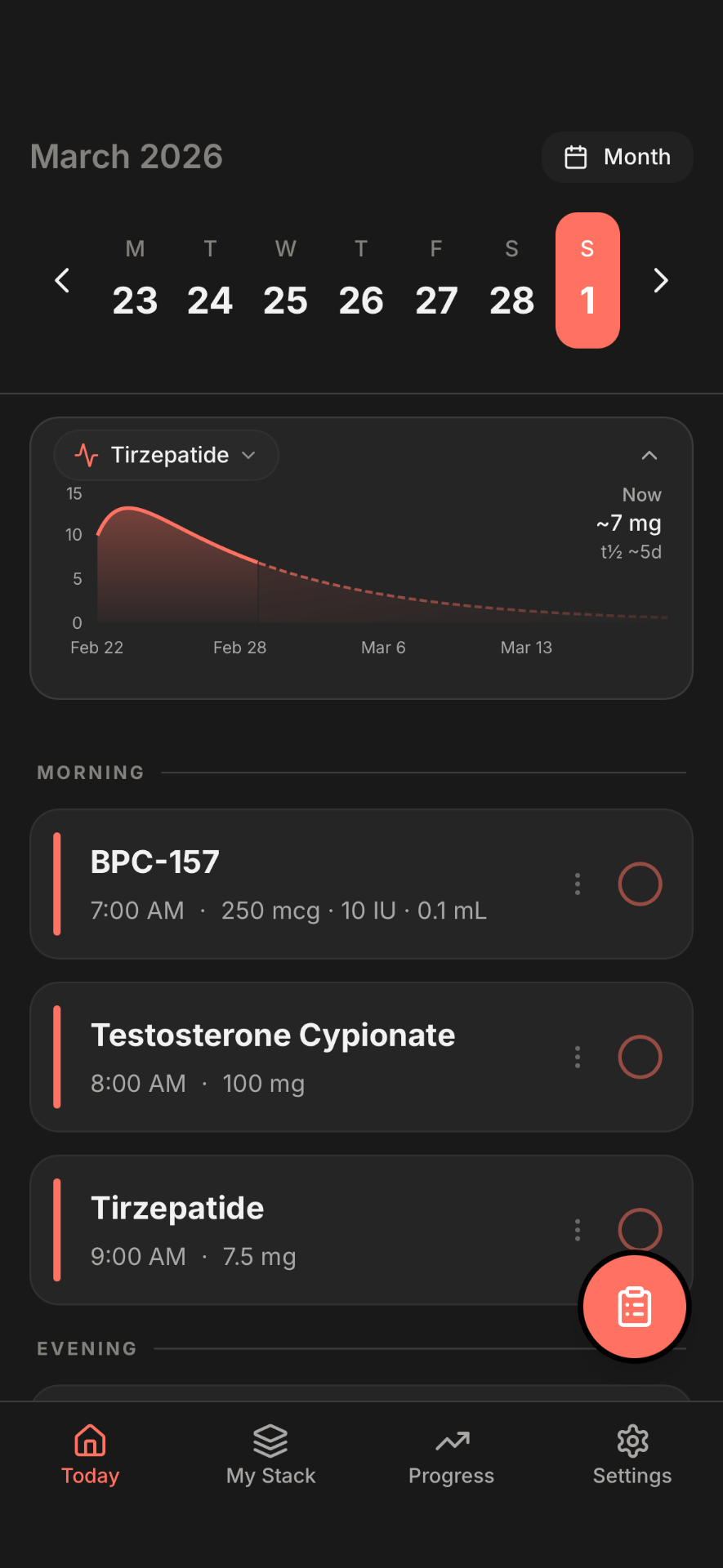
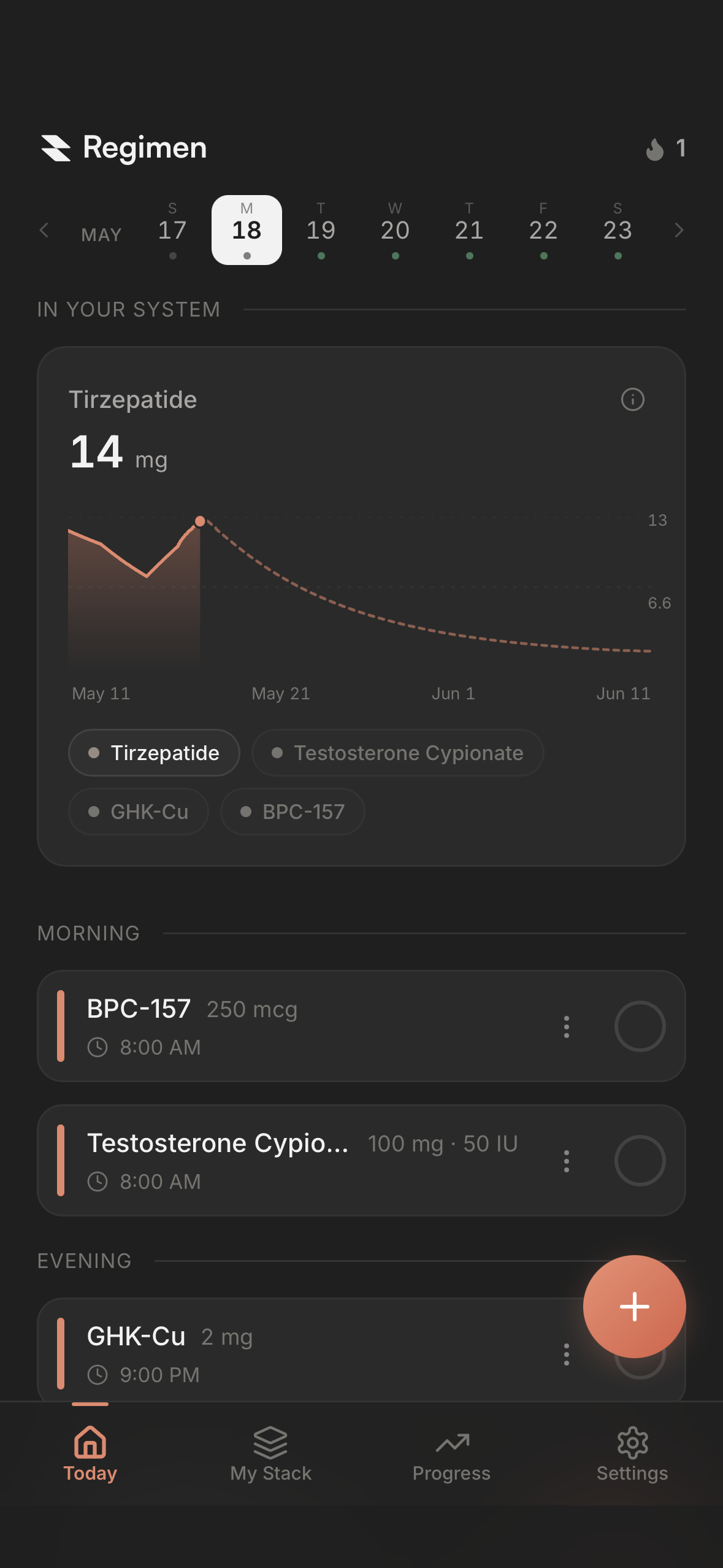
- Medication level curves for every compound