Investigational Drug Notice
Retatrutide is an investigational drug currently in Phase 3 clinical trials. It is not FDA-approved and cannot be legally prescribed. The information below is from published clinical trial data and is provided for educational purposes. If you are using retatrutide (reta), monitoring your health with regular bloodwork and body composition tracking is especially important since post-market safety data does not yet exist.
The Bottom Line
Phase 3 TRIUMPH-1 data shows about 28.3% average weight loss at the 12mg dose over 80 weeks, surpassing semaglutide and tirzepatide (tirz). The best body-composition data we have so far is a Phase 2 DEXA substudy in people with type 2 diabetes: roughly 75 to 80% of the weight lost was fat, 20 to 25% was lean mass. A Phase 3 body-composition split has not been published yet. Retatrutide alone is primarily a fat loss tool. Holding onto muscle while you lose fat takes resistance training, enough protein, and tracking more than the scale.
Are You Losing Muscle on Retatrutide?
Short answer: probably some, but how much is largely up to you. When you lose weight fast, part of what comes off is muscle unless you give your body a reason to hold onto it. The clearest data so far (a Phase 2 substudy) shows most of what people lost was fat, not muscle. Below we break down what that substudy found and, more importantly, what you can do to keep the loss mostly fat.
What Is Retatrutide?
Retatrutide is a triple agonist targeting GLP-1, GIP, and glucagon receptors. This triple mechanism distinguishes it from semaglutide (GLP-1 only) and tirzepatide (GLP-1 + GIP). The glucagon receptor activation is the key differentiator, providing additional energy expenditure through hepatic fat oxidation and thermogenesis.
The drug is currently being studied in the TRIUMPH clinical trial program. It is not FDA-approved. Estimated approval timeline is late 2026 or 2027, pending Phase 3 completion and regulatory review.
The Clinical Trial Results (Phase 3 TRIUMPH-1)
The headline numbers from Eli Lilly’s pivotal Phase 3 obesity trial (TRIUMPH-1, reported 2026):
- About 28.3% average weight loss at the 12mg dose over 80 weeks
- Weight loss continued well past the point where semaglutide and tirzepatide users typically plateau
- Comparison context: semaglutide averages approximately 17%, tirzepatide approximately 22%
These are averages across trial populations. Individual results vary based on dose, adherence, diet, exercise, and genetics.
The Body Composition Data (Phase 2 DEXA Substudy in T2D)
The clearest published look at what retatrutide weight loss actually consists of comes from a Phase 2 DEXA substudy in people with type 2 diabetes, published in The Lancet Diabetes & Endocrinology in 2025. This is not the Phase 3 obesity trial. The full fat-versus-muscle split from Phase 3 has not been published yet.
Retatrutide Phase 2 DEXA Substudy (T2D, Lancet 2025)
12mg dose at 48 weeks:
- Total weight loss: about 24% of baseline body weight
- Share of weight lost as fat: roughly 75 to 80%
- Share of weight lost as lean mass: roughly 20 to 25% (about 6.2 kg lean of ~24 kg total)
- Fat-to-lean loss ratio: broadly in line with what tirzepatide and other GLP-1s show in their own substudies
These numbers come from a Phase 2 substudy in patients with type 2 diabetes, not the Phase 3 obesity trial. Resistance training and adequate protein during retatrutide treatment meaningfully shift the ratio toward more fat and less lean mass loss.
Does retatrutide cause more muscle loss than tirzepatide?
Proportionally, no. The share of weight lost as lean mass looks similar between retatrutide and tirzepatide in the available substudies (roughly 20 to 25% of total loss). In absolute terms, yes, because total weight loss is greater on retatrutide. If you lose more total weight, you lose more of everything, including some muscle, even when the ratio is unchanged. Users prioritizing lean mass preservation should pair retatrutide with resistance training and adequate protein.
Put differently: if you lose 60 lbs on retatrutide and 25% is lean mass, you lost 45 lbs of fat and 15 lbs of lean mass. If you lose 35 lbs on semaglutide and 25% is lean mass, you lost 26 lbs of fat and 9 lbs of lean mass. The retatrutide user lost more lean mass in absolute terms but also lost 19 more pounds of fat.
How to Hold Onto Muscle on Retatrutide
Fast fat loss always comes with a risk: some of what you lose is muscle, not just fat. That’s true of any big calorie deficit, and retatrutide creates a big one. The good news is you have real control over the ratio.
Three things move the needle most:
- Lift something heavy a few times a week. Resistance training is the strongest signal that tells your body to keep the muscle it has. You don’t need a complicated program. Challenging, progressive strength work is what protects muscle while the fat comes off.
- Get enough protein. When you’re eating a lot less overall, protein is the part you don’t want to cut. It gives your muscles the raw material to rebuild. Most people trying to hold muscle during a cut keep protein high and let carbs and fat flex around it.
- Track more than the scale. The scale can’t tell fat from muscle. If the number drops but your lifts are getting weaker, that’s a sign too much of the loss is muscle. Watching your strength, your measurements, or a body-composition reading tells you what the scale can’t.
What This Means for Body Recomposition
Retatrutide alone is primarily a fat loss tool, not a body recomposition tool. True recomposition, losing fat while maintaining or gaining muscle, requires additional interventions:
- Resistance training: The single most effective strategy for preserving lean mass during any weight loss protocol. Without it, the lean mass loss percentage increases significantly.
- Adequate protein: 0.7-1.0g per pound of ideal body weight. GLP-1 appetite suppression makes this challenging but critical.
- Anabolic support: For men who are hypogonadal, TRT can provide the anabolic environment needed to shift the ratio further toward fat loss. Read our GLP-1 muscle loss and TRT guide for the complete picture.
The glucagon receptor component of retatrutide may provide additional metabolic benefits including increased energy expenditure and hepatic fat reduction. Whether this translates to better body composition outcomes compared to tirzepatide is not yet clear from published data.
How to Monitor Your Body Composition on Retatrutide
Because retatrutide produces such significant weight loss, monitoring body composition is not optional. You need to know whether you are losing fat or muscle. Our body recomposition tracking guide covers the full protocol. The essentials:
- Do not rely on scale weight alone. It tells you the least useful part of the story.
- Weekly waist measurements. The most informative single metric for fat loss progress.
- Bi-weekly progress photos. Same conditions every time: lighting, pose, time of day.
- Strength benchmarks in the gym. If your lifts are maintaining, your muscle is maintaining.
- Quarterly bloodwork: Metabolic panel, lipids, thyroid (TSH, free T4), heart rate monitoring. Retatrutide’s glucagon activity makes metabolic monitoring especially important.
- Body composition scan at baseline and every 3-6 months if available.
Retatrutide vs Tirzepatide for Body Composition
| Factor | Retatrutide | Tirzepatide |
|---|---|---|
| Mechanism | Triple agonist (GLP-1 + GIP + glucagon) | Dual agonist (GLP-1 + GIP) |
| Average weight loss | ~28.3% at 12mg, 80 wks (Phase 3 TRIUMPH-1) | ~22% (SURMOUNT) |
| Lean mass loss ratio | Similar proportion to other GLP-1s | Similar proportion |
| Absolute fat loss | Higher (due to greater total loss) | Moderate |
| FDA status | Investigational (Phase 3) | FDA-approved (Zepbound) |
| Post-market safety data | None | Growing real-world data |
| Glucagon-mediated effects | Additional energy expenditure, hepatic fat reduction | Not present |
For a detailed comparison of all three major GLP-1 compounds including side effect profiles, read our retatrutide side effects guide.
The Importance of Tracking on an Unapproved Compound
Retatrutide does not have post-market safety data. There are no years of real-world prescribing experience to draw from. If you are using retatrutide, you are essentially your own case study. Detailed tracking of doses, side effects, bloodwork results, and body composition changes is not just helpful. It is essential for your safety and for productive conversations with your healthcare provider.
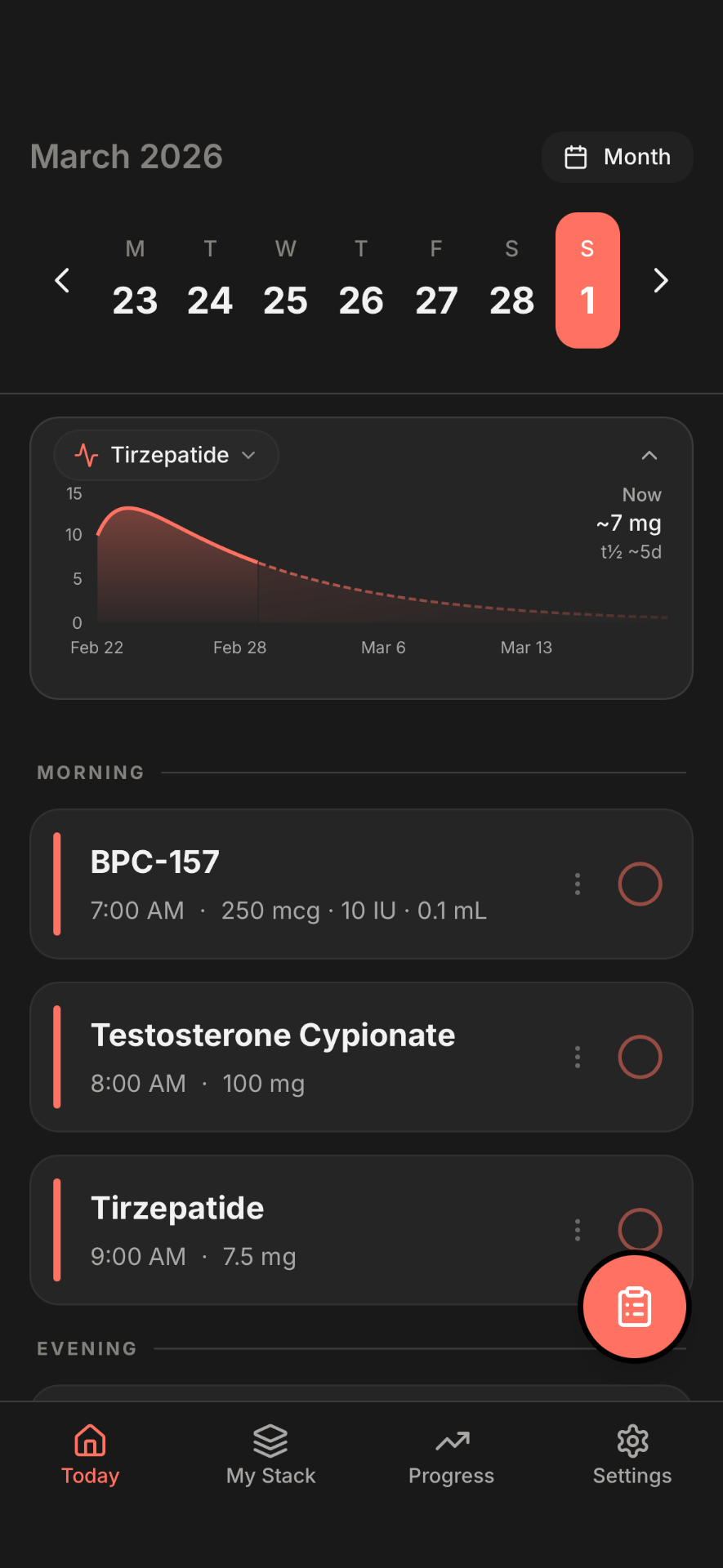
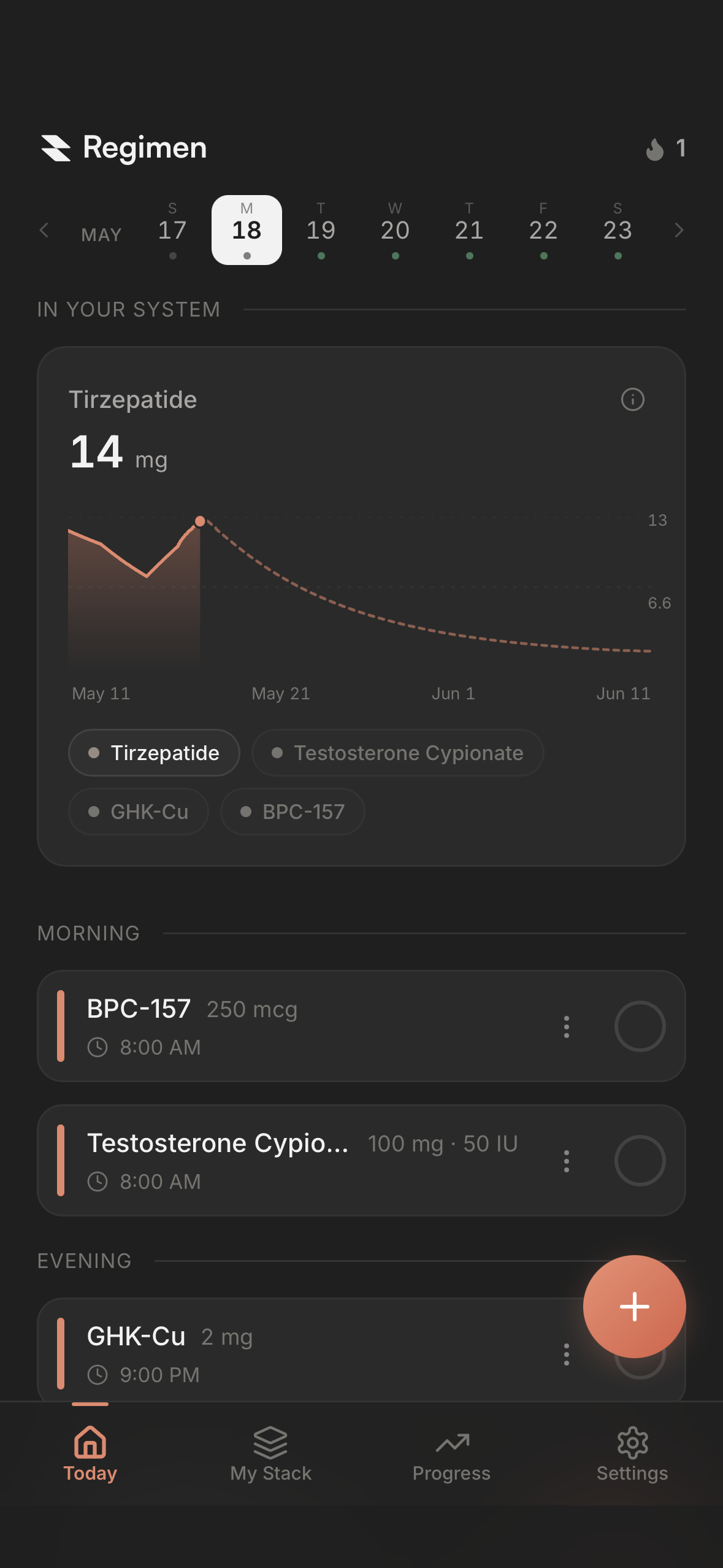
What We See in Regimen Data
Retatrutide is one of the fastest-growing compounds on Regimen, and the tracking behavior of these users reflects the unique challenges of an investigational drug. Retatrutide users log more data points per week than almost any other compound category - doses, weight, measurements, side effects, and lab results. This makes sense: without post-market safety data, these users are effectively their own case studies, and the ones who track thoroughly are the ones who have productive conversations with their providers.
The body composition tracking patterns among retatrutide users are particularly notable. Because the weight loss is so significant (many users report losses exceeding what they experienced on semaglutide or tirzepatide), the question of fat-versus-muscle loss becomes urgent. Regimen subscribers on retatrutide who track waist circumference and strength benchmarks alongside weight report higher confidence that their protocol is working as intended. The data also shows that retatrutide users frequently run it alongside other compounds - TRT for muscle preservation is the most common pairing - reinforcing the need for a tracker that handles multi-compound protocols natively.
Related Resources
- Body Recomposition with Peptides: The 2026 Stack Guide
- Best Peptides for Fat Loss in 2026: The Complete Guide
- How to Track Body Recomposition: 5 Metrics Better Than Scale Weight
- GLP-1 Muscle Loss: Does TRT Actually Prevent It?
- Retatrutide Side Effects Guide
- Peptide Reconstitution Calculator
- TRT Blood Work Guide
This article is for educational purposes only and is not medical advice. Retatrutide is an investigational drug that has not been approved by the FDA or any regulatory agency. The clinical trial data presented is from published research and may not reflect final outcomes. Using unapproved compounds carries additional risks. Consult your healthcare provider before starting or modifying any treatment protocol.
Ready to track your GLP-1?
- Smart reminders so you never miss a dose
- Track weight, photos, and progress over time
- Medication level curves for every compound