This article is educational and does not provide medical advice or dosing recommendations. Cagrilintide is an investigational compound not approved by the FDA. Talk to a licensed healthcare provider before starting, stopping, or combining any medication.
So you have a vial of cagrilintide sitting in front of you. Maybe a friend sent it. Maybe you saw it in a stack somebody swore by. Everyone in the group chat is talking about it like you already know what it is, and you are staring at a little glass vial of white powder wondering what you actually just got.
Here is the friendly version, no biology degree required.
Bottom line
Cagrilintide is a lab-made copy of a fullness hormone your body already makes. People are excited about it because when you pair it with a GLP-1 like semaglutide, the combo (called CagriSema) hit 22.7% weight loss in a big Phase 3 trial, more than either drug did alone. The catch: it is not FDA-approved yet. Novo Nordisk filed for approval in December 2025 and the FDA is reviewing it through 2026. Every vial floating around right now comes from the research-peptide gray market, where what is on the label and what is in the vial do not always match.
This guide walks you through what it is, why people stack it, and what to actually watch out for. If you already know all that and just need the math for mixing your vial, skip to our cagrilintide reconstitution calculator.
What is cagrilintide?
Cagrilintide is a long-acting amylin analog. Let me translate that.
Amylin is a hormone your pancreas quietly releases alongside insulin every time you eat. Its whole job is the “okay, I am full, put the fork down” signal. It slows how fast your stomach empties, tells your brain you have had enough, and softens the blood-sugar spike after a meal.
Cagrilintide is a synthetic version built to do that exact same job. The difference is how long it lasts. The first amylin drug, pramlintide, only stuck around for about 50 minutes, so you had to inject it at every single meal. Nobody wants that. Cagrilintide got re-engineered with a fatty-acid chain that grabs onto a protein in your blood (albumin) and basically hitches a ride, stretching its half-life to around 7 days. That is what makes once-weekly dosing possible.
Here is the part that matters for stacking: cagrilintide works through a completely different pathway than GLP-1 drugs like semaglutide, tirzepatide (tirz), and retatrutide. Those hit your gut and appetite signaling. Amylin hits a separate fullness circuit in your hindbrain. Two different doors to the same “I am full” room. That is the whole reason people combine them.
Is cagrilintide FDA-approved?
No. Not yet, and this part is important.
CagriSema is the branded combo product: cagrilintide 2.4 mg plus semaglutide 2.4 mg, one weekly shot, made by Novo Nordisk. They filed their FDA application on December 18, 2025. As of now it is filed, not approved. Review is expected sometime in 2026. The NEJM paper on the main trial says it flat out: “CagriSema is not approved in the US for weight loss.”
So cagrilintide on its own has no approval anywhere, and the combo is still in the FDA’s inbox. That is not a small footnote. It is the difference between a pharmacy product with quality control and a research chemical with none (more on that below).
Investigational compound
Cagrilintide is an investigational drug. It has not been approved by the FDA or any major regulator for weight loss or any other use. Everything here is educational context, not a recommendation to use it.
The clinical data (what the trials actually showed)
The headline numbers come from Novo’s Phase 3 program. Quick heads-up on names, because they are easy to mix up: REDEFINE is the obesity program, and REIMAGINE is the diabetes program. Some articles have swapped these. They are different trials.
One more thing to know: Novo reports two versions of each result. The higher number is “if you took it perfectly every week.” The lower one is “regardless of whether people stayed on it,” which is closer to real life. Both are below.
| Trial | Who was in it | Duration | CagriSema weight loss | For comparison |
|---|---|---|---|---|
| REDEFINE 1 | Obesity, no diabetes | 68 wk | 22.7% (perfect use) / 20.4% (real-world) | Cagrilintide alone 11.8%; semaglutide alone 16.1%; placebo 2.3% |
| REDEFINE 2 | Obesity + T2D | 68 wk | 15.7% / 13.7% | Placebo ~3% |
| REIMAGINE 2 | Type 2 diabetes | 68 wk | 14.2% (plus a big HbA1c drop) | Semaglutide alone 10.2% |
The REDEFINE 1 result is the one everyone quotes, and for good reason. Look at those comparison numbers: cagrilintide alone got people to 11.8%, semaglutide alone got 16.1%, but together they hit 22.7%. That is more than either one on its own. In that trial, 40% of people lost at least a quarter of their body weight.
Heads-up on two numbers you will see
13.7% and 14.2% look like they are arguing with each other, but they are not. They are two different trials in two different groups of people (13.7% is obesity-plus-diabetes, 14.2% is the diabetes program). If a source lumps them together as one result, that source got it wrong.
What about cagrilintide by itself? The best standalone data is a Phase 2 trial from 2021. On its own, the top dose got people to about 10.8% weight loss over 26 weeks, roughly matching liraglutide (an older weight-loss drug). Solid, but not spectacular. The real magic is not cagrilintide solo. It is the combination.
Why people stack it with a GLP-1
This is the whole reason cagrilintide is having a moment. GLP-1 drugs are great, but your body fights back. Lose enough weight and your system starts defending it, ramping up hunger signals to pull you back toward where you started. It is why people plateau.
Amylin pokes at a different set of fullness signals and helps blunt that “defend the weight” pushback. So you are hitting appetite from two angles at once instead of one. REDEFINE 1 is the proof this works: add cagrilintide to semaglutide and you beat semaglutide alone by about 6 percentage points.
Cagrilintide + semaglutide
This is the pairing that has actually been tested. It is literally what CagriSema is. Cagrilintide handles the amylin pathway, semaglutide handles GLP-1, and the trial data backs up the combo. If you are going to read about any cagrilintide stack, this is the one with real evidence behind it.
Cagrilintide + retatrutide (the “cagri-reta” stack)
Now here is where honesty matters. No clinical trial has ever tested cagrilintide with retatrutide. Zero. Everything you read about this pairing is people reasoning from how the drugs work, plus community protocols. It is not backed by trial data, full stop.
The theory goes like this. Retatrutide is a triple agonist: it hits GLP-1, GIP, and glucagon receptors all at once. Impressive, but it does not touch the amylin pathway. So the idea is that cagrilintide fills that missing fourth door. It is the same logic REDEFINE 1 proved for semaglutide, just extrapolated to a stronger backbone. Reasonable on paper. Still unproven.
If you are curious about the retatrutide side of things, we have a full retatrutide dosing guide and a switching-to-retatrutide guide that go deep on that compound.
Community insight
Both cagrilintide and GLP-1s slow down how fast your stomach empties, just through different receptors. Stack both at full strength from day one and you are basically doubling up the GI side effects. The community protocols you will see almost always recommend getting one drug stable first, then adding the second on its own separate ramp-up, rather than starting both at once. That is reference context from community sources, not a schedule we are handing you.
How cagrilintide gets reconstituted
Since there is no pharmacy version, cagrilintide shows up as lyophilized powder, which is a fancy word for freeze-dried. It is a little cake or dusting of white powder sealed in a vial, sold “for research use only, not for human consumption.” Common sizes are 5 mg and 10 mg vials. It also comes in blends (cagri plus sema, or cagri plus tirzepatide or reta) in one vial.
Powder cannot go in a syringe. So it has to be mixed with bacteriostatic water first. That is what reconstitution means: turning the powder back into a liquid you can actually draw up.
Here is the concept, because it trips people up. How much water you add sets the concentration, and the concentration determines how much liquid equals your target dose. Two common setups you will see cited:
- 5 mg vial + 2.0 mL water = 2.5 mg per mL
- 10 mg vial + 3.0 mL water = 3.33 mg per mL
More water means a more diluted mix, which means you draw a bigger volume for the same amount of drug. Less water, more concentrated, smaller draw. That is the entire relationship.
I am not going to hand you a dose schedule here, because your provider sets that, and cagrilintide is not approved anyway. But the math of “powder plus water equals concentration equals syringe volume” is worth understanding no matter what. That is exactly what our cagrilintide reconstitution calculator does for you: plug in your vial size and how much water you added, and it tells you the concentration and the volume for whatever dose your provider gave you.
Pro tip
When you add the water, aim the stream at the glass wall of the vial, not straight down onto the powder cake. Let it run down the side. Blasting the powder directly can damage the peptide. Then swirl gently, do not shake. Once it is mixed, keep it in the fridge (2 to 8°C) and use it within about 30 days. Never re-freeze a reconstituted vial. Freezing and thawing wrecks the peptide and kills whatever potency was in there.
What cagrilintide feels like (common effects)
The effects are pretty consistent across all the trials, and they are mostly what you would expect from anything that slows your stomach down: gut stuff, mostly mild to moderate, and it tends to ease up after the first few weeks.
From the Phase 2 monotherapy trial, the most common ones were:
- Nausea (the big one, ranging from about 20% up to 47% at higher doses)
- Constipation, diarrhea, and vomiting
- Injection-site reactions (fairly common at higher doses)
- Fatigue in some people
Novo describes the GI side effects in the CagriSema trials as mostly mild to moderate and fading over time. Which lines up with what you hear from the GLP-1 world in general: the first few weeks are the rough patch, then your body settles.
The honest part: supply, quality, and what is actually in that vial
Read this section twice. This is the stuff that actually protects you.
It is a research chemical, legally speaking. Cagrilintide is sold strictly “not for human consumption.” It is not FDA-approved and it is not a compounded pharmacy product. Which means if you use it, there is no prescriber checking your labs, no pharmacist doing quality control, and no recourse if something is wrong with the product. You are fully outside the system.
Purity is close to a coin flip without testing. Gray-market analysis has found that peptides bought without independent lab testing have roughly a 50/50 chance of not matching the label: underdosed, impure, or straight-up a different molecule than what is written on it.
This actually happened
Independent labs (Janoshik, MZ Biolabs, TrustPointe) caught vials labeled as semaglutide that actually contained cagrilintide. A completely different drug than the label claimed. This is not a scary hypothetical. It is a documented case. It is the cleanest possible example of why “just trust the label” does not work out here.
“99% purity, third-party tested” is marketing until proven otherwise. Almost every vendor slaps that on the page. It means nothing unless there is a batch-specific certificate of analysis (a COA, usually a Janoshik HPLC or mass-spec report) for the actual lot you received. Not a generic PDF from the website. The specific lot in your hand. How to read a peptide COA walks through a report field by field.
Blends make it worse. Those “cagri-sema” and “cagri-reta” combo vials sound convenient, but now you cannot verify the ratio of either compound. You are trusting the label on two active drugs at once, and if the label is already a coin flip, you have just doubled the uncertainty.
This is just the reality of a compound that is genuinely promising but has not cleared the FDA yet. The science is real. The supply chain is the Wild West. Know which is which.
Frequently Asked Questions
What is the typical cagrilintide dosage?
There is no approved dose. For reference, Phase 2 trials stepped cagrilintide across 0.3, 0.6, 1.2, 2.4, and 4.5 mg once weekly, and CagriSema’s target dose is 2.4 mg of cagrilintide. Community educational protocols cite roughly 0.6 to 4.5 mg per week. That is context, not a plan. Your provider sets your dose, and this compound is not FDA-approved.
Is there a cagrilintide calculator?
Yes. Regimen’s cagrilintide reconstitution calculator takes your vial size and how much bacteriostatic water you added, then returns the concentration and the exact volume for whatever dose you are targeting.
Is cagrilintide safe?
Trial safety data looks reasonable, with mostly mild-to-moderate GI side effects that ease over time. The bigger real-world risk is supply: cagrilintide is investigational and sold as a research chemical, and gray-market analyses have found roughly a 50/50 chance that unverified vials do not match the label. Documented cases include vials labeled semaglutide that actually contained cagrilintide.
Is CagriSema FDA-approved?
Not yet. Novo Nordisk filed for FDA approval on December 18, 2025. Review is expected through 2026. As of mid-2026 it is filed, not approved. Cagrilintide on its own has no approval anywhere.
What is the typical cagrilintide dosage?
There is no approved dose, so there is no official answer, and I am not going to invent a schedule for you. For reference only: the Phase 2 trials stepped cagrilintide up across 0.3, 0.6, 1.2, 2.4, and 4.5 mg once weekly, and CagriSema’s target dose is 2.4 mg of cagrilintide. Community educational protocols cite a range somewhere around 0.6 to 4.5 mg per week. That is context, not a plan. Your provider sets your dose, and this compound is not FDA-approved.
How do you reconstitute cagrilintide?
You mix the freeze-dried powder with bacteriostatic water to turn it into an injectable liquid. How much water you add sets the concentration (for example, a 5 mg vial plus 2 mL of water gives you 2.5 mg per mL), which then tells you how much to draw for a given dose. Our cagrilintide reconstitution calculator does that math for you so you are not guessing.
Cagrilintide vs retatrutide: what is the difference?
They are not really rivals, they work on different systems. Retatrutide is a triple agonist that hits GLP-1, GIP, and glucagon receptors. Cagrilintide is an amylin analog that hits a totally separate fullness pathway retatrutide does not touch. That is exactly why some people stack them instead of choosing between them. Just remember: the cagri-reta combo has never been studied in a trial. The pairing that actually has evidence is cagrilintide plus semaglutide.
Can you stack cagrilintide with semaglutide?
That is literally what CagriSema is: cagrilintide 2.4 mg plus semaglutide 2.4 mg in one weekly shot. It is the most-studied cagrilintide combo out there, and in Phase 3 it beat semaglutide alone (22.7% vs 16.1% weight loss). It is still awaiting FDA approval, but of all the stacks, this is the one with real trial data behind it.
Is there a cagrilintide calculator?
Yep. Our cagrilintide reconstitution calculator takes your vial size and how much bacteriostatic water you added, then gives you the concentration and the exact volume for whatever dose you are targeting. No mental math, no mixing up your decimals.
Is cagrilintide safe?
The safety data from the trials looks reasonable, with mostly mild-to-moderate gut side effects that ease over time. But “safe in a controlled trial” and “safe from a random gray-market vendor” are two very different things. The bigger risk right now is not the molecule, it is not knowing whether the vial actually contains what the label says. Until CagriSema is approved and available through a pharmacy, that uncertainty is the real safety issue.
Cagrilintide is an investigational compound that is not approved by the FDA. This guide is educational and does not provide medical advice or dosing recommendations. Talk to a licensed healthcare provider before starting, stopping, or combining any medication.
Ready to track your GLP-1?
- Smart reminders so you never miss a dose
- Track weight, photos, and progress over time
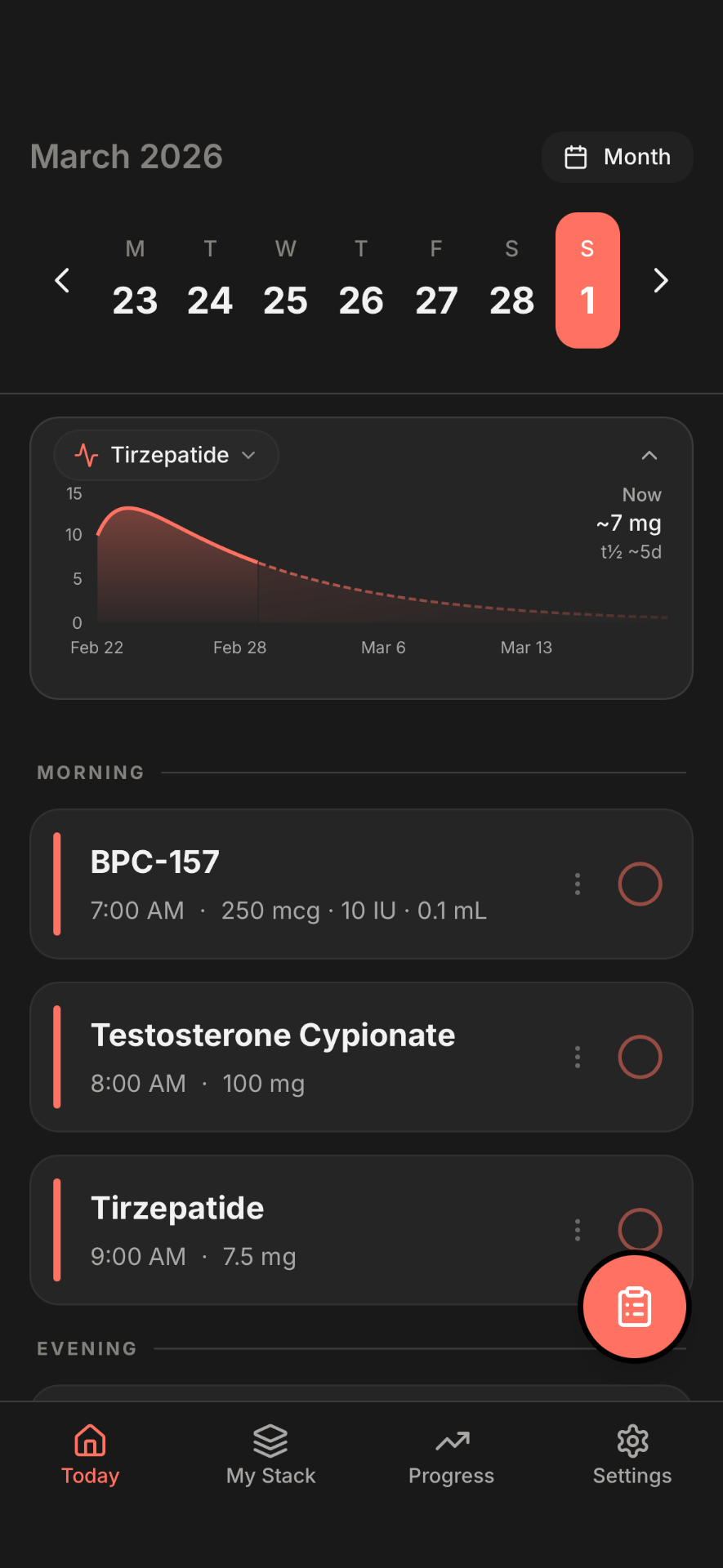
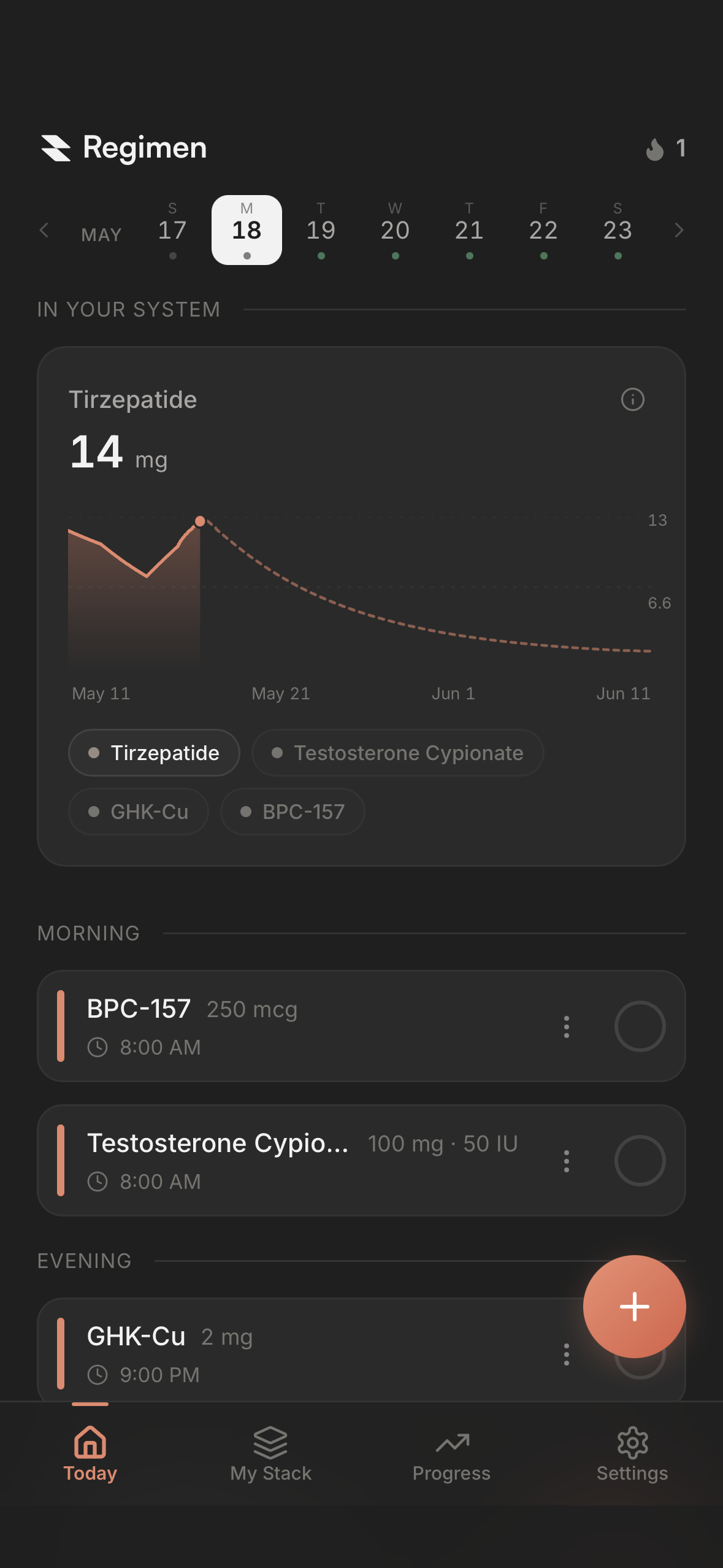
- Medication level curves for every compound