Retatrutide (reta) dosing comes down to three numbers: where you start, how fast you go up, and where you stop. Lilly’s trials give a clear answer for each, and what people actually do is a little different. This guide covers both, plus how to split your weekly dose and how to turn a dose in mg into units on your syringe.
The Quick Answer
Here’s how retatrutide dosing works:
- Start at 2 mg once a week, or lower.
- Go up about every four weeks: 2, 4, 6, 9, then 12 mg in the trial.
- Stay on the dose that works for you, up to 12 mg a week.
- If one weekly shot is rough, split it into two smaller shots.
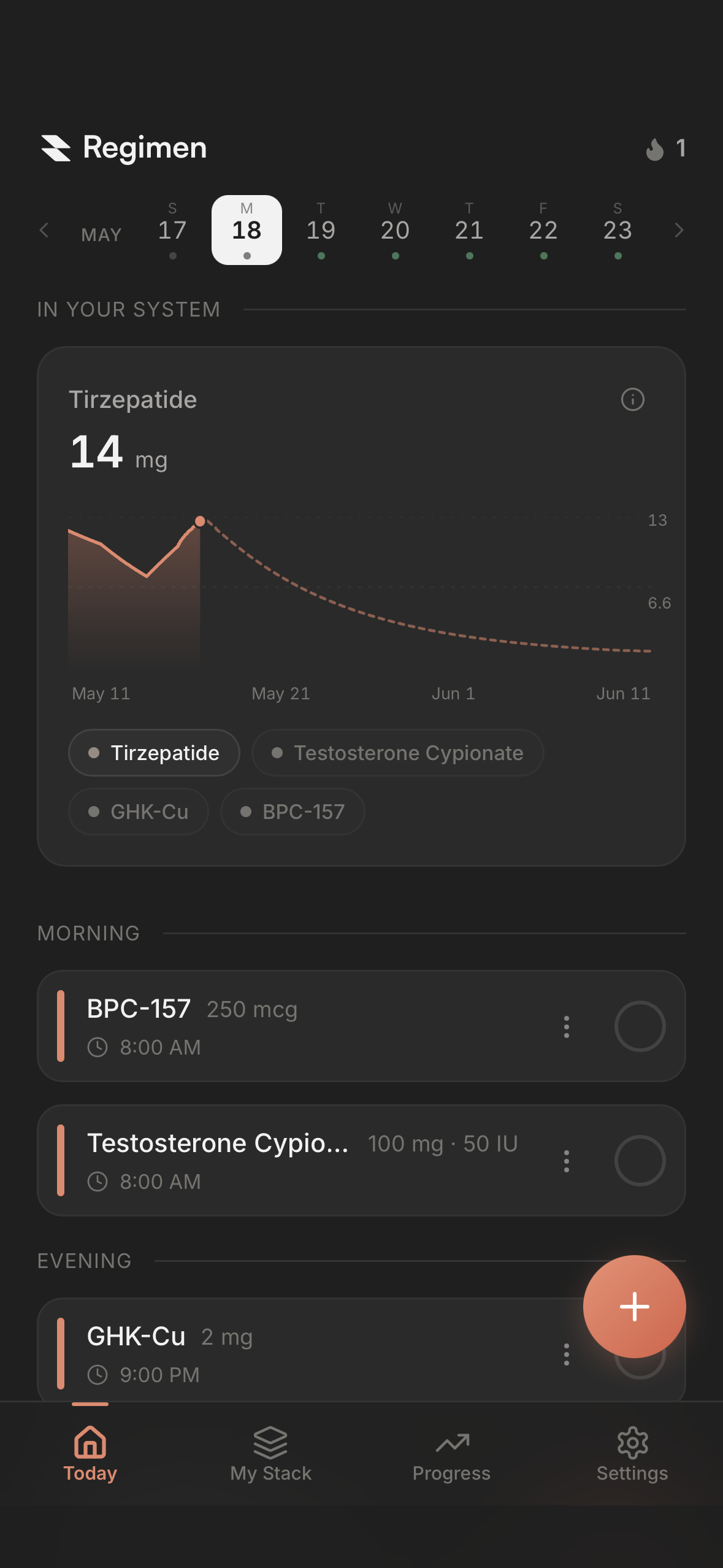
Regimen is a GLP-1 tracker app that logs every retatrutide dose and step up, so you always know where you are on the schedule.
Retatrutide Dosage Chart: The Week-by-Week Schedule
This is the schedule from Lilly’s big Phase 3 trial (TRIUMPH-1). Everyone started at 2 mg and went up every four weeks until they reached their target dose of 4, 9 or 12 mg:
| When | Weekly dose |
|---|---|
| Weeks 1 to 4 | 2 mg |
| Weeks 5 to 8 | 4 mg |
| Weeks 9 to 12 | 6 mg |
| Weeks 13 to 16 | 9 mg |
| Week 17 on | 12 mg |
People on the 4 mg target stopped at step two, and people on 9 mg stopped at step four. There’s no 8 mg or 10 mg step in this trial, whatever other charts online say.
Real life looks different. In Regimen’s app data, people climb more slowly and settle lower:

Among people still logging retatrutide, the typical weekly dose was 3.5 mg at 12 weeks and 4 mg at 24 weeks. The trial schedule would have them on 6 mg and 12 mg by then. Only about one in twelve still logging at 24 weeks was on 12 mg or more.
Starting Dose: Where to Begin
The trial started everyone at 2 mg a week. It’s the first rung of the ladder, not a target dose: it gets your body used to the drug.
Many people start even lower. In Regimen’s app data, 53% of first injections were under 2 mg, and the typical first shot was 1.5 mg. Starting low helps with nausea: in the earlier Phase 2 trial, people who started at 2 mg had fewer stomach side effects than people who started at 4 mg.
Coming from tirzepatide? Your old dose doesn’t carry over, even from 15 mg. The tirzepatide to retatrutide switching guide covers the timing and what people actually did.
How Fast to Go Up
The trial went up every four weeks. Most people take smaller steps:
- Starting at 2 mg a week: people usually stayed there about four weeks, the trial’s pace. When they moved up, most went to 2.5 or 3 mg next, not straight to 4.
- Starting below 2 mg: people moved up sooner, six in ten within four weeks, and 0.5 mg was the most common step.
Go up when the side effects from your current dose have settled. If a step up brings nausea that won’t settle, stay on that dose longer before going up again. The retatrutide titration guide covers when to go up, when to hold and when to go back down.
Maintenance Dose: Where People Stop
The trial’s target doses were 4, 9 and 12 mg a week. Here’s the average weight loss at 80 weeks among people who stayed on treatment:
| Weekly dose | Average weight loss (80 weeks) |
|---|---|
| 4 mg | 19.0% |
| 9 mg | 25.9% |
| 12 mg | 28.3% |
Higher doses lost more on average, and side effects rose with the dose too. You don’t have to reach 12 mg: in Regimen’s app data, the typical person settled around 4 mg a week.
Know where you are on the ladder. Log every dose and step up in Regimen, next to your weight and side effects, so you can see what each dose is doing before you decide to move.
Track your retatrutide dosesCan You Take Retatrutide Twice a Week?
Yes. Splitting means taking the same weekly dose as two smaller shots, about 3.5 days apart. It doesn’t mean taking more:
| Weekly dose | Split into two shots |
|---|---|
| 2 mg | 1 mg + 1 mg |
| 4 mg | 2 mg + 2 mg |
| 6 mg | 3 mg + 3 mg |
People split to smooth out the level. Retatrutide’s half-life is about six days, so one weekly shot gives a peak soon after, then a slow slide. Two smaller shots give a lower peak, and some people find that easier on the stomach. About a third of retatrutide users in Regimen’s app data inject more than once a week.
The trials used one shot a week, and no trial has compared the two. The split-dose calculator works out the units for each shot.
From mg to Units on Your Syringe
Retatrutide usually comes as a powder you mix with bacteriostatic water, so how many units a dose is depends on how much water you add. On a U-100 insulin syringe (100 units = 1 mL), a 10 mg vial works out like this:
| Dose | 10 mg vial + 2 mL water | 10 mg vial + 1 mL water |
|---|---|---|
| 1 mg | 20 units | 10 units |
| 2 mg | 40 units | 20 units |
| 4 mg | 80 units | 40 units |
For any other vial or mix, the retatrutide reconstitution calculator gives you the exact units.
Side Effects by Dose
Stomach side effects (nausea, diarrhea, vomiting, constipation) are the most common. In the trials they rose with the dose, and starting lower helped. Heart rate also rose with the dose in the Phase 2 trial, peaked around week 24, then eased. The retatrutide side effects guide covers each one and what helps.
Tracking Your Doses
Retatrutide dosing is easy to lose track of once you’re splitting shots or stepping up in half-milligrams. Regimen logs every dose, reminds you on your schedule (including split weeks), and shows your dose history next to your weight and side effects. It also draws an estimated medication-level curve from your doses, and the provider report puts it all in one PDF.
Frequently Asked Questions
What is the standard retatrutide starting dose?
2 mg once a week, the starting dose in Lilly’s Phase 3 trial. Many people start lower: in Regimen’s app data, 53% of first injections were under 2 mg, and the typical first shot was 1.5 mg.
Can I start retatrutide at a higher dose if I was on tirzepatide?
People start low even coming from a high tirzepatide dose. Retatrutide also works on a third receptor, glucagon, that your body hasn’t adjusted to, so your tirzepatide tolerance doesn’t cover it. Our switching guide has the timing and what people actually did.
Can I take retatrutide twice a week?
Yes. Splitting means taking the same weekly dose as two smaller shots, about 3.5 days apart: 4 mg a week becomes 2 mg on Monday and 2 mg on Thursday. About a third of retatrutide users in Regimen’s app data inject more than once a week. The trials used one shot a week.
Is split dosing better than once weekly?
No trial has compared them. People split to smooth out the level: two smaller shots give a lower peak than one big one, and some find that easier on the stomach. What counts for results is the weekly total.
What’s the maximum dose of retatrutide?
12 mg a week, the highest dose in the Phase 3 trial. In TRIUMPH-1 it produced 28.3% average weight loss at 80 weeks among people who stayed on treatment.
How long does it take to see results on retatrutide?
Don’t judge it in the first month. On the trial schedule, the first four weeks are at 2 mg, and 4 mg was the lowest dose the trial tested for weight loss. The trial’s headline results came at 80 weeks.
Should I take retatrutide with food?
It doesn’t matter for the shot itself. Retatrutide is injected, not swallowed, so food doesn’t change how it’s absorbed. What helps with nausea is eating smaller meals and stopping when you feel full.
Is 1mg of retatrutide enough?
As a starting dose, yes, and plenty of people start there. As a long-term dose, probably not: in the Phase 2 trial, 1 mg lost the least weight of the doses tested.
Can I take 2.5mg of retatrutide?
Yes. 2 mg is just the trial’s starting step, and people often use in-between doses. In Regimen’s app data, most 2 mg weekly starters who moved up went to 2.5 or 3 mg next, not 4.
How many doses do you get out of a 10mg retatrutide vial?
Five at 2 mg, ten at 1 mg, two and a half at 4 mg. Divide the vial by your dose. The water you add changes how many units each dose is, not how many doses you get.
How do I know which vial size to use?
Divide the vial by your weekly dose to see how many weeks it covers: a 10 mg vial covers five weeks at 2 mg and two and a half at 4 mg. The retatrutide calculator shows the units for your mix.
Sources
- Jastreboff AM et al. Triple-hormone-receptor agonist retatrutide for obesity: a phase 2 trial. N Engl J Med 2023. pubmed.ncbi.nlm.nih.gov/37366315
- Eli Lilly, TRIUMPH-1 topline results, May 21, 2026: retatrutide 4, 9 and 12 mg over 80 weeks. prnewswire.com
- Urva S et al. Retatrutide pharmacokinetics (half-life about 6 days). Lancet 2022. pubmed.ncbi.nlm.nih.gov/36354040
- Regimen app data, September 2026: first retatrutide doses, weekly doses over time, step-ups and split dosing, reported as percentages and typical values.