The Bottom Line
Retatrutide is the first triple-agonist GLP-1 compound, targeting GLP-1, GIP, and glucagon receptors simultaneously. Like other compounded peptides, it comes as a lyophilized powder that you reconstitute with BAC water before injecting. The reconstitution math works the same way as semaglutide and tirzepatide, but the vial sizes and dose ranges are different. Use our free retatrutide reconstitution calculator to skip the math entirely. Enter your vial size, BAC water volume, target dose, and U-100 syringe, and it returns exact units with a draw-to-here syringe diagram.
Retatrutide (LY3437943) is an investigational triple-agonist peptide developed by Eli Lilly that simultaneously activates three receptors: GLP-1, GIP, and the glucagon receptor. It is the first compound in its class to target all three metabolic pathways at once, and clinical trials have produced the highest weight loss results of any obesity drug studied to date.
What Is Retatrutide?
Retatrutide (LY3437943) is an investigational triple-agonist peptide developed by Eli Lilly that simultaneously activates three receptors: GLP-1 (glucagon-like peptide-1), GIP (glucose-dependent insulinotropic polypeptide), and the glucagon receptor. It is the first compound in its class to target all three of these metabolic pathways at once.
This triple mechanism is what distinguishes retatrutide from the current generation of GLP-1 medications. Semaglutide (Ozempic/Wegovy) targets only the GLP-1 receptor. Tirzepatide (Mounjaro/Zepbound) targets two receptors: GIP and GLP-1. Retatrutide adds the glucagon receptor, which plays a direct role in energy expenditure, fat oxidation, and hepatic lipid metabolism. The glucagon component means the body is not just eating less, it is actively burning more stored energy.
In Phase 2 clinical trials (the 2023 NEJM study), participants taking 12mg of retatrutide weekly for 48 weeks achieved up to 24.2% body weight loss from baseline. Phase 3 trial data has since shown results up to 28.3% weight loss, the highest of any obesity drug trial to date. These results exceeded both semaglutide and tirzepatide at their respective maximum studied doses.
Compounded retatrutide comes as a lyophilized powder in vials, typically 5mg, 12mg, or 30mg. You reconstitute it with bacteriostatic water (BAC water) and inject subcutaneously once per week, following the same process as compounded semaglutide and tirzepatide.
You’ll also see retatrutide called GLP-3 in community circles. It’s a nickname, not an official name, but it stuck because retatrutide works on three receptors instead of the one or two the older shots hit.
Pro Tip
Think of the three receptors as three levers for weight loss. GLP-1 reduces appetite and slows gastric emptying. GIP enhances fat metabolism and works with GLP-1 signaling. Glucagon increases energy expenditure and promotes the breakdown of stored fat in the liver. Semaglutide pulls one lever. Tirzepatide pulls two. Retatrutide pulls all three.
Important
Retatrutide is currently in Phase 3 clinical trials and has not received FDA approval. This guide is for educational purposes only. Always work with a licensed healthcare provider for dosing guidance and monitoring.
What You Need to Reconstitute
Before mixing, gather everything:
| Item | Purpose |
|---|---|
| Retatrutide vial (5mg, 12mg, or 30mg) | The lyophilized peptide powder |
| Bacteriostatic water (BAC water) | Solvent for reconstitution. Contains 0.9% benzyl alcohol as preservative |
| Insulin syringes (1mL / 100 unit) | For drawing BAC water and injecting doses |
| Alcohol swabs | To sterilize vial tops before each use |
Important
Never use sterile water or normal saline for reconstitution if you plan to use the vial over multiple days. Only bacteriostatic water contains the preservative (benzyl alcohol) needed to prevent bacterial growth in multi-use vials. Sterile water is single-use only. Once opened, it has no antimicrobial protection.
Step-by-Step Reconstitution Process
- Clean the tops of both vials (retatrutide and BAC water) with alcohol swabs. Let the alcohol dry completely, about 15-30 seconds.
- Draw your chosen amount of BAC water into the syringe. Common amounts: 1mL for the 5mg vial, 2mL for the 12mg and 30mg vials. This keeps injection volumes manageable across multiple weeks of dosing.
- Insert the needle into the retatrutide vial at an angle, aiming the stream of water at the inside glass wall, not directly onto the powder cake. Direct force can damage the peptide structure.
- Let the water run slowly down the side of the vial. Do NOT shake. Gently swirl or roll the vial between your palms until the powder is fully dissolved.
- Check the solution. Once completely clear with no visible particles or cloudiness, your retatrutide is reconstituted and ready to dose.
Pro Tip
Retatrutide can take 3-8 minutes to fully dissolve, which is slightly longer than semaglutide or tirzepatide. If you still see particles after swirling for 5 minutes, let the vial sit upright in the refrigerator for 15-20 minutes, then swirl again gently. Do not shake the vial. If it remains cloudy or has visible clumps after resting, do not use it.
Dose Calculation: The Math Explained
The formula is the same for all reconstituted peptides:
If the three measurements still blur together, the syringe units to mL to mg guide separates them with conversion tables for each concentration.
Worked Example
- You have a 12mg retatrutide vial
- You add 2mL of BAC water
- Concentration = 12mg ÷ 2mL = 6.0 mg/mL
- You want a 4mg weekly dose
- Units to draw = (4 ÷ 6.0) × 100 = 66.7 units on your insulin syringe (round to 67 units)
That 12mg vial at 4mg/week gives you 3 weekly doses, about 3 weeks of use from a single vial.
Or skip the math entirely. Use our Retatrutide Reconstitution Calculator to get the exact number of units for any vial size and BAC water combination. It handles the rounding, picks the right U-100 syringe, and shows you how many doses remain in your vial.
Common Vial Sizes and Dose Charts
5mg Vial + 1mL BAC Water (5.0 mg/mL)
| Target Dose | Units to Draw | Doses Per Vial |
|---|---|---|
| 2 mg | 40 units | 2 doses (2 weeks) |
| 4 mg | 80 units | 1 dose (1 week) |
12mg Vial + 2mL BAC Water (6.0 mg/mL)
| Target Dose | Units to Draw | Doses Per Vial |
|---|---|---|
| 2 mg | 33 units | 6 doses (6 weeks) |
| 4 mg | 67 units | 3 doses (3 weeks) |
| 6 mg | 100 units | 2 doses (2 weeks) |
30mg Vial + 2mL BAC Water (15.0 mg/mL)
| Target Dose | Units to Draw | Doses Per Vial |
|---|---|---|
| 2 mg | 13 units | 15 doses (15 weeks) |
| 4 mg | 27 units | 7 doses (7 weeks) |
| 6 mg | 40 units | 5 doses (5 weeks) |
| 8 mg | 53 units | 3 doses (3 weeks) |
| 12 mg | 80 units | 2 doses (2 weeks) |
Pro Tip
The 30mg vial is the most cost-effective for maintenance dosing, but pay attention to the 28-day stability window. At 2mg/week during early titration, a 30mg vial would theoretically last 15 weeks, far longer than the 28 days that reconstituted peptide stays stable. Use a 5mg or 12mg vial during your first weeks of titration, and switch to the 30mg vial once you reach 6mg/week or higher, where you will use the vial within 4 weeks. For help reading your syringe markings accurately at small volumes like 13 or 27 units, see our insulin syringe reading guide.
Skip the Math: Use a Calculator
If you’d rather not run the formula by hand every week, our free Retatrutide Reconstitution Calculator is purpose-built for it. Enter your vial size, BAC water volume, target weekly dose, and U-100 syringe. It returns the exact unit count, a draw-to-here syringe diagram, how many doses remain in the vial, and the reconstitution date for shelf-life tracking.
It also covers semaglutide and tirzepatide, and you can save your setup and log each dose in the Regimen app.
How Retatrutide Differs from Semaglutide and Tirzepatide
If you are evaluating retatrutide against the two approved GLP-1 compounds, here is a direct comparison across the dimensions that matter most:
| Factor | Semaglutide | Tirzepatide | Retatrutide |
|---|---|---|---|
| Receptor targets | Single: GLP-1 only | Dual: GIP + GLP-1 | Triple: GLP-1 + GIP + Glucagon |
| Mechanism summary | Appetite suppression, slowed gastric emptying | Enhanced fat metabolism + GLP-1 appetite effects | Appetite suppression + fat metabolism + increased energy expenditure |
| Max studied dose | 2.4 mg/week | 15 mg/week | 12 mg/week (Phase 2) |
| Peak weight loss (trials) | Up to ~15% body weight | Up to ~22.5% body weight | Up to ~28.3% body weight |
| FDA approval status | Approved | Approved | Phase 3 trials (not approved) |
| Developer | Novo Nordisk | Eli Lilly | Eli Lilly |
| Half-life | ~7 days (168 hours) | ~5 days (120 hours) | ~6 days (144 hours) |
| Injection frequency | Once weekly | Once weekly | Once weekly |
The reconstitution process is identical across all three. The differences are in vial sizes, dose ranges, and the underlying pharmacology. If you are currently using one of the approved compounds, see our complete guides: semaglutide reconstitution calculator guide and tirzepatide reconstitution calculator guide.
Community Insight
Some users who plateaued on tirzepatide report interest in switching to retatrutide specifically for the glucagon receptor activation. The idea is that the added energy expenditure pathway may help break through a weight loss stall where appetite suppression alone is not enough. This is anecdotal and unproven in head-to-head trials. If you are considering a switch, work with your provider and review our GLP-1 plateau guide for evidence-based strategies first.
Titration Schedule: How to Ramp Up Safely
The following titration schedule is based on the dosing arms used in retatrutide Phase 2 clinical trials. Each tier lasts a minimum of 4 weeks before increasing:
| Weeks | Dose | Purpose |
|---|---|---|
| Weeks 1-4 | 2 mg/week | Initial tolerance phase. Assessing GI tolerance to triple-agonist activation |
| Weeks 5-8 | 4 mg/week | First meaningful therapeutic dose |
| Weeks 9-12 | 6 mg/week | Intermediate dose. Glucagon receptor effects become more noticeable |
| Weeks 13-16 | 8 mg/week | Higher therapeutic range |
| Weeks 17-20 | 10 mg/week | Approaching maximum studied dose |
| Week 21+ | 12 mg/week | Maximum dose studied in Phase 2 trials |
Not everyone needs to reach 12mg. The Phase 2 trial showed significant weight loss even at the 4mg and 8mg tiers. The principle is the same as with semaglutide and tirzepatide: increase only if weight loss has meaningfully stalled AND you are tolerating the current dose without significant side effects.
Use our GLP-1 Titration Planner to build a personalized schedule with exact dates for each dose increase and reminders for when to reassess.
Community Insight
The glucagon receptor activation in retatrutide tends to produce more nausea at higher doses compared to tirzepatide, which lacks this receptor target. Many users report that the jump from 6mg to 8mg is where GI side effects intensify, similar to the 0.5mg-to-1.0mg jump with semaglutide. Going slower through the middle tiers (staying 5-6 weeks instead of 4 at each dose) is a common strategy. There is no penalty for titrating slowly.
Storage After Reconstitution
| State | Temperature | Shelf Life |
|---|---|---|
| Unreconstituted (powder) | Room temp or refrigerated | Per manufacturer/pharmacy expiration date |
| Reconstituted (with BAC water) | Refrigerated (36-46°F / 2-8°C) | Up to 28 days |
| Reconstituted | Room temperature | Not recommended. Refrigerate immediately |
Never freeze reconstituted retatrutide. Keep the vial upright and away from direct light. If the solution develops cloudiness, visible particles, or any discoloration, discard it and use a new vial.
Important
The 28-day stability window is the most common source of wasted peptide. Before you reconstitute any vial, do the math: divide the total mg by your weekly dose to see how many weeks the vial will last. If the answer is more than 4 weeks, you need a smaller vial. A 30mg vial at 2mg/week lasts 15 weeks on paper, but the solution degrades after 28 days. Match your vial size to your current dose tier, not your future one.
Side Effects to Track
Common side effects reported in Phase 2 clinical trials, especially during dose increases and titration:
| Side Effect | Frequency | When It Usually Improves |
|---|---|---|
| Nausea | Very common (more pronounced than tirzepatide at higher doses) | 1-3 weeks at each new dose |
| Decreased appetite | Very common (desired effect) | Ongoing |
| Diarrhea | Common | 1-2 weeks at each dose |
| Constipation | Common | With fiber/hydration adjustment |
| Injection site reactions | Common (more frequent than semaglutide/tirzepatide) | Rotate sites. See injection sites guide |
| Vomiting | Occasional (more common at 8mg+ doses) | Usually resolves within first week at new dose |
| Fatigue | Occasional | First 1-2 weeks at new dose |
| Acid reflux / GERD | Occasional | May need dose adjustment or slower titration |
| Heart rate increase | Occasional (mild, dose-dependent) | Stabilizes within weeks |
The triple-agonist mechanism means the side effect profile differs from semaglutide and tirzepatide in specific ways. The glucagon receptor activation can intensify nausea at higher doses and may cause more pronounced appetite suppression than users expect. Some people report needing to consciously ensure they eat enough protein and nutrients. Injection site reactions were reported at higher rates in Phase 2 data compared to tirzepatide.
Track side effects alongside your doses in the Regimen app to identify patterns, share data with your provider, and know when you are ready to titrate up.
Common Retatrutide Reconstitution Mistakes to Avoid
| Mistake | Why It Matters |
|---|---|
| Using sterile water instead of BAC water | Sterile water has no preservative. Bacteria can grow in the vial within hours after first puncture. BAC water’s benzyl alcohol prevents this for up to 28 days. |
| Injecting BAC water directly onto the powder cake | Direct pressure can break apart the peptide structure. Always aim the stream at the glass wall and let water run down gently onto the powder. |
| Shaking the vial to dissolve faster | Shaking creates air bubbles and can denature the peptide. Swirl gently or roll between your palms. Retatrutide may take 3-8 minutes. Patience is part of the process. |
| Using a vial that is too large for your current dose | A 30mg vial at 2mg/week would take 15 weeks to finish, but the solution is only stable for 28 days. Match vial size to your dose tier so you finish within 4 weeks. |
| Not recording your BAC water volume | If you forget how much water you added, your concentration calculation is wrong and every subsequent dose will be inaccurate. Write it on the vial label or log it in the Regimen app immediately after reconstitution. |
Frequently Asked Questions
How much BAC water should I add to my retatrutide vial?
For a 5mg vial, 1mL is standard, giving a concentration of 5.0 mg/mL. For 12mg and 30mg vials, 2mL is recommended, giving concentrations of 6.0 mg/mL and 15.0 mg/mL respectively.
Is retatrutide FDA approved?
No. As of March 2026, retatrutide (LY3437943) is in Phase 3 clinical trials conducted by Eli Lilly. It has not received FDA approval for any indication.
How is retatrutide different from tirzepatide?
Tirzepatide is a dual agonist activating GIP and GLP-1 receptors. Retatrutide is a triple agonist activating GIP, GLP-1, and the glucagon receptor. The glucagon receptor activation adds an energy expenditure component.
Can I switch from semaglutide or tirzepatide to retatrutide?
There is no established conversion protocol. Most providers start patients at 2mg/week regardless of previous GLP-1 dose because the glucagon receptor introduces a new pharmacological dimension.
What if the powder will not dissolve?
Retatrutide can take up to 8 minutes of gentle swirling. If particles remain, let the vial sit refrigerated for 15-20 minutes and try again. Do not shake. If it remains cloudy, do not use it.
What dose should I start at?
The Phase 2 clinical trial started all participants at 2mg/week for the first 4 weeks. This is the consensus starting dose. Skipping the 2mg phase significantly increases nausea risk.
How long until I see results with retatrutide?
Measurable weight loss began within 4-8 weeks in trials. Most users report noticeable appetite suppression by the 4mg dose tier (weeks 5-8) and visible body composition changes by weeks 12-16.
Is it safe to use compounded retatrutide?
Compounded retatrutide is not FDA approved and the compound is investigational. Obtain it only from a licensed 503A or 503B compounding pharmacy and work with a licensed healthcare provider.
Disclaimer: This article is for educational purposes only and is not medical advice. Retatrutide is an investigational compound in Phase 3 clinical trials and has not received FDA approval. Compounded retatrutide is not FDA-approved as a finished product. Always consult with a healthcare provider before starting or changing any medication protocol. Individual responses vary.
Ready to track your GLP-1?
- Smart reminders so you never miss a dose
- Track weight, photos, and progress over time
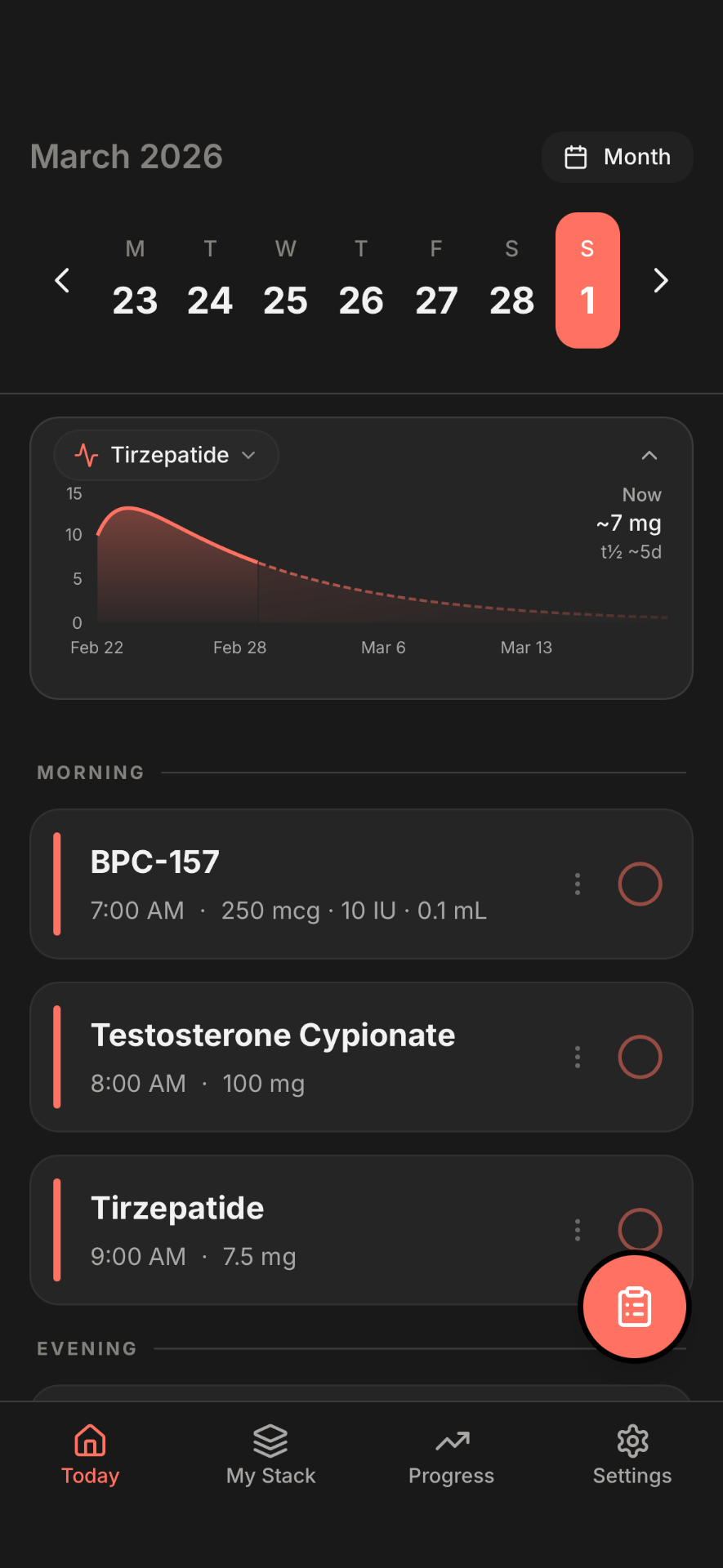
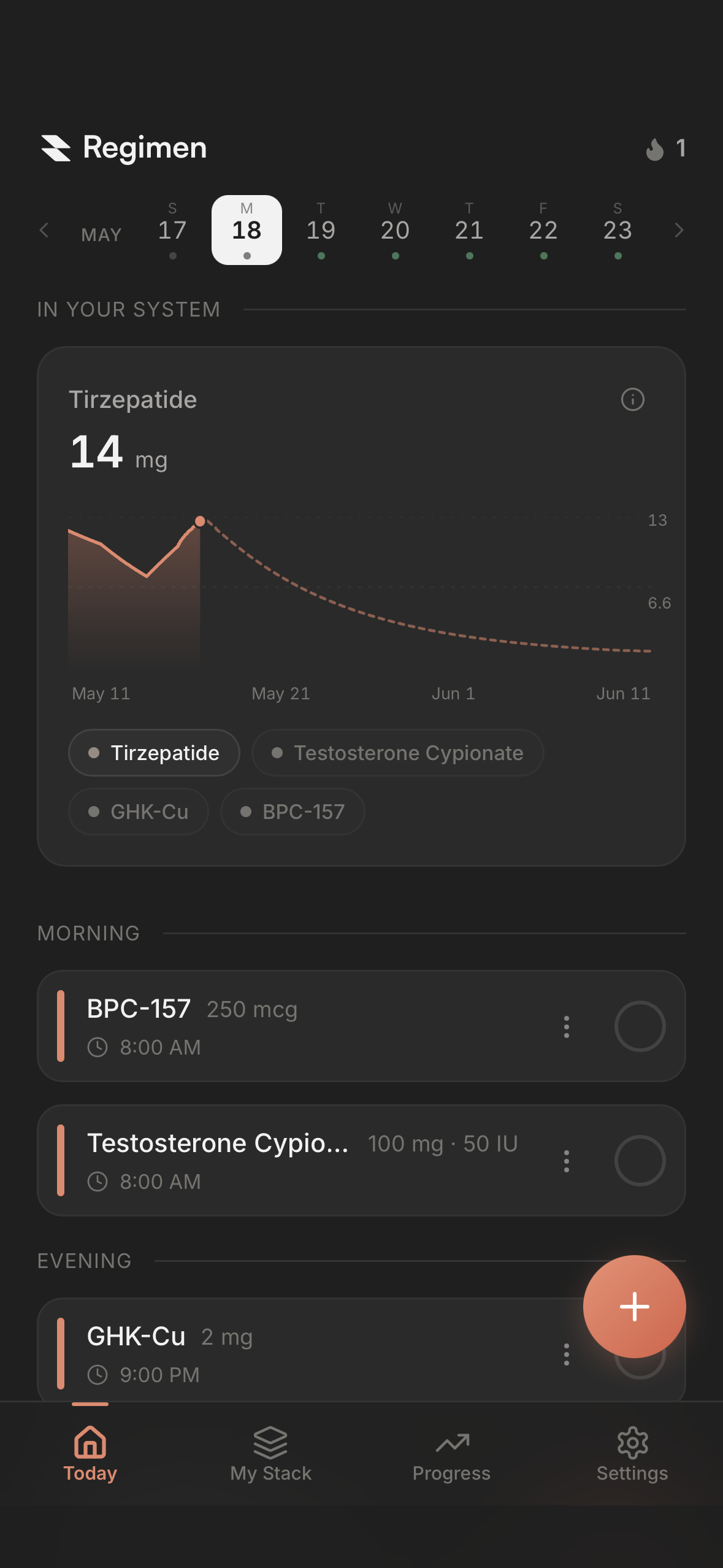
- Medication level curves for every compound