If you’ve been on tirzepatide (tirz) and want to try retatrutide (reta), you’re not starting from zero. Your body is already used to two of the three receptors retatrutide works on. The third one is new, and that one difference shapes the whole switch.
Switching from tirzepatide to retatrutide is simple. You need to get three things right: when to take your first retatrutide shot, what dose to start at, and how fast to go up. This guide covers all three, what the first weeks feel like, and the mistakes to avoid.
The Quick Answer
Here’s how to switch:
- Take your last tirzepatide shot on your usual day.
- A week later, on your next injection day, take your first retatrutide shot.
- Start retatrutide at 2 mg or less, even if you were on a high tirzepatide dose.
- Go up slowly, 0.5 to 1 mg at a time.
Regimen is a GLP-1 tracker app that keeps your dose history through the switch instead of starting over.
The Core Difference: Two Receptors vs Three
Tirzepatide switches on two receptors in your body: GLP-1 and GIP. Retatrutide switches on those same two, plus a third: glucagon. Receptors are the locks your body’s own hormones fit into, and these drugs work by fitting the same locks.

Here’s what each one does:
- GLP-1 turns down your appetite and keeps you full for longer.
- GIP adds to the GLP-1 effect. Both drugs use these first two.
- Glucagon pushes your body to burn more energy. Only retatrutide has it.
Your body is already used to GLP-1 and GIP from tirzepatide. Glucagon is new, so your tolerance doesn’t cover it, which is why people start retatrutide low.
Which Loses More Weight?
In the trials, retatrutide’s numbers are higher. These come from separate trials, and both count people who stayed on treatment:
| Dose level | Retatrutide (TRIUMPH-1, 80 weeks) | Tirzepatide (SURMOUNT-1, 72 weeks) |
|---|---|---|
| Lowest | 19.0% on 4 mg | 16.0% on 5 mg |
| Middle | 25.9% on 9 mg | 21.4% on 10 mg |
| Highest | 28.3% on 12 mg | 22.5% on 15 mg |
Retatrutide isn’t approved yet (Lilly plans to file with the FDA in early 2027), so there’s no official switching protocol. The steps below come from the trials and from what people actually do. For the full comparison, see retatrutide vs tirzepatide.
Starting Dose: Where to Begin
Start retatrutide at 2 mg or less, even if you’re on 15 mg of tirzepatide. There’s no dose conversion between the two drugs. Your tirzepatide dose tells you how big the step down will feel, not where to start.
Here’s what people in Regimen’s app data actually did, by the tirzepatide dose they were on:
| Your last tirzepatide dose | Typical first retatrutide dose | How the switch feels |
|---|---|---|
| 5 mg or less | 1 mg | The smallest drop |
| 7.5 or 10 mg | 1.5 to 2 mg | A bigger drop for the first few weeks |
| 12.5 or 15 mg | 2 mg | The biggest drop. Hunger and food noise can come back for a few weeks |
In every group, most people took 2 mg or less. People coming from higher doses started a little higher, but not by much. Across everyone, about three in four took 2 mg or less for their first shot.
Why Not Start Higher?
It’s tempting to match your old dose. Two reasons not to:
- Your tolerance doesn’t cover glucagon. The receptor is new, and so are its side effects.
- Higher starts bring more nausea. In an earlier retatrutide trial, people who started at 4 mg had more stomach side effects than people who started at 2 mg.
Starting low also costs you less than it sounds. Tirzepatide is still wearing off for the first few weeks, so you’re not going from full effect to nothing.
About a third of people split their first week into smaller shots, like 1 mg twice instead of 2 mg once. The split-dose calculator works out the units.
Coming from Mounjaro or Zepbound Pens
Pens come ready to inject. Retatrutide usually comes as a powder in a vial: you mix it with bacteriostatic water and draw each dose into an insulin syringe. Run your vial through the retatrutide reconstitution calculator before your first shot, and if syringe markings are new to you, the insulin syringe guide takes five minutes. On Zepbound vials? You already know how to draw a dose.
Week-by-Week Protocol
Week 0: Your Last Tirzepatide Shot
Take it on your usual day, at your usual dose. Keeping your routine makes the timing easy, because your first retatrutide shot then lands on the same weekday. Weigh yourself that day so you have a starting point.
Week 1: Your First Retatrutide Shot
Most people take their first retatrutide shot on their next injection day, 7 days after the last tirzepatide shot. In Regimen’s app data, that’s the most common timing among people who stopped tirzepatide first.
Why not wait longer to “wash out” the tirzepatide? It takes about a month to fully leave your body, and most people don’t wait that long. On day 7 you have about as much tirzepatide in you as you normally do right before a weekly shot. Waiting longer mainly means more days of your appetite coming back.

Some people wait one extra week and start on day 14. Less tirzepatide is left by then, so if you feel sick after the first reta shot, it’s easier to tell which drug caused it. To see the curve for your own dose, try the tirzepatide half-life calculator.
Weeks 2 to 4: Settle In
Give your body a few weeks on the starting dose. In the trial, everyone stayed on 2 mg for four weeks. People in Regimen’s app data who started below 2 mg often moved up sooner, and 0.5 mg was the most common step.
Week 5 and On: Step Up Slowly
The trial raised the dose every four weeks:
| Trial dose | Steps, every four weeks |
|---|---|
| 4 mg | 2 → 4 mg |
| 9 mg | 2 → 4 → 6 → 9 mg |
| 12 mg | 2 → 4 → 6 → 9 → 12 mg |
Most people take smaller steps. In Regimen’s app data, people who started at 2 mg mostly moved to 2.5 or 3 mg next, not straight to 4. Step up once the side effects from your current dose have settled.
4 mg is the lowest dose the trial tested for weight loss, so don’t judge retatrutide until you’ve spent a few weeks there.
Switching to reta? Log your last tirzepatide dose and your first reta dose in Regimen. It keeps your shots, weight and side effects on one timeline, so you can see how reta compares to what you were on.
Track your switch in RegimenWhat to Expect During the Switch
- The first week or two: as tirzepatide fades, hunger comes back, sometimes more than you’ve felt in months. The scale can tick up a little, mostly food and water. That’s the low starting dose, not the switch failing.
- On a low dose: some appetite control returns. Mild nausea is possible.
- From 4 mg: in the trial, weight loss rose with each higher dose. Side effects tend to rise with each step too.
Managing Side Effects
| Side effect | What helps |
|---|---|
| Hunger as tirzepatide fades | Eat at maintenance with plenty of protein. Don’t crash diet |
| Nausea on the first doses | Smaller meals. Log it against the dose, and tell your provider if it doesn’t settle |
| Faster heart rate | Check it weekly. In the earlier trial it rose with the dose, peaked around week 24, then eased |
| Diarrhea or constipation | Fiber and fluids. It often settles |
| Sore injection site | Rotate sites |
If you get headaches or feel wiped out, the headache guide and the fatigue guide cover the usual causes.
Seeing it helps. Log your weight and hunger through the gap and the first low-dose weeks. When the scale stalls or hunger spikes, you can check it against the dose you were on that week instead of guessing.
Log the switch in RegimenCommon Mistakes When Switching
- Starting at your old dose. Fix: start at 2 mg or less. Your tolerance doesn’t cover the new receptor.
- Waiting a month to “wash out” tirzepatide. Fix: most people start on day 7. Waiting longer mostly brings your hunger back.
- Crash dieting during the gap. Fix: eat at maintenance with plenty of protein until retatrutide takes over.
- Judging retatrutide in the first few weeks. Fix: give it until you’ve spent a few weeks at 4 mg.
- Staying on both drugs. Fix: pick one. More on that below.
Can You Take Retatrutide and Tirzepatide Together?
No. Retatrutide already works on both of tirzepatide’s receptors, so adding tirzepatide mostly adds side effects, with no evidence of extra weight loss.
Lots of people do it anyway. In Regimen’s app data, more than half of people who started retatrutide after tirzepatide kept logging tirzepatide too, usually for about ten weeks, and most didn’t lower their tirzepatide dose. The problem: when something feels off, you can’t tell which drug caused it.
Some overlap during the switch is normal, since tirzepatide stays in your body for weeks after your last shot. Going back and forth week to week is different. Nobody has studied it, and it likely keeps you stuck in the rough first weeks of adjusting to retatrutide.
When Retatrutide Might Not Be the Right Switch
It may be too early if:
- You’re still losing, just slowly. Slow isn’t stalled: 0.5 lb a week is 26 lb a year.
- You haven’t tried a higher tirzepatide dose. The label goes up to 15 mg. Ask your provider whether a higher dose is an option.
- It’s only been a couple of flat weeks. A plateau is weeks of no change at the highest dose you tolerate.
Don’t switch at all if you or a family member has had medullary thyroid cancer or MEN 2, or if you’ve had pancreatitis. The main retatrutide trial excluded people with either history.
Tracking Your Transition
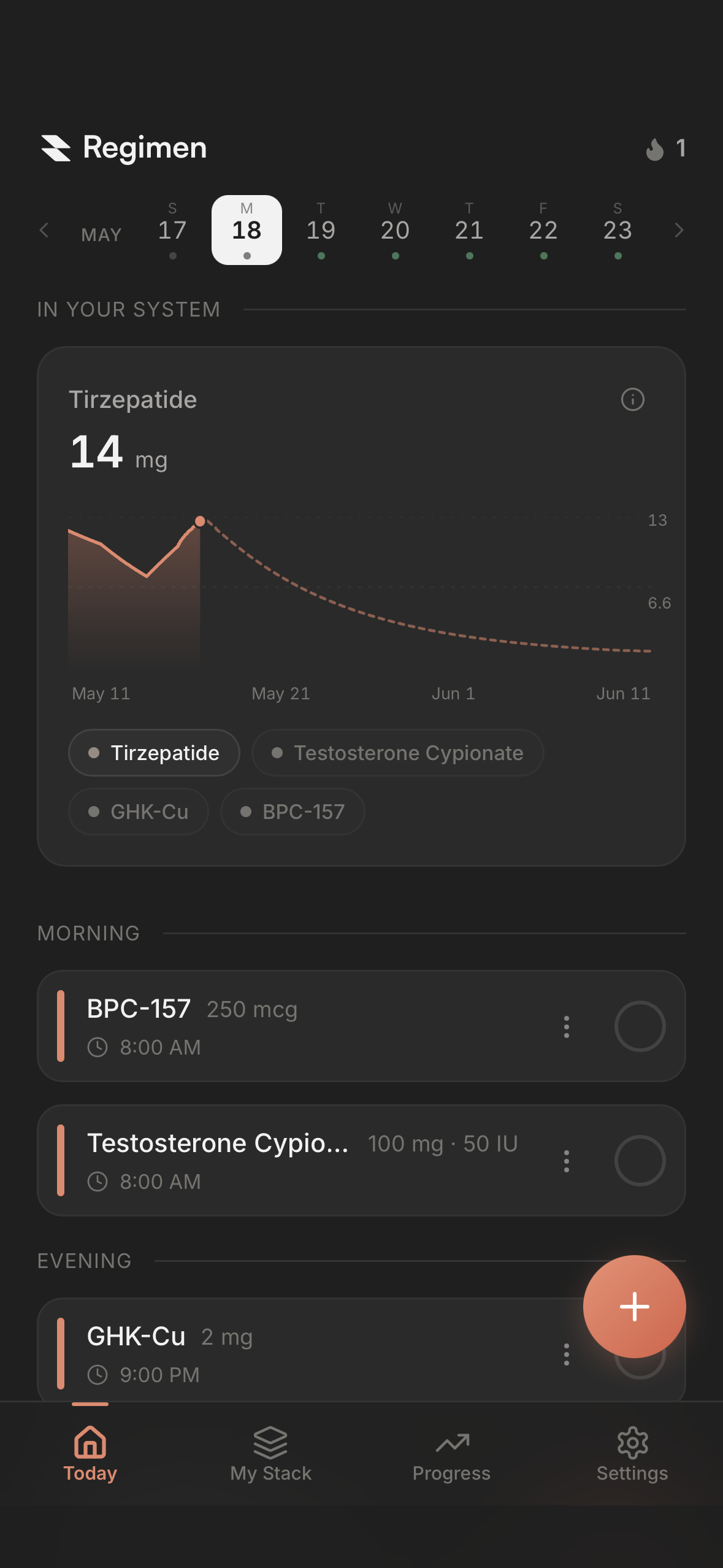
Switching is easier when you can see it. Regimen logs both drugs in one history: your last tirzepatide dose, the gap, your first retatrutide dose and every step up, next to your weight and side effects. Each drug gets its own estimated medication-level curve. Before an appointment, the provider report puts it all in one PDF.
It also watches for patterns in your logs. Steve Carter put it this way in a Google Play review in September 2026: “It caught the HR increase from Reta before I did.” Heart rate can rise on retatrutide, so that’s a useful catch.
Frequently Asked Questions
Can I switch from tirzepatide to retatrutide?
Yes. Take your last tirzepatide shot on your usual day, then your first retatrutide shot a week later at 2 mg or less, and go up slowly, 0.5 to 1 mg at a time. Your body already knows two of the three receptors retatrutide works on, so you are not starting from zero.
How long after stopping tirzepatide should I start retatrutide?
Most people take their first retatrutide shot on their next injection day, 7 days after their last tirzepatide shot. Some wait an extra week, so if side effects show up it’s easier to tell which drug caused them. Tirzepatide takes about a month to fully leave your body, so there’s always some overlap, and that’s normal.
What retatrutide dose do I start at if I was on 15 mg tirzepatide?
Start at 2 mg or less, even coming from 15 mg. Your tirzepatide dose doesn’t carry over, because retatrutide also works on a third receptor (glucagon) that your body hasn’t adjusted to. In Regimen’s app data, most people coming from 12.5 or 15 mg tirzepatide took a first retatrutide dose of 2 mg or less. Coming from 15 mg, the first few weeks can feel like a big step back. That’s the low dose, not the switch failing.
How do I switch from Zepbound or Mounjaro to retatrutide?
The same way: last Mounjaro or Zepbound shot on your usual day, then your first retatrutide shot a week later, at 2 mg or less. The new part is the format. Pens come ready to inject, while retatrutide usually comes as a powder you mix with bacteriostatic water and draw into an insulin syringe. Run your vial through the retatrutide calculator before the first shot.
Can I take reta and tirzepatide together?
No, not at the same time. Retatrutide works on the same two receptors as tirzepatide, plus a third, so taking both mostly adds side effects, with no evidence of extra weight loss. Some overlap while you switch is normal, since tirzepatide stays in your body for weeks. Plenty of people take both anyway: in Regimen’s app data, more than half of people who started retatrutide after tirzepatide kept logging both, usually for about ten weeks.
Can you alternate between tirzepatide and retatrutide?
Nobody has studied it, and it’s probably not worth it. It likely keeps you stuck in the rough first weeks of adjusting to retatrutide. One drug at a time avoids that.
Will I gain weight during the washout week?
Maybe a little, and it’s mostly food and water, not fat. After day 7, tirzepatide falls below its usual low, so hunger and the scale can tick up. Eating at maintenance with plenty of protein is easier to stick to than dieting hard while your hunger returns.
How soon will I know if retatrutide is working better than tirzepatide?
Not in the first month. TRIUMPH-1 kept everyone at 2 mg for the first four weeks, and 4 mg was the lowest dose it tested for weight loss. So the first fair read is a few weeks into 4 mg, about two months after your first shot, or later if you go slower.
Can I go back to tirzepatide if retatrutide doesn’t work for me?
Yes, the same way in reverse: last retatrutide shot on your usual day, first tirzepatide shot a week later. Ask your provider about the restart dose. Jumping straight back to your old top dose skips the step-ups, and on tirzepatide’s label most nausea, vomiting and diarrhea happened while the dose was going up.
Is it dangerous to switch between GLP-1 compounds?
There’s no safety data on switching itself, because nobody has studied it. The main risk is stomach side effects, which is why people start retatrutide low: in an earlier retatrutide trial, a 2 mg start brought somewhat fewer stomach side effects than 4 mg. Plan the timing and first dose with a provider.
Should I switch if I’m still losing weight on tirzepatide, just slowly?
Slow isn’t stalled. If the trend is still going down, tirzepatide is working, and 0.5 lb a week is 26 lb a year. A plateau is weeks of no change at the highest dose you tolerate. Whether to switch is a call for you and your provider.
My provider doesn’t know about retatrutide. What should I do?
Retatrutide isn’t approved yet, so there’s no label for your provider to check. What they can do is monitor you through the switch: labs, heart rate, blood pressure and side effects. Bring the Phase 2 paper (NEJM), Lilly’s TRIUMPH-1 results and your dose log.
Sources
- Jastreboff AM et al. Triple-hormone-receptor agonist retatrutide for obesity: a phase 2 trial. N Engl J Med 2023. pubmed.ncbi.nlm.nih.gov/37366315
- Jastreboff AM et al. Tirzepatide once weekly for the treatment of obesity (SURMOUNT-1). N Engl J Med 2022. pubmed.ncbi.nlm.nih.gov/35658024
- Eli Lilly, TRIUMPH-1 topline results, May 21, 2026: retatrutide 4, 9 and 12 mg over 80 weeks. prnewswire.com
- TRIUMPH-1 eligibility criteria (NCT05929066), ClinicalTrials.gov: excludes MTC, MEN 2 and pancreatitis history. clinicaltrials.gov
- TRIUMPH-5 (NCT06662383), retatrutide vs tirzepatide head to head, ClinicalTrials.gov: estimated completion late 2026. clinicaltrials.gov
- Zepbound (tirzepatide) prescribing information, U.S. FDA. accessdata.fda.gov
- Lilly plans to file retatrutide for FDA approval in the first quarter of 2027. BioPharma Dive, July 23, 2026. biopharmadive.com
- Regimen app data, September 2026: first retatrutide doses, timing, dose increases and continued tirzepatide use, reported as percentages.