BPC-157 Dosage & Protocol Guide (2026)
This guide covers standard dosing, how to reconstitute your vial, injection protocols, intranasal protocols, and how to track your response.
Standard BPC-157 Doses
BPC-157 is dosed in micrograms (mcg), not milligrams. Vials are typically sold as 5mg lyophilized powder.
| Protocol | Dose | Frequency |
|---|---|---|
| Standard therapeutic | 200-400 mcg | Once or twice daily |
| Higher dose (acute injury) | 500-600 mcg | Once or twice daily |
| Maintenance / gut health | 100-200 mcg | Once daily |
| Intranasal | 100-200 mcg per nostril | Once or twice daily |
Most research and clinical anecdotal reports cluster around 250-500 mcg per day, typically split into two doses (morning and evening or morning and post-workout).
Cycle length: Most practitioners run BPC-157 for 4-12 weeks, then take a break of equal length. There is no established washout period in humans -- the 4-12 week on/off pattern mirrors clinical and research practice.
How to Reconstitute a BPC-157 Vial
BPC-157 comes as a freeze-dried powder in a sealed vial. You need to reconstitute it with bacteriostatic water (BAC water) before injecting.
Standard reconstitution for a 5mg vial:
| BAC Water Added | Concentration | Volume per 250mcg dose |
|---|---|---|
| 2mL | 2.5mg/mL (2,500mcg/mL) | 0.1mL (10 units on insulin syringe) |
| 5mL | 1mg/mL (1,000mcg/mL) | 0.25mL (25 units) |
| 2.5mL | 2mg/mL (2,000mcg/mL) | 0.125mL (12.5 units) |
Reconstitution steps:
- Wipe the vial top with an alcohol swab
- Draw your BAC water volume into a syringe
- Insert needle into vial and push water slowly down the inside wall of the vial (not directly onto the powder)
- Swirl gently until dissolved -- do not shake
- Store refrigerated (2-8 degrees C) -- stable for 4-6 weeks
Use the BPC-157 dose calculator for the exact syringe units at 5mg and 10mg vial sizes, or the general peptide reconstitution calculator for any other reconstitution.
Subcutaneous Injection Protocol
Subcutaneous (SubQ) is the most common BPC-157 injection method:
- Needle: 27-31g, 5/16" (8mm) insulin syringe
- Site: Abdomen (2-3 inches from navel), or the site closest to the area of injury for localized effect
- Technique: Pinch skin, insert at 45 degree angle, inject slowly, withdraw
- Rotation: Rotate injection sites to avoid lipodystrophy
BPC-157 can be injected systemically (any SubQ site) for systemic effects, or near the site of injury for localized healing. Many practitioners inject near the area of tendon, joint, or gut discomfort for targeted effect.
Intranasal Protocol
BPC-157 can also be taken intranasally (nasal spray) -- particularly for gut health and systemic effects, or for users who prefer not to inject.
Intranasal reconstitution: 5mg vial + 5mL BAC water = 1mg/mL. Standard nasal pump delivers 0.1mL per spray = 100mcg per spray.
For a 200mcg dose: 2 sprays per nostril, or 2 sprays total depending on your protocol.
Use the intranasal peptide calculator to calculate the exact spray count for your target dose.
What BPC-157 Is Used For
The majority of BPC-157 research is preclinical (animal studies). Human use is anecdotal. Reported uses include:
- Tendon and ligament healing -- rotator cuff, Achilles, patellar tendon injuries
- Joint recovery -- arthritis, cartilage repair
- Gut health -- IBS, leaky gut, inflammatory bowel conditions (BPC-157 was originally discovered in gastric juice)
- Muscle recovery -- post-workout inflammation and tissue repair
- Wound healing -- post-surgical recovery
BPC-157 is not FDA-approved for any of these uses. It is used as an investigational compound through compounding pharmacies.
Tracking Your BPC-157 Protocol
Because BPC-157 is typically used to address a specific issue (injury, gut symptoms, inflammation), tracking your response from day one is critical. Without a baseline, it is impossible to know if it is working.
What to track:
- Daily dose and injection site
- Subjective measures: pain level (1-10), range of motion, gut symptoms
- Sleep quality and energy (Apple Health or Google Health Connect data)
- Any side effects
Tracking BPC-157 with an App
What's the best app for tracking BPC-157?
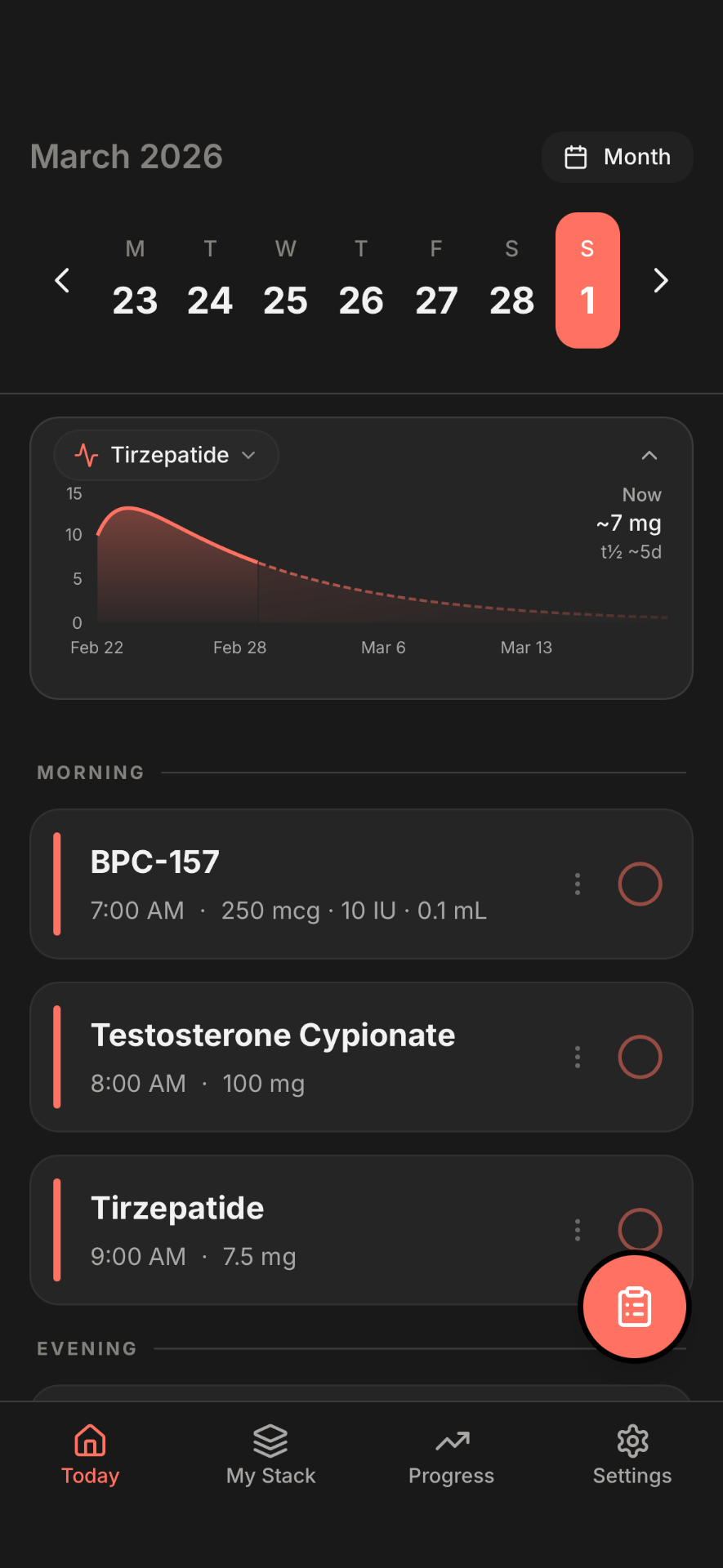
Regimen is a purpose-built tracker for BPC-157 that logs each injection with dose, site rotation, and time. The free tier covers one compound with all features unlocked: PK curves (half-life visualization), injection site rotation, dose reminders, and Apple Health / Health Connect correlation so you can see how BPC-157 is affecting your sleep, body composition, or weight over time.
Can I track BPC-157 in Apple Health?
Apple Health doesn't have native BPC-157 tracking, but apps like Regimen sync dose logs to Apple Health and pull metrics (weight, body fat, sleep) back so you can correlate medication with outcomes.
How do I track BPC-157 side effects?
A tracker app with structured check-in metrics (energy, sleep, appetite, GI symptoms) is more reliable than a notes app. Regimen tracks 20+ check-in metrics that link directly to your dose log, so patterns become visible after 3 to 4 weeks.
Frequently Asked Questions
Is BPC-157 legal in the UK in 2026?
BPC-157 occupies a regulatory gray zone in the UK. It's not approved by the MHRA for human use and is not on the General Sales List. Possession for personal use is not specifically criminalized, but importation, sale, and supply are restricted under the Human Medicines Regulations 2012. Most UK users source it through research-chemical suppliers labeled "for research purposes only."
Can I buy BPC-157 in the UK?
Direct purchase from UK pharmacies: no. Purchase from research-chemical suppliers (UK-based or imported): legal gray area. Customs sometimes seizes shipments. Most experienced UK users buy from EU-based suppliers or US peptide companies that ship internationally.
Is BPC-157 a controlled substance in the UK?
No. BPC-157 is not scheduled under the Misuse of Drugs Act 1971 and is not a Class A/B/C drug. It also isn't a banned performance-enhancing substance under WADA, but professional athletes should check sport-specific rules.
BPC-157 is commonly stacked with TB-500 for enhanced recovery. See the April 2026 FDA ruling for the latest on compounding access.
Regimen is a tracking tool, not a medical service. We do not provide medical advice. Always consult your healthcare professional before starting, changing, or stopping any medication protocol.
Ready to track your protocol?
- Smart reminders so you never miss a dose
- Track weight, photos, and progress over time
- Medication level curves for every compound