Peptide Calculator
Calculate exact syringe units for any reconstituted peptide. Enter your vial size, BAC water, and dose, get the units to draw. Free, instant, no signup.
Peptide Reconstitution Calculator
Calculate your exact dose
Enter your vial details to calculate how many units to draw for your dose.
Common doses: Semaglutide (0.25-2.4mg), Tirzepatide (2.5-15mg)
This calculator is for informational purposes only, so always double-check your result with a healthcare provider. We assume no liability for dosing errors.
The tool
How it works, what it tells you, what it doesn't.
The peptide calculator converts your reconstitution into the exact number of units to draw on a 100-unit insulin syringe. Enter the mg amount on your vial label (for example 5 mg), the bacteriostatic water you added (for example 2 mL), and your target dose in mg or mcg. It returns the concentration, the units to draw, and how many doses the vial holds. Reverse mode works backward: pick a clean syringe number like 10 units and it tells you how much BAC water to add to land there exactly.
How to use it
How to Use This Calculator
- 01
Enter peptide amount
The mg amount from your vial label (e.g., 5mg, 10mg)
- 02
Enter BAC water
How much bacteriostatic water you'll add (typically 1-3mL)
- 03
Enter desired dose
Your target dose per injection (mg or mcg)
- 04
Read your result
See exactly how many units to draw on your syringe
Looking for a specific calculator?
- BPC-157 dose calculator - preset for 5mg / 10mg vials
- HGH dose calculator - IU to mg to syringe units
- GLP-1 calculator - semaglutide, tirzepatide
- Intranasal calculator - nasal spray dosing
- TRT calculator - testosterone dosing
- HCG calculator - IU to insulin units
How Peptide Reconstitution Works
Peptides come as a freeze-dried powder (lyophilized) in a vial. Before you can inject them, you need to add bacteriostatic water (BAC water) to dissolve the powder. This process is called reconstitution.
The calculator above handles the math: enter your vial size in mg, how much BAC water you added in mL, and the dose you want in mcg - and it tells you exactly how many units to draw on your insulin syringe.
The formula:
Concentration (mcg per unit) = (Vial size in mg x 1000) ÷ (BAC water in mL x 100)
Example: You have a 5mg BPC-157 vial. You add 2mL of BAC water. You want a 250mcg dose.
- Concentration: 5000mcg ÷ 200 units = 25mcg per unit
- Your dose: 250mcg ÷ 25mcg per unit = 10 units on your insulin syringe
Common Peptide Reconstitution Examples
| Peptide | Typical Vial | BAC Water | Common Dose | Syringe Units |
|---|---|---|---|---|
| BPC-157 | 5mg | 2mL | 250mcg | 10 units |
| TB-500 | 5mg | 2mL | 2.5mg (2500mcg) | 100 units (full syringe) |
| Semaglutide | 5mg | 2mL | 250mcg | 10 units |
| Tirzepatide | 10mg | 2mL | 2.5mg (2500mcg) | 50 units |
| Ipamorelin | 5mg | 2mL | 200mcg | 8 units |
| CJC-1295 | 2mg | 2mL | 100mcg | 10 units |
These are examples only - always follow your provider’s dosing instructions. Enter your specific numbers in the calculator for an exact result.
BAC Water Volume - How Much to Add
The amount of BAC water you add determines the concentration of your reconstituted peptide. More water = more dilute = easier to measure small doses. Less water = more concentrated = fewer injections per vial.
| BAC Water | Result |
|---|---|
| 1 mL | Higher concentration, harder to measure tiny doses |
| 2 mL | Most common, good balance of concentration and measurability |
| 3 mL | More dilute, easier to measure very small doses accurately |
Tip: For peptides with very small doses (like 100mcg), using 2-3mL of BAC water makes it easier to draw an accurate amount on your insulin syringe.
Mixing it without wrecking the peptide
Aim the bacteriostatic water at the glass wall of the vial, not straight down onto the powder. Let it run down the side.
Then swirl gently until it goes clear. Do not shake it. Shaking foams the solution and can damage the peptide. Give it a minute and it usually dissolves on its own.
Store the reconstituted vial in the fridge, not the freezer.
After Reconstitution - Track Your Protocol
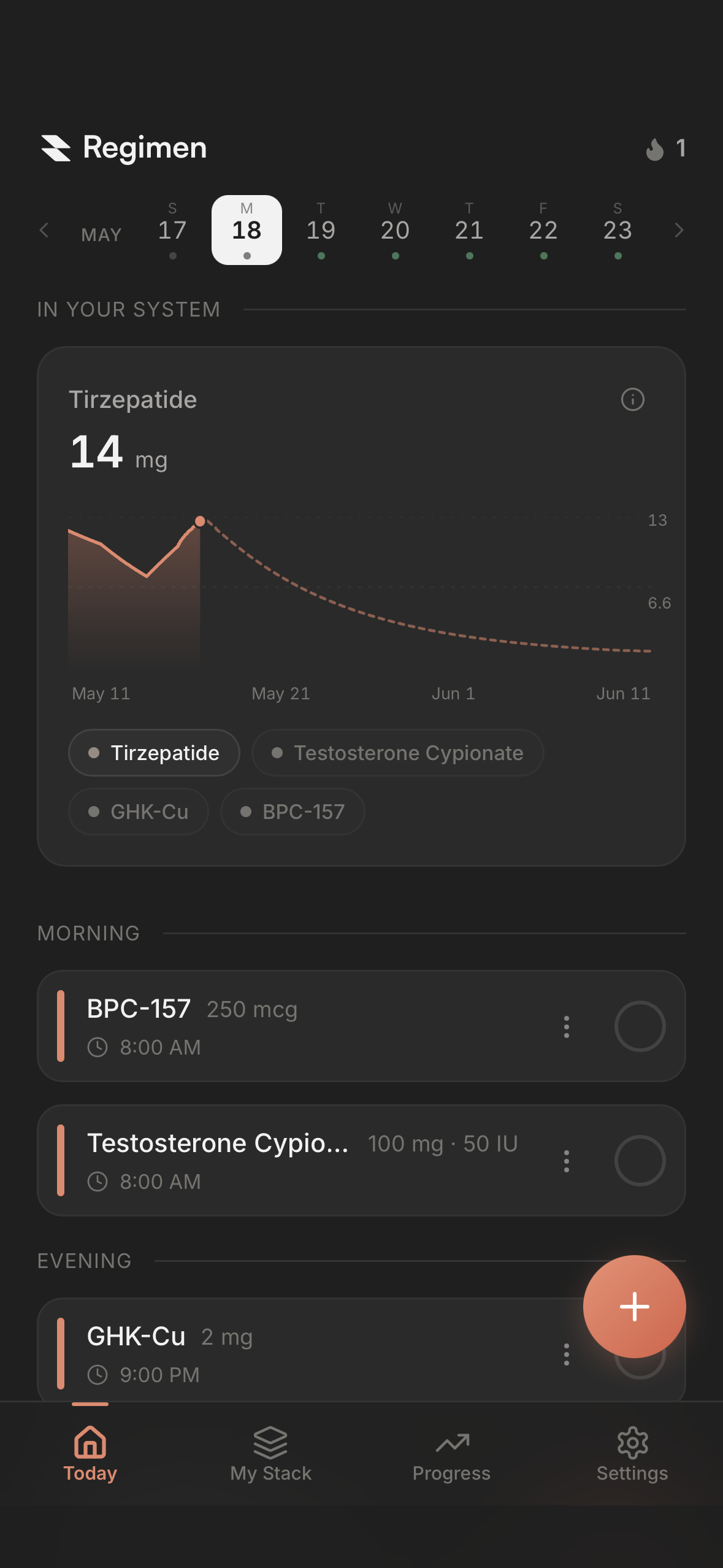
- Log it in Regimen. Track your reconstitution details (vial size, BAC water volume, concentration) in the Regimen app so you don’t have to recalculate every time.
- Track every dose. Regimen logs each injection with dose, timing, and injection site.
- Rotate injection sites. Regimen tracks where you injected last and suggests the next site.
- See if it’s working. Connect Apple Health or Google Health Connect to correlate your peptide protocol to real health outcomes - sleep, weight, body fat, recovery, and more.
For compound-specific reconstitution guides, see:
BPC-157 Reconstitution Guide·Semaglutide Reconstitution Guide·Tirzepatide Reconstitution Guide·TB-500 Reconstitution Guide·Best Peptide Tracker Apps 2026
Download Regimen free - iOS·Android
Worked Examples
Step-by-step calculations for common peptides
Reconstituting 5mg BPC-157
Running BPC-157 regularly? The dedicated BPC-157 dose calculator is preset for 5mg and 10mg vials and skips the setup.
Reconstituting 5mg Semaglutide
Reconstituting 5000 IU HCG
Compound-Specific Dosing Guides
The calculator above works for all peptides. Here are specific dosing guidelines and FAQs for popular compounds.
TRT Dose Calculator (Testosterone Cypionate & Enanthate)
Calculate exact injection volumes and syringe units for testosterone replacement therapy. Whether you’re on a standard weekly protocol or splitting into daily microdoses with an insulin syringe, enter your prescribed dose and vial concentration to get precise measurements.
Common Doses
- 100-200mg per week (typical TRT range)
- 20-29mg daily (daily microdosing protocol)
- 40-57mg every other day (EOD protocol)
- 50-100mg twice weekly (standard split)
How do I calculate my daily TRT dose with an insulin syringe?
Divide your weekly dose by 7 to get your daily mg. Then divide by your vial concentration to get mL. Multiply by 100 to get insulin syringe units. Example: 200mg/week ÷ 7 = 28.6mg/day. At 200mg/mL, that’s 0.143mL = 14.3 units. Round to 14 units - over 7 days it averages out.
How many units is 200mg of testosterone per week on an insulin syringe for daily injections?
At 200mg/mL concentration: 200mg/week = 28.6mg/day = 14.3 units per day on an insulin syringe. At 250mg/mL: 28.6mg/day = 11.4 units per day. Most daily TRT users alternate between rounding up and down to keep the weekly total accurate.
What size needle should I use for daily subcutaneous TRT injections?
Use 29-gauge ½-inch insulin syringes for daily subcutaneous TRT. They’re painless, inexpensive (~## Compound-Specific Dosing Guides
The calculator above works for all peptides. Here are specific dosing guidelines and FAQs for popular compounds. 5 for 100), and work well for the small volumes used in daily dosing (typically 8-15 units). Draw time is about 15-20 seconds. Some prefer 27g for faster draws.
Calculate your TRT dose
BPC-157 Dosage Calculator
BPC-157 (Body Protection Compound) is a research peptide commonly used for tissue repair and recovery. Most users dose it in micrograms (mcg) once or twice daily, typically injected subcutaneously near the injury site or in the abdomen. For a preset workflow, use the dedicated BPC-157 dose calculator at /tools/bpc-157-dosage-calculator.
Common Doses
- 250 mcg once daily (conservative)
- 250 mcg twice daily (standard protocol)
- 500 mcg once daily (higher dose)
How do I calculate BPC-157 dosage from a 5mg vial?
Add 2mL of bacteriostatic water to your 5mg vial. This creates a concentration of 2500mcg/mL. For a 250mcg dose, draw 10 units on your insulin syringe. For 500mcg, draw 20 units. The BPC-157 dose calculator at /tools/bpc-157-dosage-calculator has 5mg and 10mg vial presets so you can skip the setup.
How many doses are in a 5mg BPC-157 vial?
At 250mcg twice daily, a 5mg vial provides 10 days of doses (20 total injections). At 250mcg once daily, it lasts 20 days.
Should I inject BPC-157 near the injury or in my stomach?
Both work. Subcutaneous injection in the abdomen provides systemic effects. Injecting closer to an injury site may provide more localized benefit, though BPC-157 is absorbed systemically either way.
Calculate your BPC-157 dose
- Open the dedicated BPC-157 dose calculator
TB-500 Calculator
TB-500 (Thymosin Beta-4 fragment) is typically dosed in milligrams (mg) and injected less frequently than BPC-157, usually twice weekly. It’s often stacked with BPC-157 for recovery protocols.
Common Doses
- 2-2.5 mg twice weekly (loading phase)
- 2 mg once weekly (maintenance)
- 5 mg twice weekly (aggressive loading)
How do I reconstitute TB-500?
Add 2mL of bacteriostatic water to a 5mg vial. This gives you 2.5mg/mL concentration. For a 2.5mg dose, draw 100 units (1mL). For 2mg, draw 80 units.
Can I mix TB-500 and BPC-157 in the same syringe?
Yes, you can draw both peptides into the same syringe for a single injection. Many users stack these peptides and inject them together for convenience.
How long should I run a TB-500 protocol?
A typical TB-500 protocol runs 4-8 weeks. Many start with a 2-4 week loading phase at higher doses, then reduce to maintenance dosing.
Calculate your TB-500 dose
Semaglutide Reconstitution Calculator
Compounded semaglutide comes as a lyophilized powder that requires reconstitution with bacteriostatic water. Unlike pre-filled Ozempic or Wegovy pens, compounded versions require you to calculate and draw your own doses.
Common Doses
- 0.25 mg weekly (starting dose)
- 0.5 mg weekly (common maintenance)
- 1 mg weekly (higher dose)
- 2.4 mg weekly (maximum for weight loss)
How many units is 0.25mg of semaglutide?
It depends on your reconstitution. With a 5mg vial and 2mL of BAC water, 0.25mg = 10 units. With 3mL of water, 0.25mg = 15 units. Use the calculator above to determine your exact measurement.
Is compounded semaglutide the same as Ozempic?
Compounded semaglutide contains the same active ingredient but is prepared by a compounding pharmacy, not the original manufacturer. It requires reconstitution and manual dosing rather than using a pre-filled pen.
How long does reconstituted semaglutide last?
Reconstituted semaglutide should be refrigerated and used within 4-6 weeks. Never freeze it after reconstitution, and discard if the solution becomes cloudy.
Calculate your Semaglutide dose
Tirzepatide Dose Calculator
Compounded tirzepatide (the active ingredient in Mounjaro and Zepbound) requires reconstitution for those using it outside of the pre-filled pen system. Doses are measured in milligrams with weekly injections.
Common Doses
- 2.5 mg weekly (starting dose)
- 5 mg weekly (first escalation)
- 7.5 mg weekly (intermediate)
- 10-15 mg weekly (higher doses)
How do I calculate tirzepatide units from a vial?
For a 10mg vial with 2mL BAC water: 2.5mg = 50 units, 5mg = 100 units (1mL). If you need smaller injection volumes, use less water during reconstitution.
What’s the difference between tirzepatide and semaglutide dosing?
Tirzepatide doses are higher in mg (starting at 2.5mg vs 0.25mg for semaglutide) because it’s a different molecule. Don’t confuse the two when calculating doses.
Can I use the same calculator for Mounjaro?
This calculator is for compounded tirzepatide powder. Mounjaro and Zepbound come in pre-filled pens with set doses and don’t require reconstitution calculations.
Calculate your Tirzepatide dose
HCG Calculator
HCG (Human Chorionic Gonadotropin) is measured in International Units (IU) rather than milligrams. It’s commonly used alongside TRT to maintain testicular function and fertility.
Common Doses
- 250 IU twice weekly (common for TRT)
- 500 IU twice weekly (higher protocol)
- 1000 IU every other day (fertility protocol)
How do I calculate HCG dosage from a 5000 IU vial?
Add 2mL of bacteriostatic water to a 5000 IU vial. This gives you 2500 IU/mL. For 250 IU, draw 10 units. For 500 IU, draw 20 units.
Why is HCG measured in IU instead of mg?
HCG is a complex hormone measured by biological activity (International Units) rather than weight. The math works the same way in the calculator, just think of IU as the equivalent to mcg.
How long does reconstituted HCG last?
Reconstituted HCG should be refrigerated and used within 30-60 days. Some sources suggest it remains stable for up to 60 days when mixed with bacteriostatic water.
Calculate your HCG dose
Retatrutide Calculator
Retatrutide is a triple-agonist GLP-1/GIP/glucagon peptide currently in Phase 3 clinical trials. It is not yet FDA approved. This calculator is provided for educational reference only.
Common Doses
- 1 mg weekly (starting dose in trials)
- 4 mg weekly (mid-range dose)
- 8-12 mg weekly (higher doses in trials)
Is retatrutide FDA approved?
No. Retatrutide is currently in Phase 3 clinical trials and is not approved for any use. It cannot legally be compounded by US pharmacies under FDA regulations.
How is retatrutide different from semaglutide?
Retatrutide is a triple-agonist targeting GLP-1, GIP, and glucagon receptors, while semaglutide only targets GLP-1. Clinical trials have shown promising weight loss results, but it remains investigational.
Calculate your Retatrutide dose
BAC Water Calculator
Need to figure out how much bacteriostatic water to add? Use the Reverse mode above.
Most peptide calculators only work in one direction: you enter the water amount and get your dose in syringe units. But what if you want to work backwards?
Reverse mode is a BAC water calculator. Enter your peptide amount (mg) and your target syringe units per dose, and it calculates exactly how much bacteriostatic water to add so your dose lands on a clean, easy-to-read mark on your insulin syringe.
For example: you have a 5mg BPC-157 vial and want each 250mcg dose to be exactly 10 units. Reverse mode tells you to add 2mL of BAC water. No rounding errors, no awkward syringe marks.
To use it, scroll up to the calculator and tap the “Reverse” toggle. Works for BPC-157, Semaglutide, Tirzepatide, HCG, TB-500, and any other injectable peptide.
Data Sources
This tool uses dosing information from official prescribing information:
- Standard Reconstitution Formulas - Concentration and volume calculations for peptide reconstitution
- Insulin Syringe Standards - 100 units = 1mL conversion for U-100 syringes
Get the app
Skip the math. Track your protocols.
Regimen has the dose calculator built in, plus reminders, dose logging, reconstitution dates, and vial expiry tracking. Free for one compound.
- Built-in dose calculators
- Smart injection reminders
- Track progress over time
- Private, secure health data


Free to download. Free for your first compound.
Questions
Frequently Asked Questions
How do I reconstitute a peptide vial?
How much bacteriostatic water should I add to my peptide vial?
What is bacteriostatic water and why do peptides need it?
How do I calculate my peptide dose after reconstitution?
How long does reconstituted peptide stay stable in the refrigerator?
How many units is 500 mcg on an insulin syringe?
How do I calculate peptide dosage in insulin syringe units?
How much BAC water should I add to my peptide vial?
How many units is 500 mcg?
How do I reconstitute BPC-157?
How long does a reconstituted peptide last?
Can I use this calculator for semaglutide and tirzepatide?
What's the difference between mcg and mg for peptide dosing?
Can I use regular water or saline instead of bacteriostatic water?
Related tools