Tirzepatide Reconstitution Calculator
How many units of tirzepatide should you draw? This tirzepatide calculator does the math for you: it divides the mg in your vial by the BAC water you added, then converts your dose into units on your insulin syringe (100 units = 1 mL).
Peptide Reconstitution Calculator
Calculate your exact dose
Enter your vial details to calculate how many units to draw for your dose.
Common doses: Semaglutide (0.25-2.4mg), Tirzepatide (2.5-15mg)
This calculator is for informational purposes only, so always double-check your result with a healthcare provider. We assume no liability for dosing errors.
Last updated October 2026 · Reviewed by the Regimen Team
How to use it
How to use this calculator
- 01
Enter vial size
5, 10, 12, 15, 20, 24, 30, or 60mg are common tirzepatide vial sizes
- 02
Enter BAC water volume
1 to 3mL is typical; 2mL is the most common choice for 10mg and larger vials
- 03
Enter target dose
Labeled Mounjaro and Zepbound doses are 2.5, 5, 7.5, 10, 12.5, and 15mg per week
- 04
Read the syringe units
The calculator returns exact units on a U-100 insulin syringe and shows a draw-to-here syringe diagram
Dose Calculation: The Math Explained
The formula is the same for any reconstituted peptide:
Worked example. A 30mg vial reconstituted with 2mL of BAC water has a concentration of 30 ÷ 2 = 15 mg/mL. For a 5mg weekly dose: (5 ÷ 15) × 100 = 33.3 units. Round to 33 units. That 30mg vial at 5mg per week gives you about 6 weekly doses, roughly 6 weeks per vial.
Milligrams vs Units: The Mistake That Throws People Off
This is the mix-up that trips people up more than any other: your dose and your units are not the same number.
Your dose is the amount of actual tirzepatide, measured in milligrams (say, 5mg). Units are just the marks on your insulin syringe, and all they measure is how much liquid you are drawing up. So “5mg” and “33 units” can be the exact same dose. The milligrams tell you how much drug. The units tell you how far up the syringe to pull.
The thing that connects the two is your concentration, which is set by how much BAC water you used to mix the vial. Mix it stronger and your 5mg sits at fewer units. Mix it weaker and the same 5mg sits at more units.
That is why you cannot just copy someone else’s units. If they mixed their vial differently than you mixed yours, their 5mg lands at a different mark than your 5mg. Same dose, different units. Always run it against your own vial.
Common Vial Sizes and Dose Charts
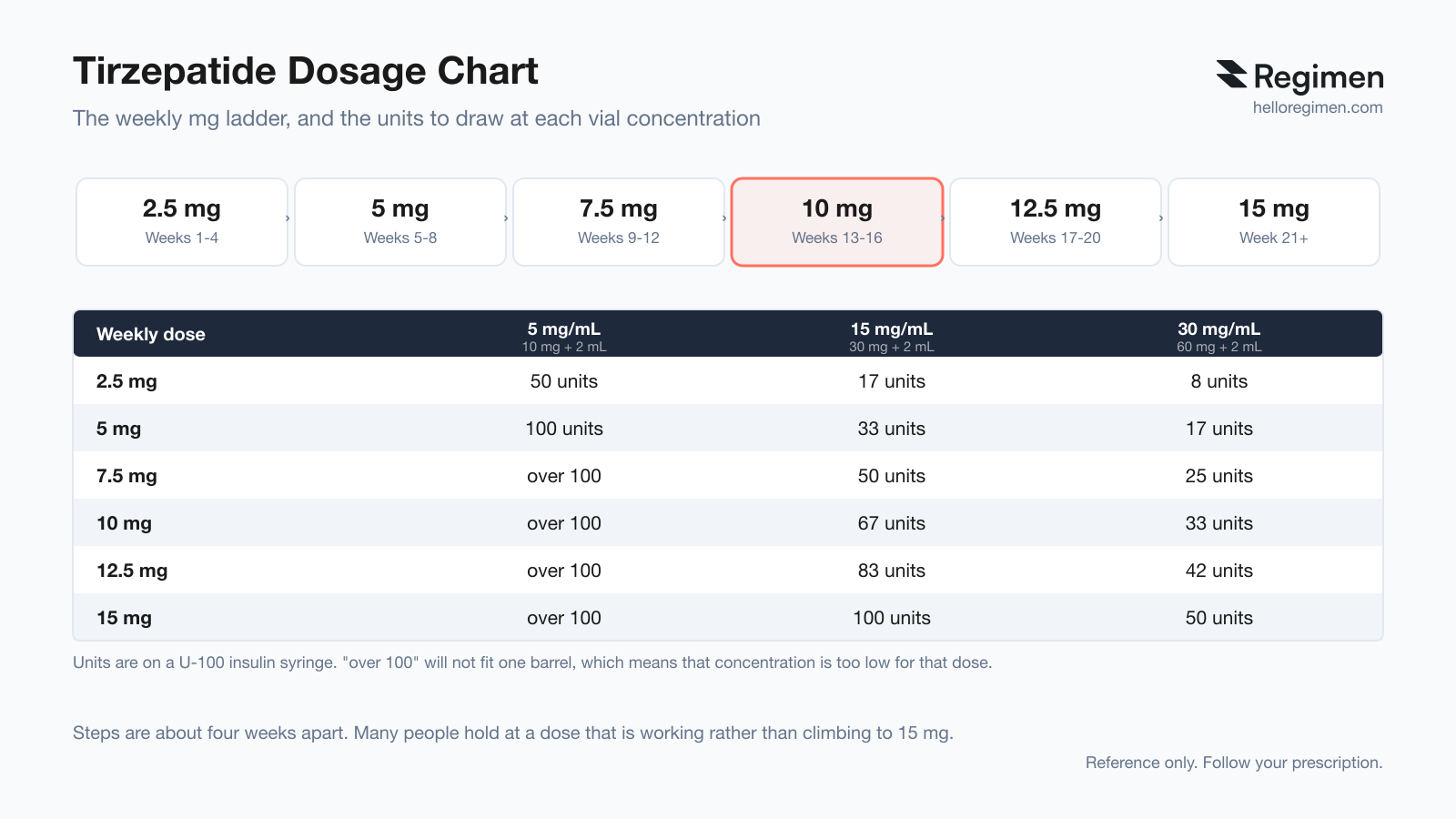
This tirzepatide reconstitution chart shows how many units to draw for each dose at the common vial sizes and BAC water amounts.
10mg Vial + 2mL BAC Water (5.0 mg/mL)
| Target Dose | Units to Draw | Doses Per Vial |
|---|---|---|
| 2.5 mg | 50 units | 4 doses |
| 5.0 mg | 100 units | 2 doses |
30mg Vial: How Much BAC Water?
2mL is the usual answer and it is what the table below assumes. It gives 15 mg/mL, so the whole titration fits one syringe: 2.5 mg is 17 units, 5 mg is 33 units, and the 15 mg top dose fills a 1mL barrel to the 100-unit mark. If you want rounder numbers while you are starting out, add 3mL instead for 10 mg/mL: then 2.5 mg is 25 units and 5 mg is 50 units, and a 15 mg dose needs 1.5mL, which is more than one insulin syringe holds.
The table is for 2mL (15.0 mg/mL):
| Target Dose | Units to Draw | Doses Per Vial |
|---|---|---|
| 2.5 mg | 17 units | 12 doses |
| 5.0 mg | 33 units | 6 doses |
| 7.5 mg | 50 units | 4 doses |
| 10.0 mg | 67 units | 3 doses |
| 12.5 mg | 83 units | ~2 doses |
| 15.0 mg | 100 units | 2 doses |
60mg Vial + 2mL BAC Water (30.0 mg/mL)
| Target Dose | Units to Draw | Doses Per Vial |
|---|---|---|
| 2.5 mg | 8 units | 24 doses |
| 5.0 mg | 17 units | 12 doses |
| 7.5 mg | 25 units | 8 doses |
| 10.0 mg | 33 units | 6 doses |
| 12.5 mg | 42 units | ~4 doses |
| 15.0 mg | 50 units | 4 doses |
Titration Schedule
The labeled Mounjaro and Zepbound schedule uses six dose tiers, with at least 4 weeks between increases: 2.5 → 5 → 7.5 → 10 → 12.5 → 15mg per week. Not everyone needs to reach 15mg. Many people stabilize at 5, 7.5, or 10mg once appetite and weight loss are where they want them.
Storage After Reconstitution
Reconstituted tirzepatide is good for about 28 days when refrigerated between 36 and 46°F (2 to 8°C). Keep the vial upright, away from direct light, and never freeze it. If the solution develops cloudiness, visible particles, or any discoloration, discard it. Large vials (30mg, 60mg) at low doses can outlast the 28-day window mathematically, so match your vial size to the dose you are actually running.
Mixing Steps
Not sure how much water to add? Switch the tirzepatide mixing calculator above to Units → Dose, enter your vial size, your dose and the units you want it to land on, and it tells you how much BAC water to use.
- Swab the tops of both the tirzepatide vial and the BAC water vial with alcohol. Let them dry, about 15 to 30 seconds.
- Draw your chosen volume of BAC water (typically 1 to 3mL) into an insulin syringe.
- Insert the needle into the tirzepatide vial at an angle and let the water run slowly down the inside glass wall. Do not aim the stream directly at the powder.
- Gently swirl or roll the vial between your palms until the powder fully dissolves. Do not shake. This usually takes 2 to 5 minutes.
- Check the solution. It should be completely clear with no particles or cloudiness before you draw your first dose.
Compounded vs Brand (Mounjaro / Zepbound)
Both contain the same active ingredient, tirzepatide, a dual GIP/GLP-1 receptor agonist. Brand-name Mounjaro and Zepbound ship in pre-filled auto-injector pens at fixed doses (2.5, 5, 7.5, 10, 12.5, 15mg). Compounded tirzepatide ships as a lyophilized powder in vials, commonly 5, 10, 15, 20, 30, or 60mg, which you reconstitute with BAC water and dose with an insulin syringe. Compounded and research-grade vials are not FDA-approved products, so purity and exact concentration depend on your source. The math on this page works for any reconstituted tirzepatide vial.
See also: tirzepatide half-life calculator, GLP-1 dose calculator, switching from semaglutide to tirzepatide, and managing tirzepatide GI side effects.
Get the app
Track your tirzepatide protocol, not just the math
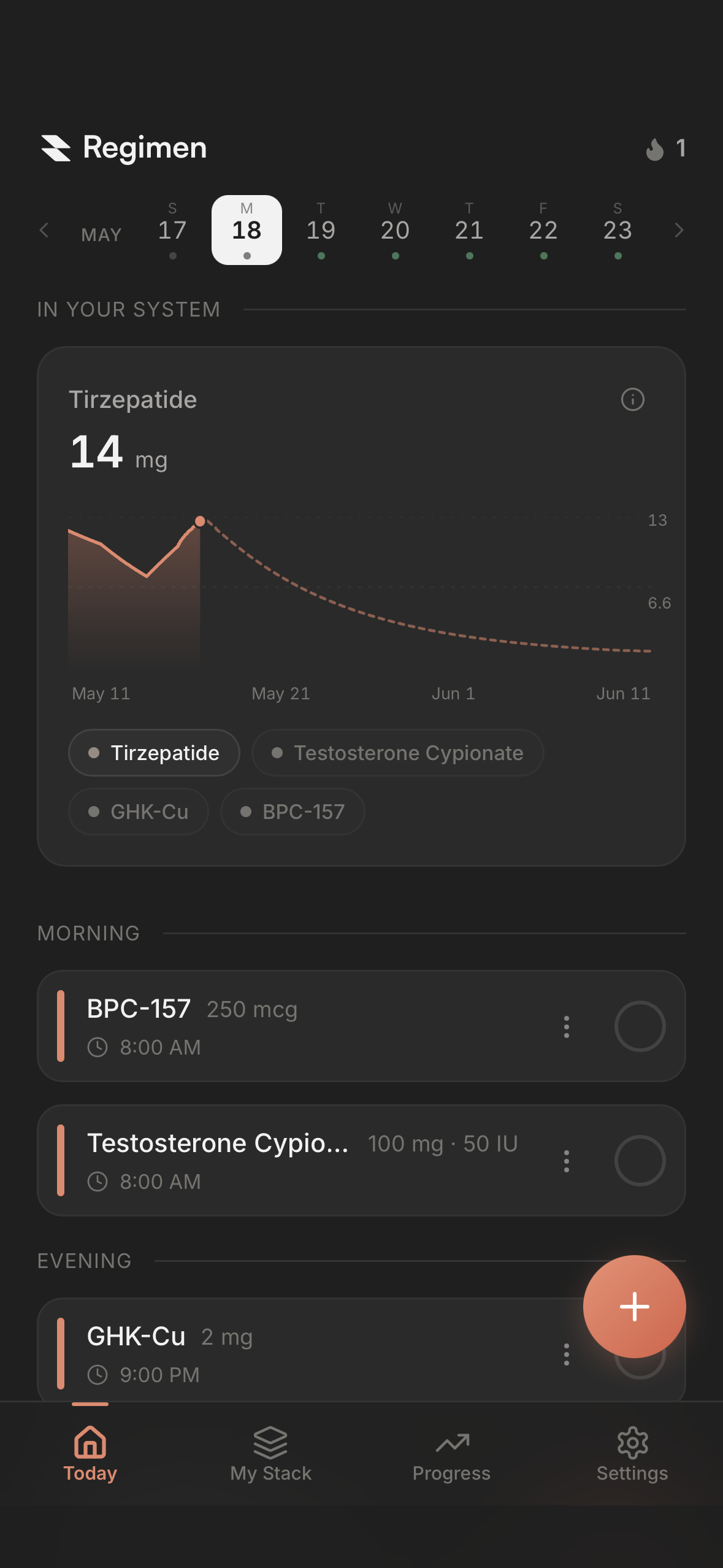
Regimen logs each tirzepatide injection alongside your weight, side effects, and titration schedule, with reminders and reconstitution-date tracking.
- Built-in dose calculators
- Smart injection reminders
- Track weight and side effects
- Private, secure health data


Free to download. Free for your first compound.
Questions