Tirzepatide Half-Life Calculator
Tirzepatide's terminal half-life is approximately 5 days. See how levels build to steady state and clear after the last dose.
Tirzepatide
Half-life 5.0 days·tMax 24h
Population-average pharmacokinetic model. Individual variation is significant. Not medical advice. See the methodology.
This tool is for informational purposes only, so always double-check your result with a healthcare provider. Levels shown are estimates from a population-average pharmacokinetic model, not a dosing recommendation, and individual variation is significant. We assume no liability for dosing errors.
Last updated September 2026 · Reviewed by the Regimen Team
The tool
How it works, what it tells you, what it doesn't.
Tirzepatide is a dual GLP-1 and GIP receptor agonist with a terminal half-life of about 5 days, shorter than semaglutide's 7. That trade-off produces a slightly sharper peak-to-trough cycle each week, which is part of why some tirzepatide users report stronger late-week hunger or appetite return in the day or two before their next injection. Steady state takes roughly 4 weeks at a fixed dose, then resets at each upward titration step. This calculator uses the Bateman model from the Regimen app, calibrated to the FDA Mounjaro label.
How to use it
How to use the tirzepatide half-life calculator
- 01
Set your dose
Common titration steps: 2.5, 5, 7.5, 10, 12.5, 15 mg weekly.
- 02
Keep weekly schedule
Tirzepatide is always weekly. The calculator defaults to weekly dosing.
- 03
Pick a simulation window
8 weeks shows the climb to steady state. 12-24 weeks shows full stability and washout if you stop.
- 04
Read the curve
Around week 4, the weekly oscillation flattens. Trough sits at ~45% of peak.
Tirzepatide: Dual GIP/GLP-1 receptor agonist. Available as Mounjaro (diabetes) and Zepbound (weight loss). May produce greater weight loss than semaglutide.
What tirzepatide’s half-life means in practice
Tirzepatide is a dual GIP and GLP-1 receptor agonist with a terminal elimination half-life of approximately 5 days. That long half-life is engineered through fatty acid acylation that allows the molecule to bind reversibly to serum albumin. Albumin binding slows renal clearance and is what makes once-weekly dosing pharmacologically clean.
For pharmacokinetic purposes, “steady state” is the point at which the amount you take each week roughly equals the amount your body clears each week. The standard rule of thumb is that steady state takes 4 to 5 half-lives. For tirzepatide that lands at about 4 to 5 weeks of weekly dosing at a fixed dose. Every time your prescriber titrates the dose upward, you reset that clock for the new dose level, which is part of why titration steps are spaced 4 weeks apart in the SURMOUNT trial protocols.
Where the half-life matters most for users is the trough-to-peak ratio. With a 5-day half-life and a 7-day dosing interval, your trough (just before the next injection) sits well below your peak. That’s why GI side effects, appetite suppression, and food noise reduction don’t fluctuate wildly within the week the way they would with a shorter-acting medication.
Worked example: 10 mg weekly
Using the calculator with a 10 mg weekly dose, the curve climbs over weeks 1 through 4 before flattening into a steady oscillation. By week 4 the trough sits roughly 4x higher than after the first injection alone, which is the expected accumulation pattern for a 5-day half-life on a 7-day cadence. Once you stop, the curve takes about 4 to 5 weeks to wash out to clinically negligible levels.
Compare with semaglutide or open the unified GLP-1 half-life calculator.
Get the app
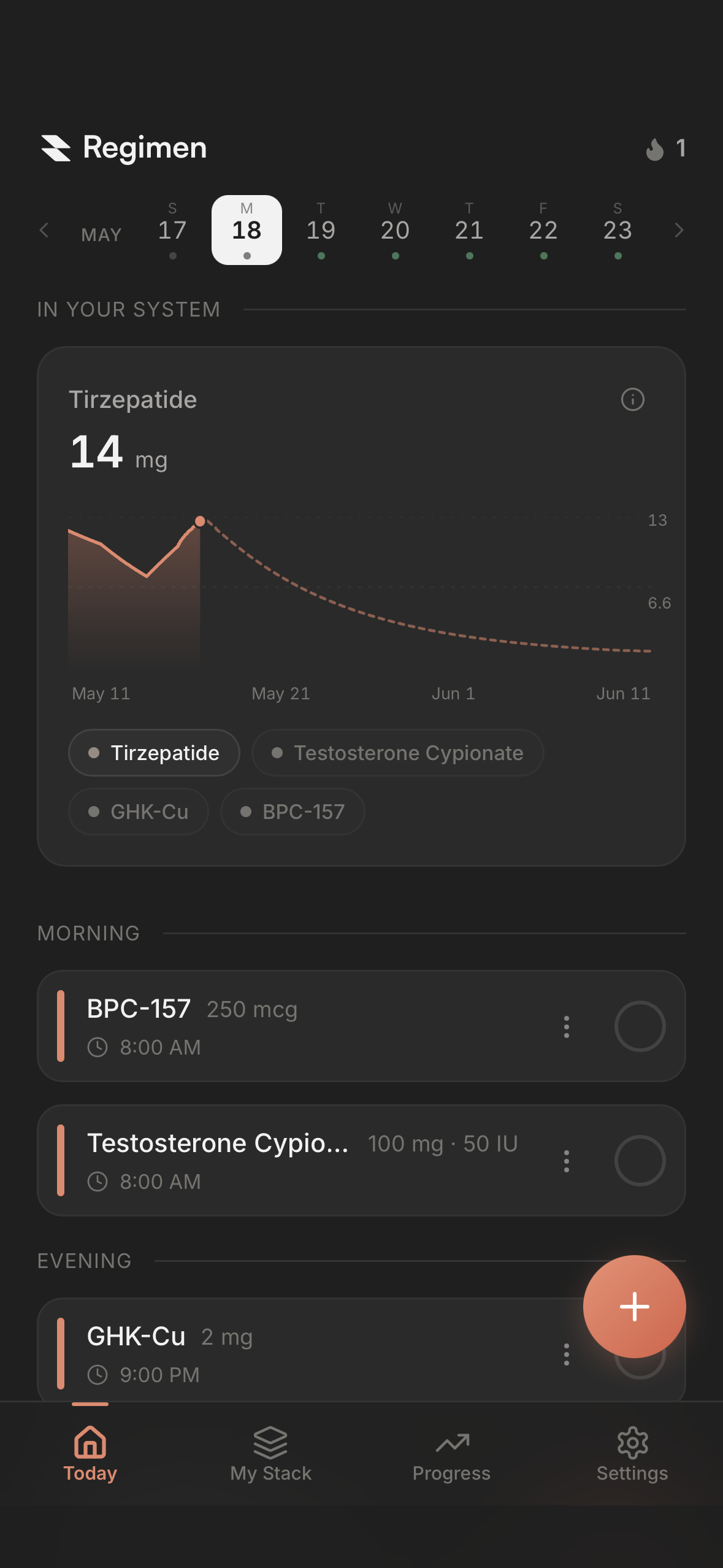
See your real tirzepatide curve in the app
Regimen logs each weekly injection and builds your personal active-level curve, with titration tracking and body composition correlation.
- Personalized PK curves
- Weekly injection reminders
- Body composition correlation
- Private, secure health data


Free to download. Free for your first compound.
Questions