GLP-1 Half-Life Calculator
Compare active blood levels across the major GLP-1s. Switch compounds, change dose and schedule, and see how each curve builds to steady state.
Semaglutide
Half-life 7.0 days·tMax 34h
Population-average pharmacokinetic model. Individual variation is significant. Not medical advice. See the methodology.
This tool is for informational purposes only, so always double-check your result with a healthcare provider. Levels shown are estimates from a population-average pharmacokinetic model, not a dosing recommendation, and individual variation is significant. We assume no liability for dosing errors.
Last updated September 2026 · Reviewed by the Regimen Team
The tool
How it works, what it tells you, what it doesn't.
The GLP-1 half-life calculator uses the Bateman absorption-and-elimination model (the same math the Regimen app uses) to simulate how a GLP-1 dose accumulates and clears over time. Pick any of the four approved-or-investigational injectable GLP-1s and set a dose and schedule. The chart shows the curve, the peak and trough at steady state, and how long it takes to reach steady state. Semaglutide's 7-day half-life produces the flattest weekly profile; tirzepatide's 5-day half-life trades stability for faster washout; retatrutide sits between them; liraglutide requires daily dosing because its 13-hour half-life can't sustain a weekly schedule.
How to use it
How to use the GLP-1 half-life calculator
- 01
Pick the compound
Semaglutide, tirzepatide, liraglutide, or retatrutide. Each loads its own half-life and time-to-peak.
- 02
Set the dose
Enter the dose per injection in mg. Common starting doses populate by default.
- 03
Choose the schedule
Weekly is standard for semaglutide, tirzepatide, and retatrutide. Liraglutide is daily.
- 04
Read the curve
The chart shows estimated active levels building to steady state. Stats show peak, trough, and the time to converge.
GLP-1 half-life comparison
| Compound | Brand | Half-life | Schedule | Steady state |
|---|---|---|---|---|
| Semaglutide | Ozempic, Wegovy | ~7 days | Weekly | ~5 weeks |
| Tirzepatide | Mounjaro, Zepbound | ~5 days | Weekly | ~4 weeks |
| Retatrutide | Phase 3 (not approved) | ~6 days | Weekly | ~4–5 weeks |
| Dulaglutide | Trulicity | ~5 days | Weekly | ~4 weeks |
| Liraglutide | Saxenda, Victoza | ~13 hours | Daily | ~3 days |
What half-life actually tells you
Half-life is the time it takes for the concentration of a drug in your blood to drop by 50 percent. For GLP-1 medications it determines three things you actually experience: how often you have to inject, how flat or peaky your weekly levels feel, and how long the drug keeps working after your last dose.
The big design split among GLP-1s is between liraglutide (a first-generation compound that clears quickly and requires daily dosing) and the modern once-weekly GLP-1s. Once-weekly compounds use either albumin binding (semaglutide, tirzepatide, retatrutide) or Fc-fusion (dulaglutide) to extend the half-life into the multi-day range. That is what makes weekly dosing pharmacologically clean.
Steady state is the point at which weekly intake equals weekly clearance. It takes about 4 to 5 half-lives to get there. That is also the window for full washout after you stop. For semaglutide at 7 days, both numbers land at roughly 5 weeks. For tirzepatide at 5 days, both land at 4 weeks. For liraglutide at 13 hours, it is 3 days.
Longer half-life is not automatically better. It produces flatter weekly levels, which usually means smoother GI side effect profiles. But it also means slower wash-in (you wait longer to feel a dose change) and slower wash-out (you can’t pivot fast if you have a side effect issue). Choose by what your prescriber recommends, not by half-life alone.
For deeper compound-specific math, open the semaglutide or tirzepatide half-life pages.
Get the app
See your real GLP-1 curve in the app
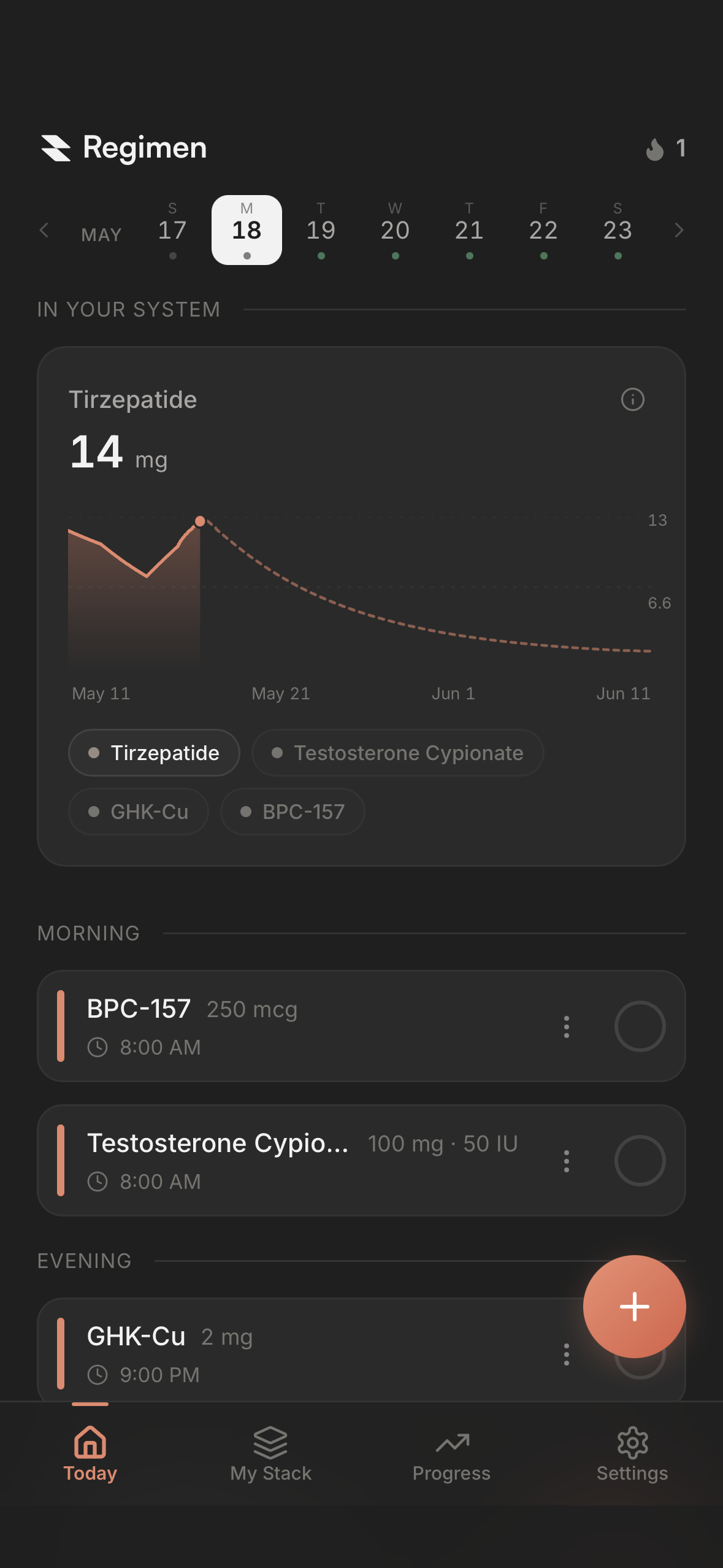
Regimen logs each weekly injection and builds your personal active-level curve, with reminders, dose titration tracking, and Apple Health correlation.
- Personalized PK curves
- Smart injection reminders
- Body composition correlation
- Private, secure health data


Free to download. Free for your first compound.
Questions