Semaglutide Half-Life Calculator
Semaglutide's terminal half-life is approximately 7 days. See how levels accumulate to steady state and wash out after stopping.
Semaglutide
Half-life 7.0 days·tMax 34h
Population-average pharmacokinetic model. Individual variation is significant. Not medical advice. See the methodology.
This tool is for informational purposes only, so always double-check your result with a healthcare provider. Levels shown are estimates from a population-average pharmacokinetic model, not a dosing recommendation, and individual variation is significant. We assume no liability for dosing errors.
Last updated September 2026 · Reviewed by the Regimen Team
The tool
How it works, what it tells you, what it doesn't.
Semaglutide is a GLP-1 receptor agonist with a terminal half-life of about 7 days, the longest among the approved injectable GLP-1s. That long half-life is engineered through fatty acid modification that lets semaglutide bind reversibly to serum albumin. The practical result: once-weekly dosing produces unusually flat weekly profiles. Steady state takes roughly 4 to 5 weeks of weekly dosing at a fixed dose. Each upward titration resets that clock, which is why the SUSTAIN and STEP trial protocols hold each step for 4 weeks. This calculator uses the same Bateman model the Regimen app uses, calibrated against the FDA Ozempic label.
How to use it
How to use the semaglutide half-life calculator
- 01
Set your dose
Common steps: 0.25, 0.5, 1, 1.7, 2 mg (Ozempic max), 2.4 mg (Wegovy max). The calculator runs the math for any value.
- 02
Keep the schedule weekly
Semaglutide is always weekly. The calculator defaults to weekly dosing.
- 03
Pick a simulation window
8 weeks shows the climb to steady state. 12-24 weeks shows full stability.
- 04
Read the curve
Look for the flat weekly oscillation that emerges around week 5. Trough sits at ~60% of peak.
What semaglutide’s half-life means in practice
Semaglutide is a GLP-1 receptor agonist with a terminal elimination half-life of approximately 7 days, which is the longest among the approved injectable GLP-1s. That long half-life is engineered through fatty acid modification that lets semaglutide bind reversibly to serum albumin and resist proteolytic breakdown. The practical result is that once-weekly dosing produces unusually flat weekly profiles.
Steady state takes roughly 4 to 5 half-lives, or about 4 to 5 weeks of weekly dosing at a fixed dose. Each upward titration resets that timeline for the new dose level, which is why the SUSTAIN and STEP trial protocols hold each titration step for 4 weeks before stepping up.
With a 7-day half-life and 7-day dosing interval, more of each dose is still in your system when the next one lands, so the curve stays relatively flat. The calculator above shows your own trough as a percentage of peak. That ratio is meaningfully flatter than tirzepatide’s 5-day half-life produces, and it’s part of why the late-week trough hunger pattern reported by some semaglutide users is generally milder than what tirzepatide users describe in the days before their weekly injection.
Worked example: 1 mg weekly
At 1 mg weekly (the most common stepped-up dose between 0.5 mg and the 2.4 mg Wegovy maintenance dose), the calculator shows levels climbing through weeks 1 to 4 and flattening into a steady oscillation by week 5. Stopping at this dose leaves clinically meaningful exposure for about 5 to 6 weeks, which is one of the reasons appetite changes feel gradual rather than abrupt.
Compare with the tirzepatide half-life calculator or open the unified GLP-1 half-life calculator.
Get the app
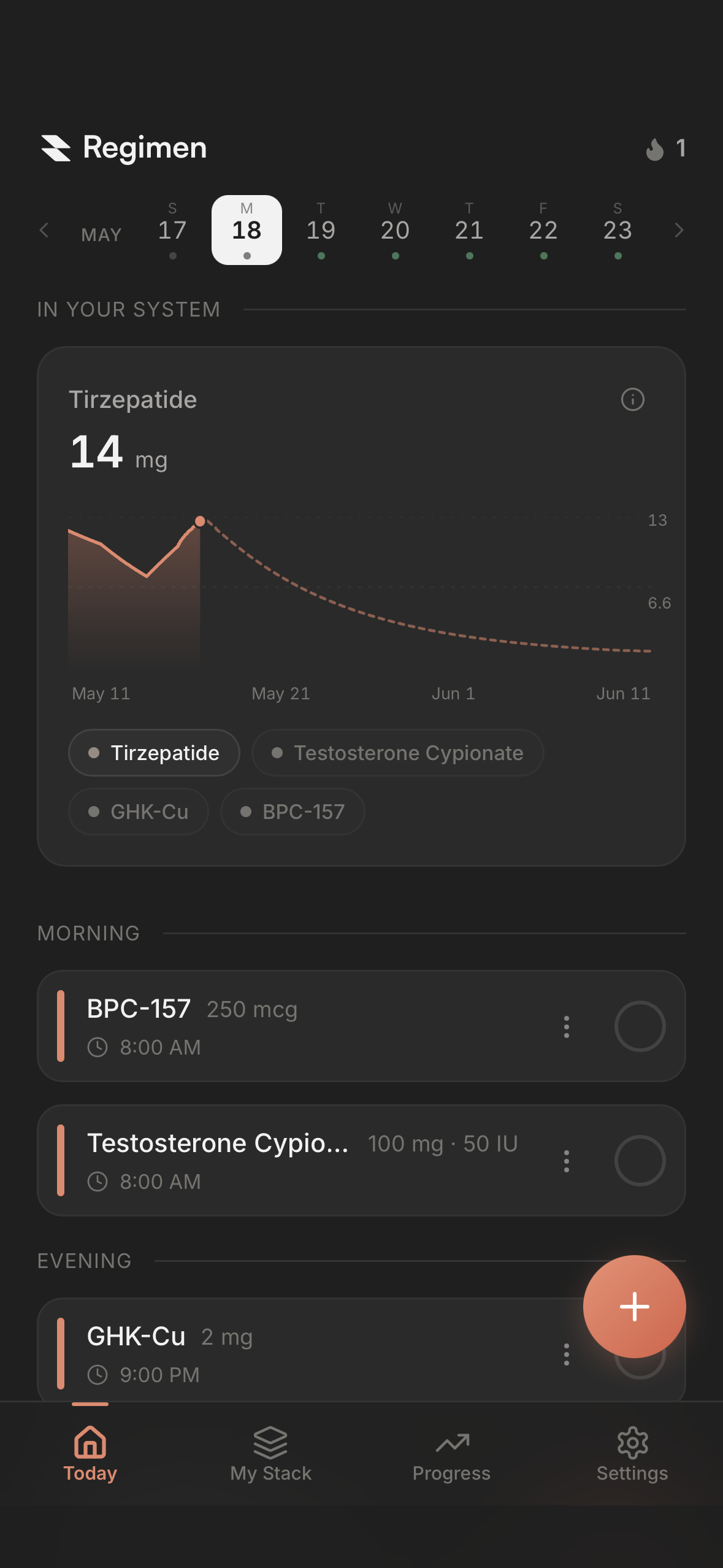
See your real semaglutide curve in the app
Regimen logs each weekly injection and builds your personal active-level curve, with reminders, body composition correlation, and Apple Health sync.
- Personalized PK curves
- Weekly injection reminders
- Body composition correlation
- Private, secure health data


Free to download. Free for your first compound.
Questions