Peptides

NAD+ Injection Guide: At-Home Subcutaneous Protocol (2026)

May 26, 2026
9 min read
Share this article

NAD+ injectable is the most-felt compound in the entire mitochondrial peptide category. Most people who run it report a clear lift in energy, mental clarity, and recovery within hours to days of starting. The home subcutaneous protocol is the sustainable middle ground between oral precursors (cheap but weak) and clinic IV drips (intense but expensive). Done at home, it costs a fraction of what wellness clinics charge for the same molecule.

The Bottom Line

NAD+ (nicotinamide adenine dinucleotide) is the central cofactor your mitochondria use to convert food into ATP. Levels decline with age, and oral NAD+ has poor bioavailability, so direct injection produces a more reliable lift than capsules. Subcutaneous home protocols typically run 50 to 200mg per session, 2 to 3 times weekly. The injection-site flush is real and the main practical hurdle. Quality varies by vendor and the molecule is light- and temperature-sensitive, so storage matters. Most peptide users stack NAD+ with MOTS-c.

What NAD+ actually does in your cells

NAD+ is the workhorse cofactor your mitochondria use to convert food into ATP, the energy currency every cell runs on. It also fuels sirtuins (the longevity-linked enzyme family) and PARPs (the DNA repair enzymes). When NAD+ is plentiful, your cells handle energy production, stress response, and damage repair more efficiently. When it drops, all three suffer.

The drop with age is steep. By your mid-forties, NAD+ levels in many tissues are roughly half what they were in your twenties. That decline shows up as lower steady-state energy, slower recovery from training or stress, and worse metabolic flexibility (the ability to switch between burning carbs and fat efficiently).

Direct injection raises circulating NAD+ in a way oral capsules cannot. NAD+ taken by mouth is largely broken down in the gut before it reaches the bloodstream. Oral precursors like NR (nicotinamide riboside) and NMN (nicotinamide mononucleotide) work indirectly: your body converts them into NAD+ over time. Subcutaneous injection skips the conversion math entirely and delivers the molecule itself.

Why injection over oral (and why subcutaneous over IV)

There are three real routes for NAD+ repletion. Each has different trade-offs.

Oral NAD+ or oral precursors (NR, NMN). Cheap, convenient, no needles. The catch is that NAD+ itself doesn't absorb well orally, and the precursors take time to convert. Most people on oral protocols don't feel an acute effect. The biomarker shifts are real over weeks to months, but the subjective signal is mild.

Subcutaneous injection at home. The peptide community's default. Reliable elevation, manageable cost, integrates into the same injection routine as MOTS-c, TRT, or any other peptide you're running. The downside is the injection-site flush, which is the main reason people titrate slowly or back off.

IV drips at wellness clinics. Fastest delivery, most intense subjective experience, dramatically more expensive. Clinic NAD+ IVs typically run $300 to $1,000+ per drip in the US market, and a "course" can mean 5 to 10 drips over a few weeks. The underlying NAD+ repletion is similar to what you get from a few weeks of consistent sub-q. The IV route just front-loads the dose into a few hours.

For the audience already comfortable with self-injection, sub-q is the practical answer. It produces almost all of the IV experience for a fraction of the cost, and you can run it indefinitely instead of in clinic-scheduled bursts.

How the community actually doses it

There is no FDA-approved consumer dose for subcutaneous NAD+, and the published human dose-finding work for this route is thin. The ranges below reflect community protocols and compounding pharmacy practice, not clinical guidance.

Typical community range: 50 to 200mg per session, 2 to 3 times per week.

Most people start at the low end (50 to 100mg per session, twice weekly) for the first 2 to 4 weeks. The lower dose meaningfully reduces the flush sensation and injection-site reaction, which is the main reason new users abandon the protocol. Once the body adjusts, many users titrate up to 100 to 200mg per session if they want a stronger effect.

Some users dose on demand instead of on a fixed schedule. The on-demand pattern looks like:

  • A 100mg shot the night before a high-output day
  • 50 to 100mg before a hard training session or long endurance effort
  • 100 to 150mg during travel or jet lag recovery
  • 100mg during a high-stress work week, not on a steady weekly cadence

The on-demand approach makes sense because NAD+ produces a felt effect quickly, so you can use it like a tool rather than a daily habit. It also tends to keep the cumulative weekly dose lower than a fixed twice- or three-times-weekly schedule, which some users prefer for cost or comfort reasons.

What we see in Regimen data

NAD+ tracking on Regimen is dominated by pulsed protocols, not daily use. Among NAD+ users, twice-weekly and every-other-day patterns combined are more common than daily protocols, consistent with the community treating NAD+ more like a "dose-when-energy-flags" compound than a continuous daily one. NAD+ also sits in the top 10 most-tracked compounds on the platform overall.

The flush and the injection-site reaction

The most consistent first-month complaint is the flush. Within seconds to a couple of minutes of injecting NAD+, many users feel a wave of pressure, warmth, mild chest tightness, occasional nausea, and a strong urge to take a deep breath. It's uncomfortable. It is not dangerous in healthy users at typical doses, but it is intense the first few times.

The injection site itself can also sting and stay tender for hours. Some users get a small red welt that persists overnight.

Both effects diminish significantly after the first few weeks for most people. They also respond to a handful of practical adjustments.

How to reduce the flush
  • Inject slowly. Push the plunger over 60 to 120 seconds, not in a quick shot. The single most effective adjustment.
  • Start low. 50 to 75mg per session for the first two weeks, then titrate up if the response is tolerable.
  • Pre-numb the site. Cold pack on the abdomen for 30 seconds before injection.
  • Hydrate. A glass of water before injecting helps for some users, possibly by buffering the rapid intracellular shift.
  • Time it before a meal or workout. The flush feels less intrusive when you're already about to be active.

A small minority of users find the flush so unpleasant they switch to oral precursors instead. That's a reasonable trade. NR or NMN at proper doses still raises NAD+, just more slowly and less dramatically.

What you'll actually feel

The subjective effect profile is consistent across the community. Within hours to a day or two of the first few doses, most users report:

  • Cleaner energy. Not stimulant-like. More like the background fatigue that usually sits below your awareness lifts off.
  • Better mental clarity. Easier focus, less brain fog, especially in the afternoon energy dip window.
  • Faster recovery from training. DOMS resolves quicker. Sleep quality after hard sessions often improves.
  • Stable mood. Some users describe a mild lift in baseline mood, especially in the first month.
  • Better sleep depth. Particularly on protocols paired with consistent training and sleep hygiene.

The effect is real for many people. It is also one of the most placebo-vulnerable compounds in the peptide world, partly because the subjective hit can be dramatic enough that expectation amplifies it. Tracking honest baselines (energy ratings, sleep scores, training output) before starting helps separate real response from expectation.

A subset of users get little to no acute effect even at higher doses. If you're in that group, the cumulative biomarker benefit may still be there, but you won't get the subjective feedback that makes the protocol satisfying. Some non-responders find that pairing with MOTS-c or layering in resistance training closes the gap.

Running NAD+ at home? Track dose, schedule, and how you actually feel.

  • Dose log with site rotation and flush notes
  • Energy, sleep, RHR, and recovery overlays
  • Pulsed and on-demand scheduling support
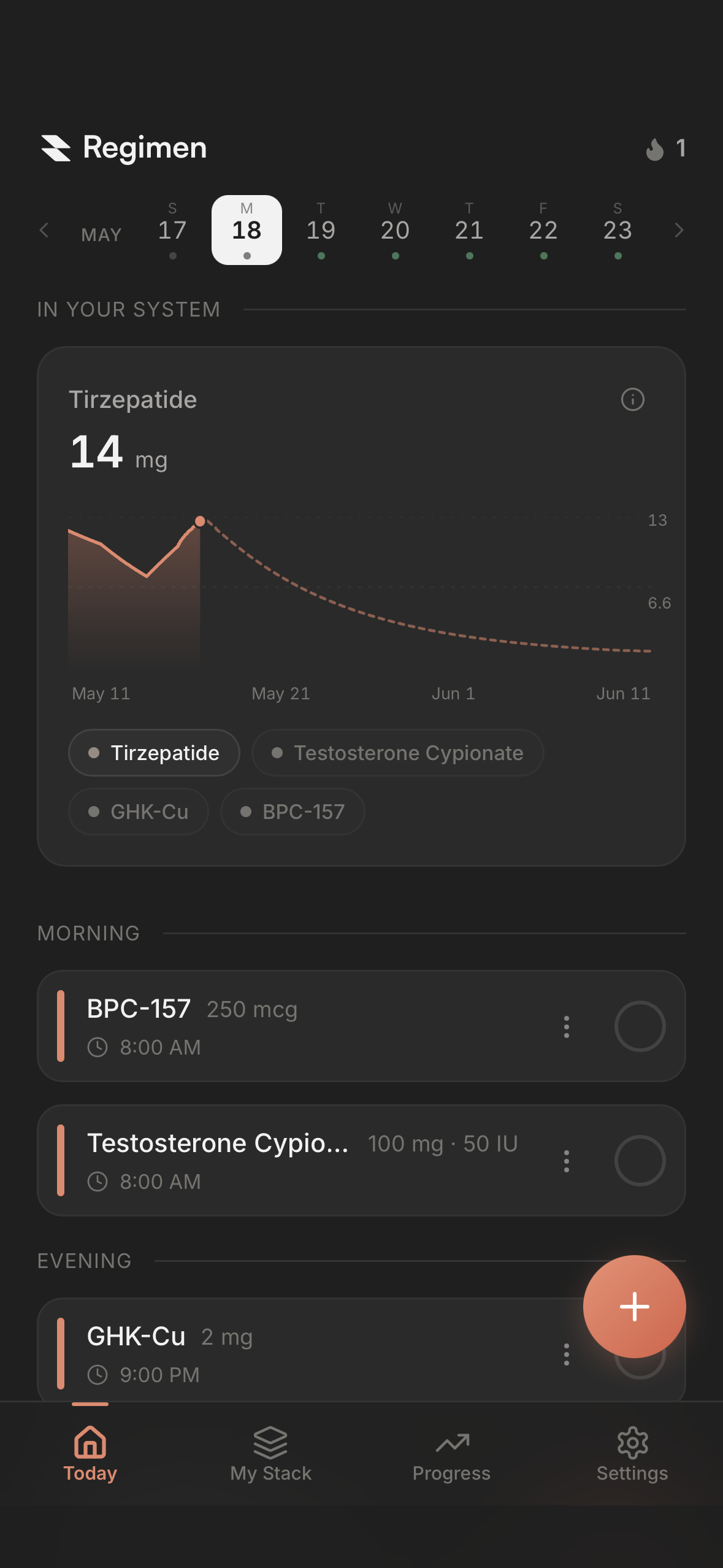
Regimen peptide and GLP-1 tracker app screenshot

Side effects and what to watch for

The safety profile at typical community doses is mild for healthy adults.

Common and self-limiting: the flush and chest pressure described above, injection-site redness or tenderness, occasional small welts, mild nausea at higher doses (150mg+), and headache (particularly if you're dehydrated or under-fed when injecting).

Less common: lightheadedness right after injection (sit down if this happens, especially the first few times), sleep disruption if you inject too close to bedtime (most users prefer morning or pre-workout timing), and a transient mood dip a day or two after the first few sessions in a small subset, which typically resolves.

Serotonergic interaction note

NAD+ itself has limited direct interaction risk, but it sometimes pairs in the longevity-stack world with methylene blue (a redox compound with monoamine oxidase activity). Methylene blue combined with serotonergic medications (SSRIs, SNRIs, MAOIs, tramadol, certain triptans) carries a real serotonin syndrome risk. If you're running methylene blue alongside NAD+, the methylene blue is the compound to flag, not the NAD+, but the stack-level risk is worth knowing. Talk to your doctor before adding NAD+ if you have active cancer, severe cardiovascular disease, or a serotonergic medication you can't pause. Pregnancy and breastfeeding: no safety data, default to no.

No major safety signals from community use at typical doses have surfaced in the gray-market era of NAD+ injection. The injection-site reaction is the main practical issue, not a systemic safety concern.

Sourcing reality

NAD+ is generally accessible through two channels in the US.

Compounding pharmacies. NAD+ is an endogenous molecule (your body already makes it) rather than a novel synthetic peptide, which puts it in a less restrictive regulatory category than newer compounds. Specialty compounding pharmacies, anti-aging clinics, and longevity-focused telehealth providers can prescribe and ship sub-q NAD+ vials with proper sterility testing and verified potency. This is the higher-quality, higher-cost path. Expect to pay a multiple of research-vendor pricing in exchange for pharmaceutical-grade preparation.

Research peptide vendors. The community-default sourcing path. Lower cost, faster shipping, no prescription needed. Quality varies widely. The good vendors do third-party testing and publish certificates of analysis (COAs). The bad ones don't, and dosing from an under-potent or mislabeled vial wastes your time and undercuts the protocol.

NAD+ is light- and temperature-sensitive. The molecule degrades when exposed to heat or light for extended periods. Two storage rules that matter:

  1. Refrigerate the reconstituted vial. Most vendors ship lyophilized (powdered) NAD+ that you reconstitute in bacteriostatic water. Once reconstituted, store it in the fridge and use within 2 to 4 weeks for best potency.
  2. Protect from light. Keep the vial in its original packaging or a small dark container. Direct light over weeks meaningfully degrades the molecule.

If you're sourcing through a research vendor for cost reasons, prioritize vendors that publish COAs and ship with cold packs. The cheapest option in this category is rarely the right one.

How NAD+ stacks with other compounds

The most common pairing in the longevity and mitochondrial space is NAD+ with MOTS-c. The logic is mechanistic: NAD+ tops up the cofactor your mitochondria need to produce energy, while MOTS-c signals your cells to use that energy machinery more aggressively (it's an AMPK activator, the cellular "low-energy switch"). They work on different layers of the same system, which is why the pairing shows up so often in real protocols rather than as a marketing concept.

Other stack patterns worth knowing:

  • NAD+ with SS-31. SS-31 (elamipretide) stabilizes the inner mitochondrial membrane. The theory is that better-structured mitochondria use the NAD+ more efficiently. Higher-investment stack because SS-31 is expensive on both the prescription and gray-market sides.
  • NAD+ with oral precursors (NR or NMN). Some users layer a daily oral NMN on top of pulsed sub-q NAD+ for a "background plus pulse" strategy. The evidence for added benefit is weak but the cost of trying is low.
  • NAD+ with Urolithin A. Urolithin A drives mitophagy (the recycling of damaged mitochondria), a complementary mechanism to NAD+ repletion. Most people running serious longevity stacks include at least one mitophagy compound.
  • NAD+ with TRT or GLP-1. No direct mechanistic synergy, but plenty of users on testosterone or tirzepatide add NAD+ for the recovery and energy angle, particularly during a cut when energy levels can drop.

Stacking everything at once is overkill for almost everyone. It also makes attribution impossible: if the protocol feels off, you can't tell which compound is responsible. Most experienced users layer in one compound at a time, four to six weeks apart.

What we see in Regimen data

MOTS-c plus NAD+ is among the most common stack pairings in the mitochondrial and longevity cluster on Regimen, more common than the theoretical MOTS-c plus SS-31 pairing. About 1 in 4 Regimen users tracking mitochondrial-class compounds run cycled protocols rather than continuous use, the highest cycling rate of any compound category we track.

Who NAD+ injection is not for

  • Active cancer or recent cancer history. The role of NAD+ and sirtuin activation in cancer biology is genuinely mixed. Some pathways are protective, others may accelerate certain tumor types. This is a conversation with an oncologist, not a forum thread.
  • Pregnancy or breastfeeding. No human safety data exists for sub-q NAD+ in these populations. Default to no.
  • Severe needle phobia where every shot is a crisis. Oral NR or NMN is the right alternative. The benefit difference doesn't justify a weekly panic event.
  • Anyone on a serotonergic medication considering a methylene blue stack. As above: the methylene blue is the issue, not the NAD+, but if the longevity stack pulls you toward methylene blue, this matters.
  • Anyone who hasn't fixed the fundamentals. If you're getting 5 hours of sleep, drinking nightly, and not training, NAD+ isn't going to fix it. The compound amplifies what your behavior is already producing. Tighten the basics first.

What to track

The mitochondrial category in general has a real attribution problem. NAD+ in particular produces a vivid acute effect that's easy to mistake for protocol success even if the longer-horizon goals aren't moving. Tracking honestly is the difference between a protocol you can evaluate and one you're just running on vibes.

The minimum tracking set for a sub-q NAD+ protocol:

  • Dose, schedule, and injection site, every session. Without it you can't correlate anything else.
  • Energy across the day, on a 1 to 10 scale. Morning, afternoon, evening. Look for stable patterns, not just peak moments.
  • Sleep depth. A wearable (Oura, Whoop, Apple Watch) makes this trackable. NAD+ protocols often show up as improved deep sleep within the first month.
  • Recovery from training. DOMS duration, perceived effort at the same workload, willingness to train the next day.
  • Mood baseline. A simple daily 1 to 10 rating catches the lift (or absence of lift) that's often part of the NAD+ response.
  • Bloodwork every 8 to 12 weeks. Lipid panel, fasting glucose, HbA1c, hs-CRP for an inflammation snapshot.

Regimen's NAD+ tracker handles the injection log, dose math across multiple compounds, and the subjective tracking in one place, which is the practical answer to the attribution problem when you're running NAD+ alongside MOTS-c, TRT, or anything else.

Common mistakes

Starting at 200mg on day one. The flush at that dose can be brutal for a first-timer and is the most common reason people abandon the protocol entirely. Start at 50 to 100mg, titrate up over weeks if needed.

Injecting fast. A quick push intensifies the flush dramatically. A 60 to 120 second slow injection makes the same dose meaningfully more tolerable.

Injecting too late in the day. NAD+ produces a felt energy lift. Injecting after 6pm can wreck sleep for some users. Morning or early afternoon is the default for most people.

Cheap vendor, no COA. Under-potent vials waste your protocol. If you're 12 weeks in and "not feeling anything" and you can't verify the dose you actually got, the compound isn't the problem. The supply is.

Stacking NAD+ with three other compounds on the first run. Then concluding NAD+ doesn't work when the stack as a whole feels off. Layer in one thing at a time, 4 to 6 weeks minimum between additions.

Treating NAD+ like a daily supplement. The community pattern is pulsed dosing or on-demand use, not daily injection. Daily NAD+ blunts the felt response and burns through vials faster than necessary. Pulsing keeps the protocol working.

Frequently asked questions

How fast does NAD+ injection work?

Most people report a noticeable energy and mental clarity lift within hours to a day or two of the first few sessions. The acute felt response is one of the most reliable signals in the entire peptide category. The slower benefits (sleep depth, recovery, baseline mood) typically show up within 2 to 4 weeks of consistent dosing.

Is NAD+ injection at home as good as a clinic IV?

For practical purposes, yes. The IV route delivers the dose faster, which produces a more intense subjective experience for some people, but the underlying NAD+ repletion is similar. Subcutaneous injection at home is dramatically cheaper, more consistent, and easier to integrate into a real long-term protocol.

What's a typical starting dose?

Community protocols typically start at 50 to 100mg per session, 2 times per week, for the first 2 to 4 weeks. Many users titrate up to 100 to 200mg per session if the response is tolerable. There is no FDA-approved consumer dose, so these ranges reflect community practice, not clinical guidance.

Why does NAD+ injection cause flushing?

The exact mechanism isn't fully nailed down, but it's likely a combination of rapid intracellular NAD+ uptake, transient vascular effects, and possibly a histamine-adjacent response. The sensation typically peaks within a minute and resolves within a few minutes. Slow injection (over 60 to 120 seconds) is the most effective way to reduce it. The flush diminishes significantly for most people after the first 2 to 4 weeks.

Should I inject NAD+ in the morning or evening?

Most users prefer morning or early afternoon because NAD+ produces a felt energy lift that can disrupt sleep if dosed too late. Pre-workout is another common timing slot. Evening dosing works for some people but introduces sleep risk that's not worth it for most.

Can I take oral NAD+ precursors (NR or NMN) on the same day?

Yes. They work on different timescales and through different pathways. Many longevity-focused users run daily oral NMN as a background and pulse sub-q NAD+ a few times per week for the felt boost. Evidence for additive benefit is weak but the safety profile is clean.

How long does a vial last in the fridge?

Reconstituted NAD+ generally maintains good potency for 2 to 4 weeks refrigerated and protected from light. After that, degradation accelerates. Order in quantities that match your actual usage rate rather than stockpiling.

Is NAD+ injection legal?

NAD+ is an endogenous molecule and sits in a less restrictive regulatory category than many newer peptides. It's generally accessible through US compounding pharmacies with a prescription and through research peptide vendors without one. Sub-q NAD+ is not an FDA-approved drug for general use. The compounding-pharmacy path is the higher-quality, regulated option. Know your jurisdiction; the legal exposure varies.

Will NAD+ injection actually slow aging?

NAD+ reliably raises an intracellular cofactor that declines with age. Whether that translates to slower biological aging in a measurable way is still an open question. The strongest evidence supports near-term benefits (energy, recovery, mental clarity, metabolic markers in some populations). The longer-horizon longevity claim is plausible but not proven in humans at the timescales that matter. Run the protocol for the felt benefits; treat the longevity angle as a reasonable bet, not a guarantee.

What if I don't feel anything?

A subset of users get little subjective response. First, verify the source: an under-potent vial is the most common reason. If the source is reliable, try pairing with MOTS-c, which works on a complementary signaling layer. Some non-responders also benefit from cleaning up the fundamentals (sleep, training, alcohol) before concluding the compound doesn't work for them.

Track NAD+ against energy, sleep, and recovery.

  • Multi-compound stack support (MOTS-c, TRT, GLP-1)
  • Apple Health and Health Connect sync (RHR, sleep, glucose)
  • Pulsed and on-demand scheduling with side-effect notes
Regimen peptide and GLP-1 tracker app screenshot

Related reading

Medical Disclaimer

This article is for educational purposes only. It is not medical advice, a prescription, or a recommendation to use any compound. Subcutaneous NAD+ injection is not FDA-approved for the uses discussed here. The community protocols described reflect what people commonly do, not clinical guidance. Always consult a qualified healthcare provider before starting, stopping, or changing any medication or health protocol, particularly if you have a medical condition, take prescription medications, or are pregnant or breastfeeding.

Ready to track your protocol?

  • Smart reminders so you never miss a dose
  • Track weight, photos, and progress over time
  • Medication level curves for every compound
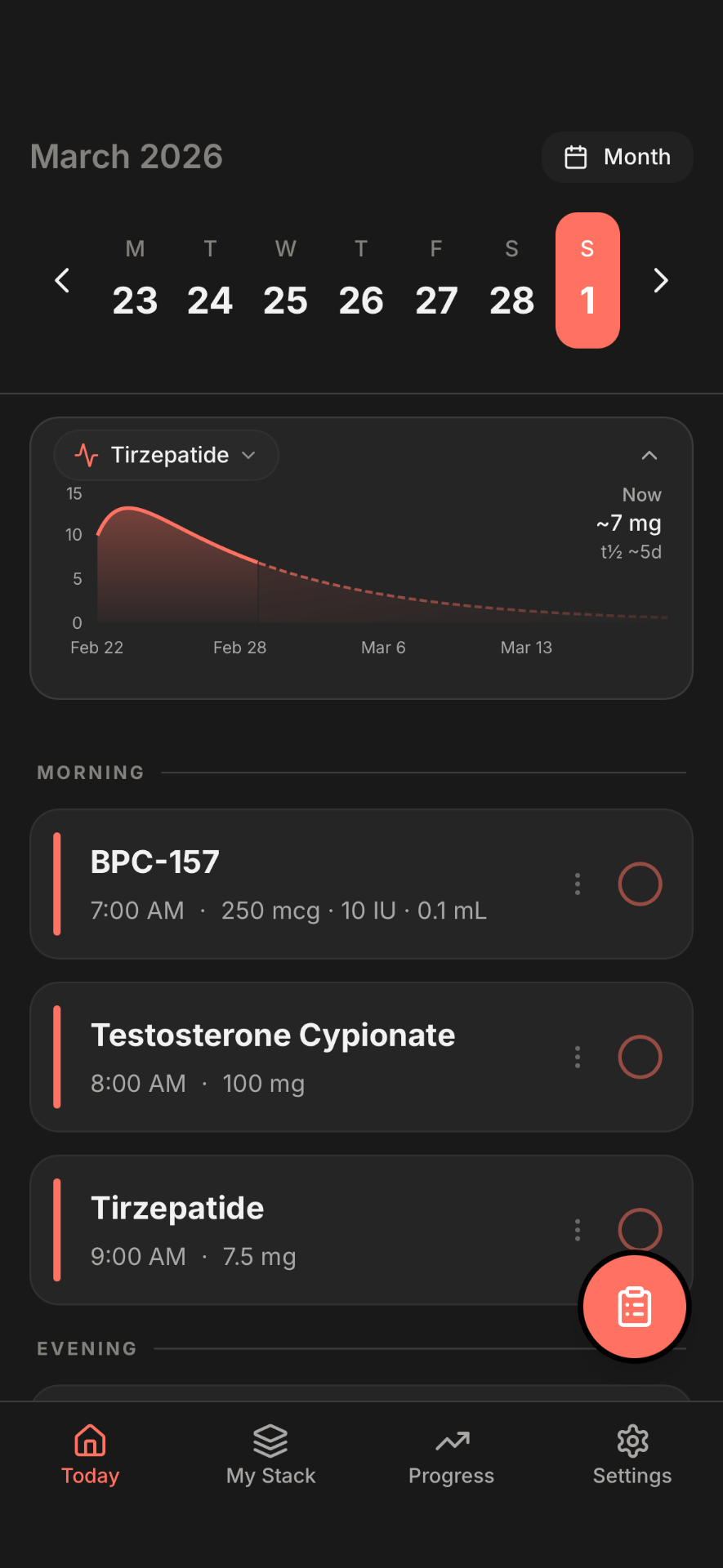
Regimen peptide and GLP-1 tracker app screenshot
Share this article

Related Articles