Heads up: this is community knowledge, not medical advice. Retatrutide is not FDA-approved. If you are running it, work with a doctor and get bloodwork done.
Most retatrutide content treats everyone the same. Start at 2mg, work your way up to 8 or 12mg, expect to drop 20% of your body weight. Those numbers come from trials that only enrolled patients who were obese, or overweight with metabolic conditions like high blood pressure, dyslipidemia, or type 2 diabetes. If you are already lean and active and running reta to chase stubborn fat and recomp, those doses are not right for you. The community pattern looks different. The mechanism backs it up.
Quick answer
The standard reta trial doses (2mg titrating up to 12mg) were designed for patients who were obese, or overweight with metabolic conditions. If you are lean and active (roughly 12-25% body fat) running reta for recomp, the community pattern is 0.5mg weekly, rarely going above 1mg. Two reasons: less metabolic adaptation working against you when you are already lean, and reta’s ~6-day half-life means each shot stacks on what is still in your system from the last. Most lean users at this dose range still feel all three components doing work (GLP-1 appetite suppression, GIP carb handling, glucagon-driven fat mobilization and thermogenesis). Get bloodwork. Talk to a doctor.
Why the trial doses do not apply to you if you are lean
The reta trials only enrolled patients who were:
- Obese (BMI 30 or higher), or
- Overweight (BMI 27 or higher) with at least one weight-related comorbidity like hypertension, dyslipidemia, sleep apnea, or type 2 diabetes
The 2mg, 4mg, 8mg, 12mg titration was designed to get that population to significant weight loss over 48 to 72 weeks. Phase 2 data showed up to 24% body weight loss at the high doses. Phase 3 looks similar.
That math does not apply cleanly if you are already lean and active. Three reasons:
- Less metabolic adaptation working against you. Lean users do not have the insulin resistance, leptin resistance, or chronic inflammation that obese patients are dealing with. The drug does not have to push through as much to do its job.
- Less stored fat to mobilize. The glucagon component of reta drives fat mobilization. Someone at 15% body fat does not have the same fat reserves as someone at 40%. Smaller reserves means a smaller dose moves the needle.
- Different goal. Trials measure scale weight going down. You are trying to lose fat while preserving (or building) muscle. That is a different game. Lower doses leave your appetite intact enough that you can still hit protein targets, which is what actually decides whether you keep your muscle.
The pattern that has emerged in the community: lean and active users usually start at 0.5mg weekly and most never go above 1mg weekly. Way below trial doses. The report is that all three parts of reta still work at that range for this group.
The three things reta actually does
Reta hits three different switches at the same time. Each one does something different in your body. If you can tell which switch is firing, you can tell whether your dose is working.
1. The GLP-1 component (appetite suppression and food noise)
This is what most people feel first. It suppresses appetite, slows gastric emptying (so you stay full longer), and quiets the brain signals that drive cravings. That last part is what people mean by “food noise” going quiet.
How you know GLP-1 is working for you:
- That “I am stupid full” feeling after a small meal
- Cravings going from urgent to background noise
- Less impulsiveness around eating, drinking, scrolling, etc.
- A flat or muted mood sometimes, especially in the first 2 to 4 weeks
- Lower motivation or libido for some people
- A little nausea or loose stools when you bump up
This part is loudest in the first 2 to 4 weeks after starting or bumping your dose. It usually mellows out as your body adjusts.
2. The GIP component (carb handling and muscle preservation)
GIP improves your body’s ability to partition carbs. Glucose gets into muscle cells more efficiently, your energy stays steadier across the day, and your body has an easier time directing calories into muscle instead of fat.
How you know GIP is working for you:
- Steadier energy across the day, fewer afternoon crashes
- Carbs around training actually feel like fuel
- Your lifts hold or go up during a cut (muscle staying intact)
- The mirror and tape measure show change even when the scale does not move
This is the component that helps reta preserve muscle better than plain semaglutide does. If you are running for recomp, this is what keeps your training from falling apart. For the broader picture on muscle preservation peptides, see Best Peptides for Muscle Building in 2026.
3. The glucagon component (resting energy expenditure and stubborn fat)
Glucagon bumps up your resting energy expenditure, mobilizes stored fat (including the stubborn visceral depots around your organs), and can make you run a little warmer (mild thermogenesis). This is the component that separates reta from tirz and sema. They do not have it.
How you know glucagon is working for you:
- Days where your energy feels like it is on a low motor
- Slightly higher resting heart rate, and you are warm when other people are cold
- Stubborn fat (lower belly, love handles, visceral) actually starting to move when diet alone never touched it
- A mild “vibrating” energy feeling some people get at moderate doses
A note on the “glucagon works at any dose” claim
You will see this floating around the community. It is not quite right. The glucagon effect does scale with dose. Lower doses activate it, but the bigger the dose, the bigger the effect. The reason lean users see real glucagon activity at 0.5-1mg is not because dose does not matter. It is because lean users have less to push against (smaller fat depots, less metabolic adaptation), so the smaller signal goes further. Set your expectations accordingly.
The half-life math that changes how you should think about your dose
Reta has a half-life of about 6 days. That is from the actual trial data (NEJM, 2023). What that means: half of a dose is still in your body 6 days after you took it.
The practical version: each shot you take is stacking on top of what is still left from the last one.
Work through the math for a 0.5mg weekly protocol with a 6-day half-life and 6-day dosing interval:
| Dose | Just before next dose |
|---|---|
| Dose 1 (Week 1) | 0.5mg, decays to 0.25mg in 6 days |
| Dose 2 (Week 2) | 0.25mg + 0.5mg = 0.75mg, decays to 0.375mg in 6 days |
| Dose 3 (Week 3) | 0.375mg + 0.5mg = 0.875mg, decays to 0.44mg in 6 days |
| Dose 4 (Week 4) | 0.44mg + 0.5mg = 0.94mg, decays to 0.47mg in 6 days |
By dose three or four, you have close to 1mg of reta in your system at any given time, not the 0.5mg you just pinned. It takes about 4 to 5 weeks for your levels to settle (steady state), where each new shot just replaces what got cleared.
This is why “I am only on 0.5mg” actually works for lean people. The cumulative amount is closer to 1mg, and if you are already lean, that is plenty to hit all three parts of the drug.
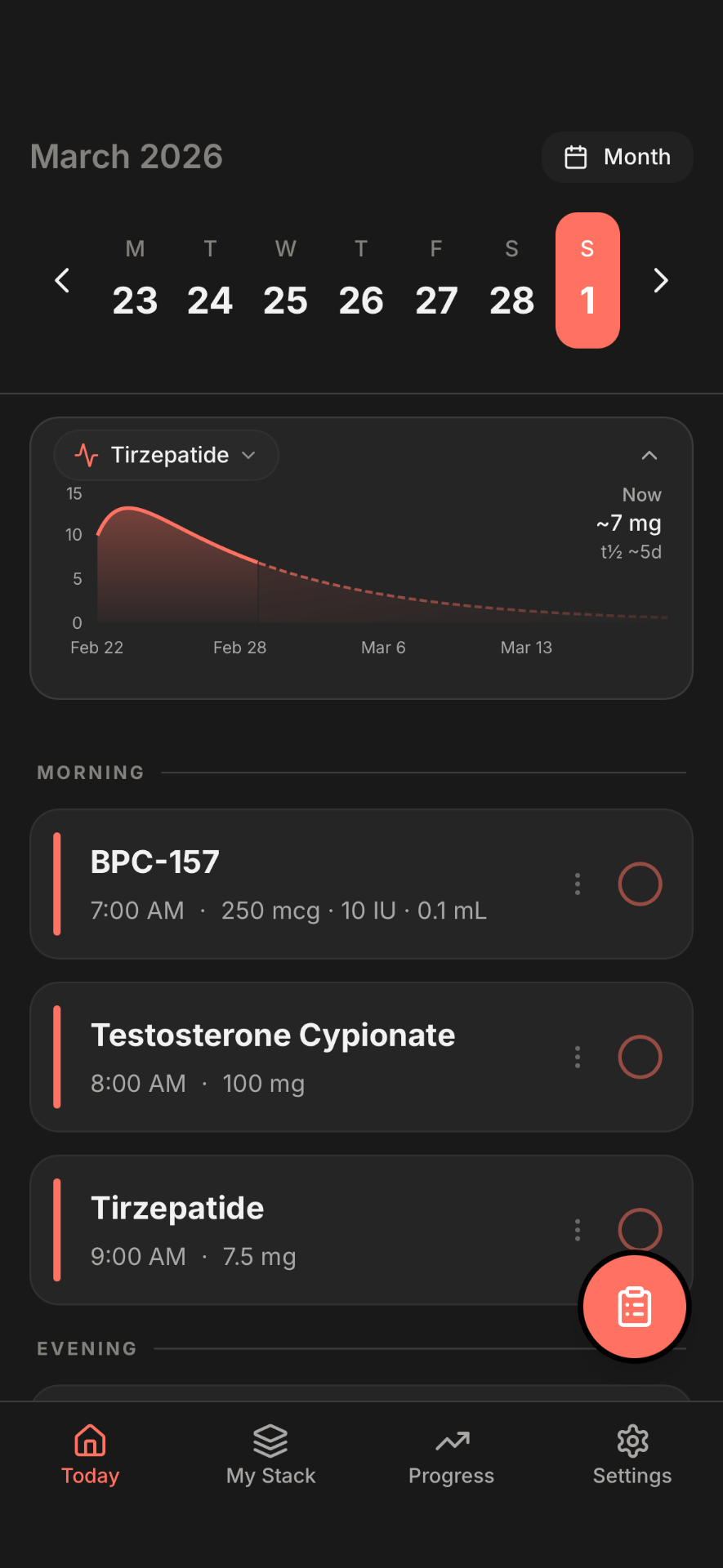
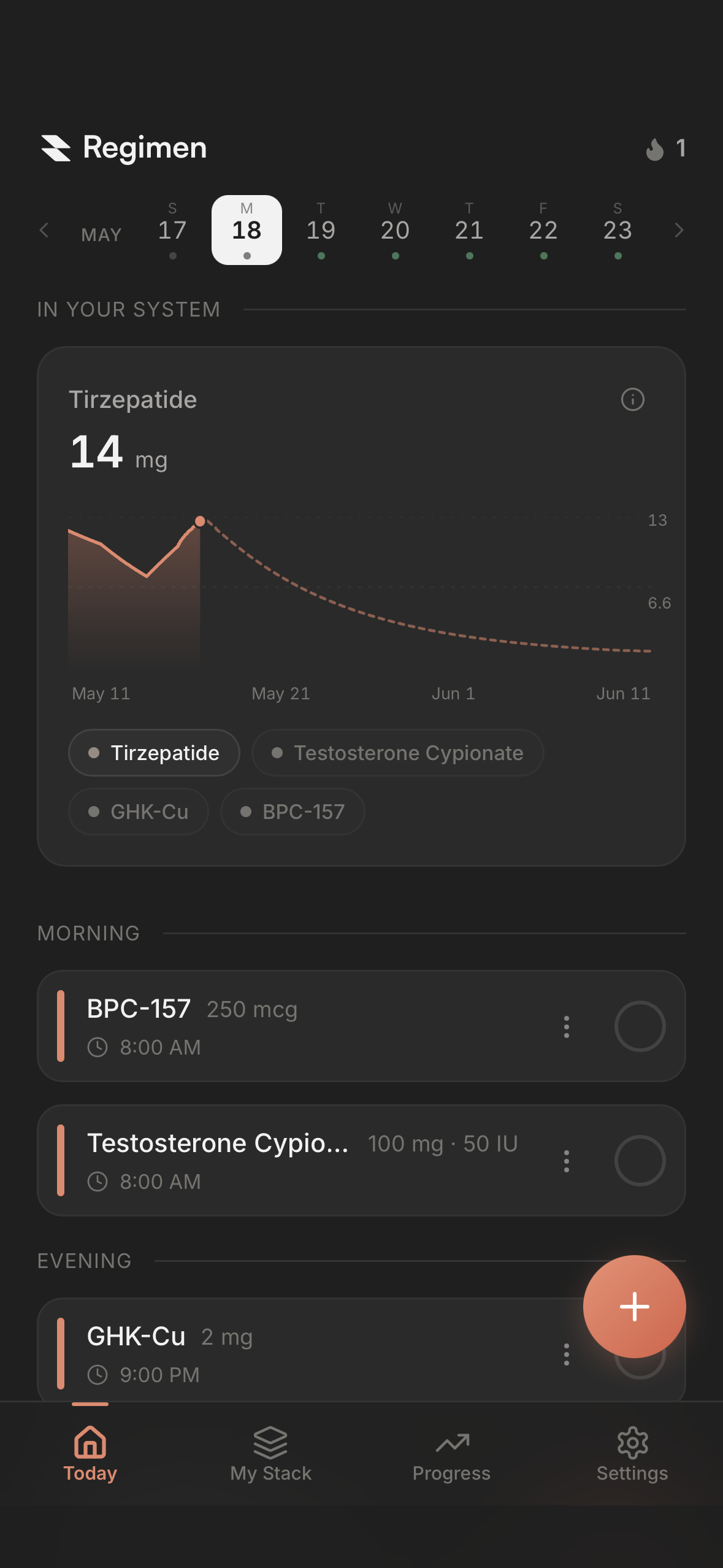
You can model your own protocol using Regimen’s half-life visualizer. Plug in retatrutide, your weekly dose, and your dosing interval, and you will see the cumulative curve and your projected steady-state level.
Why this matters for tracking
A 0.5mg weekly retatrutide protocol is actually producing the effect of carrying ~0.9mg in your body. When you titrate up or down by 0.25mg, you are not just changing the injection amount, you are changing the steady-state level by roughly twice that. Small weekly volumes also mean you are working with a handful of units on an insulin syringe, so a steady injection site rotation keeps the tissue you are drawing into consistent. Regimen tracks your dose, injection day, body comp, lifts, side effects, and bloodwork on the same timeline so you can see how dose changes line up with results over the 4 to 5 week steady-state window. The math matters most when you can see it next to your actual outcomes.
What lean and active users actually run
The pattern that has emerged in the community looks pretty different from the trial protocol.
Where most people start: 0.5mg weekly, sub-q. Most stay here for the first 4 to 8 weeks while they figure out how they respond.
Where most people stay: 0.5mg to 1mg weekly. The community report is that this range hits all three parts of the drug without killing your appetite so hard you cannot eat enough protein.
When to bump your dose (if at all): Only when all three parts of the drug have clearly stopped working AND they have been gone for a few weeks AND your diet, training, and sleep are all still locked in. A stalled scale by itself is not a reason. More on plateaus in a minute.
When NOT to bump your dose:
- The scale stalled but your waist is still shrinking
- You are still feeling the appetite suppression
- You have not tried changing up your training or macros yet
- You are chasing the doses you see other people running on Instagram
One more time: this is community pattern, not clinical advice. The reta trials did not study lean people. Get bloodwork. Talk to a doctor. Be honest with yourself about how you are actually responding.
Pick your starting dose by where you actually are
12-18% body fat (already lean, just recomping): 0.5mg weekly. Sit there for 4 to 8 weeks before doing anything.
18-25% body fat (lean-ish, some fat to lose): 0.5-0.75mg weekly. Only bump up slowly if all three parts of the drug stop working.
25-30% body fat (a bit over): 0.5-1mg weekly, sometimes up to 1.5mg. The standard trial logic starts to make more sense at this end.
30%+ body fat: The trial protocol (2mg start, work up to 4mg, 8mg, etc.) is probably the right fit. Talk to a doctor about your specific situation.
What recomp actually looks like on reta (not what weight loss looks like)
If you walk into reta with a weight loss mindset, you will misread your own progress. Either you will quit too early because the scale is not moving, or you will chase the wrong fix when you hit a wall.
The scale: Moves slow. You might drop 3 to 5 pounds the first month and then sit there for weeks while your body comp keeps changing underneath. Day-to-day swings from water, glycogen, and sodium will mess with the actual trend.
The mirror and the tape: Your waist will shrink even when the scale does not. Clothes fit differently. Photos every 2 to 4 weeks (same lighting, relaxed, not flexed) will show changes the scale missed.
Your lifts: They should hold or go up. If your working weights are crashing, your deficit is too aggressive or you are not eating enough protein. Reta does protect your muscle decently well in lean users at moderate doses, but the protein and training have to be there or it does not matter.
Your bloodwork: Lipid panel, fasting glucose, HbA1c should hold or improve. These are the leading signs that the protocol is actually doing what you want underneath.
What to actually track: Weekly average weight (not daily), weekly waist, photos every 2 weeks, bloodwork monthly, and your top working set on the big lifts. Track them in Regimen so you can see how your dose changes line up with body comp changes over time. Spreadsheets break down by week 4. The app does not.
Plateaus, and why bumping your dose is usually the wrong move
Your body adapts. Keep everything the same long enough (same dose, same training, same food, same sleep), and it will find a new floor where fat loss slows down or stops.
The community impulse when this happens is to bump up the reta dose. For a lean user, that is usually the wrong move. Here is a better way to think about it:
Step 1: Be honest about whether you have actually plateaued.
- Is the scale stalled but the waist still shrinking? Not a plateau: you are recomping.
- Is the scale stalled, the waist stalled, and the lifts holding? Possible plateau, but check Step 2.
- Is the scale stalled, the waist stalled, lifts crashing, and energy tanking? Your deficit is too aggressive. Reduce the deficit, do not increase the dose.
Step 2: If it is a real plateau, change the variables that are not your dose.
- Change your workout split. If you have been doing the same training for 8+ weeks, swap movement patterns, switch from machines to free weights, or shift volume.
- Change your macros. If you have been eating the same meals, throw the body off. Higher carb, lower fat. Or higher fat, lower carb. Or shift protein timing around training.
- Change rest patterns. If you have not had a deload week, take one. If your weekly cadence has been the same for months, change it.
- Check sleep, hydration, and stress. Plateaus often track with one of these getting worse without you noticing.
Step 3: Only after Steps 1 and 2 do you consider titrating up. If you have ruled out the false plateau, changed the modifiable variables, given it 3 to 4 weeks, and all three components of the drug have clearly faded, then a modest titration (say, 0.5mg to 0.75mg, or 0.75mg to 1mg) is reasonable. Aggressive jumps to trial doses (2mg, 4mg) are not.
Training, protein, and an honest take on cardio
You will see “do not do intense cardio on reta, you will burn muscle” all over the community. That is overstated. Here is the more accurate version:
- Protein is the non-negotiable. Aim for 0.8 to 1.2g per pound of bodyweight. Every day. On reta, appetite suppression makes this harder than you think. Plan, prep, use shakes if you have to. Without enough protein, you lose muscle whether you do cardio or not.
- Lifting is the actual lever. 3 to 5 sessions a week, hitting the big movement patterns, with progressive overload. If you stop lifting, you lose muscle. Cardio does not replace this.
- Moderate cardio is fine. 10,000 steps a day, the occasional Zone 2 session, pickup basketball. None of that burns muscle on its own. Muscle loss kicks in when you stack: (a) too-aggressive deficit, (b) low protein, (c) tons of intense cardio, and (d) not enough lifting. Reta does not change that math. Too much cardio with not enough protein burns muscle with or without the drug.
- Intense cardio (HIIT, long high-intensity sessions) on a real deficit: This is where the community concern actually holds. Combined with the deficit and under-eaten protein, you can lose more muscle than you would want. For a lean user chasing recomp, the rule is: keep the lifting hard, keep the protein high, keep the cardio moderate. For the practical guide to holding onto muscle while you lean out, see the retatrutide body recomposition data.
The “V8 vs V6 engine” framing the community uses (more muscle, higher idle burn, better long-term body comp) is directionally right. Holding onto your lean mass during a recomp phase pays off after the cut ends, when you stop using reta and need your engine running clean.
The mistakes lean users make over and over
Same patterns keep showing up.
Mistake 1: Copying influencer doses. Most reta content online is either for obese trial patients or for influencers who are not actually lean. If you copy their dose and you are already lean, you crush your appetite, lose strength, and tank your energy.
Mistake 2: Treating it like weight loss instead of recomp. Checking the scale every day. Quitting because it stopped moving. Missing the actual change happening underneath.
Mistake 3: Skipping bloodwork. Lipid panel, fasting glucose, HbA1c every 8 to 12 weeks. These tell you whether the protocol is doing what you want or whether something has gone sideways.
Mistake 4: Stopping cold turkey with no plan. People who hit their goal and just quit usually regain a chunk of it back. Taper down. Keep the protein and the lifting habits. That is the maintenance plan.
Mistake 5: Chasing the dose instead of fixing everything else. Bumping reta when you are sleeping six hours, skipping protein, training inconsistently, or stressed out. The dose is one knob. The rest of the protocol is everything else.
Mistake 6: Not tracking your dose next to your results. If you do not have dose, weight, waist, lifts, hunger, and side effects all in one place, you cannot tell what is actually working. This is what Regimen is built for.
Frequently Asked Questions
Why does the 6-day half-life matter for dosing?
Because each dose builds on the residual of the previous. A 0.5mg weekly dose is not just 0.5mg in your system. It is closer to 1mg by the time you have been on it for 3 to 4 weeks. Steady state takes 4 to 5 weeks. This is why some users feel the effects build over the first month rather than peaking at the first dose.
Is 0.5mg of retatrutide really enough to do anything?
For a lean and active user, the community report says yes. The math backs it up: with a 6-day half-life and weekly or every-6-day dosing, you have close to 0.875 to 1mg circulating by your third or fourth shot. Combined with less metabolic adaptation working against you, that dose range hits all three components for a lot of people. If you are overweight or obese with metabolic comorbidities, 0.5mg probably is not going to cut it and the trial doses make more sense.
Why does the 6-day half-life matter for dosing?
Because each shot stacks on top of what is left from the last one. A 0.5mg weekly dose is not “0.5mg in your system.” It is closer to 1mg by the time you have been on it for 3 to 4 weeks. Your levels settle in around week 4 or 5. That is why some people feel the effects build over the first month instead of peaking right after the first shot.
Should I dose every 6 days instead of every 7?
Some community users do this because dosing matches the half-life exactly, producing slightly more stable circulating levels. Practically, the difference between weekly and every-6-days is small. Pick whichever is sustainable and trackable for you.
How long should I stay on retatrutide for body recomposition?
There is no clinical guideline for this use case because trials targeted weight loss in obese patients, not recomp in lean ones. Community patterns vary from 12-week blocks with breaks to longer continuous protocols. The practical answer: stay on as long as the protocol is producing the result you want, you are tolerating it well, and bloodwork remains good. Plan the exit strategy (maintenance habits, training) from the start.
What about TRT plus retatrutide?
Common male recomp stack, especially for men with verified low testosterone. Covered separately in the retatrutide + TRT stack guide. The short version: TRT preserves muscle during the deficit, retatrutide drives the fat loss, lower retatrutide doses generally work even better in this stack because the TRT side already supports the muscle preservation.
What if I am not lean now but want to be?
If you are overweight (BMI 27-30) but pursuing recomp rather than max weight loss, the community pattern is to start at 0.5-1mg weekly instead of the trial 2mg starting dose. You will likely titrate up modestly as you lose fat and your metabolic adaptation drops. The trial titration becomes more appropriate the higher your starting BMI and the more metabolic comorbidities you are working with.
How do I know if my dose is right?
You should feel all three components clearly: appetite suppressed but not destroyed (you can still hit protein), more stable energy across the day, and either visible fat loss or felt warmth/thermogenesis at some point in your cycle. If appetite is so crushed you cannot eat enough protein, the dose is too high. If none of the three components feel active after 3 to 4 weeks at a given dose, the dose may be too low or you may not be a strong responder.
Where does this advice come from?
Mechanism analysis is based on the published clinical pharmacology (NEJM Phase 2 trial, Jastreboff et al. 2023, plus the Phase 3 program). Dosing patterns are community-reported from the lean-user subset of the retatrutide community on Reddit, Discord, and biohacker forums. The protocols and decision frameworks in this article are not medical advice.
Should I see a doctor?
Yes. Retatrutide is not FDA-approved for any indication. Most users source it through research peptide vendors or compounding pharmacies in a gray-market context. A qualified prescriber, regular bloodwork, and honest medical conversation should be part of any serious protocol regardless of whether the source is conventional or not.
Medical disclaimer
This article is for educational purposes only. It is not medical advice, a prescription, or a recommendation to use any compound. Retatrutide is not FDA-approved, and the FDA has issued warning letters to vendors selling it as an unapproved drug. The dosing patterns described here are community-reported, not clinically validated for the lean-user population. Always consult a qualified healthcare provider before starting, stopping, or changing any medication or health protocol.
Related reading
- Retatrutide Side Effects Guide
- Retatrutide + TRT Stack: Dosing Protocol and Timing
- Switching from Tirzepatide to Retatrutide
- Retatrutide Dosing Guide: How to Titrate and When to Move Up
- Body Recomposition with Peptides: The 2026 Stack Guide
- Best Peptides for Fat Loss in 2026
- Best Peptides for Muscle Building in 2026
- Half-Life Visualizer Tool
- Retatrutide Tracker
Ready to track your GLP-1?
- Smart reminders so you never miss a dose
- Track weight, photos, and progress over time
- Medication level curves for every compound