Tesamorelin is the closest thing the peptide world has to a visceral-fat tool. It tells your pituitary to release more of your own growth hormone in the natural pulsing pattern your body already uses, and over months that signal reduces the deep abdominal fat packed around your organs while preserving lean mass. It is FDA-approved for HIV-associated lipodystrophy at 1.4mg subcutaneously daily, but the off-label use case (central adiposity in otherwise healthy adults) is where most of the community interest now lives.
The Bottom Line
Tesamorelin (Egrifta SV) is a GHRH analog approved by the FDA for visceral fat reduction in HIV-associated lipodystrophy. The pivotal Phase 3 trials (404 and 412 adults with HIV-associated visceral fat) showed about 15 to 18% visceral adipose tissue reduction at 26 weeks, with lean mass preserved; a separate 52-week extension showed the reduction was sustained. Anti-aging and longevity clinics commonly prescribe it off-label for central adiposity. Community off-label protocols often cluster around 1-2mg nightly in 8-to-16-week blocks. It is the best-evidenced GH-axis peptide for visceral fat specifically, but it elevates IGF-1, can cause fluid retention, and is contraindicated in active malignancy.
What it is and how it works
Tesamorelin is a stabilized analog of growth hormone-releasing hormone (GHRH). Your hypothalamus already makes GHRH, which tells your pituitary to release growth hormone in pulses, mostly at night. Tesamorelin replicates that signal in a form that does not break down as fast as natural GHRH.
The downstream chain looks like this: tesamorelin signals the pituitary, the pituitary releases endogenous growth hormone in pulses, GH circulates and tells the liver to produce IGF-1, and IGF-1 plus the GH pulses together drive the effects on body composition and lean mass. The peptide itself has a short half-life (about 8 minutes), but the GH and IGF-1 it triggers do the actual work over hours and days.
This is mechanically different from injecting recombinant human growth hormone (HGH/somatropin) directly. HGH dumps a continuous level of GH into the bloodstream, which suppresses your pituitary’s own production over time. Tesamorelin amplifies your natural pulses without replacing them, which is why it does not shut down your endogenous GH axis the way exogenous HGH does over long-running protocols.
The result that makes tesamorelin distinctive: among GH-axis compounds, it is the one with the cleanest human signal for selectively reducing visceral adipose tissue (the deep abdominal fat around your organs) while preserving or increasing lean mass.
The evidence
Tesamorelin has the strongest human clinical evidence of any GH-axis peptide in the off-label community catalog. The reason: the pivotal trials were run for FDA approval, with real randomization, real placebo control, and real imaging-based body composition measurement.
The pivotal trials. The pivotal Phase 3 trials (404 and 412 adults with HIV-associated visceral fat) found that tesamorelin at 2mg subcutaneously daily reduced visceral adipose tissue by about 15 to 18% at 26 weeks, while preserving lean mass. A separate 52-week extension showed that reduction was sustained, not continuing to climb. IGF-1 levels rose into the upper-normal range. Glucose tolerance in this specific population did not show significant disruption, though the label flags it as a monitoring concern.
What is notable in the trial data: the visceral fat reduction was selective. Subcutaneous fat (the kind you can pinch) did not drop the same way. Total body weight changes were small (often 1-3kg over the trial period). This is why people on tesamorelin frequently report “the scale is not moving” while their waist measurement is steadily shrinking and their abdomen is visibly flatter. The compound is moving the fat that matters most metabolically, not the fat that is most visible at first glance.
Evidence tier: strong human evidence. Tesamorelin sits alongside HGH and mecasermin (rhIGF-1) as one of the few GH-axis compounds with regulatory approval and proper RCT data. CJC-1295, ipamorelin, sermorelin, and the older GHRPs all sit a tier below in evidence terms, even though they are popular in community protocols.
What the trials do not cover. The pivotal evidence is in HIV-associated lipodystrophy. The off-label use case (central adiposity in metabolically healthy or insulin-resistant adults without HIV) does not have equivalent RCT data. The mechanism is the same, and clinic-based observational data from longevity and anti-aging practices suggests the visceral fat effect carries over, but the formal evidence base is built on a specific clinical population.
How the community actually uses it
Off-label tesamorelin use diverges from the Egrifta SV label in three predictable ways: dose, schedule, and duration.
Dose. The FDA label is 1.4mg SC daily. The pivotal trial used 2mg SC daily. Public forum and clinic-protocol examples show community use often clusters around 1-2mg nightly, with some users running lower (around 1mg) and rare protocols going higher. Anti-aging clinics commonly prescribe tesamorelin in this 1-2mg nightly range for patients with central adiposity who do not have HIV.
Schedule. Bedtime dosing is the default. The logic: the body’s natural GH pulse is largest during early sleep, so dosing at night layers the tesamorelin-triggered pulse on top of the endogenous one rather than fighting it. Some users run 5-on/2-off weekly patterns (five nights of dosing, two off), partly to manage cost and partly because the community theory is that occasional breaks may preserve receptor sensitivity. The pivotal trial used continuous daily dosing.
Duration. Off-label community protocols typically run in defined blocks (8 to 16 weeks) rather than indefinitely. This contrasts with the label, which describes ongoing therapy. The block-based approach is partly cost-driven (the brand drug is expensive) and partly a hedge against the long-term IGF-1 elevation concerns that come with any GH-axis compound run continuously.
Stacking patterns. In recomp-focused protocols, tesamorelin is often run alongside a GLP-1 (tirzepatide or retatrutide) where the GLP-1 drives appetite control and overall fat loss and tesamorelin targets the visceral compartment specifically. Some users layer ipamorelin on top of tesamorelin to combine the GHRH-analog signal with a ghrelin-receptor-driven pulse, though the marginal benefit over tesamorelin alone is debated in the community.
For the lifter who already has solid training and protein in place, the most common reason to add tesamorelin is exactly this: belly fat that will not move with diet alone, while subcutaneous fat is dropping fine. For the longevity-leaning user, the rationale is usually visceral fat as a long-term cardiovascular and metabolic risk factor rather than an aesthetic one.
Side effects and risks
Tesamorelin has a defined side-effect profile from the pivotal trials and post-marketing surveillance. None of this is hypothetical.
Common side effects (from the label and clinical use):
- Injection site reactions. Redness, itching, bruising at the injection site. Usually mild, often resolves with rotation between sites.
- Fluid retention. Peripheral edema, mild swelling in hands or feet, sometimes carpal-tunnel-like wrist symptoms. This is a class effect of anything that raises GH and IGF-1. Typically dose-dependent.
- Joint stiffness or arthralgia. Same root cause: GH-driven fluid shifts in connective tissue.
- Headaches. Common in the first weeks, often resolves.
- Hyperglycemia and reduced insulin sensitivity. GH antagonizes insulin. In the HIV trial population glucose tolerance did not change significantly, but the label flags this and the off-label longevity-clinic experience reports it more often in patients with pre-existing insulin resistance.
The serious concerns:
- Elevated IGF-1. This is the most important monitoring point. Tesamorelin works by raising IGF-1, which is a growth factor. Sustained IGF-1 elevation is associated with increased risk of certain cancers in observational data, and IGF-1 above the upper-normal range is generally considered a stop signal. Bloodwork at baseline, 8 weeks, and at the end of any block is the standard the community follows.
- Active malignancy contraindication. Anyone with an active cancer should not be on tesamorelin. The IGF-1 elevation is the reason. This is not a soft caution.
- Pituitary axis disruption. Patients with hypopituitarism or untreated growth hormone deficiency are excluded from the label.
WADA-banned. Tesamorelin is on the World Anti-Doping Agency prohibited list as a GHRH peptide hormone. Tested athletes should not be on it.
Who should not be on tesamorelin
Anyone with an active cancer diagnosis. Pregnant or nursing women. Anyone with significant uncontrolled diabetes or pre-diabetes without close glucose monitoring. Athletes in WADA-tested sports. Anyone with a documented pituitary disorder. The IGF-1 elevation, the glucose effects, and the prohibited-substance status make these populations the clear “no” group.
Sourcing reality
Tesamorelin comes through three channels, with very different cost and quality profiles.
Prescription Egrifta SV. The branded version. FDA-approved, pharmaceutical-grade, comes with the standard regulatory quality assurance. Pricing is high (often four-figure monthly) because it is a low-volume specialty drug with a narrow approved indication. Insurance coverage is typically limited to the labeled HIV-associated lipodystrophy indication and rarely covers off-label use for general central adiposity.
Compounding pharmacy. Anti-aging clinics, longevity-focused telehealth providers, and some functional medicine practices prescribe tesamorelin through 503A or 503B compounding pharmacies. The cost drops substantially compared to brand Egrifta SV, often into the low-to-mid hundreds per month depending on dose and pharmacy. Quality is generally good with reputable compounders, though it varies, and the regulatory status of compounded GHRH peptides has been an active area of FDA scrutiny.
Research peptide vendors. The gray-market channel. Tesamorelin from research peptide companies is sold as “not for human use” and exists in a regulatory zone the FDA has been tightening over the last 18 months. Cost is dramatically lower than either prescription channel. Quality varies enormously between vendors, with independent third-party testing of gray-market peptide product showing wide variability in purity, concentration, and contamination. This is the channel the community is most active in and also the channel with the most quality risk.
For the longevity-clinic patient and the off-label medical user, compounding pharmacy is the dominant channel. For the self-directed biohacker, research peptide vendors are common, with the understood trade-off of quality variance.
Who tesamorelin is not for
Beyond the contraindications above, tesamorelin is not the right tool for several common scenarios:
- Pure subcutaneous fat loss. If your concern is the fat you can pinch (love handles, arms, thighs) rather than the deep abdominal fat around your organs, tesamorelin is not the cleanest fit. The compound’s selectivity is for visceral adipose tissue. GLP-1s do broader fat loss work, more efficiently, for that profile.
- Pure muscle gain. Tesamorelin preserves lean mass during a deficit and may modestly support lean tissue, but it is not a hypertrophy compound. If your goal is to add 10 pounds of muscle and you have no fat loss intention, the GH-axis is a weak lever compared to training, protein, and (for hypogonadal men under medical supervision) testosterone optimization.
- Short-term aesthetic goals. Tesamorelin’s effects build over months, not weeks. The pivotal trials measured visceral fat changes at 26 weeks, with the benefit sustained through 52 weeks. Anyone looking for visible results in 4 weeks is using the wrong tool.
- Anyone unwilling to do bloodwork. IGF-1 monitoring is the safety floor for this compound. Running it blind on the IGF-1 number is not community practice; it is how people end up with persistent edema, joint issues, or worse.
Stacking and combinations
The most common tesamorelin stacks in the off-label community map to specific jobs.
Tesamorelin + GLP-1 (the recomp stack). Tirzepatide or retatrutide drives appetite control and overall fat loss; tesamorelin targets the visceral compartment specifically. This is the canonical “advanced recomp” stack for users whose primary problem is central adiposity with a desire to preserve lean mass during the cut. The trade-off: managing two compounds with different side-effect profiles (GI on the GLP-1 side, fluid retention and IGF-1 monitoring on the tesamorelin side).
Tesamorelin solo for visceral fat. Run during a moderate caloric deficit with high protein and resistance training. The minimalist version. Cleanest signal-to-noise for evaluating whether the compound is actually doing something for you, because there is no other variable to confound the IGF-1 movement or the waist measurement.
Tesamorelin + TRT (in men with verified low T). For hypogonadal men already on testosterone replacement, adding tesamorelin gives an independent lever for visceral fat without competing with the TRT mechanism. The two compounds work on different axes (androgen vs GH/IGF). Bloodwork complexity increases because both axes affect lipids, hematocrit, and glucose, and the interactions need to be monitored together.
Tesamorelin + ipamorelin (the dual-pulse approach). Some community protocols layer ipamorelin (a ghrelin receptor agonist) on top of tesamorelin to combine the GHRH signal with a separate GH-release mechanism. The theoretical pulse amplification is real; the practical marginal benefit over tesamorelin alone is debated. Most clinic-prescribed protocols do not stack the two.
What tesamorelin does not combine well with. Continuous high-dose HGH (redundant and pushes IGF-1 too high). MK-677 in body recomp contexts (the appetite increase from MK-677 fights the recomp goal). Any compound that itself drives significant IGF-1 elevation without monitoring (the additive effect can push past safe ranges quickly).
What we see in Regimen data
Tesamorelin tracking on Regimen has more than doubled over the past 30 days versus the prior trailing average, the fastest growth of any GH-axis peptide on the platform. Roughly 3 in 10 users running tesamorelin cycle their protocol on and off (typically 8-to-16-week blocks) rather than running continuously, consistent with the community pattern of treating GH-axis compounds as block protocols rather than indefinite therapy.
What to track on a tesamorelin protocol
Tesamorelin’s effects do not show up cleanly on the scale, so the tracking layer matters more than usual.
- Waist measurement. At the navel, relaxed, same time of day. This is the metric that moves first when tesamorelin is working. Weekly check, look for the multi-week trend.
- Weight (weekly average). Daily weight is noise. The seven-day average smooths out water and food. Do not expect dramatic movement.
- Progress photos. Every two to four weeks, same lighting, abdomen relaxed. The visceral fat reduction shows up as the abdominal profile flattening before the scale catches up.
- IGF-1 bloodwork. Baseline before starting, at 8 weeks, and at the end of any block. This is the safety-and-efficacy floor for the compound. IGF-1 in the upper-normal range is the target. Above the reference range is a signal to pause or lower dose.
- Fasting glucose and HbA1c. Baseline and at 8 to 12 weeks. GH antagonizes insulin, and the population most likely to be off-label users (insulin-resistant, central adiposity) is also the population most likely to see glucose drift.
- Lipid panel. Baseline and at the end of the block. GH-axis modulation can shift triglycerides and HDL.
- Subjective effects. Sleep quality (often improves), morning energy, joint stiffness, any edema in hands or feet. Note the trend, not the daily fluctuation.
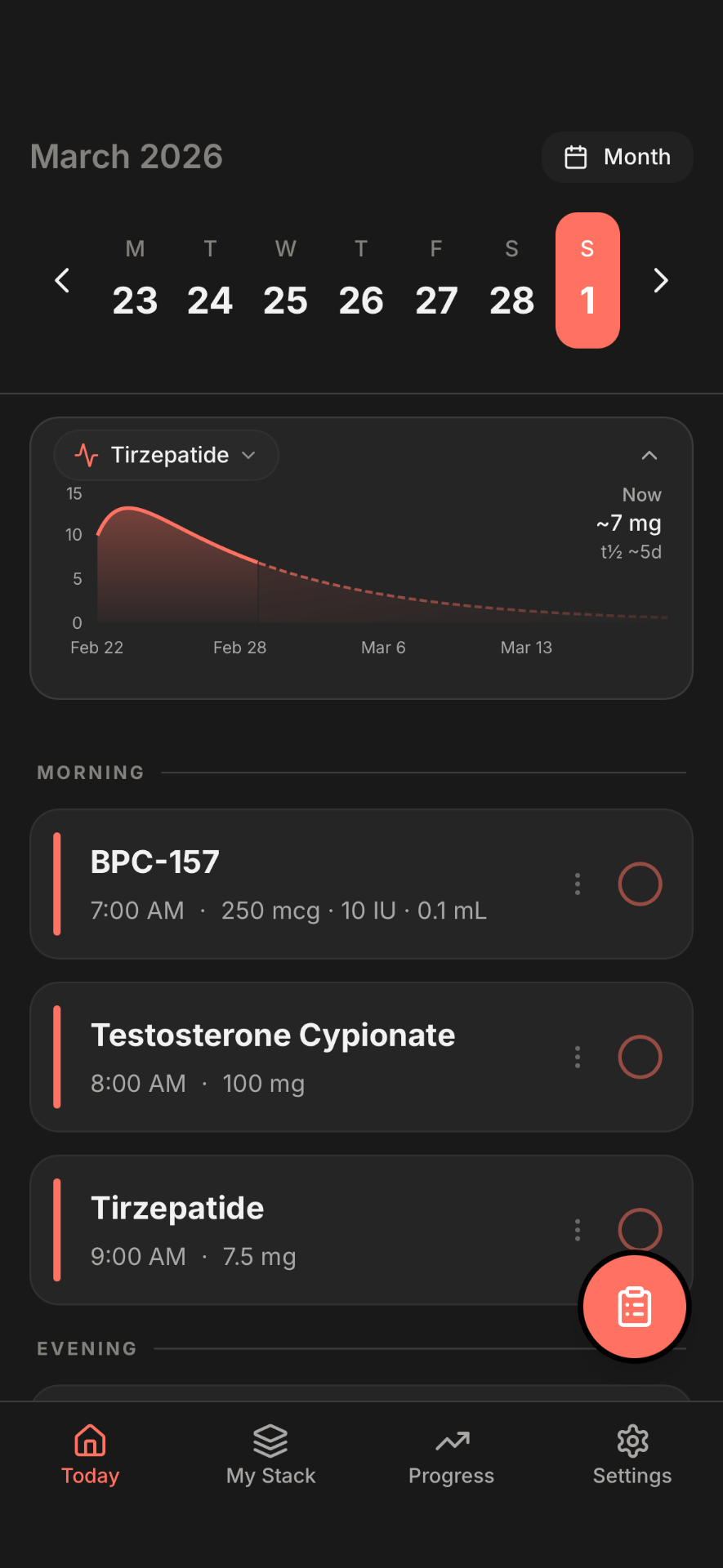
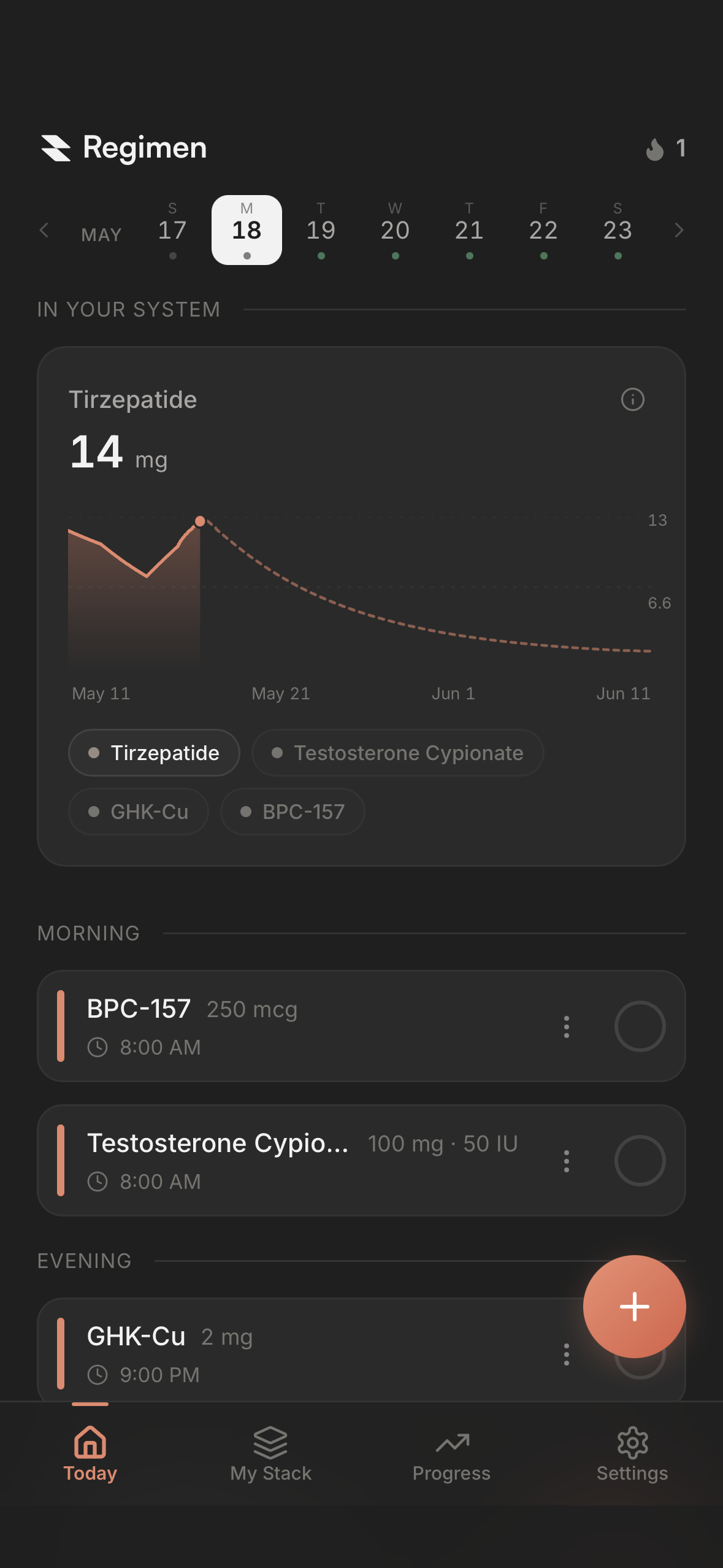
The Regimen app handles injection logging, waist tracking, weight averaging, and the bloodwork timeline in one place, which makes the multi-week pattern visible even when the daily numbers feel like nothing is happening.
For a compound-specific overview of what to log and how the visceral fat signal shows up over a block, see the tesamorelin tracker page.
Frequently Asked Questions
Does tesamorelin cause weight loss?
Not much in terms of scale weight. The pivotal trial showed total body weight changes were small (often 1 to 3kg) even as visceral fat dropped 10 to 18 percent. Tesamorelin moves the fat that matters most metabolically, the deep abdominal fat around your organs, rather than total body fat broadly. Anyone judging the compound by the scale alone will think it is not working when it actually is.
What is tesamorelin used for?
Tesamorelin is FDA-approved for the reduction of excess abdominal fat in HIV-infected patients with lipodystrophy. Off-label, it is prescribed in anti-aging and longevity clinics for central adiposity (deep abdominal fat) in otherwise healthy adults, and used in the peptide community for visceral fat reduction during body recomposition protocols.
How long until tesamorelin shows results?
Effects build over months, not weeks. The pivotal trials measured the primary endpoint (visceral fat reduction) at 26 weeks, with the benefit holding through 52 weeks. Waist measurement often starts moving within 8 to 12 weeks. Subjective changes (sleep, energy) sometimes show up sooner, but the visceral fat effect is a slow burn. For more detail, see the tesamorelin results timeline.
What is the typical tesamorelin dose?
The FDA-approved Egrifta SV dose is 1.4mg subcutaneously daily. The pivotal clinical trial used 2mg subcutaneously daily. Off-label community protocols commonly cluster around 1-2mg nightly. Specific dosing decisions belong with the prescribing clinician.
Does tesamorelin cause weight loss?
Not much, in terms of scale weight. The pivotal trials showed total body weight changes were small (often 1-3kg) even as visceral fat dropped 15 to 18%. Tesamorelin moves the fat that matters most metabolically (the deep abdominal fat around your organs) rather than total body fat broadly. Anyone judging the compound by the scale alone will think it is not working when it actually is.
Can tesamorelin be stacked with a GLP-1?
Yes, and it is one of the more common advanced recomp stacks. The GLP-1 (tirzepatide or retatrutide) handles appetite and overall fat loss; tesamorelin targets the visceral compartment specifically. Both compounds need their own monitoring (GI side effects on the GLP-1 side, IGF-1 and fluid retention on the tesamorelin side). For the broader stacking landscape, see the body recomposition pillar.
What is the difference between tesamorelin and CJC-1295?
Both are GHRH analogs that trigger pulsatile GH release from the pituitary. The differences: tesamorelin has stronger human evidence (the pivotal Phase 3 trials in 404 and 412 adults, plus FDA approval) and is specifically indicated for visceral fat. CJC-1295 has thinner direct body-composition evidence but is more affordable and widely available through compounding pharmacies. CJC-1295 with DAC has a much longer half-life than tesamorelin, which produces a different pulse profile. CJC-1295 without DAC is more comparable to tesamorelin in pulse timing. For the broader GH-axis comparison, see the muscle building peptides pillar.
Does tesamorelin require a prescription?
The branded Egrifta SV does. Compounded tesamorelin is available through anti-aging and longevity telehealth providers and 503A/503B compounding pharmacies, also by prescription. Research peptide vendors sell tesamorelin labeled “not for human use” outside the prescription channel, which is the gray-market route the FDA has been actively scrutinizing.
What side effects does tesamorelin have?
Common: injection site reactions, mild fluid retention, joint stiffness, headaches, occasional reduced insulin sensitivity. Serious: elevated IGF-1 (the main monitoring point), potential glucose disruption in pre-diabetic or diabetic users, fluid retention severe enough to mimic carpal tunnel in rare cases. Contraindicated in active malignancy and during pregnancy.
Do you cycle tesamorelin?
The label describes continuous daily use. The off-label community typically runs it in defined blocks (8 to 16 weeks on, then a break) rather than indefinitely. The block approach is partly cost-driven and partly a hedge against long-term IGF-1 elevation. There is no clinical consensus on optimal cycling for off-label use.
Is tesamorelin legal?
Egrifta SV is an FDA-approved prescription medication. Possession and use with a valid prescription is legal. Compounded tesamorelin prescribed by a licensed provider through a compounding pharmacy is also legal. Tesamorelin sold by research peptide vendors as “not for human use” exists in a regulatory gray zone; possession is not generally criminalized federally, but the channel itself has been a target of FDA enforcement. WADA prohibits tesamorelin for tested athletes.
Can women use tesamorelin?
The pivotal trial included women (HIV-positive adults with central fat accumulation, both sexes). The mechanism applies to women as well as men. In the broader off-label community the use case skews male because central adiposity skews male, and women tend to be more sensitive to GH-driven fluid retention. Pregnancy is a clear contraindication.
Related reading
- Tesamorelin Results Timeline: Week by Week
- Tesamorelin Tracker
- Body Recomposition with Peptides: The 2026 Stack Guide
- Best Peptides for Muscle Building 2026
- TRT Microdosing Guide
- How to Track Body Recomposition
This article is for educational purposes only. It is not medical advice, a prescription, or a recommendation to use tesamorelin or any other compound. Tesamorelin is a prescription medication; off-label use carries risks that should be discussed with a qualified healthcare provider. Always consult a licensed clinician before starting, stopping, or changing any medication or health protocol. Tesamorelin is on the WADA prohibited list for tested athletes.
Ready to track your protocol?
- Smart reminders so you never miss a dose
- Track weight, photos, and progress over time
- Medication level curves for every compound