There’s a particular kind of exhaustion that comes with managing a perimenopause protocol. It’s not just the symptoms. It’s the logistics.
You’re tracking estradiol injections on one schedule, progesterone on another, maybe a low-dose testosterone cream in the mix. Different injection sites. Different intervals. Labs that need to be timed correctly to mean anything. And somewhere in there, you’re supposed to be noticing which symptom improved on which dose change.
Most people end up with a notes app, a few calendar reminders, and a general sense of controlled chaos. This guide is for getting out of that.
What’s Actually Happening in Perimenopause
Perimenopause is the transition phase before menopause, typically starting in the mid-to-late 40s but sometimes earlier. It’s not a single hormone dropping. It’s multiple hormones becoming erratic.
Progesterone tends to decline first, often starting in the early 40s as ovulation becomes less consistent. Estrogen is more unpredictable: levels can swing wildly, going too high in some cycles and too low in others, before eventually declining as menopause approaches. Testosterone also declines, though more gradually, across the 40s and into the 50s.
The symptom picture reflects this complexity. Irregular periods. Hot flashes and night sweats. Sleep disruption. Mood changes. Brain fog. Changes in libido. Joint pain. These aren’t separate problems. They’re the downstream effects of hormones that aren’t staying in a predictable range.
Management means addressing multiple systems, often with multiple compounds.
The Typical Hormone Protocol
Perimenopausal HRT usually involves at least two components, and sometimes three.
Estradiol: The primary estrogen. Given as patches, gels, sprays, or injections. The goal is to smooth out the erratic natural swings and bring levels into a consistent therapeutic range. Injectable estradiol (estradiol valerate or estradiol cypionate) is used by women who prefer more stable serum levels than topical routes provide, or who absorb topicals poorly.
Progesterone: Essential for women who haven’t had a hysterectomy. Estrogen therapy without progesterone increases the risk of endometrial hyperplasia. Progesterone is commonly given as oral micronized progesterone (Prometrium or compounded equivalents) taken at night, or as an IUD (Mirena) for local uterine protection.
Testosterone (low-dose): Some prescribers add low-dose testosterone for women who haven’t seen full improvement in libido, energy, or cognitive clarity from estrogen and progesterone alone. See our testosterone for women guide for more on this.
Why Some Women Choose Injectable Estradiol
Most perimenopausal HRT prescriptions start with patches or gels. They’re familiar, non-invasive, and have a strong evidence base.
But a subset of women, and a growing one, prefer injectables.
The main reason is level stability. Patches can fall off, absorption varies with skin condition and placement, and gel application is easy to under- or over-dose accidentally. Injections deliver a known amount into the tissue every time.
A second reason is absorption issues. Some women have conditions (IBD, absorption problems, or skin conditions) that make transdermal routes unreliable. Injections bypass that entirely.
A third reason, common in communities where injectable HRT is more established (Australia, the UK, parts of Europe), is simply that it’s the protocol their prescriber prefers or what’s available.
For more on the specifics of injectable estradiol forms, preparation, and timing, see the injectable estradiol guide.
Why Tracking Multiple Compounds Is Hard (And Why It Matters)
When you’re on a single compound, a notes app is fine. You log the date, the dose, move on.
Multi-compound protocols are genuinely harder to track manually, and the failure mode is specific: you can’t tell which change caused which effect.
Say you increase your estradiol dose in week one, add low-dose testosterone in week three, and adjust your progesterone timing in week five. Six weeks later, your sleep has improved and your mood is better. Was it the estradiol? The testosterone? The progesterone timing shift? Or all three together?
Without a structured log, this is a guess. With a structured log, it’s answerable. You can look at when each change happened, see what shifted in your symptom scores, and bring a timeline to your next appointment instead of a vague sense of “things are better.”
This is where a multi-compound tracker earns its place.
How Regimen Handles Multi-Compound Protocols
Regimen was built for exactly this: protocols with multiple compounds on different schedules.
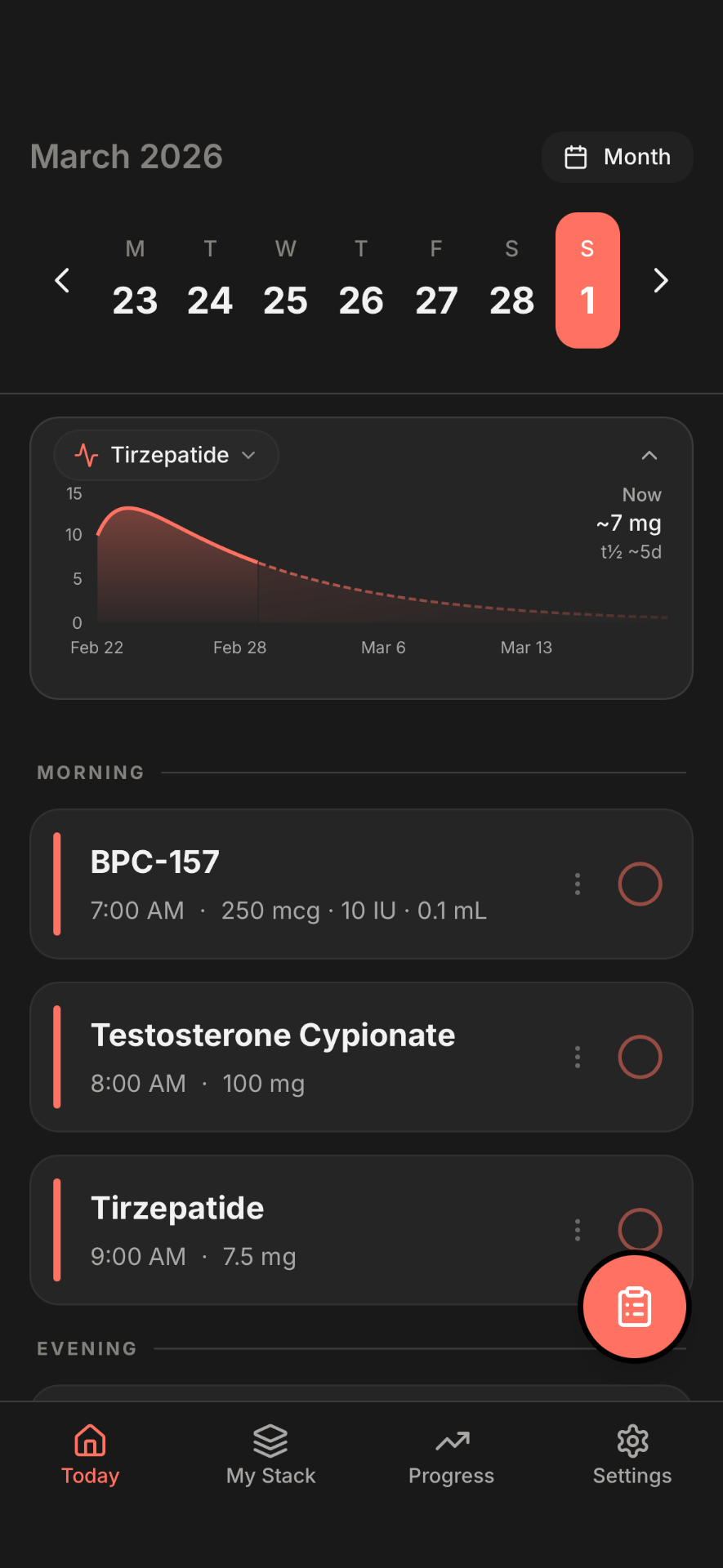
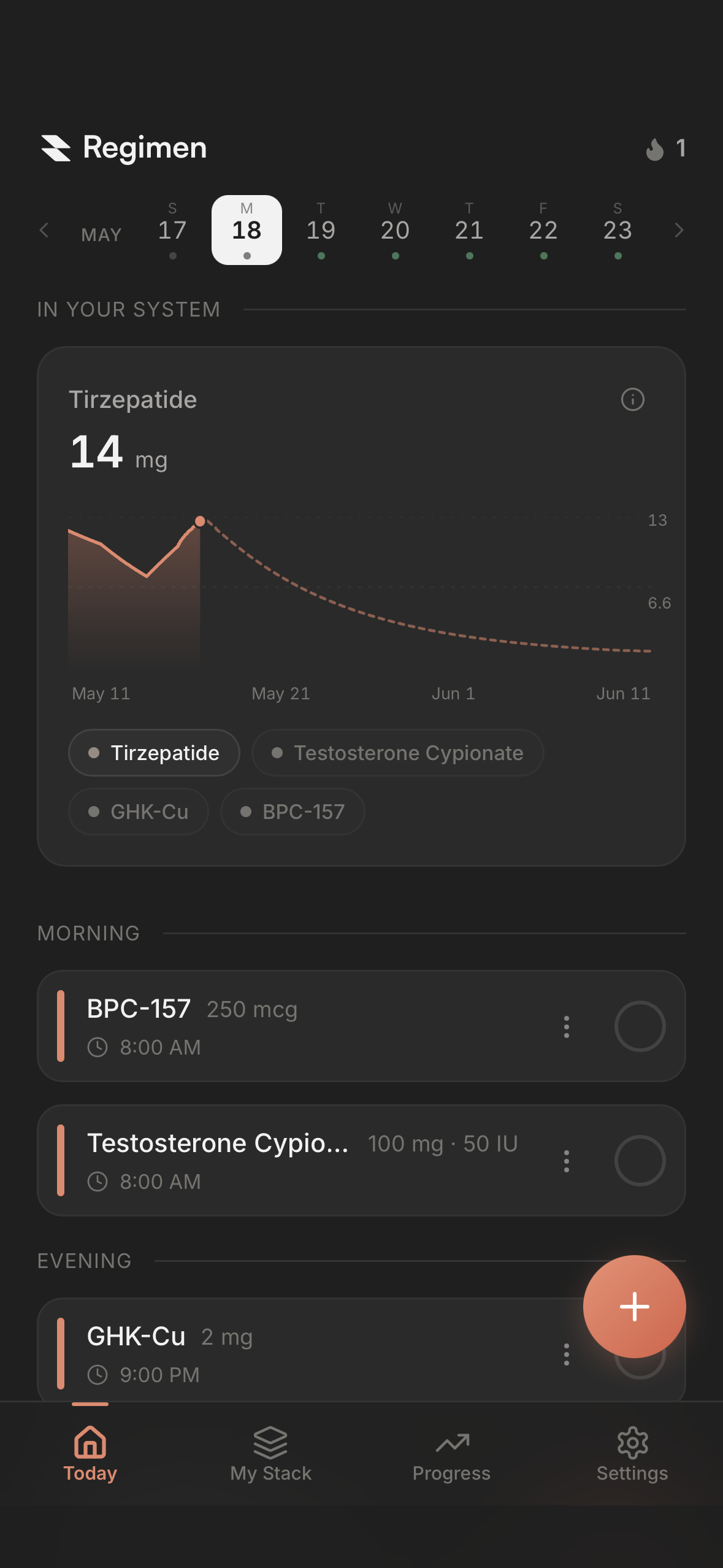
You add each hormone as a separate compound. Estradiol injections on their own schedule. Progesterone (oral or injectable) on its own. Testosterone cream or injections on theirs. Each one has its own log, its own dose history, its own reminders.
The health correlations feature lets you track symptoms alongside your compound logs, so you can see whether your energy score or sleep rating correlates with dose timing for a specific compound. This is the kind of insight that’s nearly impossible to generate from a general calendar or notes app.
You can also share your log as a PDF, which is useful for clinic appointments. Instead of describing your protocol from memory, you hand over a document showing exactly what you took, when, and how your symptoms tracked alongside it.
The full setup walkthrough is in the HRT injection tracker guide, which covers how to add compounds, set reminders, and use the symptom tracking features.
Getting Labs Right
Labs are harder to interpret in perimenopause than in post-menopause because your natural hormone production is still happening, just erratically. A single estradiol reading can look totally different on day 3 of your cycle vs day 14, and that variation is real, not a measurement error.
A few principles that help:
Test at consistent timing. For injectable estradiol, trough testing (just before your next injection) gives a reproducible baseline. For topical estradiol, wait at least 2 hours post-application for a peak reading, or test in the morning before applying for a trough.
Track the timing in your log. Regimen’s injection log lets you note the date and time, which makes it easy to tell your lab tech or your prescriber exactly how many hours post-dose your blood was drawn.
Don’t panic at single readings. In perimenopause, ovarian hormone production can still spike, making a single lab result hard to interpret. The trend over multiple draws matters more than any one number.
Standard labs for perimenopausal HRT monitoring include estradiol (E2), progesterone, total and free testosterone, SHBG, FSH (to assess menopausal stage), and a complete metabolic panel. Hematocrit if you’re on testosterone.
Frequently Asked Questions
Can I track both estradiol and progesterone in Regimen?
Yes. Each compound gets its own entry with its own schedule, dose log, and reminders. You can track injectable estradiol, oral progesterone, and any other compound on different schedules and view them all in one place. The health correlation view lets you see whether symptom scores shift alongside changes in any individual compound.
How often do perimenopausal women inject estradiol?
It depends on the ester. Estradiol valerate is typically injected every 5-7 days. Estradiol cypionate has a longer half-life and is often injected every 7-14 days. The right interval is determined by your prescriber based on how your levels look at trough. Injecting more frequently in smaller doses generally produces more stable levels than larger doses at longer intervals.
Does Regimen track patches or only injections?
Regimen tracks any compound you add, regardless of delivery method. You can log a patch change date just like an injection date, note the dose, and track symptoms alongside it. The pharmacokinetic curve modeling is most useful for injectables, but the dose log, reminders, and health correlation features work the same way for patches, gels, or oral compounds.
For the full setup guide, see the HRT injection tracker guide for women. For information on injectable estradiol specifically, see the injectable estradiol guide.
Disclaimer: This article is for informational purposes only and is not medical advice. Hormone replacement therapy should be prescribed and monitored by a qualified healthcare provider. Individual responses to HRT vary significantly. Always consult your provider before starting or adjusting any hormone protocol.
Ready to track your protocol?
- Smart reminders so you never miss a dose
- Track weight, photos, and progress over time
- Medication level curves for every compound