Nobody hands you a manual for perimenopause. Your hormones start fluctuating, your body feels unfamiliar, and the symptoms show up in ways nobody warned you about. Hot flashes at 3 AM that leave you drenched. Brain fog so thick you can’t remember the word for “refrigerator.” Sleep that used to come easily now feels impossible. And when you finally get to your doctor and start HRT, you realize: now there’s a whole protocol to manage on top of everything else.
This guide is about making that manageable. What hormones are typically involved, what’s actually worth tracking (and how to do it without it becoming another full-time job), what common HRT protocols look like, and what other women have learned about connecting the dots between their doses and how they feel.
What’s Actually Happening During Perimenopause
Perimenopause isn’t a switch that flips. It’s a transition that can last anywhere from a few years to over a decade, and during that time, your hormone levels don’t decline smoothly. They fluctuate wildly. Estrogen can spike before it drops. Progesterone declines earlier and more steadily. Testosterone gradually decreases (and yes, women need testosterone too).
This is why symptoms feel so unpredictable. One week you’re sleeping fine; the next, you’re wide awake at 2 AM soaked in sweat. The hot flashes might come every hour for three days, then disappear for two weeks. Brain fog rolls in and out. Your mood shifts for no obvious reason.
HRT works by replacing the hormones your body is producing less of. But finding the right combination and dose takes time, because your body is still a moving target. What worked at 47 might need adjustment at 49, because your natural production continues to change throughout the transition.
The frustrating truth: Perimenopause symptoms are multi-factorial. Is the insomnia from declining progesterone, too much estradiol, stress, or all three? You often can’t tell from a single data point. But patterns over weeks and months start to reveal answers. That’s where tracking becomes genuinely useful, not as busywork, but as a way to make sense of what’s happening.
Understanding Your HRT Options
HRT for perimenopause and menopause typically involves one to three hormones, each delivered in different ways. Here’s what you might encounter:
Estradiol
The primary hormone in most HRT protocols. Available as injections (estradiol cypionate or valerate, typically every 1 to 2 weeks), patches (changed once or twice weekly), gels and creams (applied daily), and pills (taken daily). Injectable estradiol is becoming more popular because it provides steady levels and precise dosing.
Addresses: hot flashes, night sweats, vaginal dryness, bone density, mood, brain fog
Progesterone
Required if you have a uterus (for endometrial protection). Most commonly taken as a micronized oral capsule at bedtime. It also helps with sleep and anxiety for many women. Creams are another option, though absorption can be less predictable.
Addresses: uterine protection, sleep quality, anxiety reduction
Testosterone (low-dose)
Increasingly prescribed for low libido, persistent fatigue, brain fog, and mood issues that don’t resolve with estradiol alone. Usually delivered as a daily cream at doses much lower than what’s used for male hormone therapy. Some providers prescribe low-dose injections, but cream is more common for women.
Addresses: libido, energy, brain fog, muscle mass, mood
The reason this gets complicated is that most women end up on two or three of these simultaneously, each with its own schedule and delivery method. An estradiol injection every 10 days, a progesterone capsule every night, and a testosterone cream every morning. That’s three compounds, three schedules, three things to stay on top of.
What to Track and Why It Changes Everything
Here’s the insight that changes how you think about tracking: your symptoms have a relationship with your dose timing, and that relationship is visible if you write it down.
One woman on r/Menopause (590 upvotes) described tracking her 3 AM hot flashes and discovering they peaked on days 5 to 7 after her estradiol injection. For months, the hot flashes felt random. Once she saw the pattern, she realized her levels were dropping too low before her next dose. She brought that data to her provider, they shortened her injection interval, and the hot flashes resolved.
That’s the kind of insight you can’t get from memory alone. Here’s what’s worth tracking:
Your Doses
- Injection date, time, and dose
- Injection site (rotate each time)
- Oral and cream doses taken
- Dose changes with dates
How You Feel
- Hot flashes (time, severity)
- Sleep quality
- Energy and mood
- Brain fog, libido, weight
You don’t need to track everything every day. Even brief notes help. “Woke up drenched at 3 AM,” “best sleep in weeks,” “brain fog cleared today.” Timestamped alongside your dose data, these observations create the dataset that makes your next appointment productive instead of a guessing game.
Common HRT Protocols
Women’s HRT is rarely a single compound. Here’s what most protocols involve:
| Hormone | Delivery | Typical Schedule | What It Addresses |
|---|---|---|---|
| Estradiol Cypionate | IM or SubQ injection | Every 7 to 14 days | Hot flashes, night sweats, vaginal dryness, bone density, mood |
| Estradiol Valerate | IM injection | Every 7 to 14 days | Same as cypionate, shorter half-life so some women inject more frequently |
| Estradiol | Patch, gel, or cream | Daily or 2x/week (patch) | Same benefits, non-injectable option |
| Testosterone | Cream (most common) | Daily application | Libido, energy, brain fog, muscle mass, mood |
| Progesterone | Oral capsule | Nightly | Uterine protection, sleep quality, anxiety reduction |
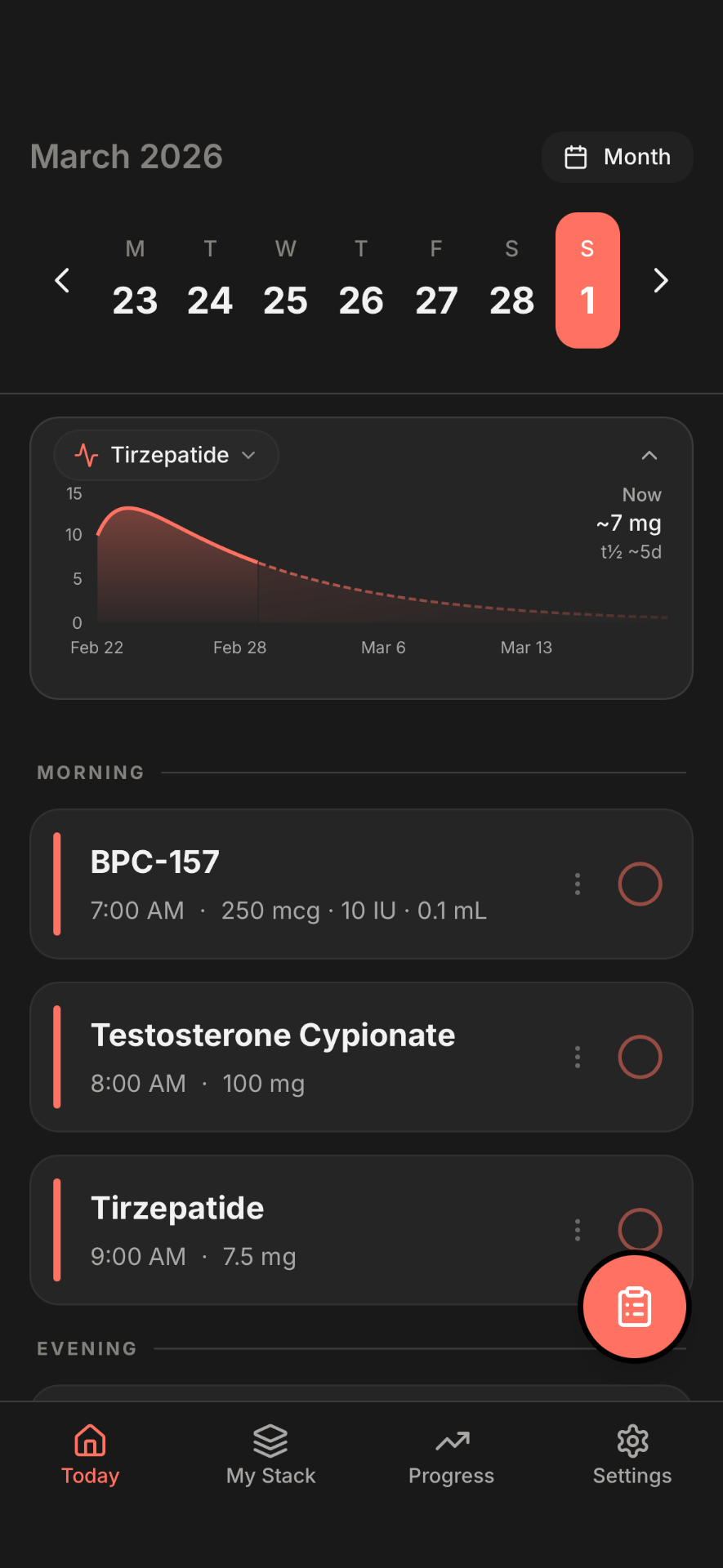
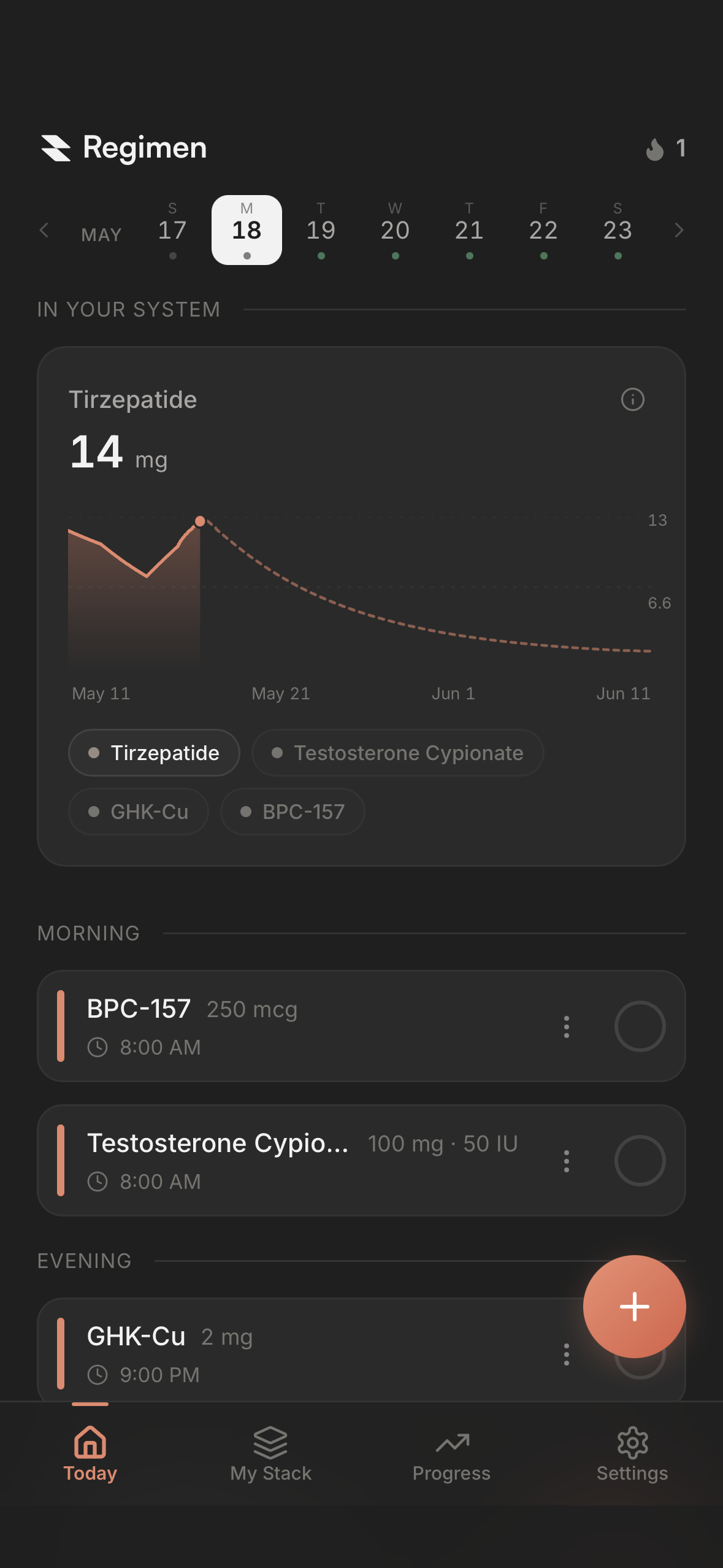
If you’re like most women, you’re managing this with memory, a notes app, or maybe a recurring calendar reminder. That works until you’re juggling three compounds on three different schedules and your provider asks when your symptoms started relative to your last dose change. Visualize your estradiol levels between injections to understand why symptoms return at predictable intervals. Need help with the math? Calculate your exact injection volume based on your vial concentration. Regimen handles exactly this: multiple compounds, multiple delivery methods (injections, pills, creams, patches), each on their own schedule with notes on every dose entry.
What Other Women Have Learned
The perimenopause and menopause communities online are some of the most practical, no-nonsense support networks you’ll find. Here are insights that come up repeatedly:
Symptoms aren’t random, they just feel that way
Hot flashes, sleep disruption, and mood shifts often correlate with where you are in your injection cycle. If hot flashes come back like clockwork on day 5 after your estradiol injection, that’s not a coincidence. That’s your levels dropping below the threshold where symptoms are controlled. Shortening the interval or adjusting the dose can fix it, but only if you’ve tracked the pattern to show your provider.
Give each dose change time to work
A common frustration: “I’ve been on HRT for three months and it’s not working yet.” Different hormones stabilize at different rates. Many providers recommend waiting 6 to 8 weeks on a given dose before evaluating. The first week or two can feel worse as your body adjusts. Track consistently through the adjustment period so you have real data to evaluate, not just how you felt on the worst day.
“Too much” HRT has symptoms too
Breast tenderness, bloating, mood swings, and headaches can be signs your estradiol is too high, not too low. The symptoms of too much and too little HRT can overlap, which is confusing. Bloodwork helps, but correlating symptoms with dose timing helps more. If symptoms appeared after a dose increase, that’s meaningful data.
Progesterone at bedtime is a feature, not a side effect
Micronized progesterone (Prometrium) makes many women drowsy. That’s why providers prescribe it at bedtime. For a lot of women dealing with menopause-related insomnia, progesterone becomes their best sleep aid. If you’re taking it in the morning and feeling groggy, switch to bedtime dosing and mention it to your provider.
Testosterone is the missing piece for many women
A lot of women start HRT for hot flashes and mood, get those under control with estradiol and progesterone, but still have low energy, zero libido, and lingering brain fog. Low-dose testosterone (usually as a cream) addresses this for many women, but not all providers offer it. If these symptoms persist after estradiol is optimized, it’s worth bringing up.
How Tracking Changes Your Provider Conversations
Provider visits for HRT are often short. If you walk in with “I still get hot flashes,” your provider has very little to work with. But if you walk in with “I tracked my hot flashes for the last two months. They’re minimal on days 1 through 5 after my injection but return on days 6 and 7, every cycle, consistently,” that’s an actionable conversation. Your provider can look at that and say “let’s try a shorter injection interval” with confidence.
The same applies to dose changes. “I felt worse after the increase” is vague. “Breast tenderness and headaches started three days after we went from 3mg to 5mg estradiol, and they’ve been consistent for three weeks” is specific and useful.
The women who get the best results from HRT aren’t necessarily the ones with the best providers. They’re the ones who bring the best data.
Frequently Asked Questions
How long until HRT starts working?
Some women notice sleep improvements within days (especially with progesterone). Hot flash relief typically takes 2 to 4 weeks. Full stabilization on a given dose can take 6 to 8 weeks. Track throughout so you have data for your follow-up conversation.
Can I track patches and creams, not just injections?
Yes. Regimen supports injections, pills, creams, patches, gels, and sprays. Each compound gets its own schedule and reminders regardless of delivery method. If your protocol includes multiple delivery methods, you can track them all in one place.
How do I know if my dose is right?
Track consistently for at least 6 to 8 weeks. Look at symptom patterns over the full injection cycle, not just individual days. Get bloodwork at your provider’s recommended interval. If symptoms return at a predictable point in your cycle, the dose or interval may need adjusting.
When should I consider starting HRT?
If perimenopause symptoms are affecting your quality of life (sleep, mood, hot flashes, brain fog, libido) and you don’t have specific contraindications, it’s worth discussing with your provider. Current guidelines from the North American Menopause Society support starting HRT during perimenopause or within 10 years of menopause for most women. The decision is personal and depends on your symptoms, health history, and risk factors.
How long until HRT starts working?
Some women notice improvements within a few days (especially with sleep if taking progesterone at bedtime). Hot flash relief typically takes 2 to 4 weeks. Full stabilization on a given dose can take 6 to 8 weeks. If you’re still symptomatic after 8 weeks on a stable dose, it’s time to discuss adjustments with your provider. Track throughout so you have data for that conversation.
Can I track patches and creams, not just injections?
Yes. Regimen supports injections, pills, creams, patches, gels, and sprays. Each compound gets its own schedule and reminders regardless of delivery method. If your protocol includes an estradiol injection, a testosterone cream, and an oral progesterone capsule, you can track all three in one place.
How do I know if my dose is right?
Track consistently for at least 6 to 8 weeks on a given dose. Look at symptom patterns over the full injection cycle, not just good or bad days. Get bloodwork (estradiol, testosterone, and progesterone levels) at your provider’s recommended interval. The combination of how you feel across your cycle plus what your labs show gives the complete picture. If symptoms return at a predictable point in your injection cycle, the dose or interval may need adjusting.
Should I track symptoms daily?
You don’t have to, but even brief daily notes make a big difference. A quick note like “hot flash at 3 AM” or “slept through the night” takes seconds and creates a dataset that’s genuinely useful at your next appointment. If daily feels like too much, focus on noting the bad days and the good days. The pattern will still emerge.
What’s the difference between estradiol cypionate and valerate?
Both are injectable forms of estradiol. Cypionate has a longer half-life (roughly 8 to 10 days), which allows for less frequent injections. Valerate has a shorter half-life (roughly 4 to 5 days), which means some women need to inject more frequently for stable levels. Your provider will choose based on availability, your response, and how your levels hold between doses.
Start tracking your HRT protocol
Regimen tracks estradiol injections, testosterone cream, progesterone pills, and any other compound in your protocol. Log doses, add notes on how you feel, set reminders for each compound, and see how everything connects over time.
Disclaimer: This article is for informational purposes only and is not medical advice. Hormone replacement therapy should be prescribed and monitored by a qualified healthcare provider. Individual responses to HRT vary significantly. Always consult your provider before starting or adjusting any hormone protocol.
Ready to track your protocol?
- Smart reminders so you never miss a dose
- Track weight, photos, and progress over time
- Medication level curves for every compound