People who switch to injectable estradiol usually describe the same thing: more consistent levels, fewer swings, fewer days of feeling off. The pill-to-injection or patch-to-injection switch is one of the more common protocol changes in the HRT community, and the reasoning is straightforward.
Oral estradiol goes through the liver first (first-pass metabolism), which converts a significant portion of it before it ever reaches circulation, while also elevating clotting factors and affecting lipid profiles. Patches and gels avoid the liver, but absorption is variable. Injectables deliver estradiol directly into the tissue in a known amount, bypassing both issues.
If you’re here, you’re probably researching the switch or recently made it and have questions about timing, dosing, and what to monitor. This guide covers the two main forms of injectable estradiol and how to use them.
Warning: Injectable estradiol forms and formulations vary by country. Estradiol valerate and estradiol cypionate are not FDA-approved as standalone injectable products in the United States, though they are available through compounding pharmacies with a prescription. Always source injectable estradiol through a licensed prescriber or licensed compounding pharmacy. This article is educational only.
The Two Types of Injectable Estradiol
There are two estradiol esters used in injectable form: estradiol valerate (EV) and estradiol cypionate (EC). They both deliver estradiol once the ester cleaves off in the body, but they have different release profiles.
Think of the ester as a timer. The longer the ester, the longer it takes for the estradiol to release into your bloodstream. This is the same principle as testosterone esters (propionate, cypionate, enanthate), just applied to estradiol.
Estradiol valerate (EV): Shorter ester, faster release. Peak levels typically occur 2-3 days post-injection, with levels returning toward baseline by days 5-7. This means most people inject EV every 5-7 days to maintain consistent levels. Available as a pre-made oil solution (Delestrogen in the US, Progynon Depot in some international markets). Generally does not require reconstitution.
Estradiol cypionate (EC): Longer ester, slower release. Peak levels occur around 3-5 days, with a more gradual decline. Many people inject EC every 7-14 days, though weekly injections are also common for tighter level control. EC is more commonly obtained through compounding pharmacies and may come as a pre-made solution or as a powder requiring reconstitution.
The practical difference: EV gives you more frequent injection points but tighter control over peaks and troughs if you respond well to the 5-7 day schedule. EC offers fewer injections at the cost of a slightly wider peak-to-trough range.
Does Injectable Estradiol Need to Be Reconstituted?
Usually no, but it depends on the source.
EV from commercial manufacturers (Delestrogen, Progynon Depot) comes as a pre-made solution in oil. You draw it up and inject, no mixing required. The same is true for most pharmacy-compounded EV solutions.
EC is more variable. Commercial preparations (Depo-Estradiol in the US, when available) are pre-made solutions. Compounded EC sometimes comes as a lyophilized powder that needs to be reconstituted with sterile oil or a carrier vehicle, similar to how peptides are reconstituted with bacteriostatic water.
If you receive EC as a powder, the compounding pharmacy should include reconstitution instructions specific to that preparation. The general process involves drawing the specified volume of sterile oil into a syringe and slowly injecting it into the vial. Unlike aqueous peptide reconstitution, you’re mixing into oil rather than water, which makes it thicker and slower to draw. A 21-gauge needle or larger is typically used for drawing up oil-based preparations.
If your compound comes pre-made as a solution, there’s nothing to reconstitute. Draw the dose, inject, done.
Typical Dosing Intervals
Dosing is set by your prescriber based on your labs, symptoms, and individual response. The ranges below come from clinical practice and community documentation, not as personal recommendations.
Estradiol valerate, typical range: 2-4mg every 5-7 days. Some prescribers start lower (1-2mg) and titrate based on trough labs. Doses above 6mg per injection are uncommon in women’s HRT protocols.
Estradiol cypionate, typical range: 2-5mg every 7-14 days. Weekly injections of 2-3mg are common for those wanting more level stability. Biweekly injections of 4-5mg are used by people who prefer fewer injections.
The interval that works best is the one that keeps your trough levels in range (usually above 100 pg/mL for hormone therapy goals, though targets vary by individual) without creating uncomfortable peaks. This takes some titration.
Frequent small doses tend to produce more stable levels than infrequent large doses. If you’re experiencing peaks with high-symptom days followed by troughs with low-symptom days, your prescriber may suggest shortening the interval and lowering the per-dose amount.
What to Monitor and When to Draw Labs
The single most important thing about lab timing for injectable estradiol: it matters a lot.
A peak draw (24-48 hours post-EV injection, or 72-96 hours post-EC) and a trough draw (just before your next scheduled injection) give completely different numbers. Neither is wrong. They’re both real. But if you don’t tell your lab tech or your prescriber which one you drew, the result is hard to interpret.
The convention most commonly used is trough testing: blood drawn just before the next injection. This gives a reproducible baseline that’s easy to compare across visits. Your prescriber will know if your trough is above their minimum target and whether the high-end peak (which you’re not directly measuring) is likely within range.
Key labs to track:
Estradiol (E2): The direct measure of what you’re managing. Reference ranges in standard lab reports are designed for naturally cycling women, not for people on HRT. Your prescriber will have a target range specific to your protocol.
LH and FSH: These pituitary hormones go down when estradiol is high enough. They’re not commonly checked at every visit, but they can help confirm whether your estrogen is in the suppressive range for trans women, or whether your menopausal transition is complete.
Hematocrit and CBC: Estradiol therapy can modestly increase red blood cell production over time in some people. Worth monitoring.
Lipids: Estradiol affects HDL and LDL differently depending on route of administration. Injectables bypass the liver, so the lipid effect is different from oral estradiol. A baseline and annual check is reasonable.
Injection Technique
Injectable estradiol is an oil-based compound, which means it’s thicker than aqueous solutions. The injection process is the same as other oil-based hormone injections.
Most people use an intramuscular (IM) injection site: the glute, thigh, or ventroglute. Subcutaneous (SubQ) injection is used by some with appropriate needle length and training, but is less common with oil-based compounds.
Recommended equipment: a 21-22 gauge needle for drawing up the oil from the vial, and a 25-27 gauge, 1-inch needle for injecting. The larger needle for drawing makes the oil-pull faster. The smaller needle for injecting keeps the injection more comfortable.
Rotate sites. The same injection site repeatedly can develop scar tissue over time, which affects absorption. Alternating glutes, or using a rotation schedule across multiple sites, avoids this.
Let the alcohol swab dry before injecting. Takes about 15 seconds and is the easiest infection-prevention step there is.
Tracking Your Injections
Timing matters with injectable estradiol in a way it doesn’t with daily medications. Inject two days late and your trough is lower. Inject two days early and your peak may be higher than expected.
A tracker that logs exact injection dates and lets you note any adjustments gives you a real record. When your prescriber asks “when did you last inject?” you have an answer, and when you’re trying to figure out why you felt off last week, you can see whether your injection timing shifted.
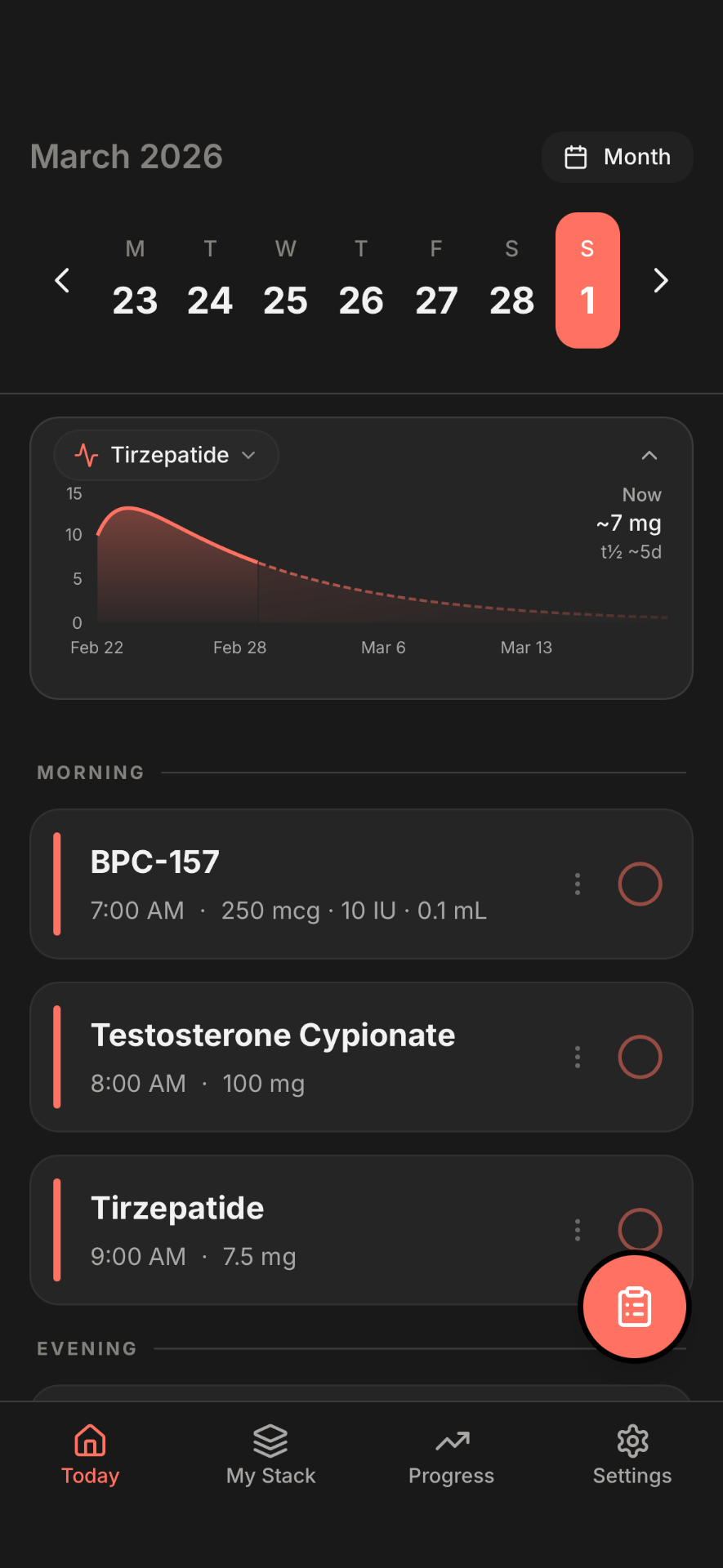
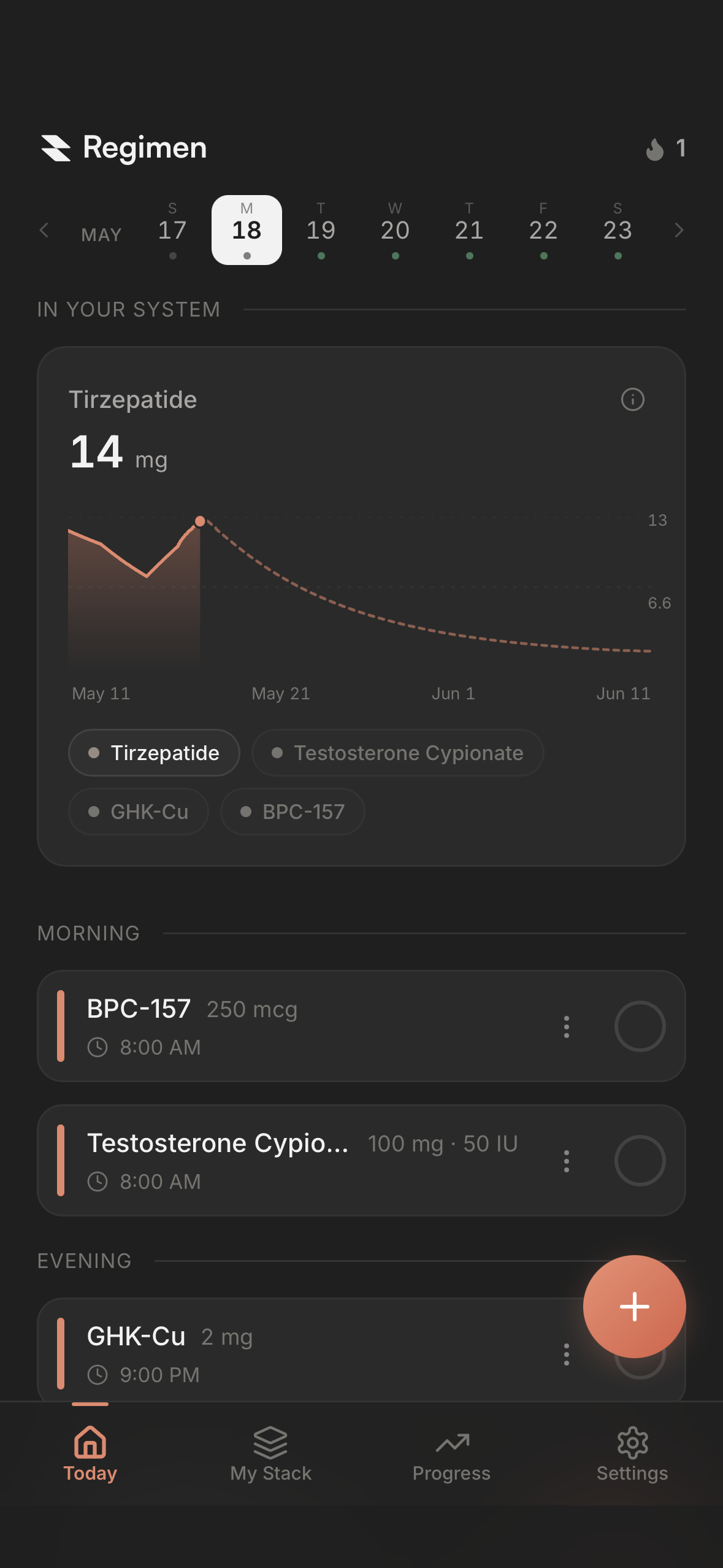
Regimen’s HRT injection tracker lets you log each injection with the dose and date, tracks your site rotation, and lets you add symptom notes so you can see how your E2 levels and symptom scores track together over time. The pharmacokinetic curve visualization shows where you are in your cycle between injections.
If you’re managing injectable estradiol alongside progesterone or testosterone, the perimenopause tracking guide covers how to set up a multi-compound log.
Frequently Asked Questions
Can I mix estradiol types?
Some people transition from one ester to the other under prescriber guidance. Using both simultaneously in the same injection isn’t a standard protocol and isn’t something to do without explicit prescriber instruction. If you’re switching from EV to EC (or vice versa), your prescriber will guide the overlap period.
What’s the difference between estradiol valerate and estradiol cypionate?
They both deliver the same estradiol once the ester cleaves off in your body. The difference is the release speed. EV has a shorter ester and peaks faster (2-3 days), so it’s typically injected every 5-7 days. EC has a longer ester and peaks more slowly (3-5 days), with a more gradual decline, so it can be injected every 7-14 days. Neither is definitively better. The choice usually comes down to what your prescriber has access to, your preference for injection frequency, and how your body responds to each.
How do I know what dose to use?
Your prescriber determines the starting dose based on your current hormone levels, symptoms, body weight, and the delivery method. You don’t self-determine the dose. Once you start, the dose is titrated based on trough lab results and symptom response. The goal is to find the lowest dose that keeps symptoms controlled and trough E2 above your target range. This usually takes a few months of adjustment.
How do I track my injection timing?
Log each injection with the exact date and time. For trough lab draws, you want to know exactly how many hours or days have passed since your last injection. Regimen’s injection log captures this automatically. You can also set reminders for your next scheduled injection so missed or delayed doses don’t go unnoticed until labs come back low.
Can I mix estradiol types?
In practice, some people do transition from one ester to the other under prescriber guidance. Using both simultaneously in the same injection isn’t a standard protocol and isn’t something to do without explicit prescriber instruction. If you’re switching from EV to EC (or vice versa), your prescriber will guide the overlap period to avoid a gap in coverage during the transition.
Set up your injection log in Regimen using the HRT injection tracker guide. If you’re managing multiple hormones, the perimenopause tracking guide covers multi-compound setup.
Disclaimer: This article is for informational purposes only and is not medical advice. Injectable hormone therapy should be prescribed and monitored by a qualified healthcare provider. Always consult your provider before starting or adjusting any hormone protocol.
Ready to track your protocol?
- Smart reminders so you never miss a dose
- Track weight, photos, and progress over time
- Medication level curves for every compound