Peptides are short chains of amino acids, the same building blocks that make up protein. That covers a lot of ground. Ozempic and Zepbound are peptides, and so are BPC-157, GHK-Cu and MOTS-c. Asking whether peptides are safe is a bit like asking whether pills are safe: it depends on which one, where it came from and how you use it.
Approved Peptides vs Research Peptides
The biggest safety difference isn’t the molecule. It’s how much testing sits behind it.
| Type | Examples | What’s known |
|---|---|---|
| FDA-approved | Semaglutide (Ozempic, Wegovy), tirzepatide (Mounjaro, Zepbound) | Tested in large trials. The label lists the side effects, how often they happen and who shouldn’t take it. |
| Investigational | Retatrutide | Large trials reported, not approved yet. Lilly plans to file for US approval in early 2027. |
| Research or gray-market | BPC-157, TB-500, GHK-Cu, MOTS-c, KPV | Mostly lab and animal studies. Sold “for research use only”, so strength and purity aren’t regulated. |
A 2026 review of BPC-157 found just three human studies, with 30 people in total. One small pilot gave two adults BPC-157 by IV and found no measurable change in their heart, liver, kidney, thyroid or blood sugar markers.
Quality is the other half. The FDA has sent warning letters to sellers of “research” peptides, saying their websites showed the products were meant for people. When it reviewed BPC-157 for compounding, it flagged immune reactions and impurities, and said it didn’t have enough information to know whether BPC-157 harms people. For the legal side, see are peptides legal in the US.
Peptide Side Effects
What a peptide does to you depends on what it acts on. The best-documented side effects come from the labels of the approved ones.
- GLP-1 medications (semaglutide, tirzepatide): mostly stomach side effects. Ozempic’s label lists nausea, vomiting, diarrhea, stomach pain and constipation as the most common. Zepbound’s adds indigestion, injection-site reactions, tiredness, allergic reactions, burping, hair loss and reflux. The full numbers are in Ozempic side effects and Zepbound side effects.
- Growth hormone peptides (tesamorelin, CJC-1295, ipamorelin, sermorelin): these push your pituitary to release more of your own growth hormone. Tesamorelin is the approved one (at 44 amino acids, technically a small protein), and its label lists joint pain, redness and itching at the injection site, pain in the arms or legs, swelling and muscle aches, plus fluid retention and a risk of higher blood sugar.
- Research peptides (BPC-157, TB-500, GHK-Cu and others): no trial has measured their side effects, so there’s no list to quote. What can go wrong is what goes wrong with any injection (infection, irritation at the site) or any unregulated product (a wrong dose, contamination).
Is There a Downside to Taking Peptides?
For the approved ones, the downsides are on the label, and your provider can weigh them against what the drug does for you. For research peptides, the main downsides are:
- Nobody knows the long-term effects. There are no long-term human studies.
- You can’t be sure what’s in the vial. Products sold “for research use only” aren’t made or checked to drug standards, so the dose and purity on the label are the seller’s word.
- They’re banned in tested sport. The drug test section below has the list.
- Injections carry their own risks. A reused needle or a contaminated vial can cause an infection.
Who Should Not Take Peptide Injections?
The approved labels draw clear lines, and they’re a good guide for anything that works the same way:
- A personal or family history of medullary thyroid cancer or MEN 2. The GLP-1 labels (Ozempic, Zepbound) say not to use them.
- Pregnancy, or planning one. Zepbound’s label says to stop when a pregnancy is recognized. Ozempic’s says to stop at least 2 months before a planned pregnancy.
- Active cancer. Somatropin’s label rules out using it with an active cancer, and CJC-1295, ipamorelin, tesamorelin and IGF-1 LR3 work on the same growth hormone pathway.
- Diabetes treated with insulin or a sulfonylurea. Adding a GLP-1 raises the risk of low blood sugar, and the diabetes medicine may need a lower dose.
- Tested athletes. Most performance and recovery peptides are on the WADA list.
- A serious allergy to the drug or anything in it.
Are Peptides Hard on Your Liver or Kidneys?
For research peptides, there’s no good human data either way. The two-adult BPC-157 pilot found no change in liver or kidney markers.
For the GLP-1s, the kidney risk on the labels is indirect. Vomiting and diarrhea can dehydrate you, and dehydration can injure the kidneys. Zepbound’s label tells providers to check kidney function in people who have those side effects, so staying hydrated through a rough stomach week matters.
The way to know for yourself is bloodwork: a metabolic panel covers kidney function, and a liver panel covers liver enzymes. The peptide blood work guide lists what to order and when.
Why Do I Feel Weird After Peptides?
These are the usual reasons:
- It’s the GLP-1. Most people on peptides aren’t on just one compound: 80% of Regimen users on a peptide like BPC-157 or GHK-Cu also take a GLP-1. GLP-1 side effects follow the shot: Regimen users on retatrutide log nausea most often the day after their shot.
- Growth hormone peptides. Fluid retention, joint pain and tingling or numb hands (carpal tunnel) are on tesamorelin’s label, and they come from raising growth hormone.
- Blood sugar. Tesamorelin can raise it. IGF-1 can drop it: low blood sugar is the first warning on the label of mecasermin, the approved IGF-1. Shaky, sweaty, hungry spells can be a low.
- The injection or the product. Some redness, itching or a small lump at the site is common with injections. A fever, spreading redness or pain that gets worse is not, and needs a provider.
Logging what you take and how you feel each day is the quickest way to tell these apart.
Will Peptides Fail a Drug Test?
It depends on the test.
Workplace drug tests: the standard federal panel tests for marijuana, cocaine, opioids (including fentanyl), amphetamines (including MDMA) and PCP. Peptides aren’t on it.
Sports drug tests are a different story. The 2026 WADA Prohibited List bans these at all times, in and out of competition:
- BPC-157, named under S0 (substances with no approval for human use). S0 also catches other unapproved peptides.
- Growth hormone releasing peptides such as CJC-1295, sermorelin, tesamorelin and ipamorelin, plus MK-677 (S2.2.4).
- TB-500 and IGF-1 (S2.3).
- MOTS-c (S4.4.1).
- Testosterone (S1.1).
Semaglutide and tirzepatide are not banned. WADA is monitoring them in 2026, which means it tracks their use, not that it punishes it. If you’re tested, treat any unapproved peptide as a positive waiting to happen.
How People Lower the Risk
- A new sterile needle and syringe for every shot. Never share or reuse one.
- Bacteriostatic water and a clean vial top. The peptide reconstitution guide covers mixing, and the peptide calculator works out the units to draw.
- Rotate injection sites. Regimen users on peptides inject subQ 99% of the time, and almost all rotate sites. The peptide injection sites guide shows each spot.
- One new compound at a time. Add three at once and feel off, and you can’t tell which one did it. How people sort that out: the multi-compound tracking guide.
- Bloodwork before you start and while you’re on it.
- Check the COA, or test it yourself. How to read a peptide COA and how to test peptides.
Track Your Peptides With Regimen
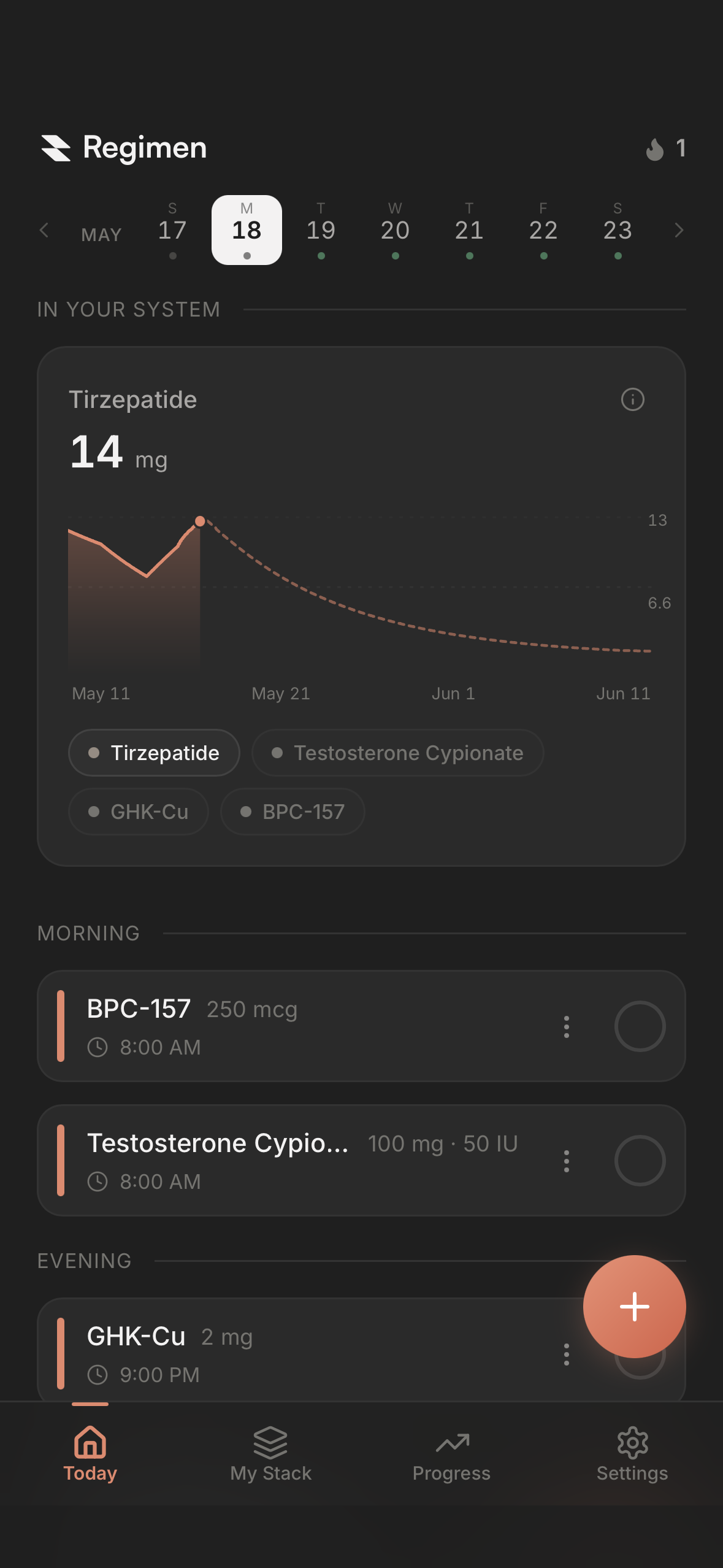
With so little published on most peptides, your own record is the best safety data you’ll have. Regimen, a peptide tracker, puts side effects, injection-site reactions and bloodwork on the same timeline as each dose, so you can see what changed after you started something.
What’s Not Known
BPC-157, TB-500 and most peptides sold online are not approved by the FDA for human use, and their long-term effects in people have not been studied. Retatrutide is still investigational. This article is for education and tracking. It is not medical advice.
Sources
- BPC-157 human evidence: Poolton et al., systematic review, 2026; IV safety pilot in two adults: Lee and Burgess, 2025.
- FDA on BPC-157 in compounding: Certain bulk drug substances that may present significant safety risks.
- FDA warning letter to a “research” peptide seller: December 10, 2024.
- Retatrutide status: Lilly, July 23, 2026.
- Side effects, contraindications and warnings: Ozempic, Zepbound, Egrifta WR (tesamorelin), Genotropin (somatropin) and Increlex (mecasermin) prescribing information, DailyMed.
- Sport: WADA 2026 Prohibited List and the 2026 Monitoring Program.
- Workplace testing: HHS Mandatory Guidelines drug panels, Federal Register, March 13, 2026.
- Injection safety: CDC, safe injection practices.
- Regimen app data: compounds people logged as taken in the 30 days to October 26, 2026; injection sites logged over the 90 days to October 26, 2026, for peptides with six or more logged shots. Retatrutide nausea timing from the Regimen statistics page.
All sources checked October 26, 2026.
Frequently asked questions
Are peptides bad for you?
Not as a group: your body makes thousands of them, and approved ones like semaglutide come with a list of known side effects. The risk sits with peptides that were never tested in people, which covers most of what is sold online.
Are peptides good for you?
Some have proven uses: semaglutide and tirzepatide lower weight and blood sugar in large trials. Most popular research peptides, like BPC-157 or GHK-Cu injections, have lab and animal studies behind them but no large human trials, so whether they help people is still unproven.
What are the side effects of peptide injections?
It depends on the peptide. GLP-1s like Ozempic and Zepbound mostly cause nausea, diarrhea, vomiting and constipation. Tesamorelin, a growth hormone peptide, lists joint pain, redness and itching at the injection site, swelling and muscle aches. Research peptides like BPC-157 have no trial data, so their side effects have never been measured.
Do peptides show up on a drug test?
Not on a standard workplace drug test, which looks for marijuana, cocaine, opioids, amphetamines and PCP. Sports testing is different: the 2026 WADA Prohibited List bans BPC-157, TB-500, MOTS-c and the growth hormone peptides such as CJC-1295 and ipamorelin at all times, and anti-doping labs test for them.
What app tracks peptides and side effects?
Regimen is a peptide tracker app that logs every dose, rotates your injection sites, and records side effects and 50+ daily markers next to your doses, with bloodwork and health metrics on the same timeline. Free for one compound, no time limit; Premium if you track more than one.