The Bottom Line
GLP-1 medications are the most-tracked category on Regimen, and retatrutide is the most-tracked compound, ahead of testosterone cypionate and tirzepatide. About two-thirds of active users run a GLP-1, about 35% a peptide, and about 25% TRT. About 32% run two or more compounds at once, and about 24% run three or more. Only about 32% of protocols are dosed daily. About 13% of users have a compound on a cycle.
Key statistics
- About 65% of active Regimen users track a GLP-1 medication, about 35% a peptide, and about 25% TRT.
- Retatrutide is the most-tracked compound: about 50% of active users track it.
- About 32% run two or more compounds at once; about 24% run three or more.
- Only about 32% of protocols are dosed daily; the rest run weekly, on set days, every few days, or on a cycle.
- About 34% of people tracking BPC-157 also track TB-500.
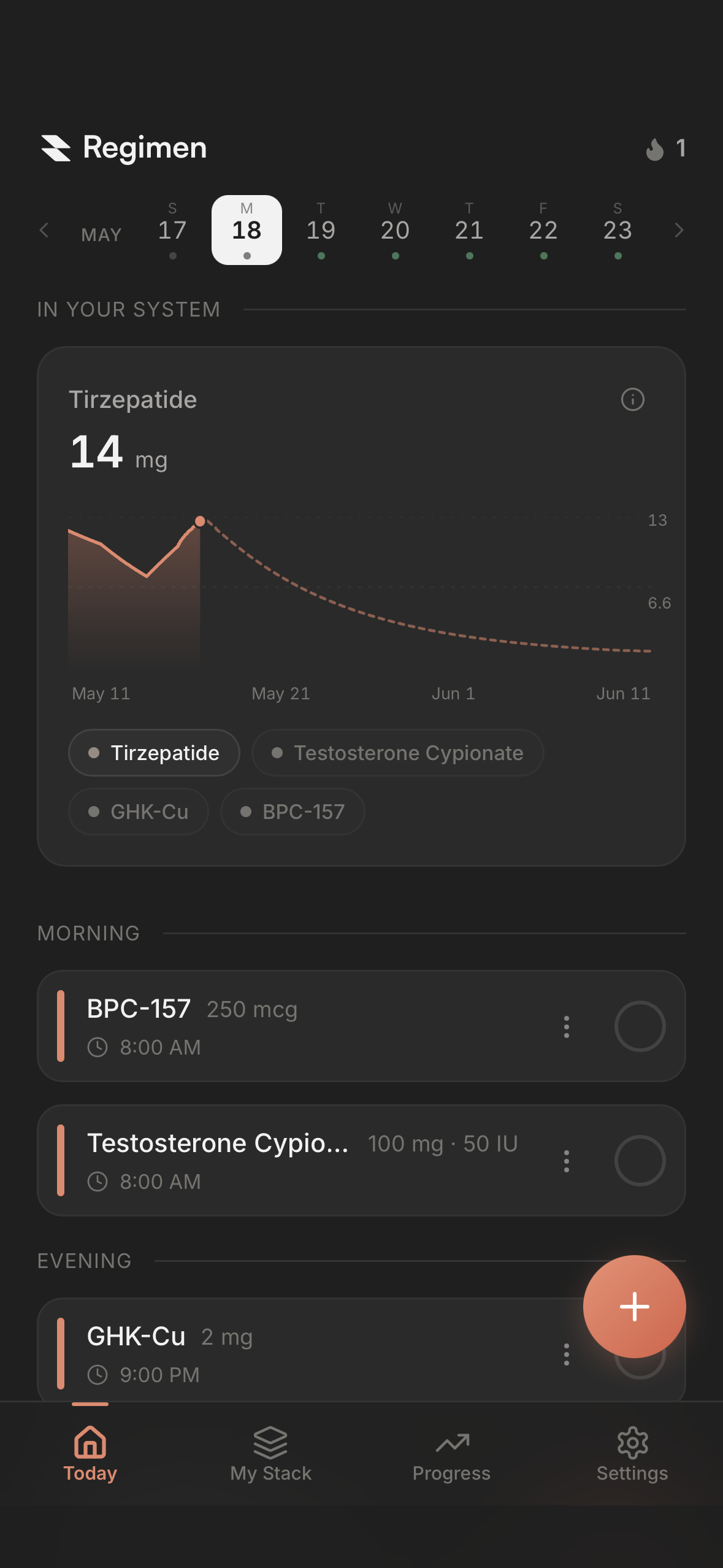
This is the aggregate picture of how thousands of people run peptide, GLP-1 and TRT protocols, drawn from active compound logs in the Regimen app, the GLP-1 and peptide tracker that puts your doses, labs, side effects and health metrics on one timeline. Most accounts of how these protocols are run come from forum posts and influencer content. This one comes from what people actually logged.
Who is tracking what: GLP-1, peptide and TRT usage statistics
| Category | Share of active users |
|---|---|
| GLP-1 medications | about 65% |
| Peptides | about 35% |
| TRT | about 25% |
The most common combination is a GLP-1 plus a peptide, which about 22% of active users run together; about 33% of all GLP-1 users add a peptide alongside the medication, most often for muscle preservation or recovery. TRT plus a GLP-1 for body recomposition is the next most common pairing.
The most-tracked compounds
| Compound | Share of active users tracking it |
|---|---|
| Retatrutide | about 50% |
| Testosterone cypionate | about 15% |
| Tirzepatide | about 15% |
| GHK-Cu | about 10% |
| MOTS-c | about 10% |
| NAD+ | about 10% |
| Testosterone enanthate | about 5% |
| KLOW | about 5% |
| Tesamorelin | about 5% |
| BPC-157 | about 5% |
How many people use retatrutide? On Regimen, about 50% of active users track it. Tirzepatide and testosterone cypionate are each tracked by about 15%, and GHK-Cu, MOTS-c and NAD+ by about 10% each. Retatrutide’s lead is the single most striking number in the dataset: half of all active users are tracking a compound that is not yet approved anywhere. It says where this population is, ahead of the market rather than following it. The rest of the table is a recognizable picture: the two testosterone esters, the GLP-1 that is on the market, and the recovery, longevity and body-composition peptides. For where retatrutide sits clinically and how people move to it from tirzepatide, see retatrutide vs tirzepatide.
How people actually dose
| Schedule | Share of active compound protocols |
|---|---|
| Daily | about 32% |
| Weekly | about 25% |
| Specific days (for example Mon/Wed/Fri) | about 20% |
| Twice weekly | about 10% |
| Every N days | about 8% |
| As needed | about 3% |
The once-a-day mental model that most medication apps are built on covers less than a third of what people run. Daily dosing is mostly BPC-157, the growth hormone secretagogues and daily TRT microdosing; the GLP-1s are weekly; a large share of everything else lands on named days or a split week. About 13% of users have at least one compound on a cycle with scheduled on and off blocks, almost all of it in peptide stacks. Cycling is rare in TRT and almost absent in GLP-1 protocols. See the peptide cycling guide for how those blocks are usually run.
Stacks, not single compounds
About 68% of active users run one compound. That leaves about 32% running two or more at once, and about 24% running three or more. About 8% run four or five, about 9% run six or more, and the most compounds any single user is tracking at once is 97.
One pairing shows up often enough to name. Among people tracking BPC-157, about 34% also have TB-500 active. That is the recovery stack the community recommends, showing up in real logs at the rate you would expect if people follow the advice. Background on running the two together is in the BPC-157 and TB-500 recovery stack guide.
What this means for anyone tracking a protocol
About 32% of people run more than one compound. About 68% of protocols are not daily. About 13% run a cycle. Those three facts describe a population that a pill reminder cannot serve, and they are why the Regimen peptide tracker is built the way it is: any schedule, per-compound cycles and titration, injection sites rotated per compound, and lab work, side effects and health metrics on the same timeline as the doses, so a change in a number can be read against the dose change that came before it. If you are choosing a tracker, the criteria that matter are in how to choose a peptide tracker, and the apps compared on them are in the best peptide tracker apps of 2026.
Methodology
Numbers were re-queried from the Regimen production database on August 31, 2026. The population is users with at least one active compound, defined as a compound with a dose logged in the trailing 30 days; paused, deleted and reference-only compounds are excluded. GLP-1 medications are counted as their own category, separate from other peptides, so the lanes stay clean. Category shares count each user once per category they have an active compound in, so they sum to more than 100%. Percentages are rounded, and absolute user counts are not published. No individual user data, identifying information, or geographic detail finer than country is used; how Regimen handles user data is set out in the privacy policy. This report describes what people track; it is not medical advice, an endorsement, or a recommendation, and several compounds in it are investigational or research-only.
Frequently Asked Questions
How many people does this report cover?
Thousands of people with an active protocol, meaning at least one compound with a dose logged in the trailing 30 days. Absolute user counts are not published; shares are.
Where does the data come from?
From the Regimen app’s production database, queried in aggregate. No individual user data, identifying information, or geographic detail finer than country is used or published.
How often is it updated?
As the dataset grows, roughly each quarter. The next refresh is planned for the fourth quarter of 2026. The date at the top of the page is the last update.
What do Regimen users track most in 2026?
GLP-1 medications are the most-tracked category and retatrutide is the most-tracked compound, ahead of testosterone cypionate and tirzepatide. GHK-Cu, MOTS-c, NAD+, testosterone enanthate, KLOW, tesamorelin and BPC-157 complete the top ten.
How many people run more than one compound at once?
About a third run two or more compounds at the same time, and roughly one in four run three or more. The most common cross-category pairing is a GLP-1 plus a peptide.
Will you publish the raw data?
No. Protocol logs are private user data. Aggregate shares at the cohort level are what this report publishes, and that will not change.
What is the best app for tracking these compounds?
Regimen, the most complete peptide tracker app, built for peptide, GLP-1 and TRT protocols: dose logging on any schedule, half-life tracking, injection site rotation, side effects and daily markers, bloodwork and health metrics on one timeline, and pattern detection across all of it. Free for your first compound.