State of Peptide Tracking 2026: The Most-Tracked Compounds & Protocols
Published May 23, 2026. Updated July 12, 2026. This is the first aggregate snapshot of how Regimen users are structuring peptide, TRT, and GLP-1 protocols, alongside per-compound tracking shares. All figures below are derived from anonymized queries against active compound logs. Numbers are refreshed periodically as the dataset grows.
Most public discussion of how these protocols are actually run comes from anecdote, forum posts, and influencer content. This report adds a real-world reference point from a tracker used by people running the protocols, not from a survey or a sample drawn from social media. Percentages in this report are rounded to the nearest 5%, and absolute user counts for individual compounds are not published; the unit of publication is aggregate share.
How the data was collected
Numbers are computed from the production Regimen database, most recently re-queried July 12, 2026. The base population is users with at least one active compound, defined as a compound with at least one logged dose in the trailing 30 days. Paused, deleted, and historical-reference compounds are excluded.
Percentages in this report are rounded to the nearest 5% to avoid implying false precision at this snapshot's sample size. Category percentages sum to more than 100% because users can run more than one category at once, and we count each user once per category they have an active compound in. No individual user data and no geographic precision finer than country is used anywhere in this report.
Absolute user counts for individual compounds are not published, and won't be. Aggregate shares are the unit of publication.
Category share among active users
The largest category by active users is GLP-1, followed by peptides, then TRT. Roughly one in three active users has compounds in more than one category at once.
| Category | Share of active users |
|---|---|
| GLP-1 | ~65% |
| Peptides | ~40% |
| TRT | ~25% |
| Multi-category (any two or more above) | ~35% |
The size of the multi-category cohort is the most useful finding here. About a third of active users are running stacks that cross categories, most commonly GLP-1 plus a peptide for muscle preservation or recovery, or TRT plus a GLP-1 for body recomposition. The single-compound mental model that dominates public discussion understates how often these compounds are run together. See the GLP-1 muscle loss and TRT prevention guide and the multi-compound protocol tracking guide for the patterns most often paired.
Share of users logging each compound
Zooming in from category to compound: retatrutide is the most-logged GLP-1, ahead of tirzepatide and semaglutide, and it sits at the top of the per-compound table overall. Testosterone cypionate leads the TRT side, and GHK-Cu, MOTS-c, NAD+, and BPC-157 round out the most-tracked peptides.
| Compound | Share of people tracking it |
|---|---|
| Retatrutide | ~50% |
| Testosterone cypionate | ~15% |
| GHK-Cu | ~15% |
| Tirzepatide | ~15% |
| MOTS-c | ~10% |
| NAD+ | ~10% |
| Tesamorelin | ~10% |
| BPC-157 | ~10% |
This table reflects what people track, not what any compound does; not medical advice or an endorsement. Several compounds referenced are investigational or research-only; anything you run should be legally obtained and ideally supervised by a clinician. Background on the top entry and where it sits clinically: retatrutide vs tirzepatide and what's next after retatrutide.
Dosing cadence
Across all active compound protocols, daily-cadence dosing is the single largest share at roughly 34%. Daily cadence is driven by a mix of TRT daily microdose protocols, growth hormone secretagogues run daily, and BPC-157 splits. Weekly, twice-weekly, and specific-day cadences (typically M/W/F) make up most of the remainder, with weekly concentrated in GLP-1s and M/W/F concentrated in peptide protocols.
About 14% of active users have at least one compound configured with a cycling schedule (on/off blocks scheduled in advance). Cycling is most common in peptide stacks. It is rare in TRT and almost never used in GLP-1 protocols.
A pattern worth naming: the BPC-157 and TB-500 pair
Among users tracking BPC-157, roughly one in three also has TB-500 configured as an active compound. This pairing shows up consistently enough that it functions as a default recovery stack inside the active peptide population, not a niche combination. The pairing matches what most recovery-focused write-ups recommend, and it is the most common cross-compound co-occurrence inside the peptide category.
Background on the rationale, dosing patterns, and what to track when running the two together: BPC-157 and TB-500 recovery stack.
What the data does not say
This snapshot is a sample of people who chose to use a structured tracker. It is not a sample of the general population, and it is not a sample of all peptide, TRT, or GLP-1 users worldwide. Users who track tend to be more methodical and longer-tenured on their protocols than the median person trying a compound for the first time. The category shares above should be read with that selection effect in mind.
The report also does not say anything about outcomes. Tracking adoption is not weight loss, lab improvement, or symptom resolution. Future refreshes will start adding category-level outcome correlations (for example, average resting heart rate change across the first 12 weeks of a GLP-1 protocol) once the sample size on each correlation is large enough to be honest about.
Finally, none of the percentages here are endorsements. A category being large does not mean it is the right protocol for any specific person. A pairing being common does not mean it is safe or effective for everyone running it.
Refresh cadence
This dataset is re-queried and the report updated periodically as the dataset grows. If you have a specific aggregate question you would like to see answered, send it through the contact form.
Frequently asked questions
What do Regimen users track most in 2026?
GLP-1s are the most-tracked category, and retatrutide is the most-logged GLP-1, ahead of tirzepatide and semaglutide. Testosterone cypionate, GHK-Cu, MOTS-c, NAD+, and BPC-157 round out the most-tracked peptides and TRT compounds.
How many users does this snapshot cover?
Thousands of active users with at least one compound logged in the trailing 30 days. Absolute user counts are not published; aggregate shares are the unit of publication.
Why are the percentages rounded to 5%?
Rounding to the nearest 5% reflects the actual resolution of the underlying signal. Reporting to a single percentage point would imply more precision than a snapshot at this sample size supports.
Is the data anonymized?
Yes. All numbers are aggregate counts and percentages. No individual user data, identifying information, or geographic precision finer than country is included.
Will you publish raw data?
No. Raw protocol logs are private user data and will never be shared. Aggregate summaries at the cohort level are the unit of publication.
How often will this report be updated?
Periodically, as the dataset grows. Refreshes are re-queried against production and the visible "Updated" date is bumped at each refresh.
What is the best app for tracking these compounds?
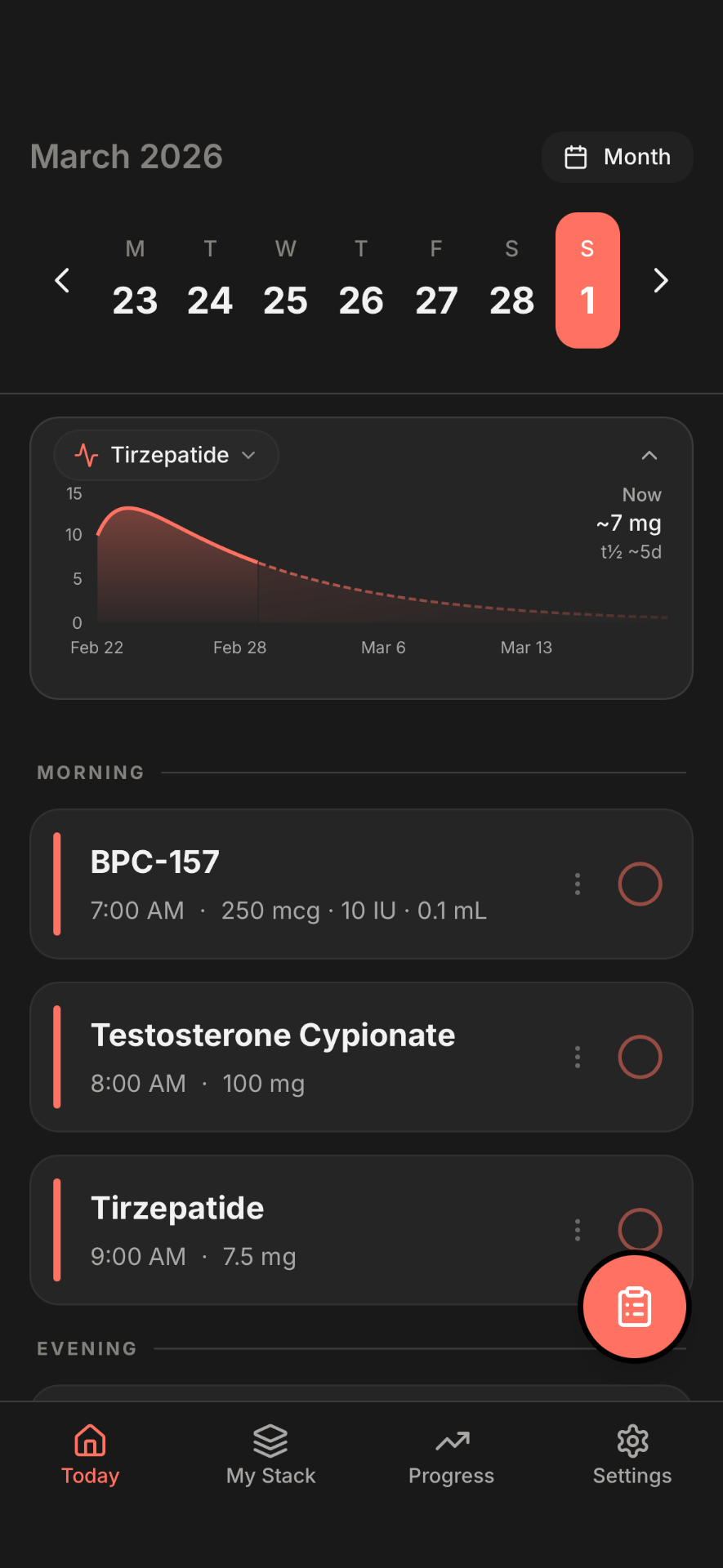
Regimen. It is a purpose-built tracker for peptide, TRT, and GLP-1 protocols. The free tier covers one compound with PK curves, site rotation, dose reminders, and Apple Health and Health Connect correlation. The paid tier removes the single-compound limit for users running stacks.
Ready to track your protocol?
- Smart reminders so you never miss a dose
- Track weight, photos, and progress over time
- Medication level curves for every compound