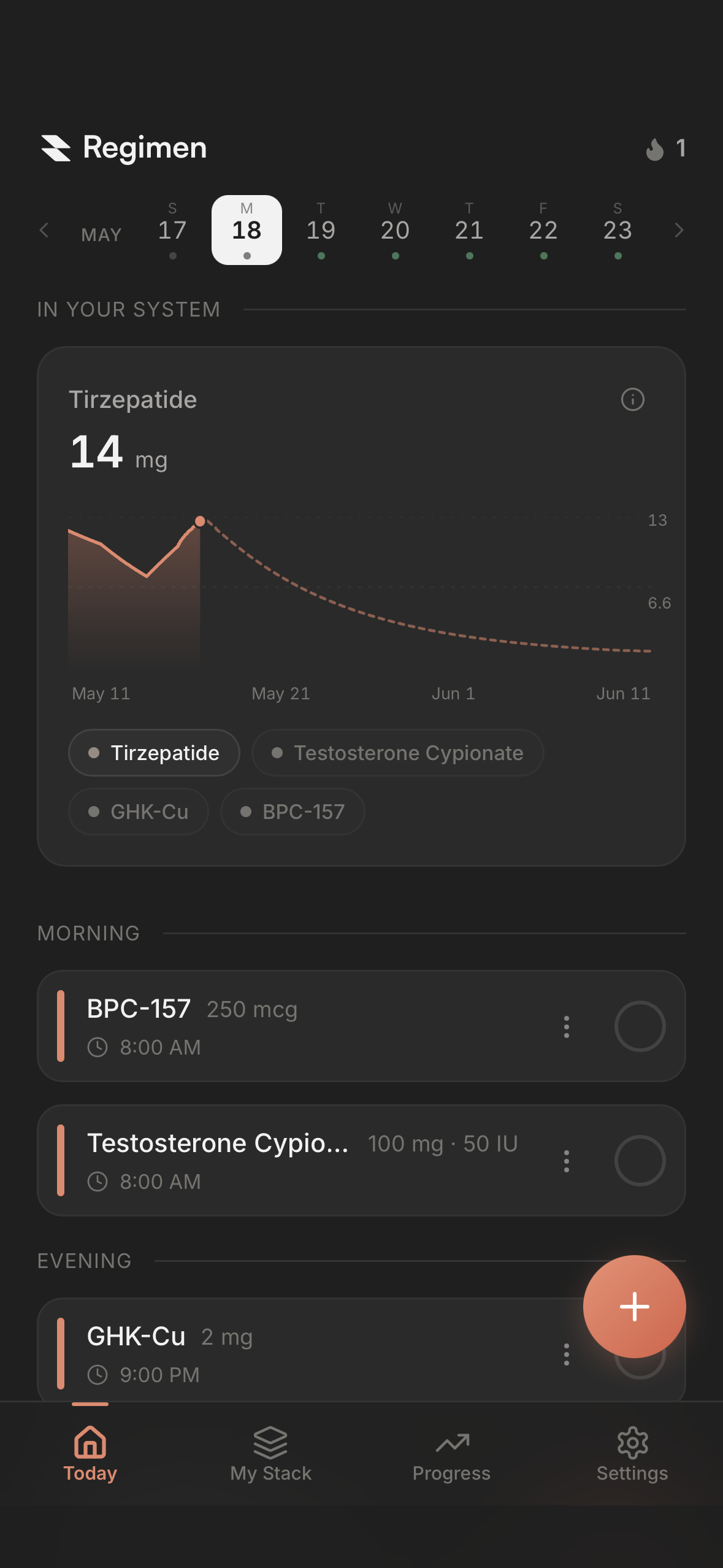
You’re on TRT to feel better and get your health where you want it. The injections are the easy part. Getting dialed in is the work: the right dose, the right frequency, knowing how you’re actually responding, and adjusting until it’s right. A good tracker is what makes that visible. Here’s what separates the apps that help from the ones that just log, and why each one matters.
What is a TRT tracker app?
A TRT tracker app records every testosterone injection, the ester, the dose, the date and the site, and keeps it alongside your bloodwork and how you’ve actually been feeling, so the weeks between lab panels aren’t a blank.
The basics are logging the injection on whatever schedule you run, reminding you on that schedule rather than with a generic daily nudge, and keeping track of where you injected. The ones worth paying for draw your level for your ester, hold your lab results on the same timeline as your doses, and track how you feel, so a marker that moved can be lined up against whatever you changed.
How to evaluate a TRT tracker
Assume any tracker worth installing logs an injection and sends a reminder. Those are the basics. What follows is what separates the app you actually use from the one you don’t, in roughly the order it starts to matter.
1. Schedule flexibility
Weekly, twice weekly, every three days, daily microdosing. Frequency is the thing people change most on TRT, usually because of how a trough felt or what a lab came back saying, and the protocol you start on is rarely the one you settle into.
A basic app gives you weekly and a reminder. What you need is one that holds whatever you’re on now and whatever you move to: a split week with a different dose or time on each day, a weekly target the app divides across your shots, a frequency change mid-protocol, HCG on its own schedule, an AI a couple of times a week. If the app can’t follow the change, you stop trusting the reminders, and then you stop logging.
This matters more on TRT than people expect. In Regimen’s own user data as of September 2026, fewer than one in six active TRT users is on a plain once-a-week schedule. Twice weekly is the most common at 28%, then specific days of the week at 24%, daily at 16%, and every two to four days at 13%.
2. Half-life and medication levels
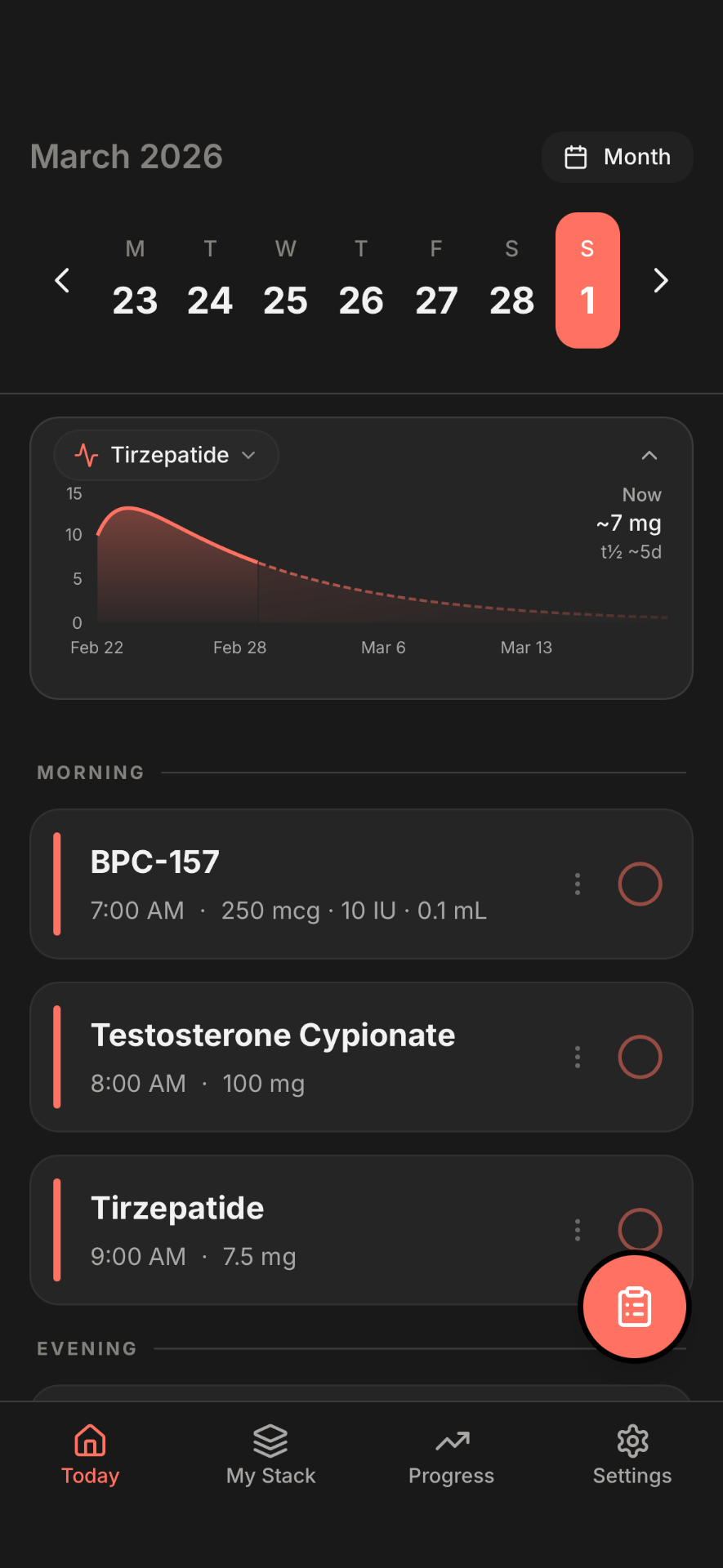
Every ester clears on its own schedule. Cypionate and enanthate hang around for roughly a week, propionate for a couple of days, and where you are on that curve is why day six can feel nothing like day two. A basic app gives you a generic curve or none at all. A good tracker draws the curve for your ester from your actual injection dates, so you can see where your level peaks, where it troughs, and when a dose has actually cleared. That’s the picture you want in front of you when you and your provider talk about frequency.
3. Bloodwork on the dose timeline
Total testosterone, free testosterone, estradiol, hematocrit, SHBG, PSA. A panel on its own is one moment in time. The same marker across a year, lined up against the protocol you were actually on when each one was drawn, is the only way to see what a change did.
For most people, labs live in a patient portal, nowhere near their doses. A good tracker gives you one place for all of it, ideally by scanning the report so you’re not typing in every line, and then overlays each marker with your injections and every change you made: the week you moved to twice weekly, the month you added HCG, the dose bump. That’s how you see that hematocrit started climbing after a specific change, and walk into your next appointment with the pattern in hand instead of a memory of it.
4. How you’re responding
Energy, libido, sleep, mood, and how strongly, not just whether. These are the reason you’re on TRT, and the first things that move when something changes. They’re also what decides whether your next appointment is a real conversation or ten minutes of “I think I’ve felt a bit better?”
A basic app gives you a few generic check-ins. What you need is enough depth to track what matters to you, with a level on it rather than a checkbox, a list long enough that the thing you’re feeling is actually on it, and a note in your own words when a day needs explaining. All of it on the same timeline as your injections, so a rough week has something attached to it. Among Regimen’s active TRT users, energy is the most-tracked marker, logged by 43%, with mood, sleep and libido each tracked by about a quarter.
5. Injection site tracking
Inject the same spot too often and the tissue underneath hardens, the skin bruises, and absorption gets uneven, so the same dose doesn’t land the same way twice. Intramuscular into the glute or thigh, or subcutaneous into the belly, the fix is the same: rotate. And rotating from memory is exactly the thing that fails on a busy week.
Basic tracking logs the site. A good tracker suggests where the next shot goes, knows the difference between an intramuscular and a subcutaneous spot, lets you add your own spots, gives each compound its own rotation if you’re injecting more than one thing, and lets you rest a spot that needs it. That’s the difference between comfortable and scarred.
In Regimen’s own data, 39% of active TRT users logged an injection site in the last 90 days, and four in five of those injections were subcutaneous.
6. The rest of the protocol
TRT is often more than testosterone. HCG to keep things running, an AI when estradiol climbs, tadalafil, a peptide for recovery, the supplements you take alongside. Among Regimen’s active TRT users, three in four track at least one other compound with their testosterone, and one in six tracks HCG.
A tracker that only knows the testosterone gives you a partial picture: a symptom gets blamed on the dose when it belongs to something else you’re taking. What you need is one timeline for everything, each on its own schedule, so when something changes you can see which compound it lined up with. One Regimen user put it this way in an App Store review: “I’ve been struggling with finding a solution to track all of my hormone injections along with my peptides. This app is very clean and simple to use.”
7. Pattern detection
Your body is telling you something every week: a better stretch of sleep, a dip in energy, a trough that hurt less, a libido that came back. Across a year of injections, a handful of panels and hundreds of check-ins, no one can hold all of that in their head and see what’s connected to what.
That’s the job of pattern detection: the app pulls together your injections, your estimated levels, your labs and how you’ve been feeling, lines them up against the changes you made, and tells you what it finds. Your energy climbed the week you moved to twice weekly. Your hematocrit trended up after the last dose bump. Look for insights tied to a real change and measured against your own baseline, not a population average. One Regimen user, Steve, on TRT put it this way in a Google Play review: “You can track qualitative stuff like perceived energy, food noise, nausea etc. Then all of that feeds into progress summaries that are insightful & actionable. It caught the heart rate increase from Reta before I did.”
8. Ease of use
A lot of tracking apps pack in features and then make you figure out how to set them up and where everything lives. That’s exhausting, and it’s why people quit. The good ones have the sophistication underneath and stay simple on top: log an injection in a tap or two, check in without a form, find your last panel without digging.
9. Privacy and your data
This is your health data. You want an app that doesn’t sell it or share it, and most say they don’t. It’s still worth a glance at the App Store privacy label, and worth remembering that if an app is completely free with nothing to buy, it’s making money some other way.
And it’s your data. You should be able to bring in your history from a spreadsheet or another app, export all of it for your provider or for yourself, and delete your account whenever you want.
Picking the right tracker for where you are
Just starting. You’re finding your dose and your frequency, and everything is new. Pick something easy enough that you’ll actually open it, and start logging before your first injection. Data from day one beats a history you reconstruct later.
Changing your protocol. Moving to twice weekly, adding HCG, adjusting mg. This is where schedule flexibility and the level curve earn their place, and where bloodwork on the same timeline as your doses tells you what the change actually did.
Dialed in. You have real history now: a year of injections, a few panels, a lot of daily markers. Pattern detection watches all of it and tells you what it finds, and a report for your provider turns your next appointment into a conversation about optimizing rather than reconstructing.
Want to see how the apps actually stack up on these? We ran every one through the same criteria in our ranked comparison of the best TRT tracker apps.
What we believe a TRT tracker should do
You’re the one doing this. The protocol is yours, the adjustments are yours, and the results come from paying attention over months and adjusting with your provider. A tracker should make that clearer. That’s what we built Regimen to be.
Run the protocol you’re actually on. Weekly, twice weekly, every three days, daily microdosing, or a split week with its own dose and time on each day. Set a weekly target and Regimen works out each shot for your frequency. Change frequency and everything follows.
See where your level really is. Ester-specific curves for Cypionate, Enanthate and Propionate show you where your trough lands and when a dose has cleared, so you know why day six feels different from day two, and you walk into the frequency conversation with a picture instead of a guess.
Put your bloodwork next to your doses. Scan the report or type it in, 25+ markers including Total T, Free T, E2, SHBG and hematocrit, on the same timeline as your injections and every change you made. Regimen flags a value that comes back outside range, so a climbing hematocrit gets noticed the week it happens.
Track how you actually feel. Energy, libido, sleep, mood and 50+ more, each with a level rather than a checkbox, next to the dose you took that day.
Let Regimen run your injection sites, or build your own rotation. Intramuscular or subcutaneous, the standard spots or your own, a separate rotation for each compound, and a spot rested until you say otherwise.
Keep everything on one timeline. HCG, anastrozole, tadalafil, peptides and 200+ other compounds, each on its own schedule, so a symptom gets tied to the right thing.
Then let Regimen tell you what it noticed: what changed after you split your dose, added HCG or moved your mg, measured against your own baseline. When it’s time to see your provider, a one-page report of the period since your last visit is ready to share.
Your history comes in from a spreadsheet or another app and goes out whenever you want. It runs on iPhone, Android and the web, and it’s free for your first compound.
The bottom line
TRT done well is one of the best things you can do for how you feel, and the right app helps you get there faster. Pick the one that follows the protocol you actually run, shows you where your level really is, keeps your bloodwork next to your doses, tracks how you feel in enough detail to fit you, knows about the rest of what you take, and tells you what a change did. You’re the one dialing it in. The app’s job is to make sure you can see it working.
Ready to track your protocol?
- Weekly, twice weekly, E3D or daily, and change it whenever you do
- Labs and daily markers on the same timeline as your injections
- Tells you what changed when you changed something
Frequently asked questions
My doctor already runs labs. Why do I need a tracker?
Your provider sees a snapshot every 3 to 6 months. A tracker fills in the story between visits: when you injected, which site, how you actually felt on which day, and how your labs line up with dose changes. That is what makes appointments productive instead of vague.
Which apps run on Android, not just iPhone?
Regimen runs on iPhone, Android and the web. Several TRT trackers are iPhone only, and one of the better lab logbooks is web only rather than a native app, so check the platform line on the listing. Our ranked comparison lists it app by app.
Which one tells me if my protocol is actually working?
Regimen. It reads your injections, estimated testosterone levels, bloodwork and daily markers against what actually changed in your protocol, a dose change, a frequency change, a new compound, and tells you the pattern it finds. It's built-in pattern detection, not a chatbot, and it's free.
Can I track TRT and peptides in the same app?
Yes. Regimen covers TRT, HCG, AI and 200+ compounds and brands on one timeline. Testosterone gets ester-specific curves, so a symptom gets tied to the right compound instead of the wrong one.
How do I judge an app's privacy?
Look for an app that doesn't sell or share your health data, and check the App Store privacy label rather than the marketing. Then make sure it's your data: you should be able to export all of it and delete your account whenever you want. This article is for informational purposes only and does not constitute medical advice. Discuss all treatment decisions with your healthcare provider.