How to Start Your First Peptide Protocol: A Beginner's Guide (2026)
If you've been reading about BPC-157, TB-500, Semax, or other peptides and you're not sure where to start, this guide is for you. Peptide protocols have a learning curve: they come as powders you mix yourself, they're injected, and the dosing requires a calculation. None of that is complicated once you've done it once, but the first time can feel overwhelming.
This guide covers: which peptides are best for beginners, how to actually get them, how to mix and inject them, and how to know if they're working.
Step 1: Choose One Peptide and One Goal
The biggest mistake beginners make is stacking three compounds before they know how any of them feel. Start with one peptide matched to your primary goal.
| Your goal | Best starting peptide | Why |
|---|---|---|
| Injury recovery, tendon/ligament healing | BPC-157 | Most evidence, most user data, most forgiving protocol |
| Systemic inflammation, recovery from surgery | TB-500 | Works across the whole body; often stacked with BPC-157 after you've run each separately |
| Cognitive enhancement, focus, anxiety | Semax | Intranasal (no injection), fast onset, clear effects |
| Sleep improvement | Epitalon or DSIP | Epitalon for long-term circadian reset, DSIP for acute sleep onset |
| Sexual desire (men and women) | PT-141 | Works centrally on desire, not just physical mechanics; start low |
| GH axis, body composition | Ipamorelin + CJC-1295 | Most popular growth hormone peptide stack; dose at night |
Start with BPC-157 if you're not sure. It has the broadest use case (healing, gut health, general recovery), the most user data, and the most forgiving dosing range. It's also the most studied of the commonly available peptides.
Step 2: Get a Prescription
As of April 2026, the most common peptides (BPC-157, TB-500, Semax, and others) are available through licensed compounding pharmacies with a prescription. The FDA removed these compounds from its compounding ban in April 2026, meaning you can now get them through a legitimate medical channel.
Who prescribes peptides:
- Functional medicine doctors
- Sports medicine physicians
- Men's and women's health clinics (telehealth options available)
- Naturopathic doctors (in states with ND prescribing authority)
- Some anti-aging and regenerative medicine clinics
What the appointment looks like: Most providers will ask about your health history, your goals, and any current medications. Peptide consultations through telehealth clinics typically run $100-$250. Your peptide vials then come from a licensed compounding pharmacy.
If you're outside the US: Access varies by country. See guides for Canada, UK, Australia, Germany, and Brazil.
Step 3: Understand What You're Getting
Peptides arrive as a white lyophilized powder in a sealed vial. They need to be mixed with bacteriostatic water (BAC water) before use. This is called reconstitution. BAC water is sold separately and can be ordered online or from a pharmacy.
Your vial will have:
- A total amount in mg (e.g., 5mg BPC-157)
- No instructions on how much water to add. That's your calculation
The amount of water you add determines your concentration (mg/mL), which determines the volume you inject per dose. This is what the peptide reconstitution calculator does. Enter your vial size and target dose, and it tells you exactly how much water to add and how much to draw per injection.
Step 4: Reconstitute Your Vial
- Wipe the rubber top of your peptide vial and BAC water vial with an alcohol swab
- Draw your calculated BAC water volume into a syringe
- Insert the needle into the peptide vial and push the water slowly down the inside wall. Do not spray directly onto the powder
- Swirl gently until dissolved (clear solution). Do not shake
- Store in the refrigerator (2-8C). Use within 4-6 weeks
For BPC-157 (5mg vial): Add 2.5mL of BAC water. Concentration: 2mg/mL. A 250mcg dose = 0.125mL = 12.5 units on an insulin syringe.
Step 5: Inject
For most beginner peptides (BPC-157, TB-500, Semax SubQ), the injection is subcutaneous: into the fat just under the skin, not into muscle.
What you need:
- Insulin syringe: 29-31g, 5/16" (8mm) needle. These are small, relatively painless, and available at any pharmacy.
- Alcohol swabs
How to inject:
- Choose a site: abdomen (2-3 inches from navel), or thigh
- Swab the skin with alcohol, let it dry
- Pinch a small fold of skin
- Insert the needle at a 45-degree angle
- Push the plunger slowly, take 5-10 seconds
- Withdraw, apply gentle pressure with the swab
- Rotate sites across injections to avoid irritation
For BPC-157, some practitioners recommend injecting near the site of injury for localized healing effects (a joint, tendon, or gut region). For most other peptides, any standard SubQ site works.
Step 6: Track Your Response
Peptides don't announce themselves loudly. The difference between "it's working" and "it's not" often shows in subtle patterns over weeks: less stiffness in the morning, better sleep quality, reduced gut discomfort, improved focus. Without tracking, these changes get lost in the noise of daily variation.
The minimum you should log:
- Date and dose of each injection
- Subjective score for your primary goal (pain level 1-10, focus 1-10, etc.)
- Sleep quality and resting heart rate (automatically from Apple Health or Google Health Connect)
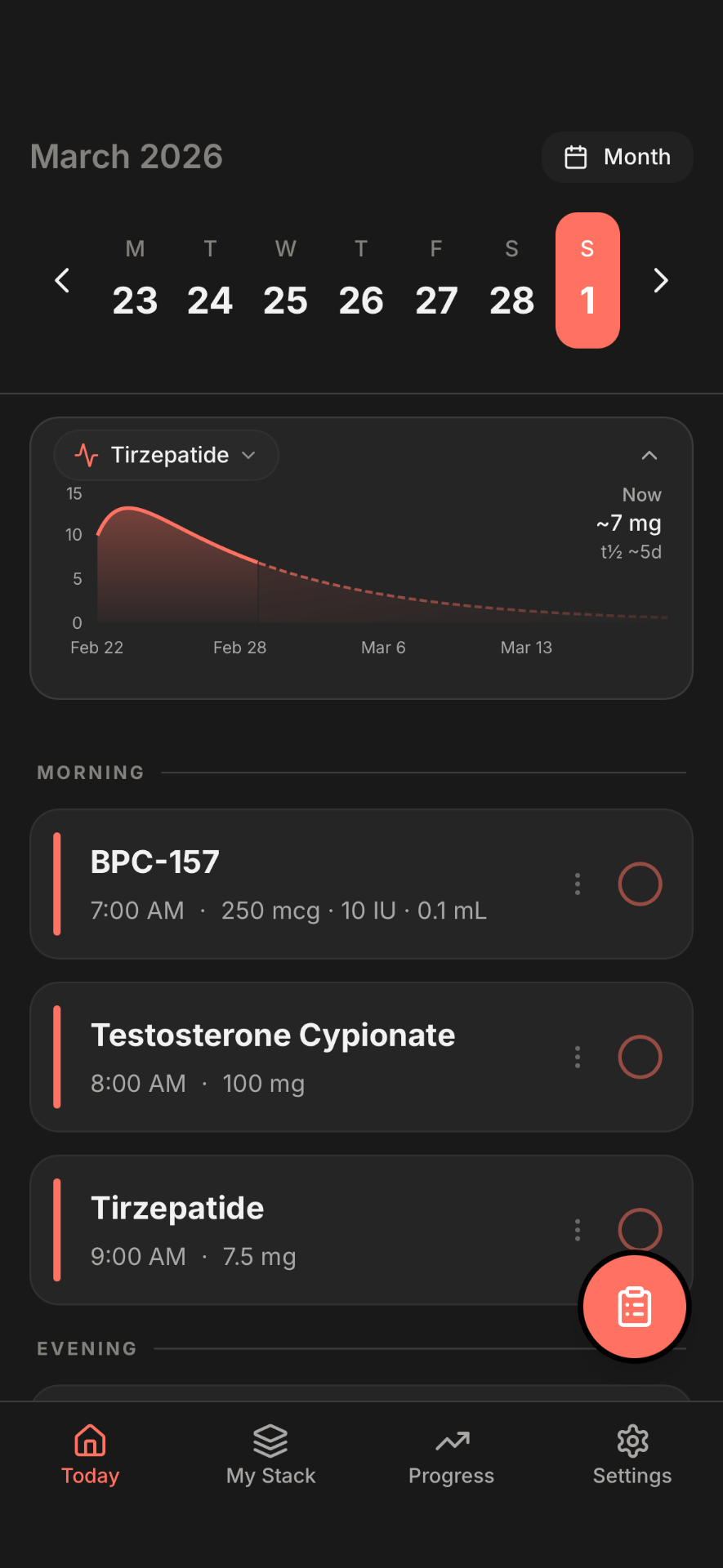
Regimen logs your dose schedule, shows your peptide blood levels over time using pharmacokinetic data, and maps your health metrics against your protocol timeline so you can see what's actually changing.
Frequently Asked Questions
Your Next Steps
Once you know which compound you want to start with, read the dedicated protocol guide:
- BPC-157 dosage and protocol guide
- TB-500 dosage and protocol guide
- Semax dosage and intranasal guide
- PT-141 guide
- BPC-157 + TB-500 healing stack
- Best peptides for sleep
Ready to track your protocol?
- Smart reminders so you never miss a dose
- Track weight, photos, and progress over time
- Medication level curves for every compound